


Since the last time Claude Only about two months have passed since Opus 4.6 was released,Anthropic Earlier today, they once again released a new generation flagship model, Claude Opus 4.7,AI Models really are evolving at such a rapid pace! And this upgrade focuses mainly on code development capabilities and visual understanding. According to results from multiple benchmark tests, Opus 4.7 not only significantly outperforms its predecessor in code-related tasks, but actually surpasses its competitors on some metrics. OpenAI The latest GPT-5.4.
but not like the ones that weren’t publicly released before Claude Mythos Preview Claude Mythos Preview is still significantly more powerful by comparison.
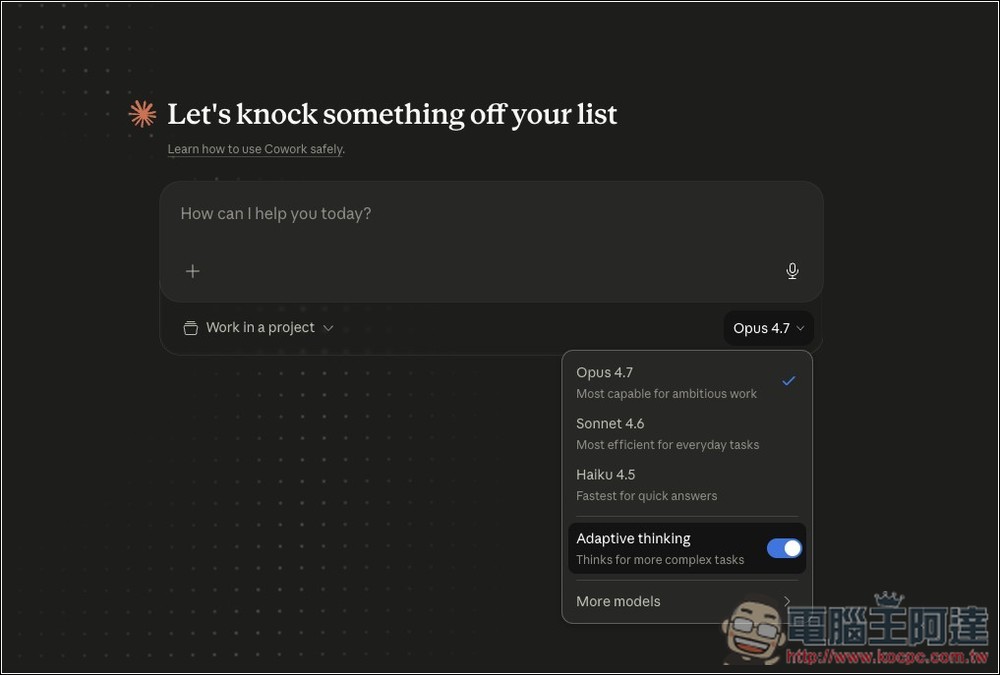
Anthropic Unveils Claude Opus 4.7: Massive Jump in Coding Abilities, 3x Visual Resolution Boost, SWE-bench Score Surpasses GPT-5.4
Opus 4.7 – This upgrade can mainly be divided into three major parts. The first is the code development capability that many people are concerned about, which has of course been significantly enhanced.
Anthropic reports that Opus 4.7 shows notable improvements in stability and rigor when handling complex, long-running coding tasks, especially high-difficulty tasks it can complete autonomously. Its instruction-following ability and self-verification mechanism have also been enhanced. Simply put, it’s better at doing what you ask it to do, and it will double-check its work after completing the task.
Based on feedback from early test users, someone used Opus 4.7 to independently build a complete Rust text-to-speech engine from scratch, then automatically used a speech recognizer to verify whether the results were correct—this ability to self-validate is something the previous generation couldn’t do.
Next is the significant enhancement of visual capabilities. Opus 4.7 supports a maximum image resolution of 2,576 pixels, a substantial jump from the previous generation’s 1,568 pixels—equivalent to more than 3 times the visual processing capability. This will result in greater accuracy when reading screenshots, understanding charts, and identifying technical details. For users who need AI to operate their computers, this is a fantastic improvement.
The third is “improvements in design and document processing.” Anthropic says Opus 4.7 makes more refined aesthetic choices when creating dashboards, presentations, data-intensive interfaces, and similar content, with more polished design in areas like layout, color schemes, and hierarchical structure. In document reasoning, Opus 4.7 has a 21% lower error rate than the previous generation.
In the test data section, in the SWE-bench Pro coding benchmark (Agentic Coding), Opus 4.7 scored 64.3%, while the previous generation Opus 4.6 scored 53.4%, representing an improvement of over 10%. OpenAI’s GPT-5.4 achieved 57.7%, with Opus 4.7 leading by a significant margin. However, Anthropic’s own Mythos Preview scored 77.8%, and the gap is still quite noticeable:
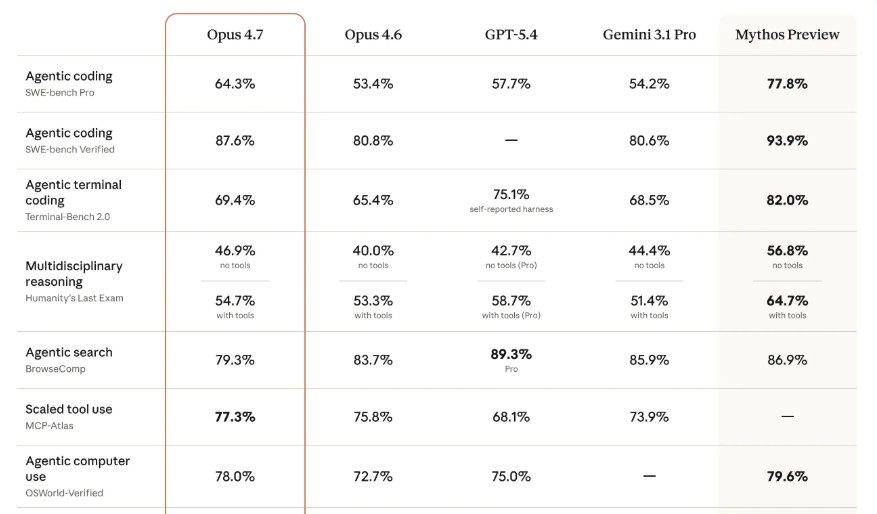
In the OSWorld-Verified computer operation task benchmark, Opus 4.7 also showed slight improvement, scoring 78.0%, higher than GPT-5.4’s 75.0% and Opus 4.6’s 72.7%, getting closer to Mythos Preview’s 79.6%.
In the Visual Reasoning section of CharXiv Reasoning, Opus 4.7 achieved 82.1% without tool assistance, compared to Opus 4.6’s 69.1%, representing a 13% improvement and not far behind Mythos Preview’s 86.1%. With tool assistance, it reached 91.0%, while Opus 4.6 scored 84.7%.

Cursor states that on the code development tool CursorBench, Opus 4.7 scored 70% compared to Opus 4.6’s 58%, a significant improvement. In CodeRabbit’s code review tests, Recall also increased by over 10%.
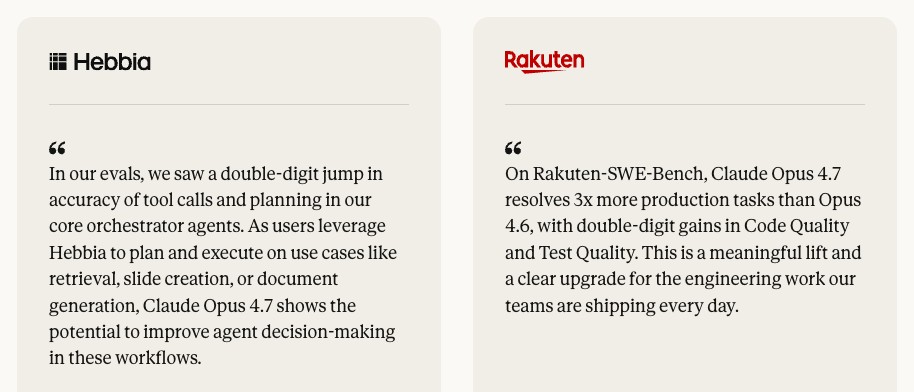
The Japanese e-commerce platform Rakuten also shared its test results, showing that Opus 4.7 can complete three times as many tasks as Opus 4.6. Notion reported a 14% improvement in success rate for complex workflows, along with fewer tool call errors.
Notably, Anthropic has deliberately reduced Opus 4.7’s cybersecurity attack capabilities. Compared to Mythos Preview, Opus 4.7’s security attack capabilities have been intentionally weakened, and automated protection mechanisms have been added to detect and block requests involving high-risk cybersecurity operations.
Opus 4.7 is now fully available across all Claude official products, Claude API, Amazon Bedrock, Google Cloud Vertex AI, and Microsoft Foundry.
Opus 4.7’s API pricing is exactly the same as the previous generation: $5 per million input tokens, $25 per million output tokens,
Source: KOCPC Chinese