


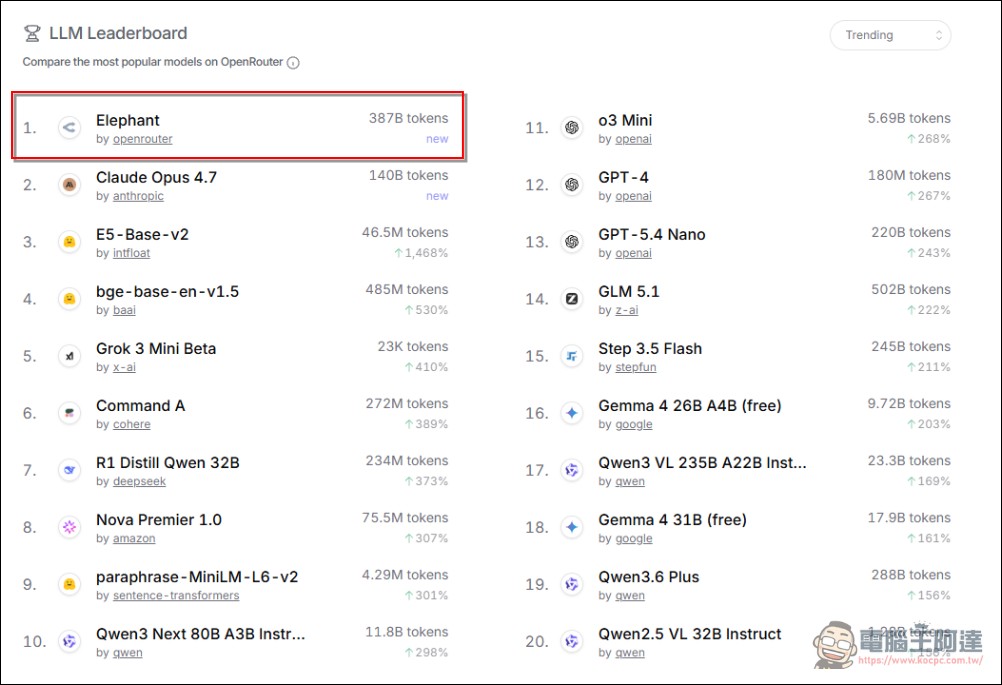
No press conference, no press release, not even knowing who the developer is. Elephant Alpha, a brand-new anonymous AI model, quietly went live on OpenRouter late on April 13. Within just 48 hours, it rocketed to the top of the Trending list, with token usage surging 377% and over 1,850 billion tokens processed, ranking eighth globally in daily active users. This mysterious model is redefining the cost structure of AI agents with a simple logic: 80% of your daily work doesn’t need the deep reasoning capabilities of flagship models.
100B parameters, but the goal isn’t “bigger” — it’s “more efficient”
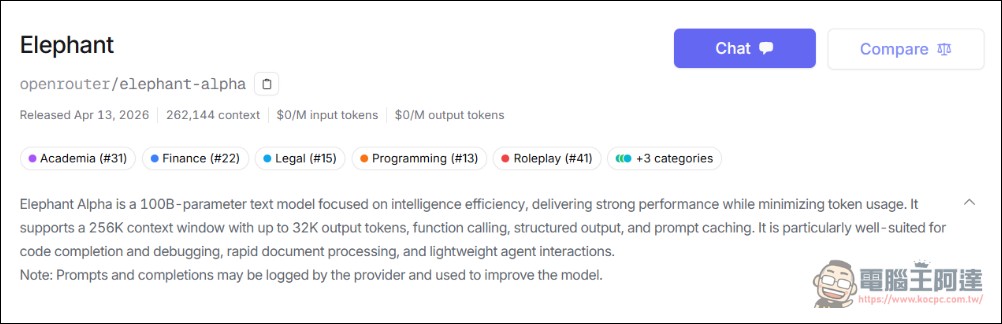
Elephant Alpha has 100 billion (100B) parameters, supports a 256K context window and a maximum output length of 32K tokens, with function calling and structured output capabilities. The specs may seem middle-of-the-road, but its core selling point isn’t scale—it’s “intelligence efficiency”: maintaining the same-level SOTA reasoning capabilities while significantly reducing token consumption.
Benchmark data shows that completing tasks of the same quality requires about half the tokens for Elephant Alpha compared to Claude Opus, and about one-third compared to GPT-5.4. For output speed, community tests report approximately 250 tokens/second (tps), with perceived performance comparable to Grok 4 Fast but higher code quality. Additionally, it’s currently completely free on the OpenRouter platform—no cost, no barriers.
Specialize in execution, not in being a jack of all trades
It is worth noting that Elephant Alpha is not an all-purpose reasoning model, but rather a pure “execution machine.” Its areas of expertise include:
- Code completion and debuggingSearching across a dozen+ files for bugs with a 256K context window that stays stable without losing references
- Batch Document ProcessingConvert lengthy contracts into structured clause tables, transform meeting minutes into actionable tasks, and summarize group chats instantly.
- Lightweight Agent InteractionBatch generation, partial repair, format conversion, and other repetitive tasks
However, community testing has also revealed its limitations: limited proficiency in non-English languages, unsuitable for complex multi-step long-chain planning, and knowledge timeliness requires manually injecting context. The clearer the instructions and the more explicit the constraints, the better the output quality; vague requirements tend to yield mediocre results.
Who made it? Nobody knows, but speculation points to a major Chinese company.
Elephant Alpha was launched “stealth-style,” with developer information on the OpenRouter platform listed as OpenRouter itself, though the model page mentions it comes from “a well-known open-source model lab.” The community widely speculates this could be a “front” for a major Chinese AI company conducting global blind testing, while others believe it may originate from a new overseas lab.
From an architectural analysis perspective, the fact that a 100B parameter model can achieve such high inference speeds suggests the industry believes it likely employs a Sparse Mixture of Experts (Sparse MoE) architecture, with the actual activated parameters far fewer than 100B. This also aligns with the recent AI industry trend of shifting from “scaling parameters” to “improving efficiency.”
The emergence of Elephant Alpha has led the AI Agent developer community to quickly adopt a standard “model layering” approach: using Claude and other flagship models for overall planning and architecture design (called only once), while Elephant handles step-by-step execution, local fixes, and batch generation (run hundreds of times). According to developer reports, this combination has improved overall efficiency by roughly 3x, with costs dropping to a tenth or even less.
Elephant Alpha broke into the top 10 daily active users on the platform within just one week through pure word of mouth, without any promotion. This proves one thing: the best models of the future might not be the ones hyped up at big tech product launches, but rather those “voted for” by users voting with their feet.
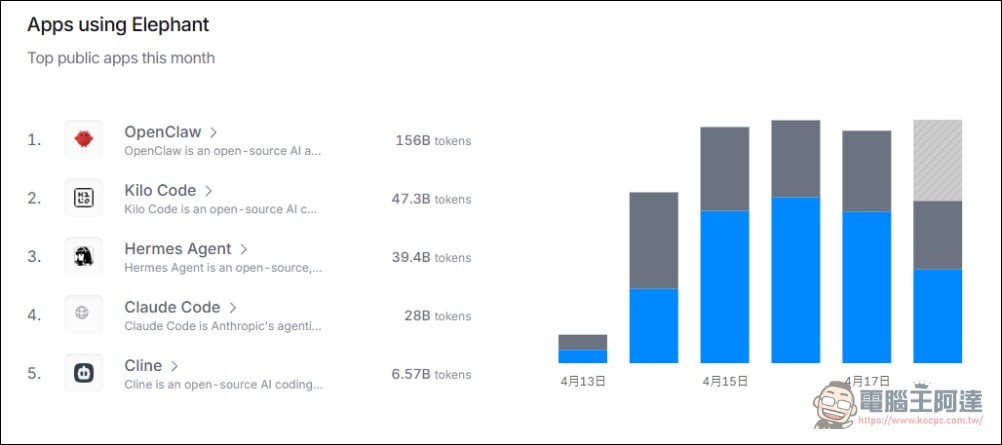
For those who want to try it out, Elephant Alpha is currently still in closed beta, completely free. It can be used on both OpenRouter and Kilo Code, and has also been integrated into the model menus of open-source AI Agent frameworks like Hermes Agent, ready to switch at any time (you can alsoOfficial websiteTo have Hermes or OpenClaw configure itself, you’ll need to set up the Openrouter API Key first.
In closing: Stop using a cannon to kill a mosquito.
Elephant Alpha’s viral success reminds all AI users of a commonly overlooked fact: model specialization is the core competitive advantage for AI players in 2026. Switching routine repetitive tasks to cost-effective, high-efficiency execution models like Elephant Alpha, and redirecting the saved budget to high-end models that truly require deep reasoning like Opus 4.7 — that’s the right way to approach AI workflows. As for who’s behind Elephant Alpha? Maybe that’s exactly what makes anonymous models most interesting: when you don’t know the brand, you judge purely by capability.
Source: KOCPC Chinese