


Following Alibaba, Tencent, MiniMax and other major companies successively releasing diffusion models that can run on consumer-grade hardware, China’s search giant Baidu officially launched the latest member of its Wenxin series on Hugging Face. ERNIE-Image with accelerated version ERNIE-Image-TurboBoth models are released under Apache License 2.0, with weights freely available for commercial download. They require only 24GB of VRAM to locally generate high-quality images on consumer-grade GPUs like the RTX 4090, making them one of the most noteworthy open-source image generation models recently.
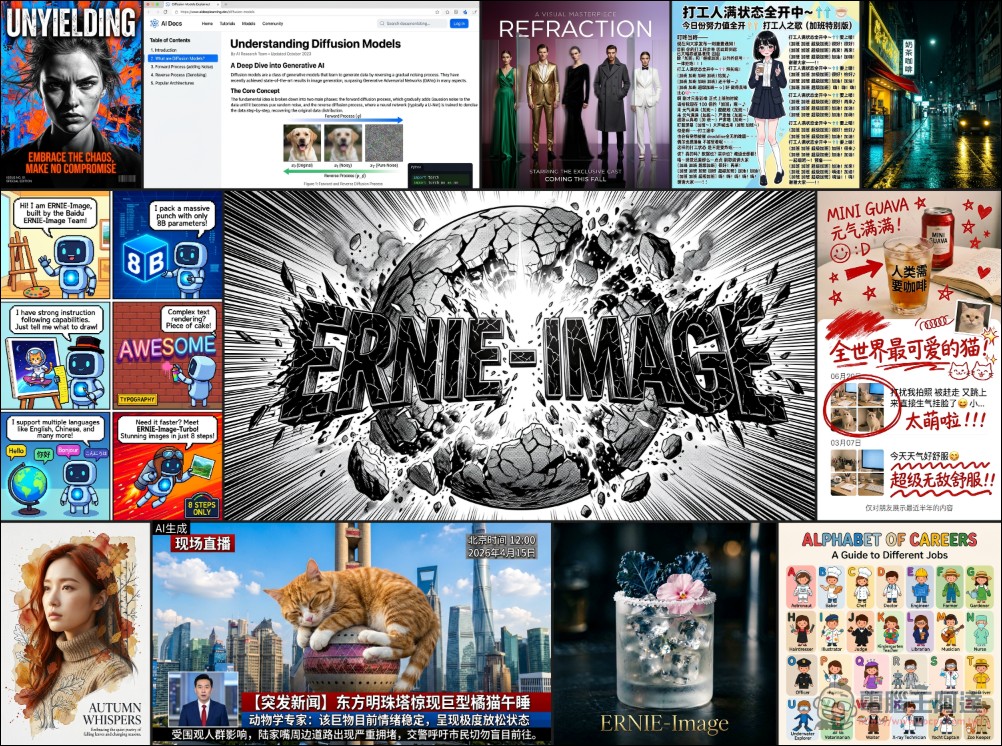
Compact single-stream DiT architecture with 8B parameters outperforms much larger models
According to the model card content published by Baidu on Hugging Face, ERNIE-Image adoptsSingle-stream Diffusion Transformer (single-stream DiT)Architecture, with only 8 billion (8B) parameters. Compared to most industry flagship models that typically have tens of billions or even hundreds of billions of parameters, ERNIE-Image achieves “state-of-the-art performance among open-weight text-to-image models” with a relatively compact size. Recommended output resolutions include 1024×1024, 848×1264, 1264×848, 768×1376, 896×1200, 1376×768, 1200×896, among various aspect ratios, and running in bfloat16 precision is recommended, which can fully run inference on a single consumer-grade GPU with 24GB of VRAM.
1/ we are excited to release ERNIE-Image, after 3 months of building from scratch.
an 8b text-to-image model from baidu's ernie image team. honestly, we didn't expect an 8b dit to get this far, this fast.
strong instruction following. best-in-class text rendering. runs on a 24gb…— Jiaxiang Liu (@lclbrew) April 14, 2026
This open-source release includes two versions: the standard ERNIE-Image (SFT) defaults to 50 inference steps, suitable for scenarios demanding the highest quality; the accelerated version ERNIE-Image-Turbo uses DMD (Distribution Matching Distillation) and reinforcement learning (RL) for distillation optimization, compressing inference steps to just 8, making it especially user-friendly for those needing large batch image generation or wanting to reduce local computation time.
Prompt Enhancer: Automatically expand short descriptions into detailed prompts
Another notable design feature of ERNIE-Image is the built-in Prompt EnhancerThis module is a lightweight language model based on the Ministral 3B architecture with approximately 3 billion parameters. It can automatically expand short keywords input by users into more complete, multi-layered descriptions, thereby improving output quality without requiring users to write lengthy prompts.
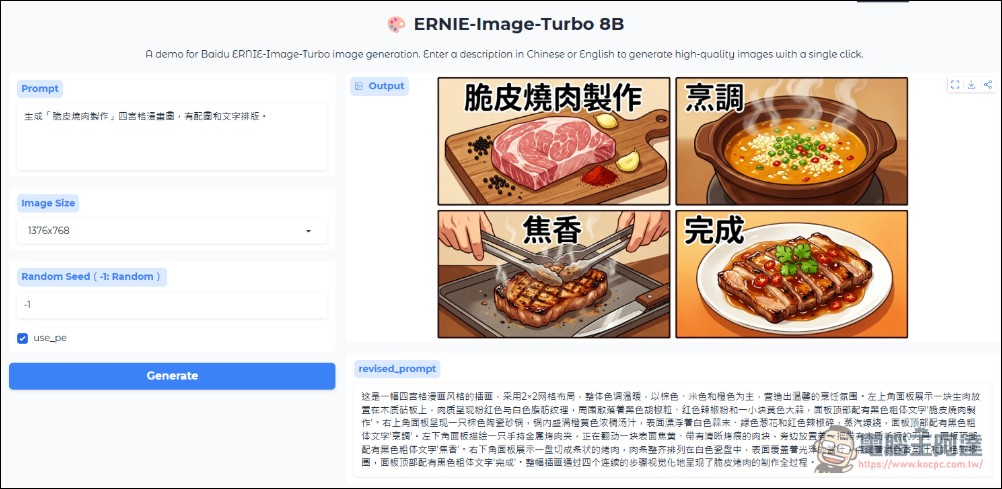
In the official sample code, as long as you pipe() add a call use_pe=True Prompt Enhancer can be enabled immediately, with virtually zero learning curve for developers working with Hugging Face diffusers.
Benchmark: Outperforms Z-Image and GPT Image 1 Across Multiple Metrics
Baidu released multiple public benchmark results on the model card (all with Prompt Enhancer enabled):
- GenEval Overall:0.8856
- OneIG-EN Overall:0.5750
- OneIG-ZH Overall:0.5543
- LongTextBench Avg:0.9733
In the English prompt-driven OneIG-Bench evaluation, ERNIE-Image’s overall performance surpassed Z-Image, also an open-source model, as well as OpenAI’s GPT Image 1 (High setting). On LongTextBench, which heavily tests models’ long text rendering capabilities, ERNIE-Image achieved a near-perfect score of 0.9733, demonstrating its clear advantage in text-intensive application scenarios such as posters, comics, presentation slides, and infographics.
Expert in multilingual text rendering
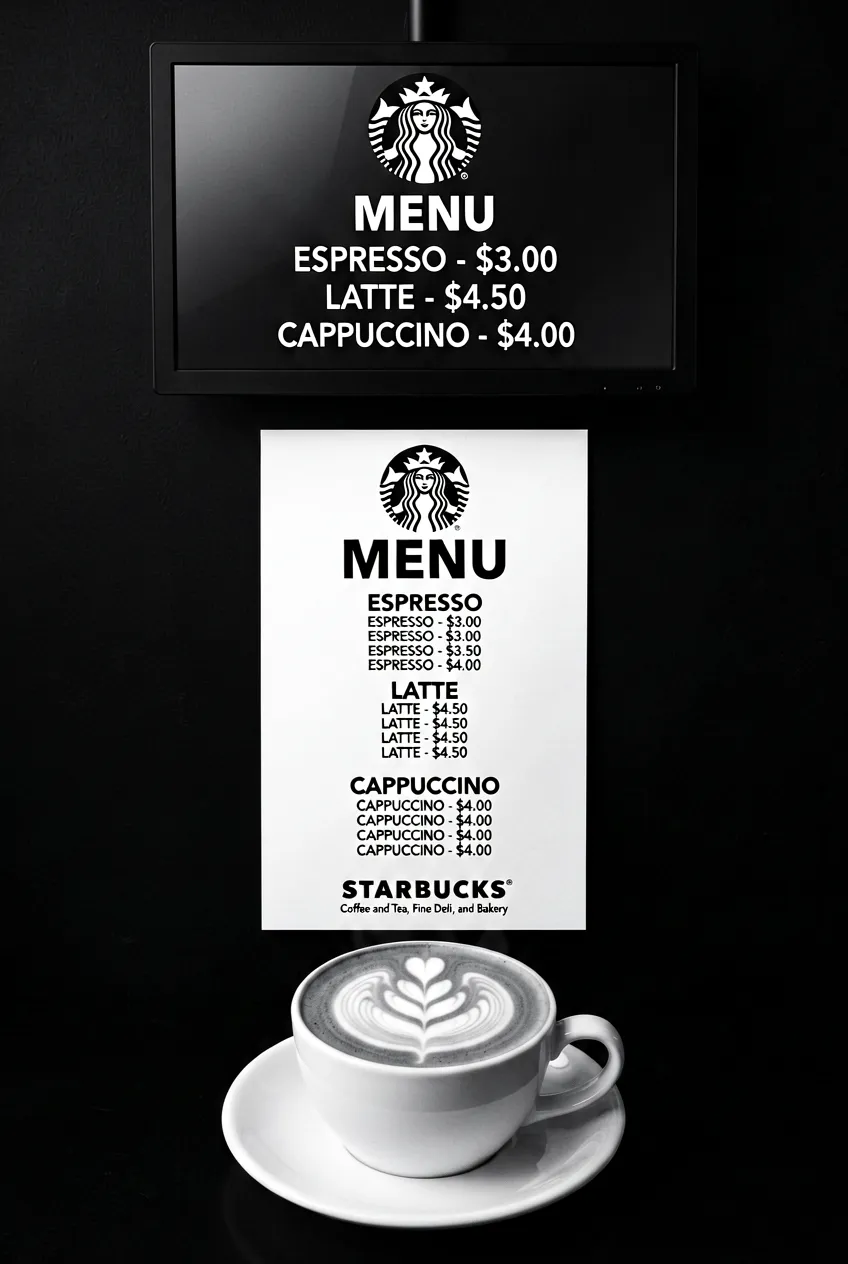
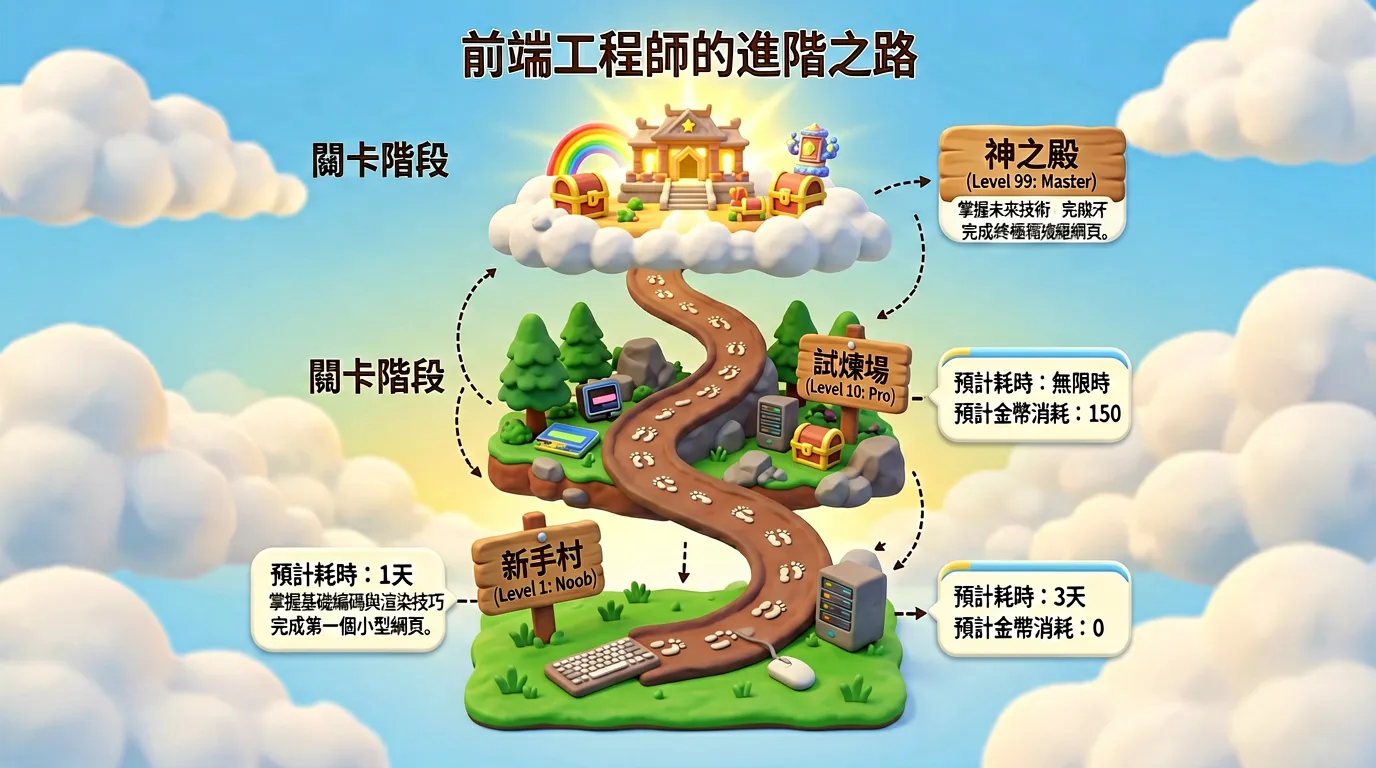
One of ERNIE-Image’s official promotional highlights is its “high-density text rendering capability.” The model can stably render English, Chinese, and multi-language titles and paragraphs in a single image, making it highly beneficial for creating bilingual posters, social media posts, menus, comic panels, and similar scenarios.
Ecosystem Integration: Try Directly on Hugging Face, Native ComfyUI Support
Baidu, besides releasing model weights and sample code this time, also launched a Hugging Face SpaceOnline DemoUsers can quickly try out ERNIE-Image-Turbo’s generation results without local deployment. For advanced users who prefer local workflows, the model is also compatible with popular open-source graphical interfaces. ComfyUICan directly load weights and combine with custom nodes for workflow orchestration.
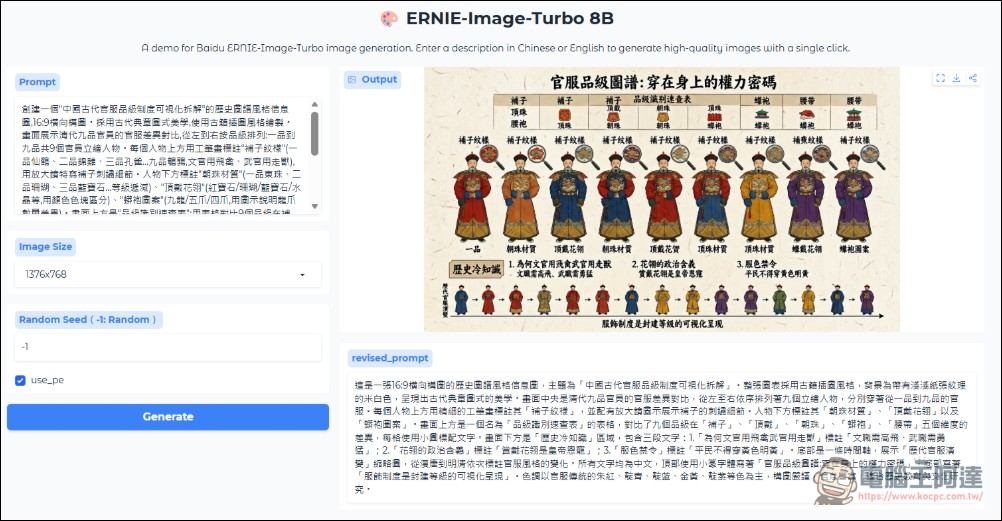
ERNIE-Image Open Source Page
Building on Open-Source Strategy: From Language to Images, Baidu’s Comprehensive Positioning
Over the past year, Baidu has progressively open-sourced the ERNIE series large language models and speech synthesis models. Now, it is bringing its flagship text-to-image model under Apache 2.0 open-source licensing, continuing its “open-source plus paid API dual-track” strategy for foundational models from 2024 to 2025. For enterprise users, Apache 2.0 licensing means commercial use, modification, and distribution are permitted without additional licensing fees—making this a quite practical advantage for downstream application developers amid the current atmosphere of frequent generative AI-related intellectual property disputes.
Overall, ERNIE-Image, with its relatively compact 8B parameter scale, 24GB consumer GPU memory requirement, and top-tier performance in text rendering and long-form instruction following, has dropped a bombshell in the 2026 open-source text-to-image field. As the competition for Stable Diffusion’s successor expands from Europe and America to Chinese tech giants, users will have an increasing number of high-quality local models to choose from, and ERNIE-Image will undoubtedly become one of the premium free open-source options for applications such as poster design, comic storyboarding, and infographics.
Source: KOCPC Chinese