


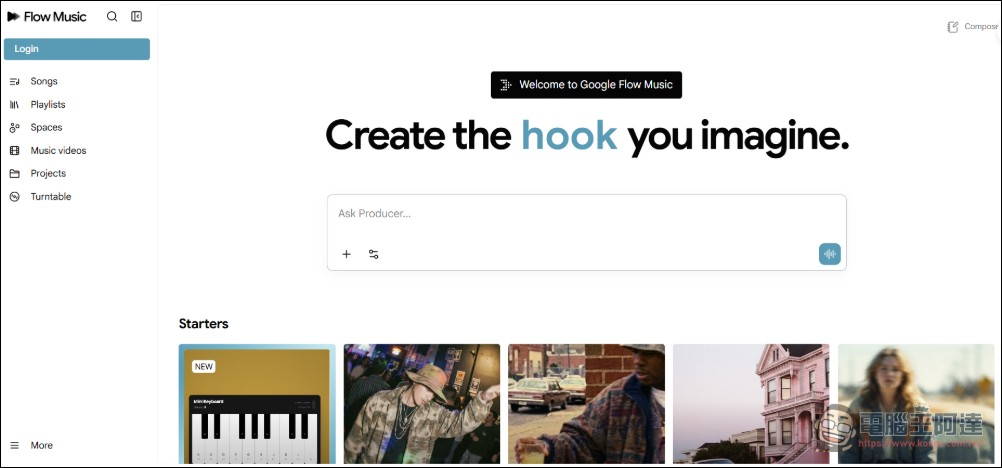
Google’s AI music strategy has officially entered a new phase. Following the February 2026 announcement of acquiring ProducerAI, the well-known AI music creation platform formerly known as Riffusion, Google officially announced on its official X account that the platform will be rebranded as “Google Flow Music.” This is more than just a brand name change—it marks DeepMind’s most advanced music model, Lyria 3, officially entering the professional creation market to compete head-on with Suno and Udio.
From ProducerAI to Google Flow Music
ProducerAI is a startup founded in 2023, originally named Riffusion, which gained attention for its unique “Stable Diffusion to Music” technology and secured $4 million (approximately NT$130 million) in seed funding. After rebranding to ProducerAI in July 2025, the company was acquired by Google into the Google Labs ecosystem in early 2026.
Now, the renaming to “Google Flow Music” reflects Google’s commitment to building a unified creative AI ecosystem called “Google Flow”. Meanwhile, the new official domain flowmusic.google Has also been officially launched, supporting users in more than 250 countries worldwide.
1/ A new era, a new name, and a new feature drop. 🚀
ProducerAI is officially “Google Flow Music”! We’re still the same team, with the same mission: building tools that push the boundaries of human creativity.
To kick off this new chapter, we’re launching new capabilities to…
— Google Flow Music (@googleflowmusic) April 17, 2026
Lyria 3 Model: Achieving Professional-Grade Precise Control
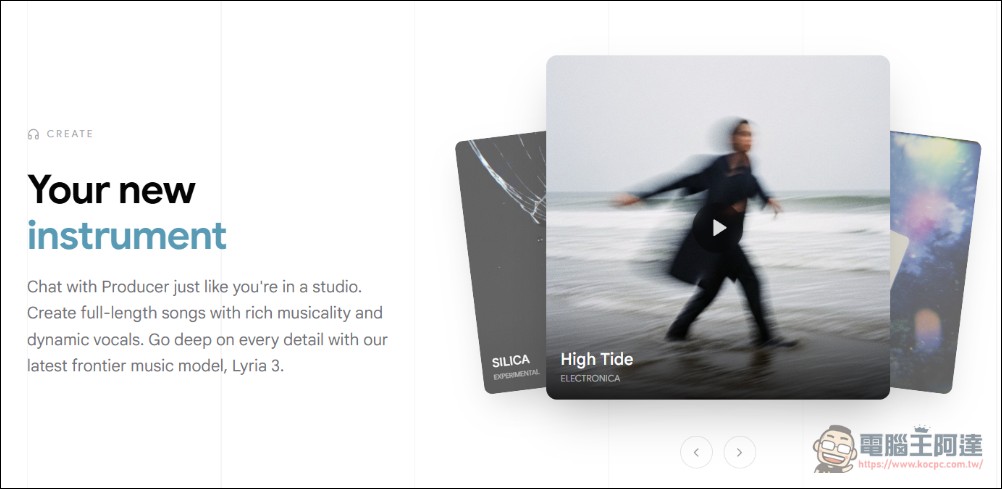
The core strength of Google Flow Music lies in its Lyria 3 model. Unlike most tools on the market that offer “one-click generation” but are difficult to fine-tune, Google Flow Music emphasizes collaborative control with musicians. Its core features include:
- Precise Remix FeatureUsers can make partial modifications to the generated tracks. For example, if you’re satisfied with the melody but don’t like the drums, you can remix only the drum track without affecting the structure of other parts.
- SpacesThrough simple text commands, users can “create” unprecedented instruments or sounds in virtual space. This highly customizable capability gives professional musicians more room to explore their creativity.
- Lyria RealTimeWith extremely low latency, it can even be paired with a physical MIDI controller for live improvisation performances.
Professional Case Study: In-Depth Collaboration with a Grammy Award Winner
To prove it is not an “AI junk content generator,” Google invited several professionals to conduct in-depth experiments through the “Music AI Sandbox.” These cases demonstrate how AI becomes an extension of human creativity.
- Wyclef Jean’s Creative ExperimentsGrammy-winning artist Wyclef Jean used Lyria 3 to help develop his song “Back From Abu Dhabi.” He treats AI as a “design collaborator” for crafting complex arrangement layers.
- Short Film Soundtrack ApplicationsFamous producer Yung Spielburg composed the entire soundtrack for the animated short film “Dear Upstairs Neighbors” created for DeepMind using Lyria 3, demonstrating AI’s high efficiency and quality in the field of visual scoring.
- Live improvisationArtist Toro y Moi (Chaz Bear) publicly demonstrated live AI music improvisation in front of an audience using Lyria RealTime paired with physical equipment, breaking the stereotype that AI creation is limited to static generation.
Pricing plan: Tied to Google AI subscription system
Based on current market observations, Google Flow Music has adopted a flexible pricing strategy:
- Free versionProvides basic generation credits, allowing general users to experience the joy of AI music creation.
- Professional Plan (starting from NT$650/month)For professionals who need higher generation frequency, priority access to the latest models (such as Lyria 3 Pro), and intend to use the outputs for commercial purposes. This plan is typically bundled with a Google AI Advanced (Gemini Premium) subscription.
- Enterprise and Developer APIDelivered through Vertex AI and Google AI Studio, enabling game companies or brand agencies to produce customized audio at scale.
Google Flow Music Official Website
Conclusion: The Next Battlefield for AI Music
The official launch of Google Flow Music shows that Google is no longer content with merely showcasing technology in the lab. By acquiring an established product team (ProducerAI) and equipping it with the most powerful core engine (Lyria 3), Google clearly intends to define a new standard for the “AI music workstation.” For creators, this means AI will evolve from a mere “generation tool” into a true “virtual production assistant.”
Source: KOCPC Chinese