


Recently, telecommunications providers announced the implementation of “new regulations for replacing lost SIM cards” in accordance with the government’s anti-fraud strategy. These regulations require citizens who lose their SIM cards to first file a police report and obtain a two-part loss report form, sparking widespread public outrage. Legislators have even described this as a measure that “burdens the public, the police, and the industry.” In response to the outcry, the NCC issued an urgent clarification stating that media reports may have been based on misunderstandings and that it would convene a meeting with the telecom operators to discuss the matter—effectively shifting the blame for the public backlash onto the telecom operators and the media outlets that exposed the issue!?
What is the full story behind the “new regulations on changing phone numbers and replacing SIM cards” that have sparked public outrage? Is this a case of telecom operators misunderstanding the policy and bringing trouble upon themselves, or is the NCC just passing the buck? Here’s an explanation:
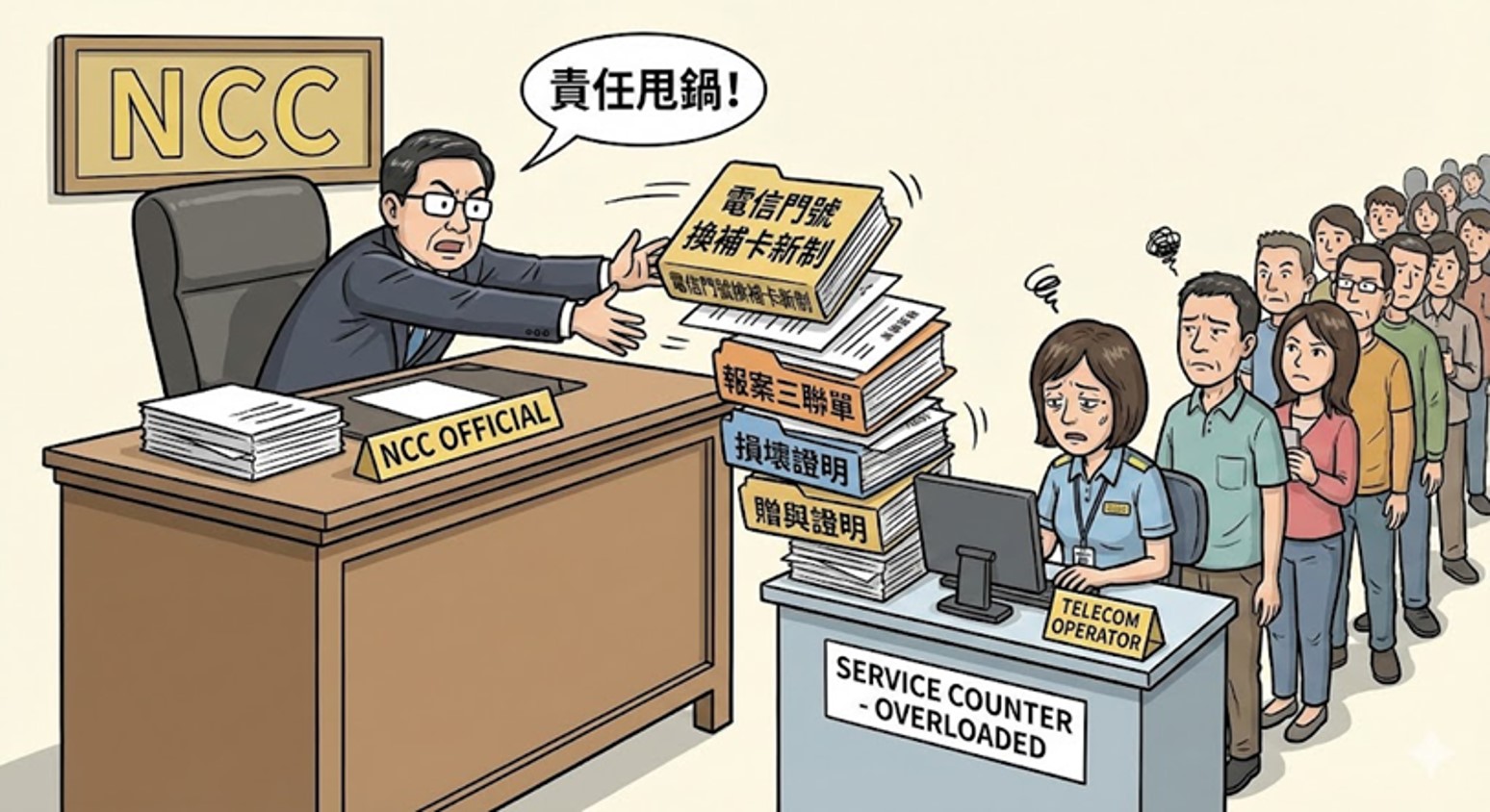
Telecom operators recently issued an urgent announcement regarding the implementation of “New Regulations on Changing Telecom Phone Numbers, Replacing SIM Cards, and Switching Numbers“, sparking public outrage over “disruptions to residents, police, and businesses.” The NCC attributed the issue to erroneous reporting and stated it would communicate with the three major telecom companies. What is the truth behind this public outcry over “disruptions to residents, police, and businesses”? Below is a summary video and detailed explanation:
1. The Background of the “New Regulations on Changing Telecom Phone Numbers, Replacing SIM Cards, and Number Portability” and the NCC’s Clarification:
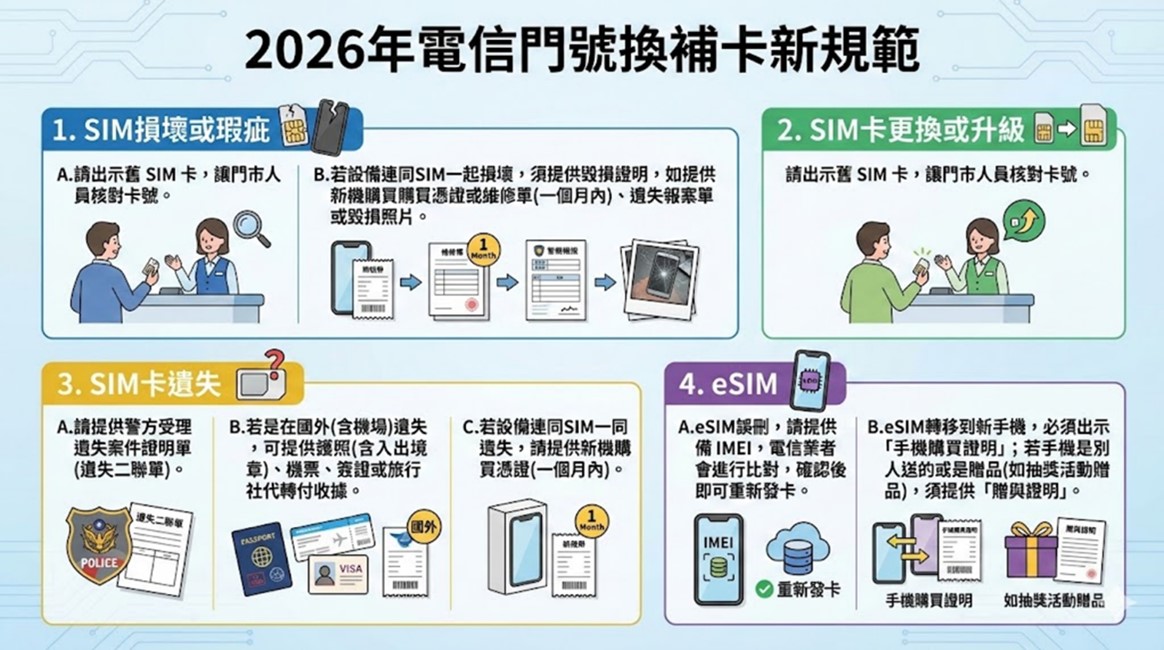
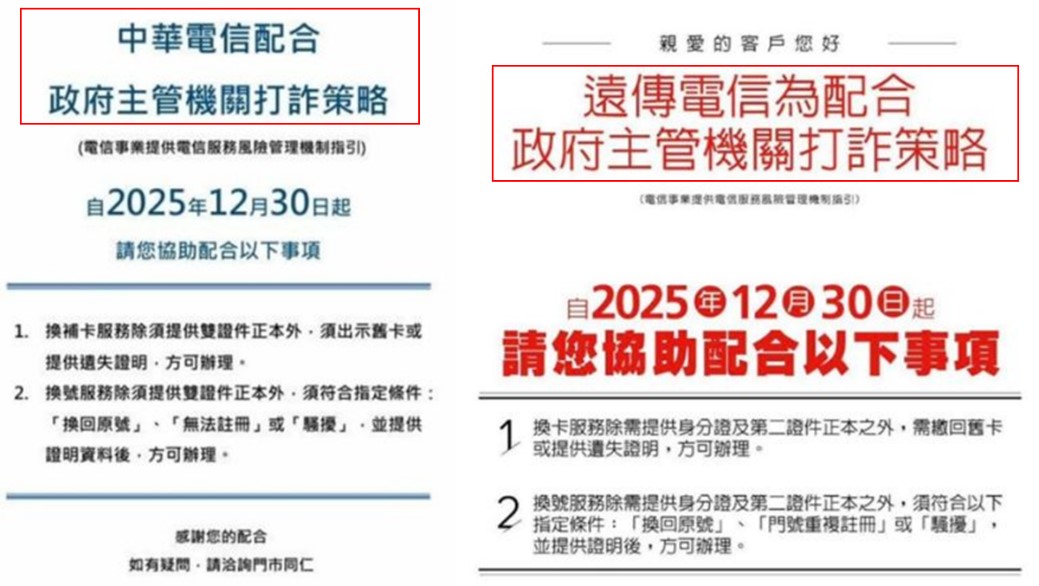
To support the government’s anti-fraud policy and the [ Guidelines on Management Mechanisms for Telecommunications Service Providers (September 26, 2025 Edition)】, Telecom operators, without prior coordination, announced on December 30, 2025, that “New Regulations on Changing Telecom Phone Numbers, Replacing SIM Cards, and Switching Numbers“. According to information revealed by the media and netizens, if a user loses their SIM card, they must provide the two-part police report form; if both the phone and SIM card are damaged, they must provide proof of damage; and if transferring an eSIM to a new phone, they must present a “proof of phone purchase” or “proof of gift”… Since the new measures were implemented without a grace period for public awareness, and given that the new regulations “create a burden for the public, the police, and service providers,” they immediately sparked public outrage. As a result, staff at telecom service centers had no choice but to advise customers to file complaints with the NCC.
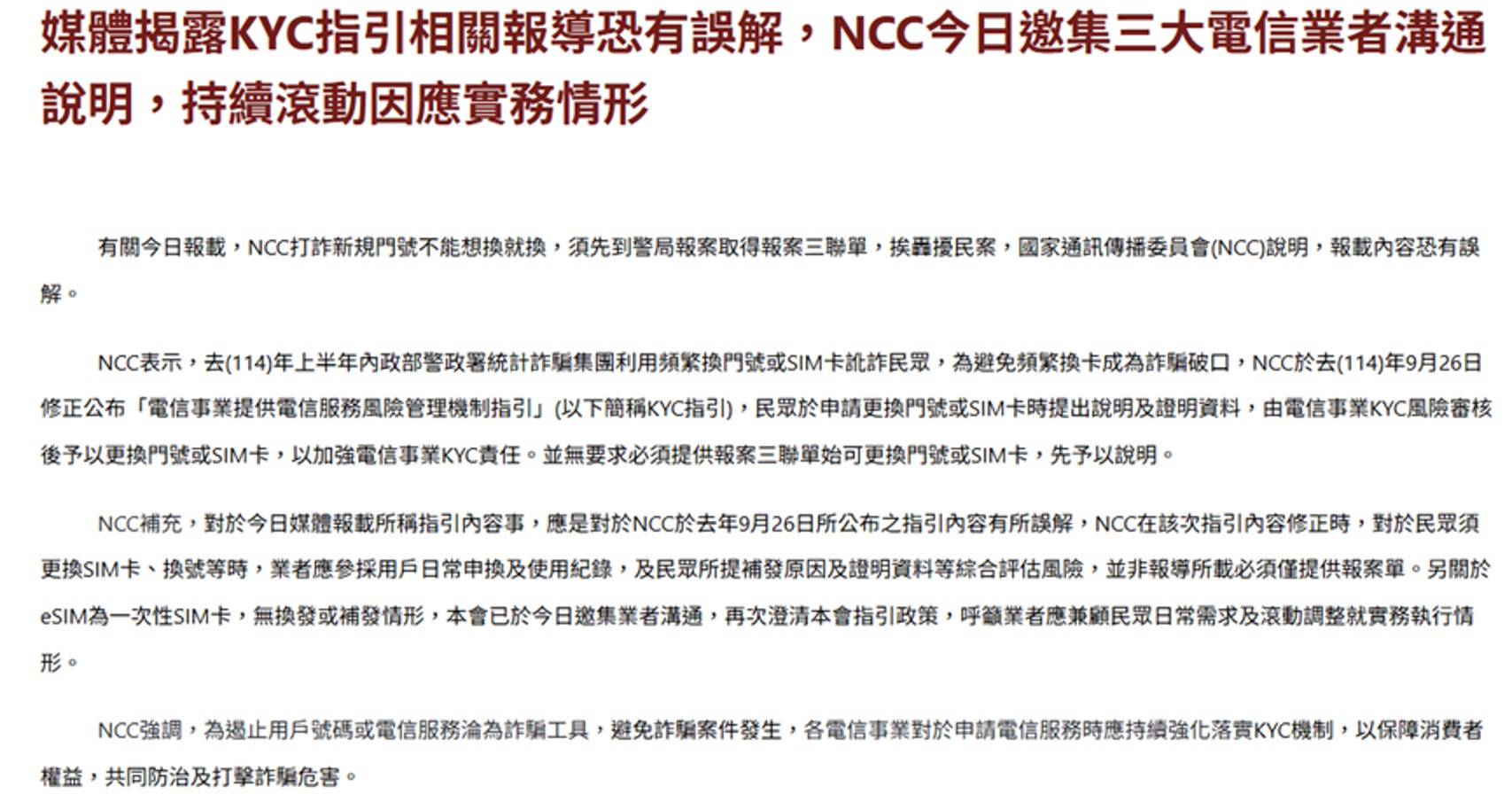
It was only after Legislator Ge Rujun exposed the matter that the NCC issued an emergencyPress ReleaseThe report stating that citizens must first file a police report at a police station to obtain a three-part report form before replacing their cards is incorrect; the authorities will convene a meeting with the three major service providers to discuss the matter.
The NCC stated: The content of the guidelines cited in media reports appears to be based on a misunderstanding of the guidelines published by the NCC on September 26 of last year. When revising those guidelines, the NCC specified that when members of the public need to replace their SIM cards or change their phone numbers, service providers should conduct a comprehensive risk assessment based on the user’s routine application and usage records, as well as the reasons provided for the replacement and supporting documentation submitted by the user—not merely the police report as stated in the reports. Additionally, regarding eSIMs—which are one-time-use SIM cards and do not require replacement or reissuance—the NCC convened a meeting with service providers today to clarify its guidance policy once again and urged providers to balance the public’s daily needs with ongoing adjustments based on practical implementation.
Since the NCC has backtracked on thisThe new regulations regarding SIM card replacement and reissuance stem from telecom operators’ misunderstanding of the guidelines. The regulations governing SIM card replacement and reissuance, as well as number portability, are expected to be revised; please refer to separate internal announcements from telecom operators for details.!
2. Are telecom operators bringing trouble upon themselves by misinterpreting the policy, or is the NCC just passing the buck?
The NCC announced [ Guidelines on the Management Mechanism for Telecommunications Service Providers (September 26, 2025 Version)】, which explicitly stipulates that when members of the public apply for a replacement or new SIM card, they must state the reason and purpose of the application and provide 【supporting documentation】, which telecommunications providers will review and evaluate in accordance with KYC procedures. The requirements subsequently implemented by telecommunications providers—such as the need to submit a “two-part lost SIM card report form,” “proof of damage,” “old SIM card,” “proof of mobile phone purchase,” or “proof of gift”—all stem from this regulation.
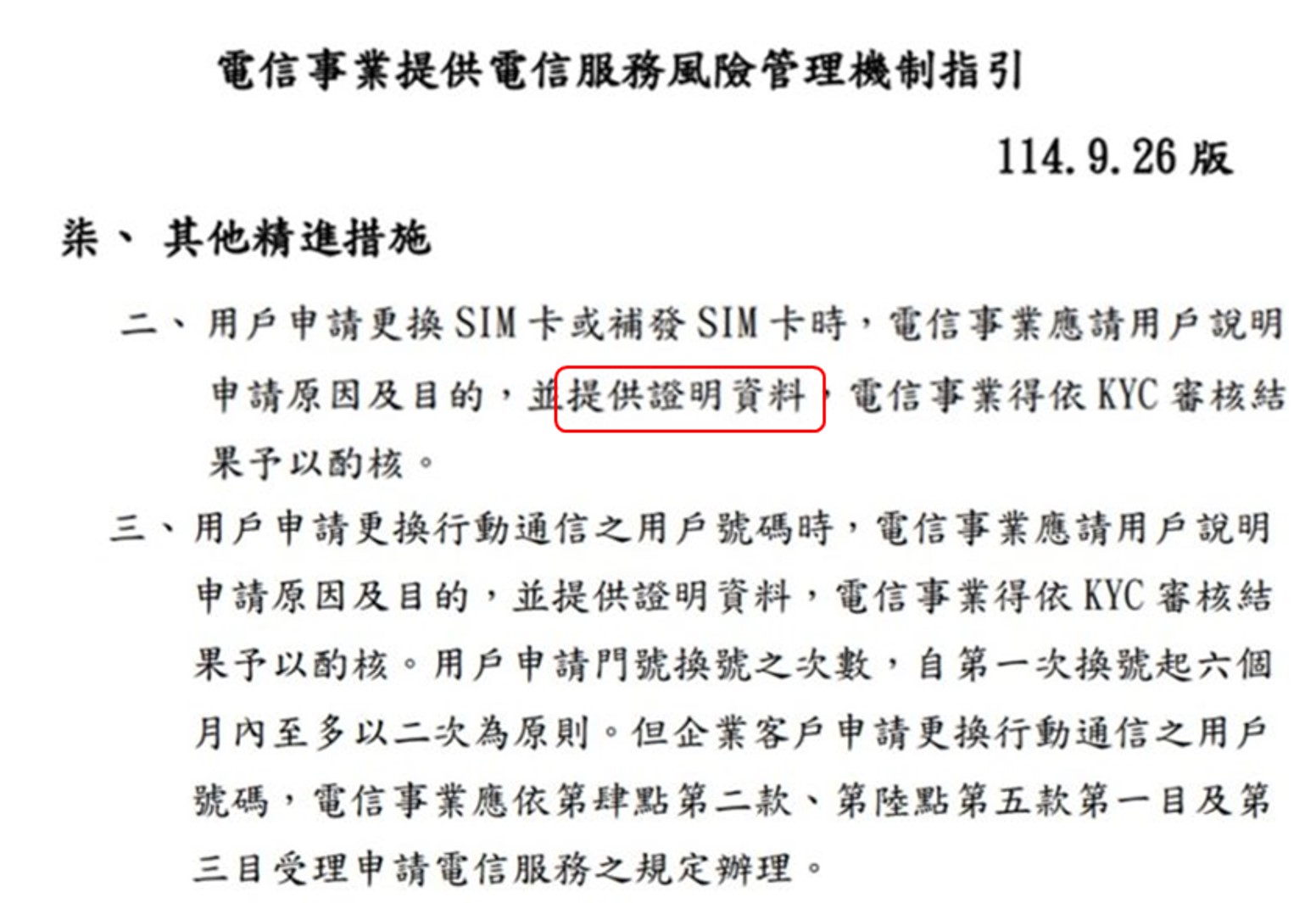
This differs significantly from the NCC’s clarification regarding the revisions to these guidelines—which stated that when members of the public need to replace their SIM cards or change their phone numbers, service providers should conduct a comprehensive risk assessment based on the user’s routine application and usage records, as well as the reasons provided for the replacement and supporting documentation—rather than the claim in the report that only a police report is required. As a veteran telecommunications professional, based on the announcements from telecom operators and public speculation, I can confidently surmise that this controversy stems from senior civil servants within the NCC’s leadership. Since the regulations explicitly require the provision of “supporting documentation,” the esteemed bureaucrats at the NCC have refused to accept the telecom operators’ explanation that the new measures would easily cause inconvenience to the public and the police. and by forcing telecom operators to highlight their political achievements, the operators were compelled to issue announcements that blatantly showcase the “magnificence and greatness of the government regulatory authority”—measures that telecom industry insiders know are out of touch, ill-informed, and disruptive to the public, the police, and the operators themselves.
I’d like to ask the NCC: Since phone numbers are essential to people’s daily lives, and even when applying for a replacement ID card due to loss, no “supporting documentation” is required, why is it required when replacing or reissuing a SIM card? Regarding the frequency of SIM card replacements mentioned in the NCC’s press release, isn’t there already a limit of two replacements every 90 days? Instead of NCC Secretary-General Huang Wen-che trying to pin the blame on the three major telecom operators, he should first look within the agency at the high-ranking officials and staff responsible for communicating with the telecom operators to understand the “true nature” of how this new policy was originally communicated!
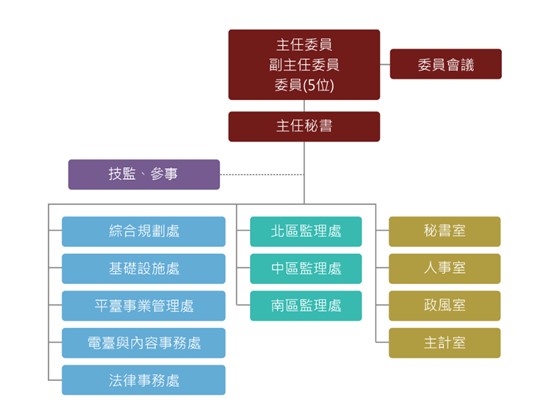
The NCC was formed through the 2006 merger of the “Telecommunications Bureau of the Ministry of Transportation” (which oversaw telecommunications) and the “Broadcasting and Television Division of the Bureau of News and Public Information under the Executive Yuan” (which oversaw broadcasting and television content). In addition to the NCC Commission, the NCC’s organizational structure includes civil servants who previously worked in the “Telecommunications Bureau of the Ministry of Transportation” and the “Bureau of News” under the Executive Yuan.
The NCC has gained a notorious reputation in recent years. In addition to the previous commission’s handling of the “refusal to renew CTS News’s license” and the “approval of Mirror TV’s establishment”—which drew strong criticism from opposition parties—previous policies such as the “750-yuan review fee for overseas online purchases of devices with wireless functions like Bluetooth and Wi-Fi” and the recent “new regulations on changing, replacing, or transferring mobile phone numbers”—these ill-conceived policies that have sparked public outrage are also among the main culprits behind the NCC’s tarnished reputation. The responsibility for this actually lies not with the NCC commissioners but with the out-of-touch civil servants under its jurisdiction.
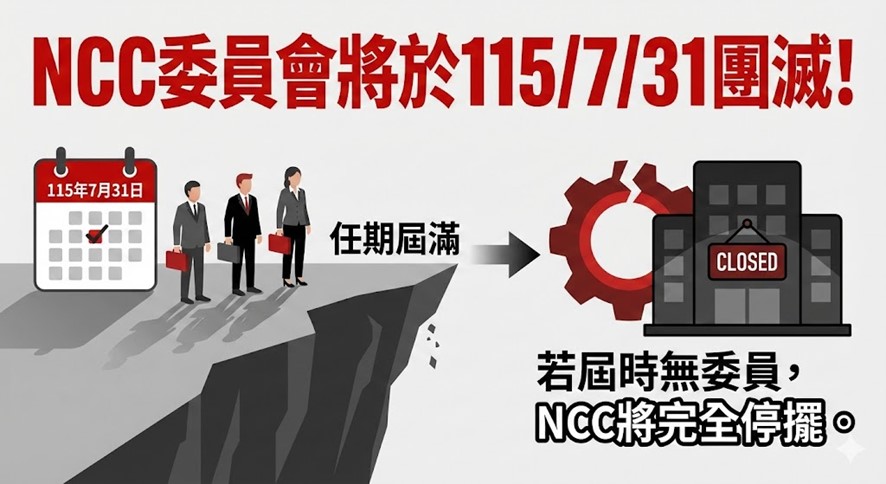
Since the NCC’s three remaining commissioners are set to step down on July 31, 2026, if new commissioners cannot be appointed in time, once the NCC is left without any commissioners, the annual review of more than 10,000 cases involving telecommunications and broadcasting services—which must be deliberated by the NCC Commissioners’ Advisory Council or the NCC Commissioners’ Meeting—will come to a complete standstill, which is unlikely to be in the public’s best interest.
Unless the NCC intends to abolish its status as an independent agency and return it to the Executive Yuan, I urge the NCC’s Acting Chairperson or Secretary-General—before the NCC Commission is completely dismantled—to rid the public of this menace by replacing the unqualified bureaucrats before stepping down!
Source: KOCPC Chinese