


Over the past month or so, a shared sense of confusion has been brewing in the global developer community: has Claude Code gotten dumber? Code reasoning abilities have notably declined, conversations keep repeating the same content, and responses have become unusually brief—these complaints started flooding GitHub Issues, Reddit, and X platforms in early March. Facing a wave of skepticism, Anthropic finally released a detailed official postmortem report on April 23, acknowledging that Claude Code had indeed suffered from three separate engineering errors that caused product quality to deteriorate continuously over the past two months, emphasizing that all issues have been fixed, while announcing a usage quota reset for all subscribers as compensation.

This published by Anthropic’s engineering teamReportrepresents a rare instance of transparent incident review in the AI industry in recent years, not only dissecting the causes and timeline of three technical failures one by one, but also committing to a series of process reform measures to prevent similar incidents from occurring again.
First mistake: Inference effort decreased from “high” to “medium”
Timeline: March 4 – April 7, 2026
The first issue stems from a seemingly reasonable product decision. The Anthropic team noticed that Claude Code’s response latency in high reasoning mode was too long, making the user interface appear frozen. To improve the user experience, the engineering team lowered the default reasoning effort from “high” to “medium”.

According to Anthropic’s internal testing, the medium tier delivers “slightly lower intelligence but significantly reduced latency” across most tasks. However, this trade-off doesn’t resonate with real users at all. Numerous developers report that Claude Code feels “clearly dumber” on code reasoning and debugging tasks.
After collecting sufficient user feedback, Anthropic rolled back this change on April 7. The current default is: Opus 4.7 model uses “xhigh” (ultra-high) level, while other models maintain “high” level.
Second mistake: Cache cleanup bug causes “amnesia”
Timeline: March 26 to April 10, 2026
The second problem is a more deeply hidden technical flaw. To reduce the cost of resuming idle conversations, Anthropic designed a prompt cache optimization mechanism, originally intended to clear old reasoning (thinking) blocks after the user has been idle for more than an hour, to save token consumption.
However, this mechanism has a serious implementation flaw in the Sonnet 4.6 and Opus 4.6 models: instead of clearing the reasoning cache once after idleness, the system continuously discards reasoning blocks in every turn of conversation. This directly causes Claude to exhibit obvious “amnesia” symptoms in long conversations, constantly repeating content it has already said, while also accelerating the depletion of users’ usage quotas due to repeated cache misses.

More concerning is that this bug successfully evaded code review, unit tests, and end-to-end tests. It went undetected because it only triggered under specific boundary conditions (only affecting idle conversations), compounded by an unrelated display change during the same period that masked the symptoms.
An interesting detail is that when Anthropic later used their own code review tool to retrospectively test that problematic code, Opus 4.7 successfully detected the bug, while Opus 4.6 failed to find it. The issue was ultimately fixed in version v2.1.101 on April 10.
The third mistake: the 25-character limit killed code quality
Timeline: April 16–20, 2026
The third issue had the shortest duration of impact, but was perhaps the most absurd for developers. During pre-launch tuning for Opus 4.7, Anthropic added a restriction in the system prompt: “Text between tool calls limited to 25 characters, final responses limited to 100 characters, unless the task requires more detail.”
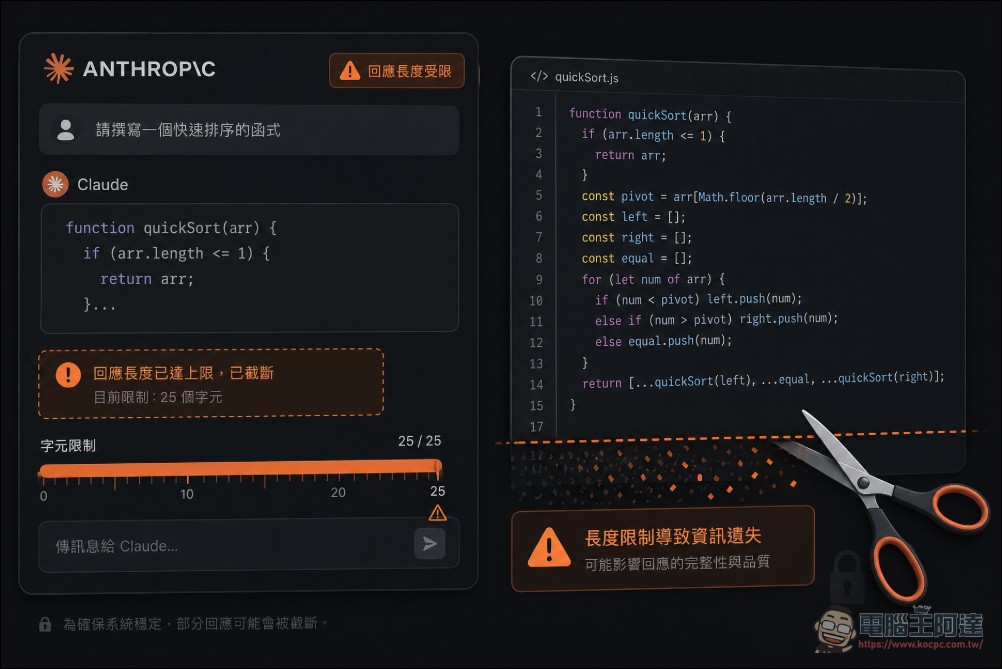
The intent of this change was to make Claude Code’s responses more concise. After several weeks of internal testing, the team believed there was no significant degradation in quality. However, when engineers conducted evaluations using more rigorous ablation studies, they found that this constraint caused approximately 3% overall intelligence degradation on both Opus 4.6 and Opus 4.7.
Although 3% may not sound like much, in code generation scenarios, this level of quality degradation is sufficient for developers to noticeably perceive the difference during daily use. Anthropic rolled back the change on April 20 immediately after discovering the issue.
A perfect storm of three stacked bugs
From the timeline, these three issues had some overlap periods. Between March 26 and April 7, the reasoning degradation and cache bug coexisted. Then between April 16 and 20, the lingering aftereffects of the cache issue that hadn’t fully dissipated overlapped with the conciseness limit. This means some users may have been affected by two or even three issues simultaneously during certain periods, which explains why the community’s anger ran so high.

Anthropic also clarified in the report that these issues only affected the Claude Code product layer, and the underlying Claude API was not impacted throughout the period. The scope of affected products includes Claude Code, Claude Agent SDK, and Claude Cowork.
Compensation Measures and Process Reform
Beyond the technical fixes, Anthropic announced several compensation and prevention measures:
Regarding user compensation, Anthropic reset usage limits for all Claude Code subscribers on April 23.
Regarding process reform, Anthropic has committed to the following improvements:
Internal testing will use the public release version rather than the development version to ensure consistency between the testing environment and user experience. All system prompt changes must undergo benchmark evaluation and ablation testing for the specific model. Changes affecting intelligence capabilities will include a soak period and gradual rollout. Enhance our Code Review tool’s capabilities to support cross-repository context analysis. Changes targeting a specific model will be strictly scoped to that model to avoid affecting other models.
Additionally, Anthropic announced the launch of the @ClaudeDevs account on X and GitHub as a dedicated communication channel for publicly explaining product decisions to the developer community.
We’ve refreshed Claude Code on the web and mobile. A few things that recently shipped 🧵 pic.twitter.com/hJHIckTxx3
— ClaudeDevs (@ClaudeDevs) April 24, 2026
This incident highlights the risks of “product-level tuning” in AI products. Claude’s underlying model capabilities remained unchanged, yet three independent decisions and bugs at the product level were enough to cause significant degradation in user experience. This also serves as a reminder to the entire industry: as AI tools increasingly become a core part of developers’ workflows, any seemingly minor system parameter adjustment can trigger unpredictable cascading effects on actual usage quality.
Anthropic chose to address this crisis with openness and transparency, publishing a detailed technical post-mortem—a rarity in the AI industry. Whether driven by a commitment to user trust or adherence to its own engineering culture, this report sets a commendable example for the industry on how to handle incidents.
Source: KOCPC Chinese