


China’s National Development and Reform Commission (NDRC) released today (the 27th)Official statementClearly issued a prohibition decision against the “foreign acquisition of the Manus project,” requiring all relevant parties to immediately revoke the transaction. This ban officially ended Meta’s attempt to acquire the Chinese AI startup Manus for over $2 billion, marking the collapse of a highly scrutinized deal and signaling that Beijing’s regulatory reach in the AI sector has now extended beyond its borders.
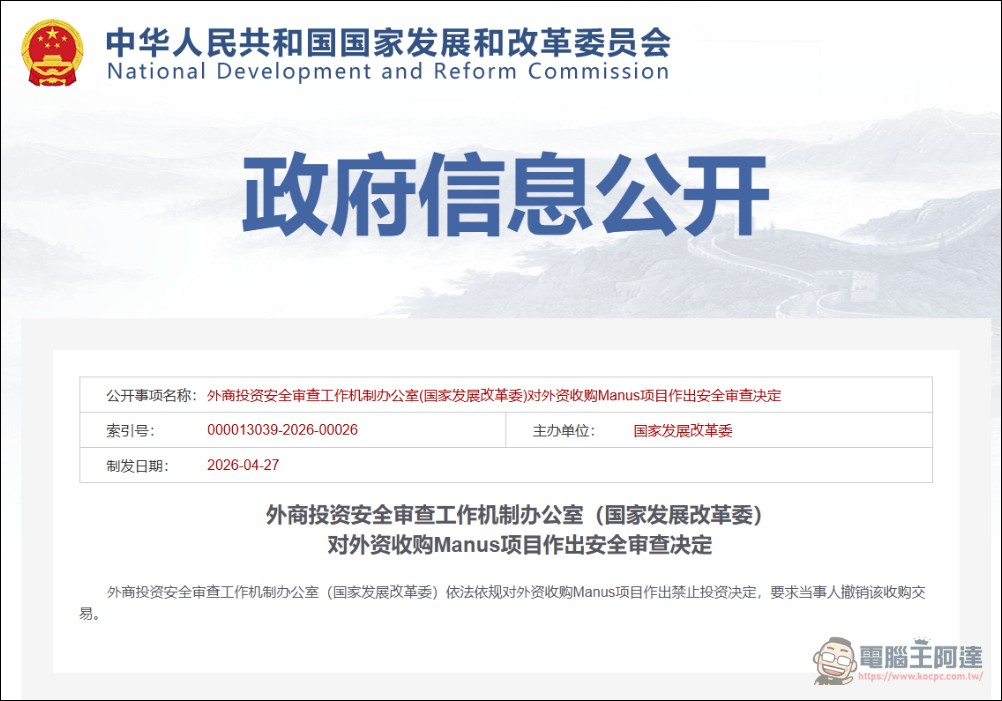
China’s NDRC Officially Blocks Meta’s Acquisition of AI Startup Manus
Even Singapore Headquarters Can’t Stop It: Beijing’s Regulatory Long Arm Reaches Overseas
Manus was founded in China but previously relocated its headquarters to Singapore, attempting to avoid geopolitical risks through a strategy of decoupling from China. However, Beijing’s regulatory actions clearly indicate that a mere address change cannot exempt a company from China’s national security review.According to sources familiar with the matterManus CEO Xiao Hong and Chief Scientist Ji Yichao were summoned to Beijing in March by China’s National Development and Reform Commission for a meeting, after which they were immediately told that they were formally prohibited from leaving China because regulators are reviewing Meta’s acquisition deal.
The Manus case demonstrates that even when a company relocates its headquarters to Singapore and appears to have escaped Chinese jurisdiction, as long as its core team and technology originate from China, Beijing’s regulators can intervene citing “national security” concerns. This serves as a strong warning signal for all Chinese tech companies trying to bypass Chinese regulations through structural adjustments.
Transaction Details and Regulatory Dispute Focus
Meta announced in December last year that it would acquire Manus for over $2 billion, aiming to strengthen its capabilities in the “AI Agent” (artificial intelligence agent) field. Manus was once praised by Chinese state media as “the next star project after DeepSeek,” claiming to have released the world’s first general-purpose AI Agent system, capable of automatically decomposing tasks, calling tools, and completing execution—viewed as one of the key directions in current artificial intelligence development.
According to the announcement by the Office of the Working Mechanism for Security Review of Foreign Investment, the regulatory authority has determined that the transaction involves foreign investors acquiring sensitive technologies and assets. Under the current Measures for Security Review of Foreign Investment, the transaction may not proceed, and any completed portions must be disposed of within a specified period, including equity adjustments, asset divestitures, and other necessary measures to restore the situation to its pre-transaction state.
China tightens foreign investment regulations in AI sector
The impact of this ban extends beyond Meta. According to reports, Beijing regulators plan to further tighten controls, requiring several leading Chinese AI companies—including Moonshot AI, StepFun, and ByteDance—to obtain explicit government approval before accepting American funding. This shows China is tightening control over the outflow of critical AI technology.
From DeepSeek to Manus, Beijing’s stance on any deals that could be viewed as “Chinese AI assets going abroad” has grown increasingly tough. DeepSeek’s emergence late last year already put Western nations on alert, and now Manus—hailed as “the next DeepSeek”—has been blocked by Beijing itself, showing that China has designated AI technology as a core national strategic asset and will no longer tolerate any possibility of “brain drain.”
Meta’s Global Expansion Faces Geopolitical Headwinds
Meta had high hopes for this deal, expecting to bring cutting-edge AI Agent technology to billions of users. However, with the deal forced to fall through, the U.S. tech giant will undoubtedly face greater geopolitical resistance in its global AI expansion.
Notably, according to sources familiar with the matter, while Xiao Hong and Ji Yichao can move freely within China, they currently cannot return to Singapore to collaborate with the Meta team, leaving the integration work between the two sides at a standstill. This also means that even though the deal has been officially rejected, the Manus team’s predicament will remain difficult to improve in the short term.
viewpoint
The collapse of the $2 billion acquisition deal is not just a financial loss for Meta, but a strategic blow in the AI Agent race. Manus’s general-purpose AI Agent technology is exactly the gap Meta urgently needs to fill. Now that this shortcut has been blocked by Beijing, Meta has no choice but to return to developing its own technology, and the pressure to catch up in the AI field will become even more severe.
Source: KOCPC Chinese