


Most people probably kept the PSP handheld machine 22 years ago and did not play it. However, the foreign genius Yifeng Wang has recently broken the limits of the hardware and successfully transplanted the classic PC shooting masterpiece “Counter-Strike” to this old console. He named this project “OpenStrike” and squeezed the performance to the extreme. The game only takes up an incredible 12MB of memory and can run a smooth 60 FPS on the PSP.
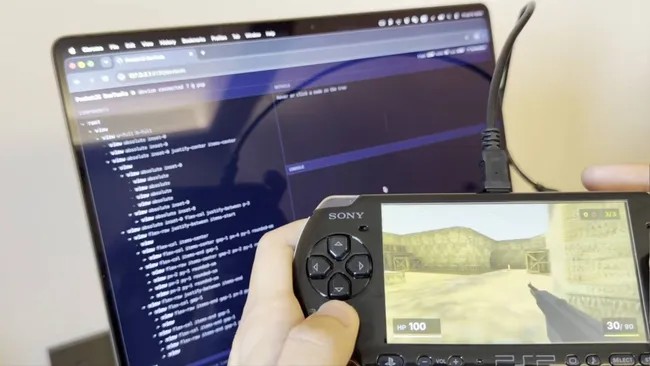
Running “Absolute Force” on PSP 22 years ago still has 60 FPS! OpenStrike only takes up about 12 MB of memory
According to foreign media PCGamer Report by developer Yifeng Wang“OpenStrike” projectAlthough it was just for proof of concept, a lot of effort was put into it. Created his own 3D engine “Pocket3D” based on the Rust language, plus a JavaScript engine called “PocketJS”.
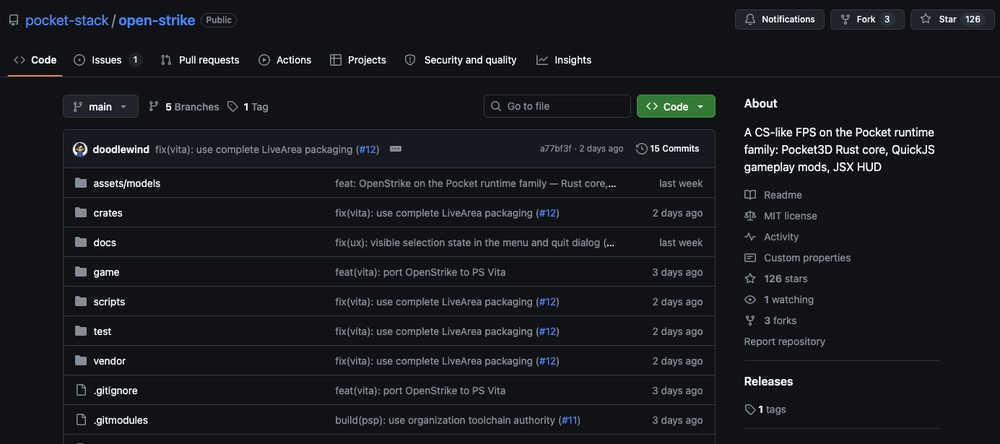
The Pocket3D engine is responsible for tasks such as player movement, collision detection, AI robots, weapons, bullets, and scene drawing that cannot drop frames. Game rules, weapon parameters, and interfaces such as blood volume, ammunition, crosshairs, and scores on the screen are handled by the PocketJS architecture, and JavaScript and TypeScript are executed through the embedded QuickJS.
To put it simply, Rust is responsible for the most performance-consuming parts of the bottom layer, while the upper-layer game rules and interfaces retain the easy-to-modify characteristics of JavaScript. By simply changing `rules.ts`, developers can adjust the turn flow, number of robots, or weapon settings without having to rewrite the entire 3D engine.
The great thing about this architecture is that the entire OpenStrike project takes up about 12 MB of memory on the PSP.
Although the original PSP was equipped with 32 MB of memory, the actual space left for user programs was only about 24 MB. According to the memory analysis disclosed by Yifeng Wang, including the Rust engine, QuickJS, JavaScript program and the entire processed map, the executable file occupies about 6.2 MB; the peak usage of QuickJS Heap, engine status and vertex temporary storage area of each frame is about 4.4 MB, which means that in the end, there is still about 13 MB of space left.
OpenStrike is currently a proof-of-concept version of v0.1, which is still a long way from fully reproducing CS 1.6, but the degree of completion is already very high.
The current version has tested 8 classic “Absolute Force” maps, including de_dust, de_dust2, de_inferno and cs_office. Players can engage in annihilation battles with AI robots on the map, and victory will be determined by destroying all robots. If the player dies first, the judgment fails and the game will automatically start the next round and keep the score:
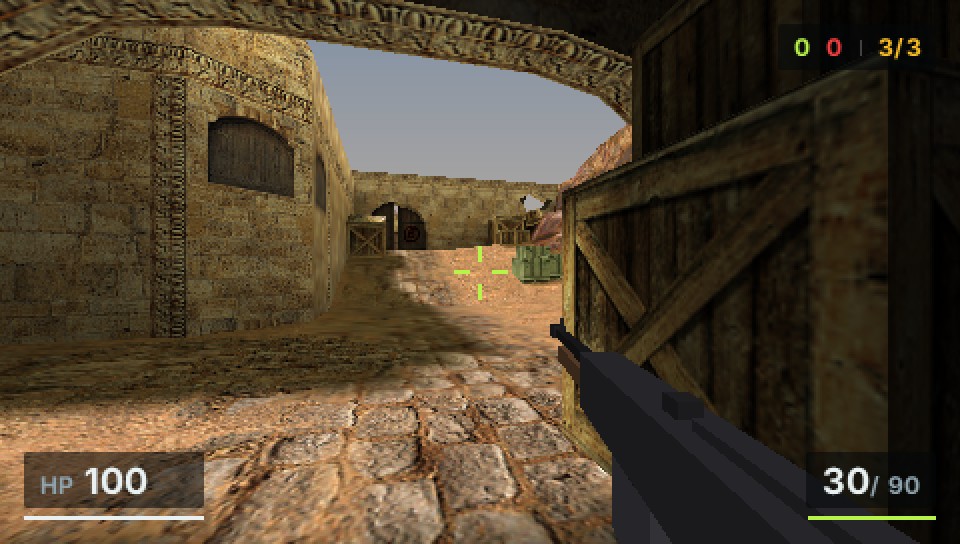
The key to OpenStrike running at 60 FPS on the PSP is to make the PSP perform as little redundant work as possible.
It is worth mentioning that the original “Absolute Force” used the BSP map format of the GoldSrc era, and the full name of BSP is binary space partitioning. It will first divide the entire map into many areas, and the map file also contains PVS, which is the “possibly visible area” data.
For example, in Dust2’s outdoor environment, the engine can instantly determine the visual range of the screen by looking up the table. For those rooms and passages that are hidden behind walls and cannot be seen, the engine will simply ignore them without any detection. Naturally, it will not waste GPU performance for rendering.
This technology works well for the PSP. Modern graphics cards are powerful enough to handle more complex occlusion culling algorithms, but what the PSP lacks most is computing resources. Instead of re-determining the visible range every frame, it would be better to just use the calculation results written in the 1990s.
Light and shadow processing is a similar idea. The GoldSrc map originally comes with a Lightmap, which is used to record the shadow and light and dark changes of walls, floors and objects. OpenStrike does not let the PSP recalculate light and shadow when starting the game or during execution. Instead, when the computer compiles the game, it first bakes the lightmap results into the vertex color of the model.
As long as the PSP draws the triangle according to these colors, the hardware will complete the color gradient, and there is no need to layer an additional layer of real-time light and shadow.
Of course, this comes at a price, as game graphics won’t have the dynamic lighting and gorgeous shadows of modern games, but for the 4.3-inch, 480 × 272 resolution PSP screen, this trade-off is very reasonable.
OpenStrike is already on GitHub It is open source with MIT license. In addition to the desktop version, it can also be packaged into an EBOOT executable file for PSP. Players who do not have a real machine can use the PPSSPP simulator to execute. If you want to install it on a real PSP, you need a console that can run homebrew programs. After putting the packaged folder into the Memory Stick, OpenStrike will appear in the game menu.
It should be noted that this project does not provide Valve’s copyrighted map and texture files. Players must prepare the `.bsp` map and `.wad` texture from a legally held copy of the “Absolute Force” game. The GitHub README states that in theory any BSP v30 map from the GoldSrc era will work.
Source: KOCPC Chinese