


In Generative AI After two years of rapid growth, the business market has been waiting for a killer app. Last night Google Chief Executive Officer Sundar Pichai Officially announced a partnership with the retail giant on the X platform Walmart(Walmart) has partnered with platforms such as Shopify and Wayfair to jointly promote an initiative called “General Business Agreement」(Universal Commerce Protocol, UCP) new standard. The emergence of this technical agreement marks the future ofOnline ShoppingThe AI may handle the entire process for you.

Google Partners with Walmart and Other Platforms to Launch the UCP (Universal Commerce Protocol)
For a long time, retailers’ inventory data (SKUs), real-time prices, and logistics status have been locked away in their own “data silos.” Although Google excels at indexing web pages, it often cannot provide a real-time, definitive answer as to whether “organic strawberries” are currently available on a supermarket shelf. The “Universal Commerce Protocol” (UCP) was created precisely to solve this problem. According to Google’s technical white paper and announcement, UCP is an open data exchange standard. It allows retailers to “feed” their inventory systems in a structured, real-time manner to large language models (LLMs), such as Google’s Gemini.

The key breakthroughs in this agreement are twofold:
-
Dynamic Semantic Understanding: UCP enables AI to not only read product names but also understand product attributes. For example, when Gemini receives data from Walmart, it not only knows that this is a “tent,” but also that it is a tent “suitable for 4 people, with a wind resistance rating of 5, and in stock at a warehouse in Texas.”
-
Trading Execution Permissions: Traditional APIs are read-only, whereas UCP integrates “action” permissions. This means that, after obtaining user authorization, an AI agent can directly perform actions such as “Add to Cart” and “Checkout” at the protocol level, without having to simulate human clicks on a webpage.
Sundar Pichai emphasized that UCP aims to build an “open commerce ecosystem,” which stands in stark contrast to the closed marketplace model of traditional online shopping.
From the “Search Bar” to the “Conversational Flow”: A Radical Transformation in the Consumer Shopping Experience
Under the UCP framework, the consumer shopping experience will undergo a fundamental transformation. People will no longer need to go through the tedious process of “searching for keywords → browsing listings → clicking through to a website → comparing specifications → placing an order.”
For example, a father told Gemini, “I’m throwing a Paw Patrol-themed birthday party for my 6-year-old son next week. My budget is $200, and I need decorations, a cake, and gifts. Please take care of everything for me.”
In the past, this would have required dozens of searches and cross-platform price comparisons. But with UCP’s support, Gemini can instantly access inventory from Walmart and Shopify sellers, understand the preferences of a “6-year-old boy,” filter out combinations that fit the budget, and directly display a “shoppable cart.” Users simply need to confirm with a glance, click “Buy,” and Walmart’s backend supply chain takes over logistics and delivery.

Seamless Cross-Channel Integration
Another area of potential for UCP lies in cross-platform integration. Since it is a universal protocol, Gemini could, in theory, retrieve furniture data from Wayfair and fresh food data from Walmart simultaneously, integrating products from different sources into a single conversational interface. This has truly transformed Google into a “Super Aggregator,” allowing it to reclaim the product search traffic it had lost following Amazon’s rise.
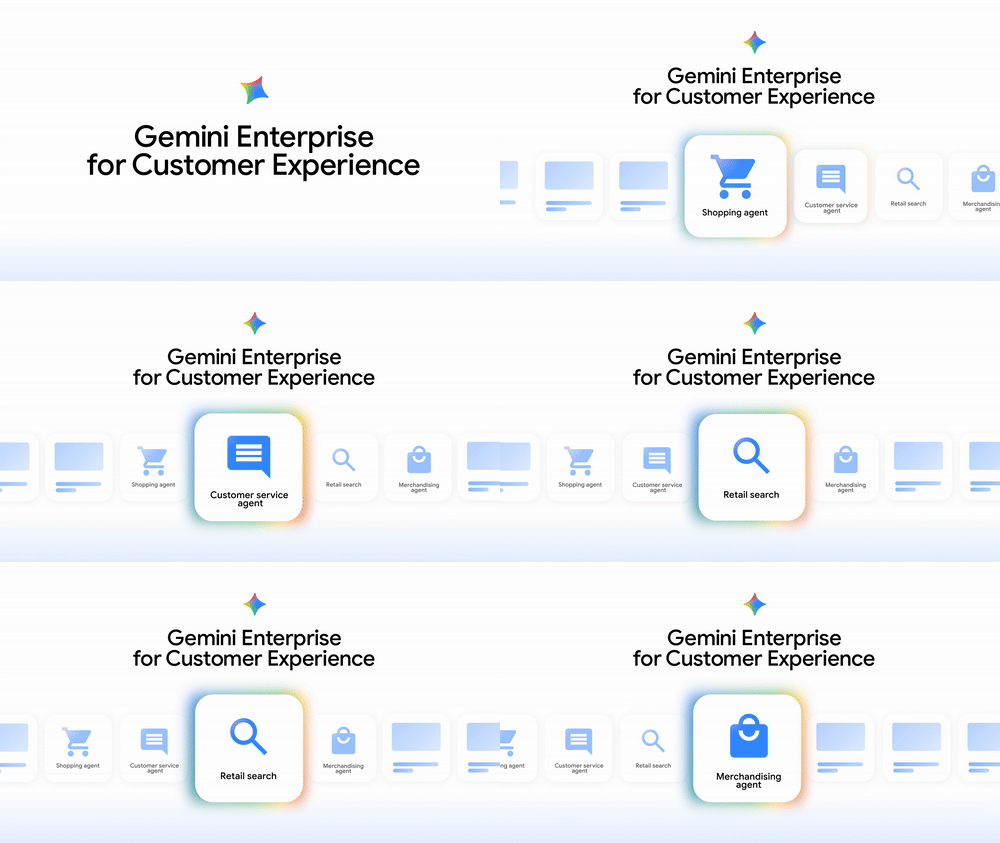
Behind the alliance between Google and Walmart lies a strategic counteroffensive by the two giants against their common enemies: Amazon and TikTok Shop.

For Google,
Although Google has the largest search traffic, it has long been outperformed by Amazon when it comes to “high-conversion” shopping searches. Users are accustomed to searching for products directly on Amazon, bypassing Google. Through UCP and Gemini, Google is attempting to leverage the convenience of AI—which helps users think and make choices—to intercept their purchase intent, thereby upgrading its ability to monetize traffic from simple “ad clicks” to “transaction commissions” or “service fees.” Furthermore, promoting UCP as an industry standard can prevent e-commerce data from being monopolized by a single platform (such as Amazon).
For Walmart and other retailers,
Walmart has a robust supply chain, but it has consistently struggled to fully replace tech giants in the technology space. Joining the UCP ecosystem gives Walmart direct access to Gemini’s massive user base without having to pay the high “toll fees” associated with listing on Amazon or sacrificing brand control. For independent sellers on Shopify, this is a huge boon, as they lack AI development capabilities; UCP allows them to instantly gain access to AI sales agents on par with those used by large enterprises.
The Hidden Concerns and Challenges of UCP
Although the future envisioned by UCP is exciting, veteran tech commentators have also pointed out potential risks. First is “algorithmic bias”: When AI makes decisions on behalf of humans, does it recommend Walmart products because they are truly the best fit for the user, or because Walmart is UCP’s launch partner? Google must guarantee the neutrality of its algorithms in the agreement; otherwise, it will face antitrust investigations. Second is the “attribution of returns and customer service”: When a transaction occurs within the Gemini chat window, should consumers turn to Google or Walmart if there is a problem with the product? UCP must clarify the allocation of responsibility in such “agency transactions”; otherwise, it will trigger massive consumer disputes.
Conclusion:
Google’s newly launched UCP (“Universal Commerce Protocol”) may reshape the future of online shopping. If the UCP becomes widely adopted, e-commerce will no longer be about “people finding products”; instead, AI agents will navigate through billions of SKUs on behalf of consumers and complete transactions. But the reality is not quite that simple. If AI were to handle all of a consumer’s shopping needs from start to finish, it would inevitably impact Google’s own most critical advertising business. Would merchants still need to spend money on various ads to increase their visibility? Furthermore, if the AI’s shopping recommendations are not based on the consumer’s best interests but rather on merchants’ purchases of “AI priority shopping rights” from Google, this would undoubtedly have a significant impact on Google’s reputation and consumer rights.

Previously, Doubao Mobile from mainland China attempted to use its own AI to assist consumers with shopping, but this resulted in a crackdown by e-commerce platforms across China, effectively rendering the service a mere shell of its former self. Will Google follow in its footsteps? Perhaps we’ll just have to wait and see.
Source: KOCPC Chinese