


As everyone knows Capcom The AAA blockbuster *,* released last year,Monster Hunter: Wilds》(Monster Hunter Wilds) has always had serious performance issues and has been jokingly dubbed the “worst-optimized game,” but the reason for the game’s lag may not be due to poor programming or the RE Engine—it’s actually because players “purchased DLC “Insufficient quantity.” This is not an April Fools’ Day joke, but rather Reddit forumAfter reverse-engineering the game and conducting detailed tests of control variables and code analysis, veteran players have pointed out that the game’s internal DLC detection mechanism contains serious flaws. As a result, the CPU resources of regular players who have not purchased a large amount of DLC are consumed by unnecessary check loops, thereby causing a sharp drop in frames per second (FPS).
Reddit user claims that they’ve figured out what causes Monster Hunter Wilds performance issues – and it’s kind of wild.
According to their investigation:
• Owning more DLC = more FPS
• This is due to an aggressive check the game does to see what DLC you own
• It is NOT… pic.twitter.com/LNADlNHlcP— KAMI (@Okami13_) January 14, 2026
Causes of Stuttering in *Monster Hunter: Wild* Revealed
The person who uncovered this issue is not just an ordinary player; according to his own account, he previously helped Capcom fix a serious CPU performance bug in *Dragon’s Dogma 2* in 2024. At the time, using analysis tools (such as a profiler) and reverse engineering, he identified the NPC animation functions as the primary cause of the FPS drop and submitted the data to Capcom’s technical staff, which led to the subsequent release of a patch.
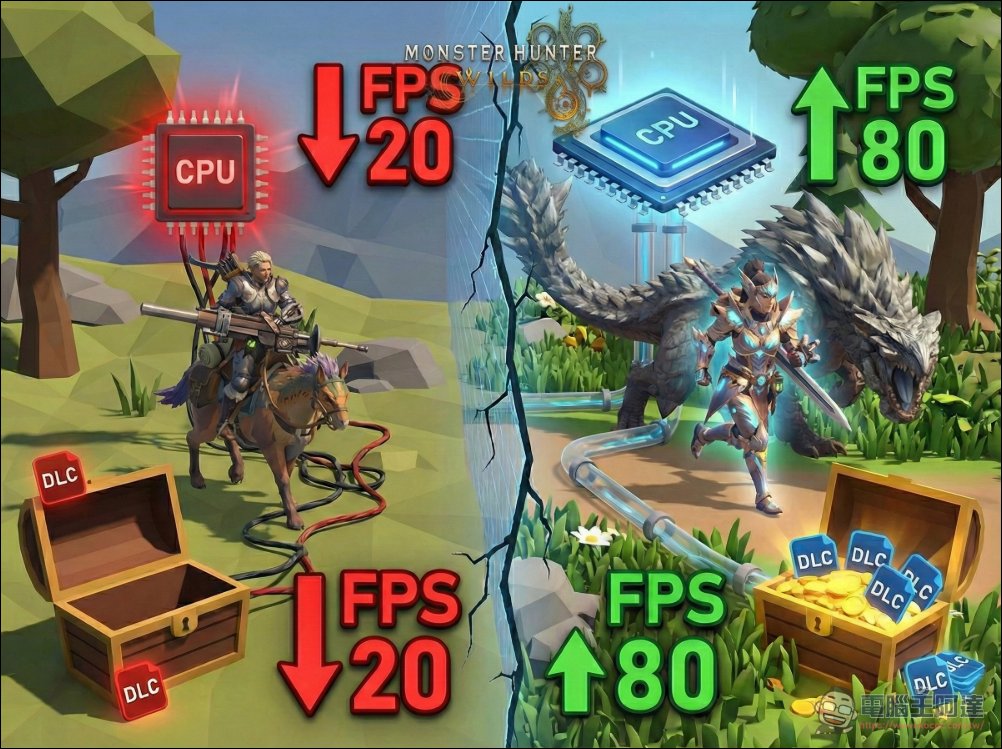
According to his test description, he encountered severe FPS instability in the game’s hub areas, such as the Plains Camp. At first, he tried common “folk remedies”—adjusting Windows settings, clearing the registry, and so on—but none of them worked. Only when he forcibly switched his laptop to “Performance Mode” (which boosts the CPU from 3 GHz to 5 GHz) did the situation improve. This clearly points to one fact: this is a CPU-bound bottleneck, not a graphics card performance issue.

A Key Turning Point: The “Performance Class Gap” Between Rich and Poor Accounts
The discovery of the root cause of the issue was purely accidental. During testing, the player borrowed a friend’s Steam account to play another game. When he switched back to his friend’s account to play *Monster Hunter: World*, he was surprised to find that the game ran exceptionally smoothly.

To verify whether this was an illusion, he conducted a series of rigorous “controlled experiments” (A/B testing):
-
Consistent Hardware Environment: Cross-testing was performed using the same laptop (equipped with an RTX 3070 Ti) and the same desktop computer.
-
Consistent Software Environment: The same driver version, the same graphics settings (with no high-resolution texture packs installed), the same game scene, camera angle, and coordinates.
-
The only variable: You are logged in with a different Steam account.
The test results were staggering:
-
Account A (the player): I only own the standard edition of the game and haven’t purchased any additional DLC. The FPS inside the base drops to 20-25 FPS。
-
Account B (Friend): The player described his friend as a “Sheikh” who had purchased nearly all the cosmetic and item DLCs. Under exactly the same conditions, the FPS remained consistently at 80 FPS or higher。
The player ruled out the influence of texture packs (neither player had one installed); the only difference lay in the DLC inventory list in the account dashboard. This led him to suspect the game engine’s logic for handling DLC verification. To test the hypothesis that “the number of DLCs affects performance,” the player conducted further technical verification (although this involved modifying the game’s behavior, he emphasized that it was solely for research purposes). He wrote a small mod to trick the game into believing that the current account owned all available DLCs.
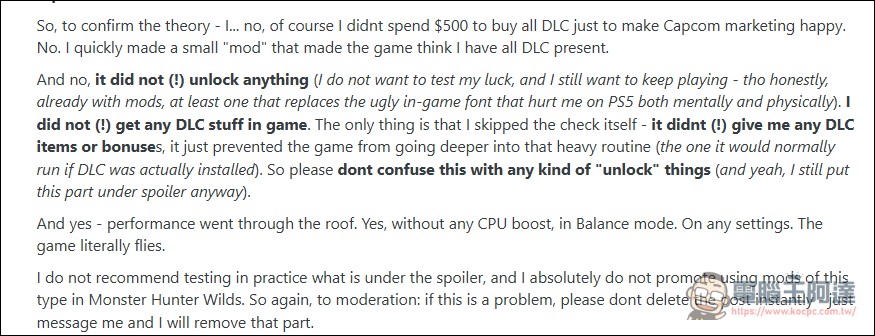
According to his reverse engineering analysis, Capcom implemented an extremely aggressive and poorly written “DLC ownership check function” in the game.
-
Operating Mechanism: The game will continuously check whether players own specific DLC content.
-
Where the Bug Is: When the system detects that a player “does not own” the DLC, the code appears to get stuck in a heavy, repetitive processing loop (heavy routine) or execute an extremely inefficient error-handling path, consuming a large number of CPU cycles.
-
Counterintuitive Results: When a player owns a large number of DLCs, or uses a mod to trick the system into thinking “I have them all,” the code will quickly skip this resource-intensive process once it passes verification, freeing up the CPU resources that were being used.
He also posted a video on Reddit showing a performance test for *Monster Hunter: World* to see how the number of DLCs affects performance, and it does indeed have a significant impact:
The player emphasized that this is not an issue with anti-tamper technologies (anti-cheat/DRM) such as Denuvo, but rather a programming error in the DLC presence check. After using a mod that simulated the presence of all DLCs, even in “Balanced Mode” without CPU acceleration enabled, the performance of the previously stuttering account instantly skyrocketed, matching—and even surpassing—that of an account with all DLCs. He tested scenarios simulating 0 to over 200 DLCs and found that the increase in FPS showed a striking positive correlation with the number of DLCs:
-
0 to 100 DLCs: The greatest improvement in efficiency, showing nearly linear growth.
-
More than 100: Performance continues to improve, but the rate of improvement is slowing; at this point, the bottleneck shifts back to the graphics card (GPU).
What’s even more interesting is that the performance of the emulated test was actually slightly higher than that of an account that had actually purchased all the DLC. The player speculated that this was because the game code likely still contained some hidden DLC that had been discontinued or was region-locked, and the emulator “satisfied” all these check conditions at once, completely eliminating unnecessary background calculations. It must be clarified that the player explicitly stated (and emphasized multiple times in the post) that he believes Capcom did not do this on purpose…it’s probably just a simple but devastating low-level programming error.
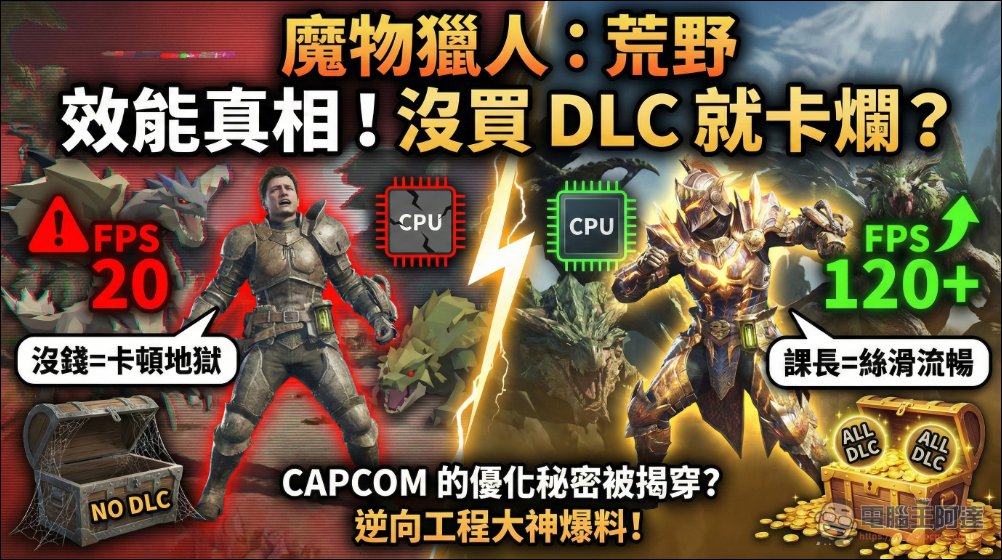
From a software engineering perspective, DLC verification should be a low-frequency, low-resource-consumption event (for example, checked only once when the game launches or when entering the store) . However, in *Monster Hunter: World*, this check was apparently mistakenly implemented within the high-frequency game loop. It’s as if your brain had to recite your ID number every time you blink—which would undoubtedly cause the system to crash.
Future Developments and the Gaming Community’s Reaction
Currently, the player has submitted all test data, observation reports, and technical details to Capcom’s customer support, specifically requesting that they be forwarded to the same technician who handled the issues with *Dragon’s Dogma 2* back then. In a public statement, the player issued an ultimatum: if Capcom ignores this issue or delays fixing it, he will release this performance-enhancing “mod” as open source. He specifically emphasized that the mod will absolutely not unlock any paid content (it will not allow players to obtain skins or items for free); it merely circumvents the anti-cheat mechanisms to restore the game’s intended smooth performance. He is well aware of the boundaries of copyright law and has no intention of encouraging piracy.
Meanwhile, a leading hardware review organization Digital Foundry They have also launched an investigation, which lends significant credibility to the matter. If DF is able to reproduce this issue in a video, Capcom will face immense public pressure. It’s likely that the company will release a patch to fix the problem shortly, after which players should be able to enjoy a smoother *Monster Hunter: World* experience (I hope).

Source: KOCPC Chinese