


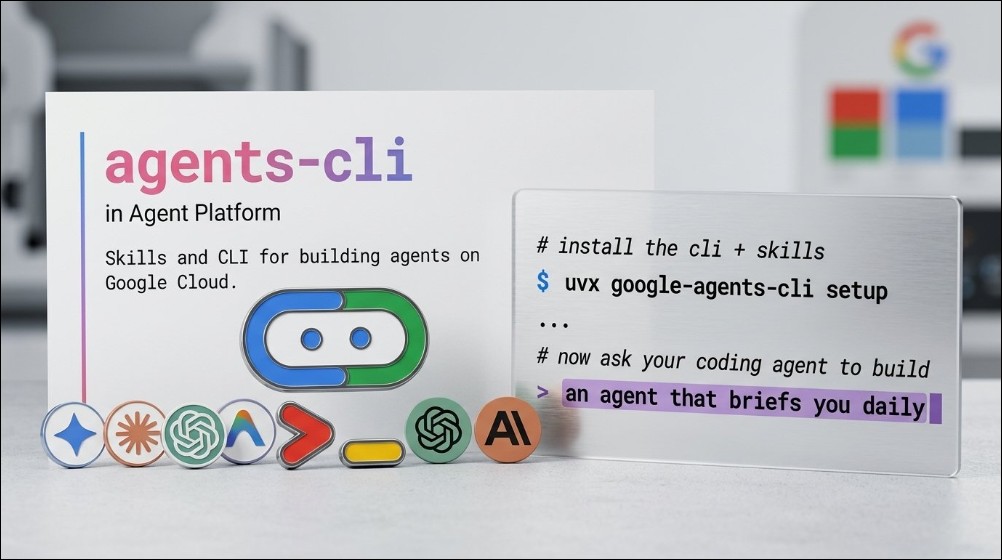
At Google Cloud Next ’26, Google announced a uniquely positioned open source tool:Agents CLI in Agent Platform(Project Name agents-cliIt is not another AI coding assistant, but rather a tool specifically designed for coding assistants (Claude Code, Gemini CLI, Codex, Cursor, etc.). The purpose is clear: to enable your AI assistant to build, evaluate, and deploy AI Agents on Google Cloud. In less than three weeks, it has accumulated over 2,300 stars and 262 forks on GitHub. Version 0.1.3 was just released on May 6th, under Apache-2.0 license.
Why do we need the Agents CLI tool?
The official post on Google’s Developer Blog opens candidly: AI agents are moving from experimental scripts to production services, but the infrastructure for building, evaluation, and deployment remains stubbornly fragmented. Developers and their coding assistants often struggle in siloed environments, wasting time and tokens reading through extensive documentation just to bridge the gap between local and cloud. This isn’t a small problem. When your Claude Code or Gemini CLI has to figure out how to combine various Google Cloud services, it often gets caught in endless loops and token waste.agents-cli The solution is straightforward: embed structured knowledge directly into the CLI, making interactions deterministic and efficient.
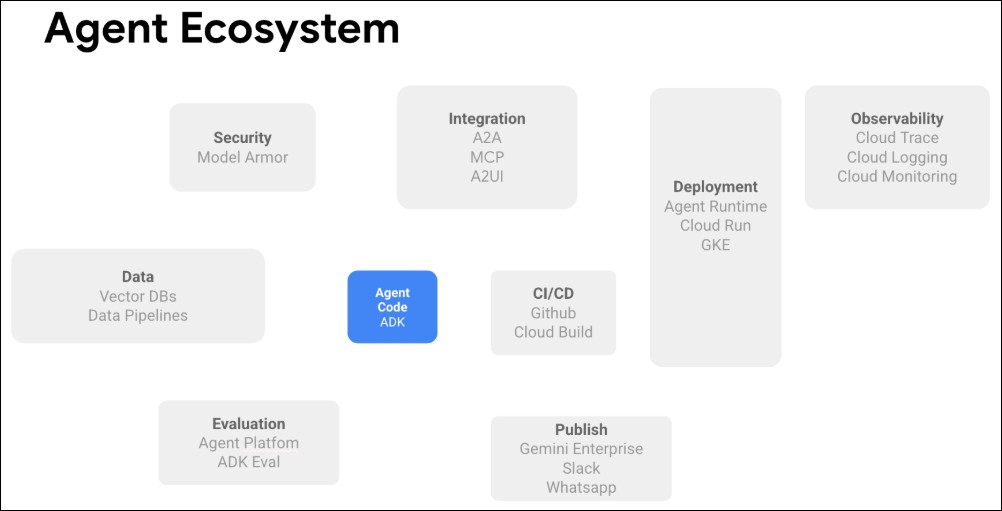
Positioning clarification: Not a coding assistant, but a tool for the coding assistant
This is the point most people misunderstand.agents-cli The official FAQ answers the first question directly:It’s not a replacement for Gemini CLI, Claude Code, or Codex, but rather a tool built for these coding assistants.。
It provides CLI commands and “Skills” that make your coding assistant better at building, evaluating, and deploying Agents on Google Cloud. You can also run it directly from the terminal without the coding assistant:agents-cli scaffold、eval、deploy Each command can operate independently.
Core Design: 7 Built-in Agent Skills
agents-cli The standout feature is the skill system. After installation, it injects seven predefined skills into your coding environment:
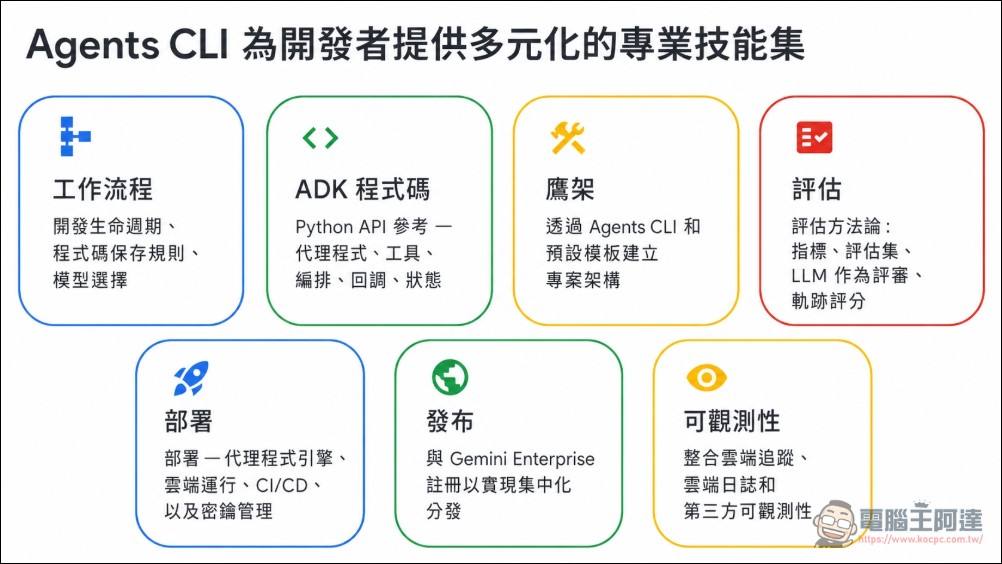
- workflow : Development Lifecycle, Code Retention Rules, Model Selection
- adk-code ADK Python API: Agent, Tools, Orchestration, Callbacks, State Management
- scaffold Project creation: create, enhance, upgrade
- eval Evaluation Methods: Metrics, Evaluation Set, LLM-as-Judge, Trajectory Scoring
- deploy Deployment: Agent Runtime, Cloud Run, GKE, CI/CD, Secrets Management
- publish Gemini Enterprise Registration Release
- observability Observability: Cloud Trace, Logs, Third-party Integration
These capabilities enable the coding assistant to directly access precise API references and sensory inputs, allowing it to build standards-compliant projects without searching through a massive pile of documentation.
Complete the entire lifecycle from scaffold to deploy with one click
The official tutorial demonstrates a complete example: a “Caveman Compressor” Agent that compresses verbose text into brief caveman-style summaries. The developer speaks a single sentence to the coding assistant, which then launches the workflow and scaffold skill, automatically querying the deployment target and security constraints, before executing the scaffold, installing dependencies, and producing a complete project structure with tests and evaluation sets.
Built-in evaluation system: No more guessing whether your Agent is accurate enough
agents-cli Provides native evaluation instructions (agents-cli eval run and agents-cli eval compare), you can organize unit tests, validate data retrieval, and compare results across different evaluation rounds. Previously, Agent behavior testing required developers to manually set up evaluation frameworks. Now, the CLI comes with built-in LLM-as-judge and trajectory scoring mechanisms.
Human Mode: Don’t let AI have full control
A noteworthy feature is “Human Mode,” which allows developers to directly execute CLI commands rather than relying entirely on Agent-driven automation. This provides transparency when inspecting and controlling workflows—an aspect that is often overlooked in fully autonomous systems.
Deploy to Google Cloud: End-to-End IaC + CI/CD
On the deployment side,agents-cli Can automatically generate Infrastructure as Code (IaC), set up CI/CD pipelines, deploy Agents to Cloud Run or Kubernetes, and publish to Gemini Enterprise for internal enterprise use.
Big Picture View: The Google Cloud Agent Strategy Puzzle
hold agents-cli In a broader context, it represents a crucial piece of Google Cloud’s Agent strategy. The AI coding assistant market in 2026 has become extremely crowded—Claude Code, Gemini CLI, OpenAI Codex, Cursor, Copilot, Aider—each competing on reasoning quality, context length, and pricing models. But agents-cli Chose a different angle:It’s not competing with these tools, but rather enabling them to maximize their value within the Google Cloud ecosystem.
In the April 2026 comparison test, Claude Code and Gemini CLI both scored 6.8/10 on the same tasks, but Gemini CLI offers a free 1 million token context window.agents-cli an open attitude—declaring support for Claude Code, Codex, Cursor, and any other coding assistants: enabling complementary relationships with other platforms rather than a closed ecosystem
Agents CLI in Agent Platform GitHub Repository
Current Status and Outlook
Currently agents-cli Still in Pre-GA stage (v0.1.3, released on 2026-05-06), with only 19 commits total, it’s a very early-stage project. However, Google iterated from v0.1.0 to v0.1.3 in just three weeks, fixing Windows Shell compatibility issues, adding infrastructure planning functionality, and improving the local development experience.
The project’s 2.3k stars and steadily growing community feedback show that developer demand for agent development standardization tools is real. If Google continues iterating and fills in third-party ecosystem integration,agents-cli Has the potential to become a key gateway into the Google Cloud Agent ecosystem.
Source: KOCPC Chinese