


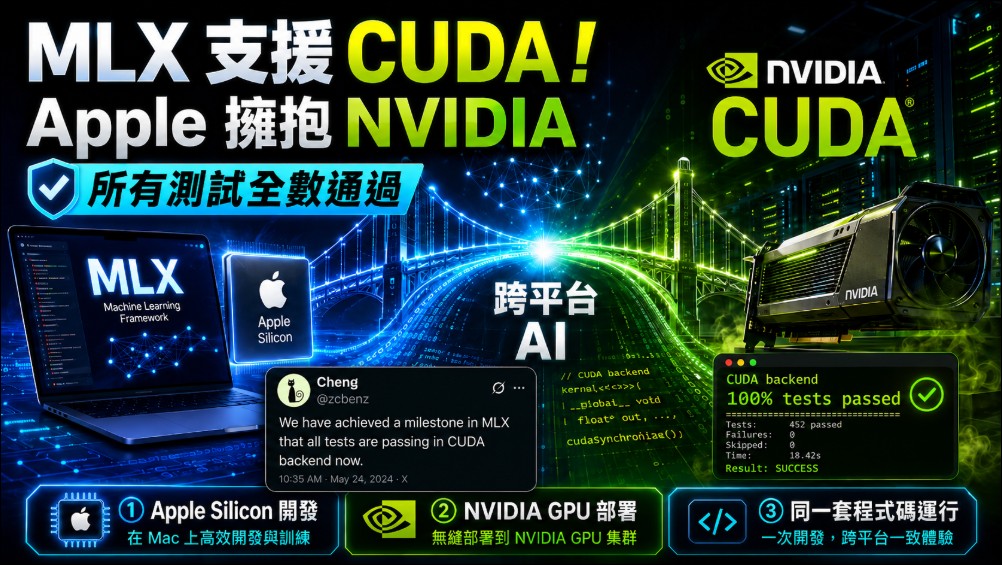
Cheng Zhao (@zcbenz), founder of Electron.js and current Apple MLX maintainer, posted on X yesterday:MLX’s CUDA backend has passed all tests.This brief post sparked quite a stir in the developer community. The main reason: MLX is Apple’s machine learning framework designed specifically for Apple Silicon, while CUDA is NVIDIA’s proprietary GPU computing platform. When Apple’s ML framework announced full support for NVIDIA’s ecosystem, the significance behind this goes far beyond a simple technical milestone.
MLX: From Apple Silicon Exclusive to Cross-Platform Framework
MLX was first open-sourced by Apple’s machine learning research team in late 2023, featuring a NumPy-like array computing interface that deeply integrates with Apple Silicon’s Unified Memory architecture, enabling developers to efficiently run LLM inference and even fine-tune models on Mac.
However, MLX has long been viewed as an “Apple Silicon-exclusive toy” because it runs well on Macs but becomes useless outside the Apple ecosystem. In contrast, while PyTorch is cross-platform, its performance tuning is complex, and NVIDIA’s CUDA, though powerful, is tied to its own GPUs. MLX’s CUDA backend, led by zcbenz since mid-2025, has undergone nearly a year of refinement and has finally achieved full parity.
zcbenz: The legendary developer from Electron to MLX
The name Cheng Zhao first comes to mind for senior developers as Electron.js: the framework that brought web technologies to desktop applications. After joining Apple to work full-time on maintaining MLX, he once again took on a pivotal role in bridging ecosystems.
We have achieved a milestone in MLX that all tests are passing in CUDA backend now. pic.twitter.com/MgeUWwYXBT
— Cheng (@zcbenz) May 13, 2026
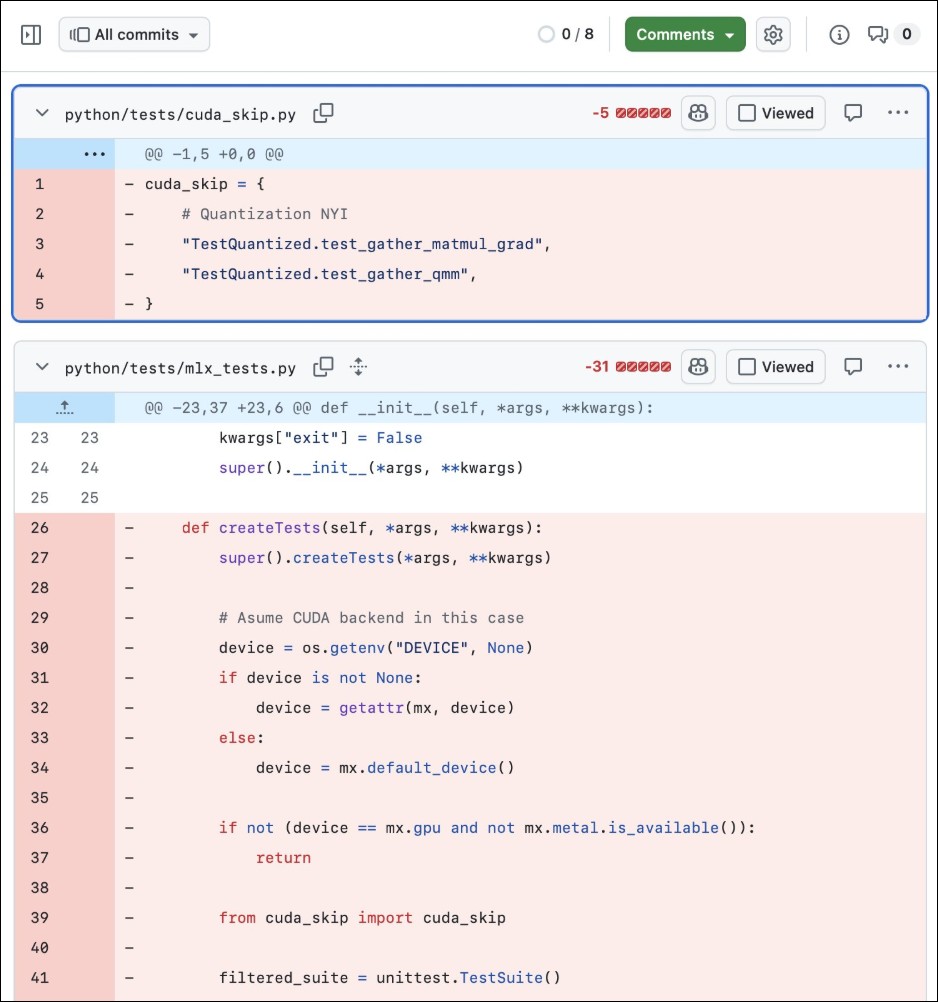
From what he posted GitHub The diff screenshot shows that the specific content of this milestone is deletion/removal of python/tests/cuda_skip.py This file — which originally listed TestQuantized.test_gather_matmul_grad and TestQuantized.test_gather_qmm Previously, CUDA tests had to be skipped due to “quantization not yet implemented” (Quantization NYI). Now that all these exceptions have been removed, the CUDA backend in MLX is fully functional.
Apple Embraces CUDA: Genuine Openness or a Calculated Move?
From a strategic perspective, this development is quite intriguing. For years, Apple has always charted its own course in GPU strategy—Metal API, proprietary GPU architecture, and keeping its distance from CUDA. Now that MLX supports CUDA, it signals Apple’s acknowledgment of NVIDIA’s GPU ecosystem’s significance in the AI space, opting for a “if you can’t beat them, join them” approach (something that has already been evident from Apple’s recent move to open up external NVIDIA graphics card drivers).
However, this is not a simple compromise. MLX’s design philosophy is “write once, run anywhere.” Developers can develop and test with MLX on a MacBook, and when deploying, they can run directly on cloud servers with NVIDIA GPUs without any porting work. This stands in sharp contrast to PyTorch’s “write once, debug everywhere.”
Just as the Apple ML research teamAs stated on the official blog“MLX’s design goal is to enable rapid iteration for researchers while maintaining optimal model performance on Apple Silicon.” The addition of the CUDA backend undoubtedly expands the boundaries of this vision.
Additionally, the MLX ecosystem is also rapidly expanding. In March 2026, Ollama announced that its Apple Silicon inference engine will switch to MLX, which represents an important ecosystem validation for MLX. From pip install "mlx[cuda]" enables a clean design with CUDA support while also lowering the barrier to adoption for developers
Has the Cross-Platform Local AI Era Arrived?
MLX CUDA backend passes all tests—what does this mean for local AI developers? The most direct impact is: if you have both a MacBook and a desktop or cloud instance with an NVIDIA GPU, you can now seamlessly switch between them using the same MLX code, without needing to maintain two separate PyTorch/CUDA environments.
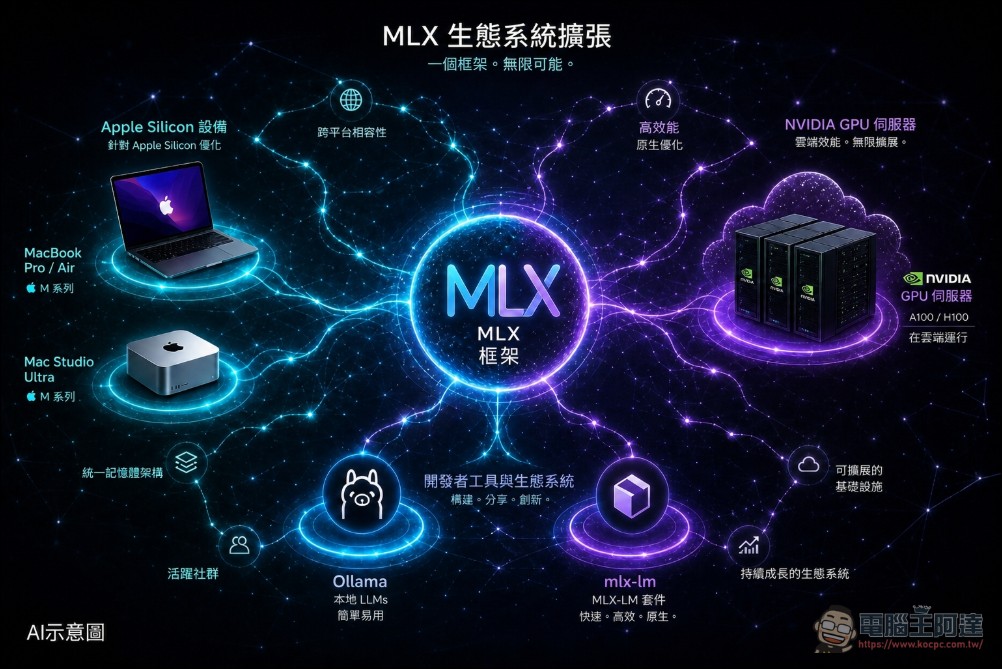
For Mac users, this is also good news: MLX performance continues to improve on Apple Silicon, and MLX packages written by the developer community—such as mlx-lm and mlx-snn—can now also run on NVIDIA GPUs, expanding the ecosystem’s appeal.
Of course, MLX still has a long way to go before it can truly challenge PyTorch’s dominant position—PyTorch’s ecosystem maturity, community size, and number of third-party packages are far beyond what MLX can match. But MLX is taking a different path: clean API design, deep hardware integration, and now cross-platform CUDA support. When it comes to developer experience, it truly delivers a level of smoothness that PyTorch simply can’t match.
Conclusion
“The CUDA era for MLX is officially underway.” This may be a slight overstatement, but this small step has definitely pushed MLX beyond its Apple Silicon comfort zone. As Apple’s ML framework begins embracing NVIDIA’s ecosystem, the landscape of local AI development is quietly being reshaped. What worth watching next is whether MLX can attract more developers and open-source projects to truly kick off that “cross-platform era.”
Source: KOCPC Chinese