


The open-source AI agent project OpenClaw (also known as “Little Openclaw”) has recently taken the tech world by storm, but Huggingface CEO Clément Delangue made a startling prediction on X the day before yesterday, suggesting that this craze “will fade in six weeks.” These remarks not only sparked heated discussion online but also prompted the public to ask: In today’s rapidly evolving AI landscape, just how long can the buzz surrounding an open-source project actually last?

The “Six-Week Paternity Leave” Debate: The AI Craze Comes and Goes Like a Fleeting Cloud
Clément Delangue made a rather poetic remark on X: “One underappreciated benefit of six weeks of paternity leave is that by the time you return, the AI craze will have almost run its full course, and trends like OpenClaw will have faded into obscurity.”
One underrated benefit of six weeks on paternity leave: by the time you’re back, almost an entire AI hype cycle has come and gone, and fads like OpenClaw are already dead
— clem 🤗 (@ClementDelangue) March 12, 2026
On the surface, these remarks appear to be a new father sharing his insights, but they actually serve as a metaphor for the “fast-food culture” currently prevalent in the AI field: new technologies and concepts emerge one after another, but most lack staying power and often go from viral sensation to obscurity in a very short time. As the leader of HuggingFace, Delangue has witnessed the rise and fall of countless open-source AI projects, and his assessment may be based on a deep understanding of industry cycles.
Looking back on the development of AI over the past two years—from the generative AI boom sparked by ChatGPT, to the image-generation frenzy surrounding Midjourney and Stable Diffusion’s image-generation storm, and the fleeting popularity of various AI agent frameworks—all of this has indeed confirmed the pattern that “what comes quickly, goes just as quickly.” Every new technology is hailed as a “revolutionary breakthrough” upon its emergence, only to be replaced by newer technologies within a matter of months. Will OpenClaw follow in their footsteps and become yet another footnote on this “path of fleeting success”?
Netizens in an Uproar: Chinese Market Gives CEO a Slap in the Face
However, Delangue’s prediction did not receive unanimous approval. The comments section quickly became polarized,OppositionCountering this directly with the current boom in the Chinese market: “How can OpenClaw be dead? Haven’t you seen how popular it is in China?” This question hits the nail on the head: OpenClaw’s penetration rate in the Chinese developer community is indeed far higher than in Europe and the U.S. Whether among individual developers or enterprise users, “raising shrimp” has become a standard topic of conversation in the tech community recently. From GitHub star counts to the intensity of discussions on major tech forums, OpenClaw’s performance in China far outshines that in other regions.
SkepticsFrom a business perspective: “Are you kidding me? I don’t understand why the CEOs of those big companies oppose OpenClaw. It boosts AI adoption and increases revenue for most companies, yet it still faces fierce criticism.” This perspective suggests that, as an open-source project, OpenClaw is, to some extent, in a competitive-cooperative relationship with Huggingface. Given that Huggingface is the world’s largest open-source AI model hosting platform, one can’t help but wonder whether its CEO’s “dismissive” remarks about this emerging competitor are motivated by self-interest.
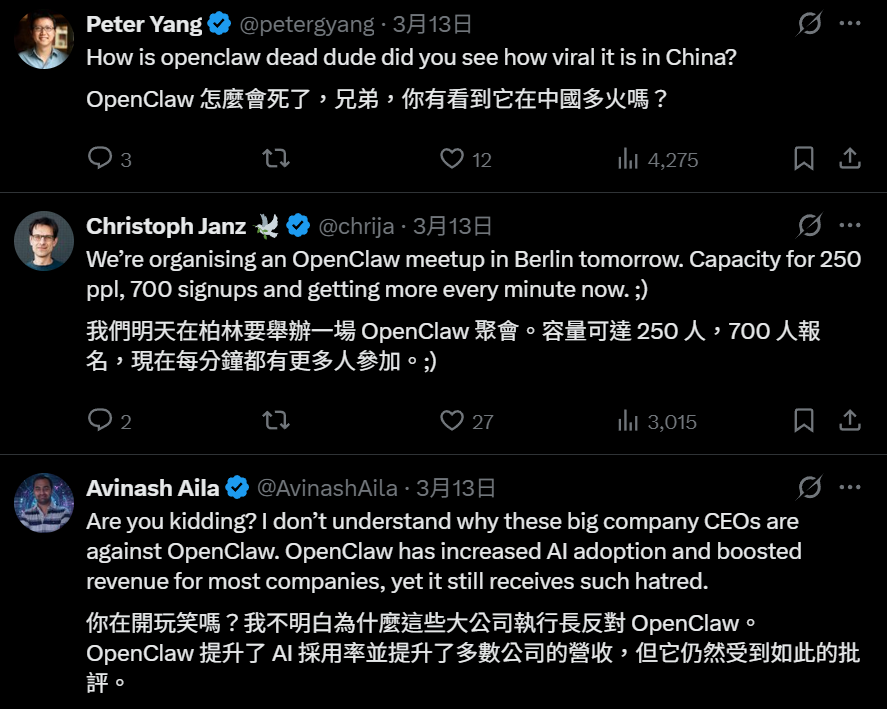
Some analysts have pointed out that Delangue’s remarks may reflect a collective anxiety among European and American tech giants regarding “decentralized AI.” The lightweight, self-hosted, low-barrier AI solutions represented by OpenClaw have, to some extent, undermined the business models of traditional cloud service giants. When developers can build their own AI agents at extremely low cost, who would still be willing to pay high API fees to OpenAI, Anthropic, or Hugging Face?
OpenClaw Update: From Viral Sensation to Security Alert
The reason OpenClaw has quickly gained popularity is that its product positioning precisely addresses the market’s pain points:Lightweight and flexible, self-hosted, and multi-cloud compatible. Compared to enterprise-level AI solutions that often require massive computing power and complex configurations, OpenClaw enables individual developers and small and medium-sized businesses to deploy their own AI agents at an extremely low cost. From simple chatbots to complex workflow automation, OpenClaw can handle it all—and the term “raising shrimp” has even become a popular meme in the tech community.
However, this popularity is accompanied by underlying concerns. These security risks include: a lack of authentication mechanisms in the default configuration, which can lead to unauthorized access; a lack of vetting in the third-party plugin ecosystem, which may harbor malicious code; and improper handling of sensitive data, which could result in data breaches. Officials recommend that users update to the latest version promptly, optimize default configurations, and exercise caution when installing third-party plugins to prevent serious security issues such as the leakage of sensitive data.

The timing of the security alert was rather delicate, coming just as OpenClaw was reaching the peak of its popularity. This inevitably raises the question: Is this reasonable regulation of new technology, or a disguised attempt to “pour cold water” on the trend? In any case, for the rapidly expanding OpenClaw ecosystem, security issues are indeed a hurdle that must be overcome.
The “Rapid Cooling-Off” Law of the AI Craze: Can OpenClaw Break It?
Looking back at the history of AI development, “rapid decline in hype” seems to be an inescapable law. ChatGPT caused a global sensation at the end of 2022, but just one year later, people’s attention has already shifted to new concepts such as multimodal AI, AI agents, and embodied intelligence. Each wave of hype arrives with great fanfare, only to be swiftly replaced by the next. In this environment, can OpenClaw escape the curse of the “six-week rule”?
The answer may depend on several key factors: First,Ability to Iterate on Technology. Will OpenClaw continue to introduce new features and optimize performance to remain appealing to users? Next isEcological Development. Can we establish a thriving plugin marketplace and a vibrant developer community to create a virtuous cycle? Finally,Commercialization Pathways. As an open-source project, how can we find a sustainable revenue model while remaining open?
From these perspectives, OpenClaw currently shows promising potential. Its active GitHub repository, rapid version updates, and ever-expanding plugin ecosystem all indicate that this is more than just a passing trend. However, only time will tell whether it can truly become a long-term success.
Viewpoint
Delangue’s “Six-Week Theory” reflects, to some extent, the collective anxiety currently plaguing the AI industry: technological advancements are happening too quickly, trends are fleeting, and no one can be certain whether today’s star projects will be forgotten tomorrow. But this prophecy of “transience” may itself be a form ofSelf-fulfilling Prophecy——When enough people believe a trend will fade, that expectation alone accelerates its decline.
From another perspective, the continued popularity of OpenClaw in the Chinese market may reveal thatRegional DifferencesImpact on the technology lifecycle. While developers in Europe and the U.S. may have already moved on to the next new toy, China’s developer ecosystem seems more inclined to thoroughly explore a tool’s极限应用场景. This difference in itself may be more worth observing than the question of “whether it will fade away in six weeks.”
As for the security warning, it serves as a wake-up call for all “shrimp farmers”: the convenience of open-source should not be used as an excuse to sacrifice security. While pursuing efficiency, maintaining a minimum level of security will be the key test determining whether OpenClaw can evolve from a “flash in the pan” into “infrastructure.” After all, no matter how popular a technology may be, if it fails to address security issues, it will ultimately be unsustainable.
Source: KOCPC Chinese