


Lei Jun, Founder, Chairman and CEO of Xiaomi, recently announced on Weibo that Xiaomi’s robotics team won back-to-back championships at the CVPR 2026 Workshop Competition and the ICRA 2026 WBC Challenge, with core metrics significantly ahead of the second-place finisher in both events. This marks Xiaomi’s first dual championship at hardware-focused competitions at the international conference level in the robotics field, providing concrete validation for its “robots entering the physical world” technical approach.
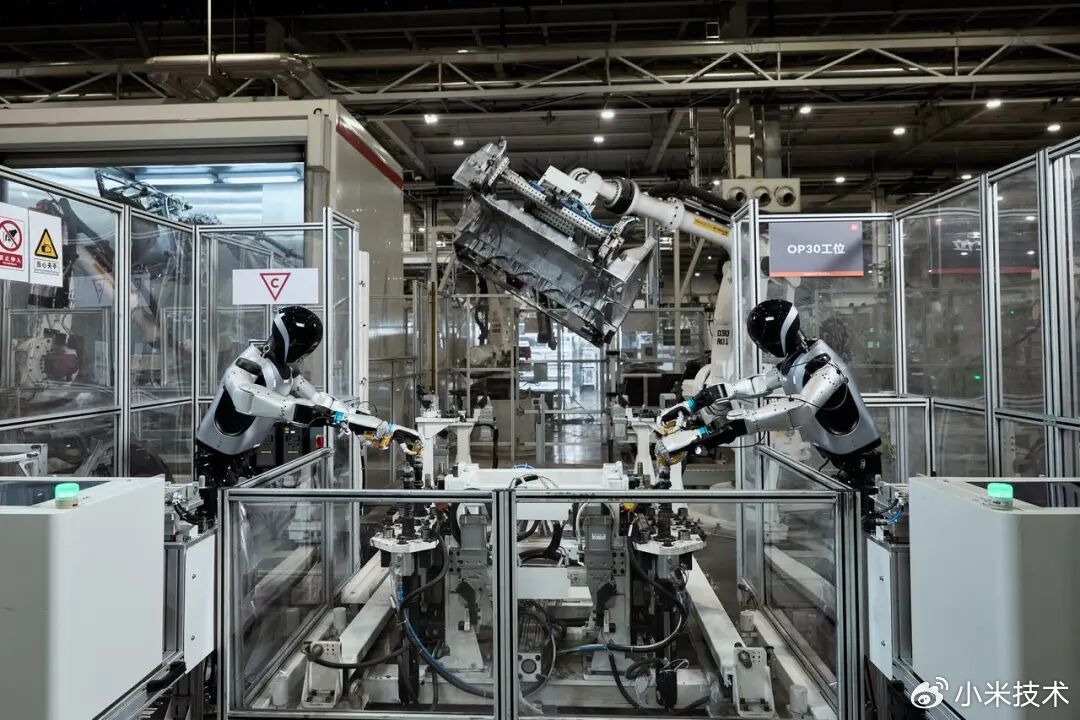
CVPR 2026 RoboChallenge: Anonymous Participation, The Only One to Break 40% Success Rate
The GigaBrain Challenge-RoboChallenge Track under CVPR 2026 Workshops is a robotics competition centered on real-machine operation. The event features 30 ultra-high-difficulty tasks covering dual-arm dexterous manipulation, flexible object grasping, tool causal reasoning, and cross-platform adaptation. Each team must submit a unified multi-task model and complete 10 consecutive uninterrupted stability tests on physical hardware, with a focus on evaluating the model’s generalization capability.
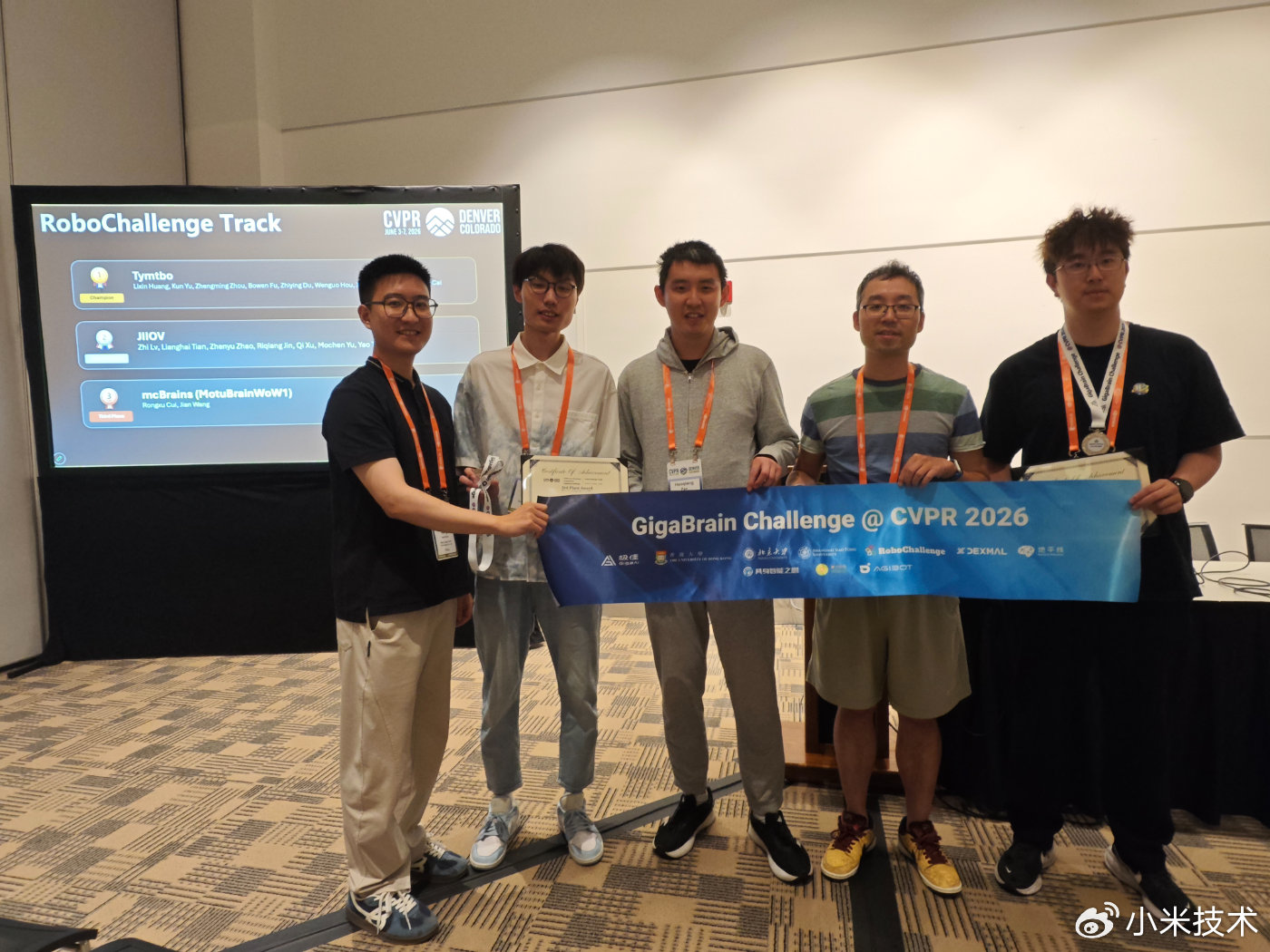
Xiaomi participated under the anonymous codename “my16”, ultimately 40.89% Its task success rate topped the overall leaderboard, making it the only model in this competition to exceed the 40% success rate threshold.
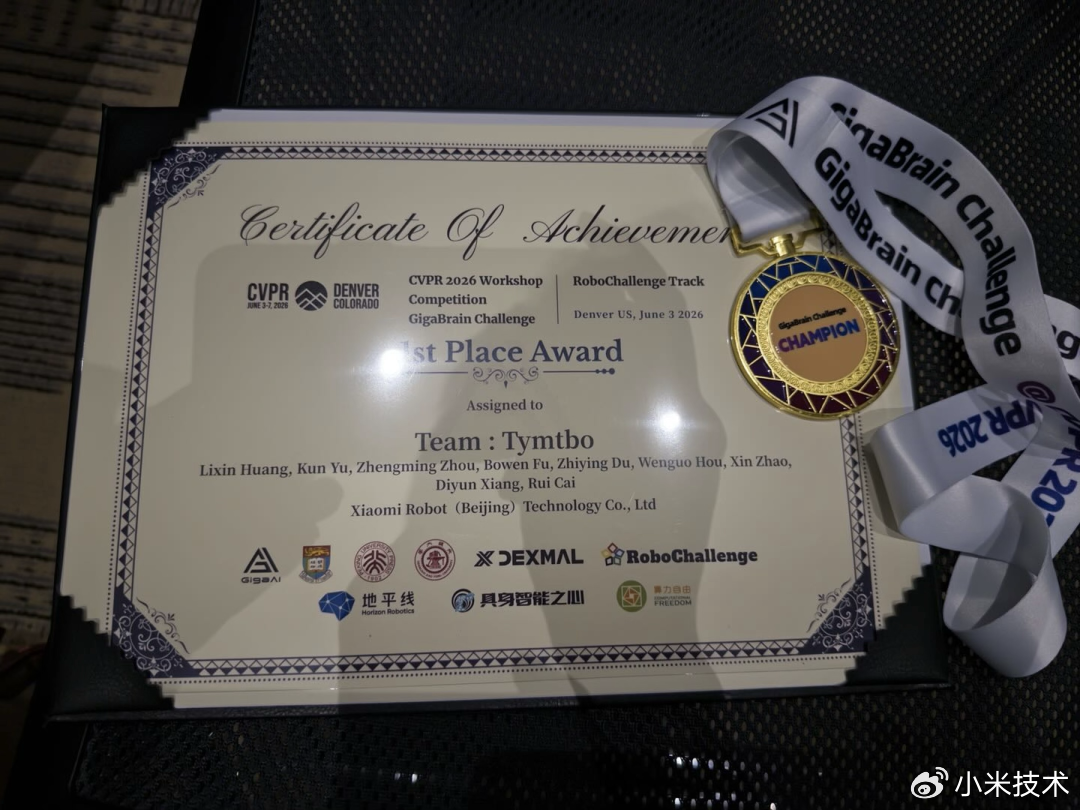
According to Xiaomi Technology’s official blog, “my16” is a self-developed WAM (World Action Model) featuring a “big brain + small brain + long-short term memory” architecture. Specifically, through the unified architecture of “S1/S2 dual system + long-short term memory + cross-embodiment pre-training,” the model integrates three core capabilities into a single model: model-level cognitive depth, controller-level execution precision, and long-term stability brought by the memory system.
ICRA 2026 WBC: Near-Perfect 99.2 Score in Real-World Mall and Supermarket Testing
Another competition, ICRA 2026 WBC (World Botathon Challenge), focuses on real-world retail supermarket scenarios. The challenge requires robots to autonomously pick specified beverages from shelves across 16 major categories and 20 subcategories, based on instructions, and place them into shopping carts. The entire operation covers environmental perception, autonomous navigation, whole-body posture adjustment, and single/double-arm fine manipulation, comprehensively assessing end-to-end technical capabilities from sensing to execution.
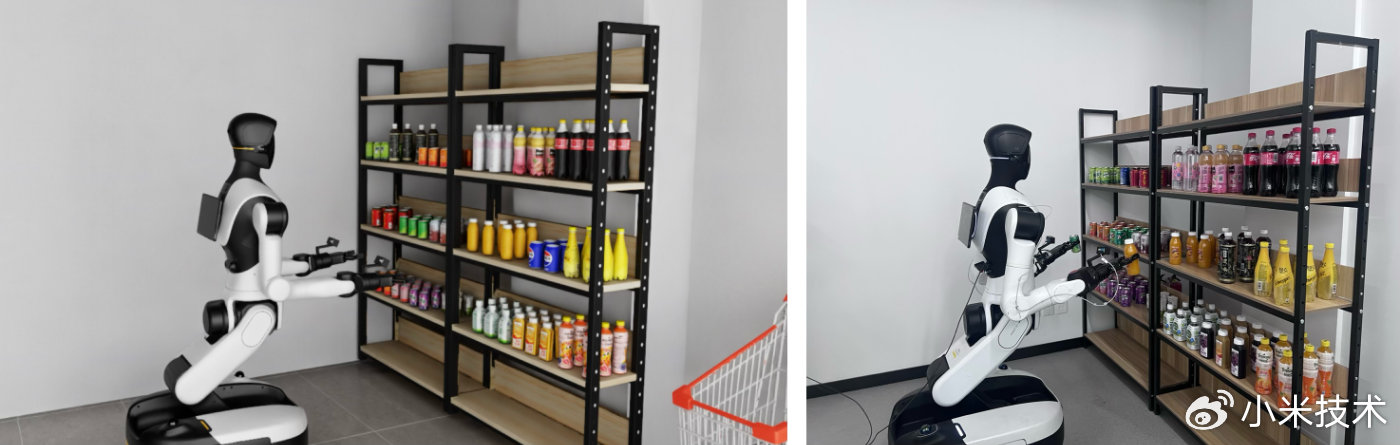
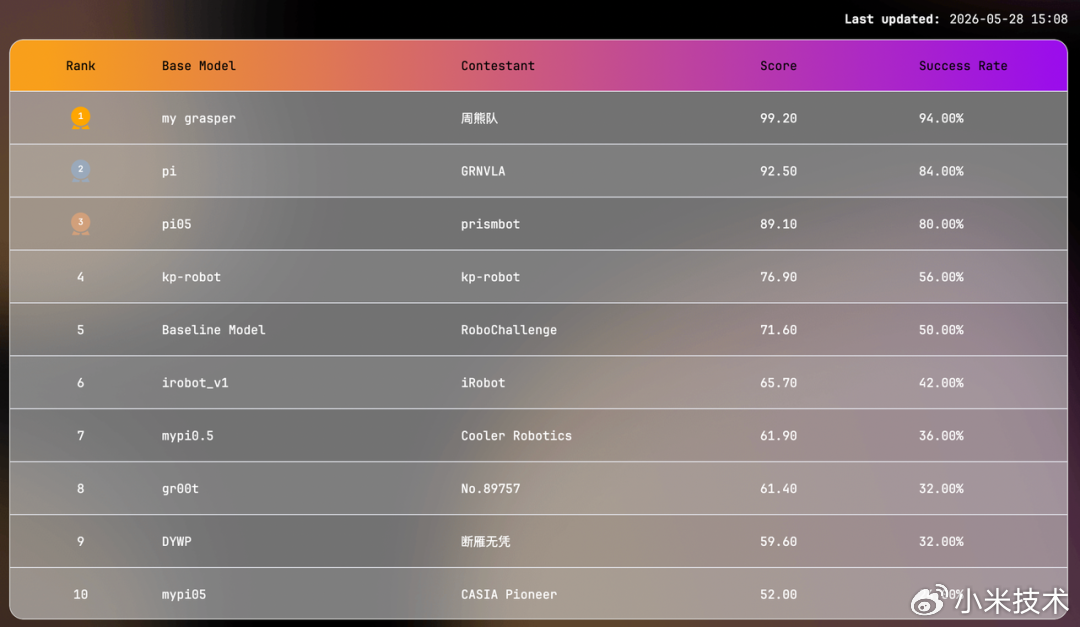
The Xiaomi team achieved in this competition 99.2 pointswith an overall score close to perfect. The full machine operation success rate reached 94%It is the only team among all competing solutions to achieve a success rate exceeding 90%, leading the second-place team by a full 10 percentage points. Breaking it down by category, the simple task success rate reached 100%, while the high-difficulty complex task success rate remained steady at 90%.
The value of the two events
CVPR (the IEEE Computer Vision and Pattern Recognition conference) and ICRA (the IEEE Robotics and Automation Society’s flagship conference) are the most influential international academic conferences in computer vision and robotics respectively. Winning championships in the affiliated competitions at both conferences demonstrates that Xiaomi Robotics has reached internationally leading levels across multiple technical dimensions, including perception, decision-making, and manipulation.
Lei Jun wrote in his post: “The direction of Xiaomi Robotics’ efforts is to have robots truly enter the physical world and do real work.” This sentence also highlights Xiaomi’s core strategy in the robotics track: not treating papers or simulation results as the end goal, but using real-machine practical capabilities as the ultimate standard for technology validation.

Xiaomi’s Robot Technology Roadmap: From Robotic Vacuums to General-Purpose Robots
Xiaomi’s布局in the robotics field dates back a long time. From the early Mi Home robot vacuum and mop product line, to the full-size humanoid bionic robot CyberOne first showcased externally in 2022, and now to the achievements in this year’s CVPR and ICRA competitions, it is clear that its technical approach is gradually shifting from scenario-specific product robots toward general-purpose robotics.
The “cerebrum-cerebellum + long short-term memory” architecture adopted by the WAM model in this competition essentially combines the reasoning capabilities of large language models with the execution precision of robotic control systems, while using a memory module to address state tracking issues in long-duration sequential tasks. This technical approach aligns with the current industry mainstream direction of Embodied AI, and Xiaomi’s test results demonstrate that considerable progress has been made at the engineering implementation level.
Summary
Xiaomi’s robotics team secured dual championships at CVPR 2026 and ICRA 2026, two of the world’s top-tier competitions, with core metrics significantly outperforming all competitors. From a technical architecture perspective, Xiaomi’s self-developed WAM model achieves a balance between cognitive reasoning and physical manipulation through its “dual-system + long short-term memory + cross-embodiment pre-training” design. From an application standpoint, the over 90% success rate in supermarket beverage grasping demonstrates that the technology has a solid foundation for transitioning from lab to real-world deployment. As the humanoid robotics and embodied AI race intensifies, these two championship titles serve as strong evidence of Xiaomi’s robotics R&D capabilities. I’m curious to see when Xiaomi robots will become available for purchase online.
Source: KOCPC Chinese