


SpaceX dropped another major bullish catalyst just one week before its IPO. According to regulatory filings submitted on June 5, Google agreed to pay SpaceX $920 million per month from October 2026 through June 2029 to rent approximately 110,000 NVIDIA GPUs and related CPU and memory computing resources in its data centers. This 32-month contract totals $29.44 billion, making it SpaceX’s second massive infrastructure deal following the computing power rental agreement signed with Anthropic in May.

Contract details: Conditional 920 million monthly fee
This contract isn’t a “sign it and you’re guaranteed to get paid” deal. Documents show that SpaceX must by September 30, 2026Deliver the committed GPU capacity. If delivery is not on schedule, Google has a one-month grace period, after which it may choose to terminate the contract immediately or accept the lesser capacity delivered and receive a proportional reduction in the monthly fee. Prior to the official billing period (October 2026), the contract includes a “capacity ramp-up period” operating at a lower rate, essentially testing whether SpaceX can deliver hardware on schedule. After December 31, 2026, either party may terminate the contract with 90 days’ advance notice.
Additionally, Google retains ownership of its AI models, content, and related data. What SpaceX provides is infrastructure access rights, not co-ownership of cloud products or AI models.
Why does Google need external computing power?
A Google Cloud spokesperson said the deal is to “ensure we have bridging capacity to meet the surge in demand from Gemini Enterprise customers, which is higher than we expected.” Gemini Enterprise is an enterprise-level Agent platform launched by Google in October 2025, targeting large enterprise subscriptions.
At first glance, this seems contradictory—Google is estimated by multiple sources to be the world’s largest single holder of AI computing power, so why does it still need to rent out capacity? The main reason is that AI demand is growing too fast and too aggressively, and data center construction simply can’t keep pace. This is more about “buying time” rather than “being unable to buy hardware.” Alphabet has already raised its capital expenditure this year from $175–185 billion to $180–190 billion, and has warned that 2027 will see a “significant increase.” While its own infrastructure continues to expand, customer demand simply can’t wait.

The surge in demand for Gemini Enterprise was not without precedent. Since late 2025, Google has been deeply integrating Gemini into Workspace, Cloud Platform, and the Android ecosystem, with enterprise customer demand for Agent capabilities far exceeding internal expectations. According to Google Cloud’s financial reports, cloud revenue in Q1 2026 grew 35% year-over-year, with AI-related services accounting for an increasing share. The expansion speed of its own data centers couldn’t keep up with customer demand, becoming the direct trigger for this deal.
SpaceX’s AI Compute Rental Business
For SpaceX, this revenue came as an unexpected windfall. xAI’s Colossus 1 data center in Memphis, Tennessee, was built at breakneck speed, but the reality is that its own Grok AI had embarrassingly low usage, utilizing only 11% of the facility’s compute capacity. Originally a hot potato for SpaceX, it has now transformed into a money-making rental asset thanks to other AI companies’ massive compute demands. In May, Anthropic made the first move, leasing the entire compute capacity of Colossus 1 at a price of $1.25 billion per month (approximately NT$406 billion), with the contract running through 2029. Google’s acquisition of 110,000 GPUs this time around is roughly half of what Anthropic leased at Colossus 1.
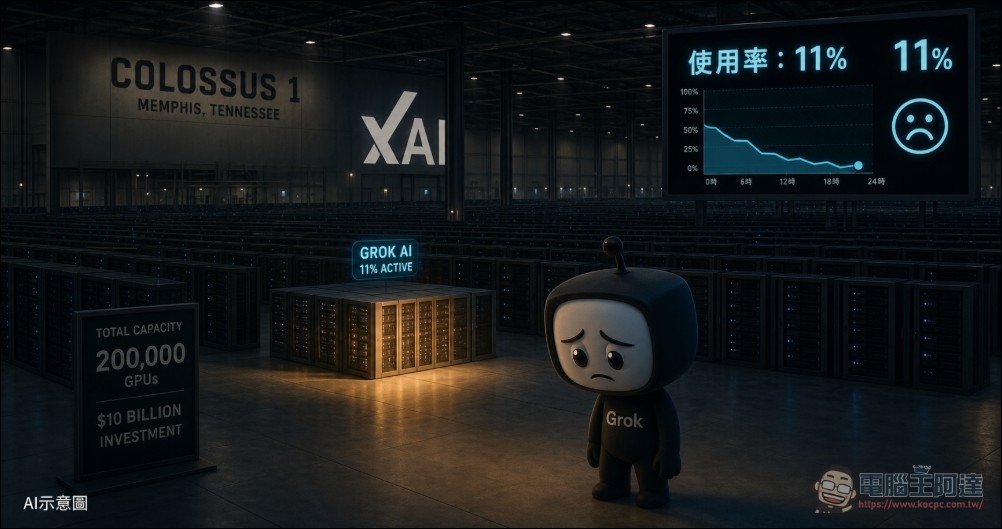
SpaceX has not disclosed which data center Google will use, but it is most likely the Colossus 2 compute capacity originally reserved for xAI’s own use. From SpaceX’s perspective, this is a shrewd asset monetization. xAI’s Grok model has not yet posed a real threat to OpenAI, Anthropic, or Google in the market, with AI business revenue of only $818 million in Q1 this year but losses of $2.5 billion. Rather than letting the data center sit idle, why not lease it to a competitor? After all, compute is compute—it doesn’t take sides. Stable cash flow is what matters most.
The Computing Power Story Before the IPO
The timing of this contract announcement is intriguing. SpaceX is expected to list on Nasdaq next week (June 12) under the ticker SPCX, aiming to raise approximately $75 billion at a valuation of $1.75 to $2 trillion, which would make it the largest IPO in history. SpaceX candidly stated in its prospectus that capital expenditures reached $10.1 billion in Q1 this year, more than doubling from the same period last year, with $7.7 billion going toward data center construction. By announcing consecutive computing power contracts with Anthropic and Google before the IPO, the company is essentially showing investors that these massive infrastructure investments have shifted from being a liability to already generating returns.
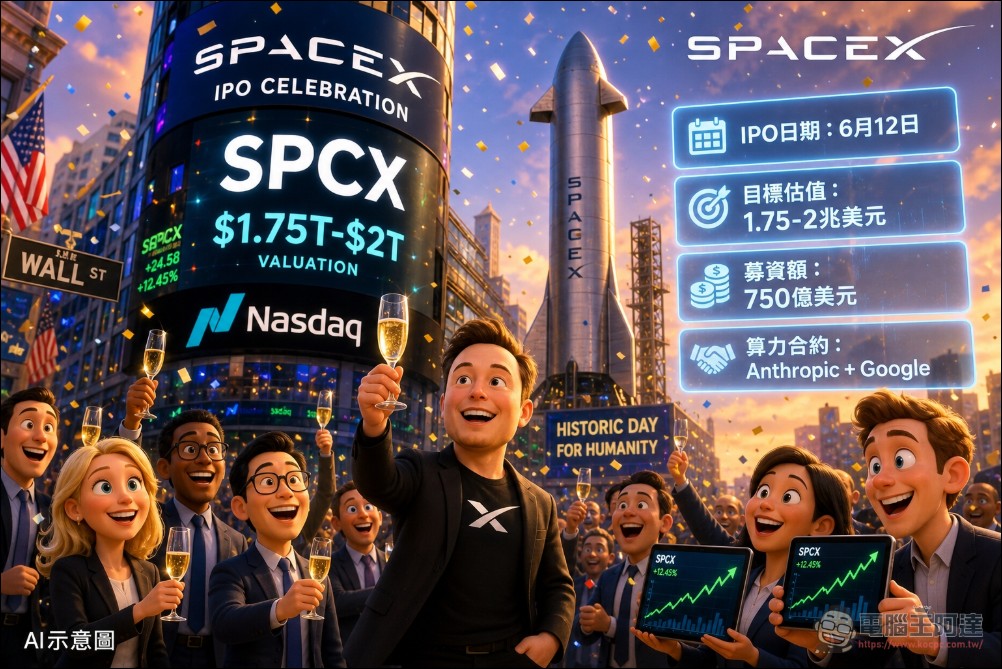
Google is also a long-term investor in SpaceX. When Alphabet invested in SpaceX in 2015, the latter was valued at just $12 billion. Today, SpaceX is targeting a valuation of $1.75 trillion, with Alphabet’s stake expected to be worth over $100 billion after the IPO. The relationship between the two has flipped from “Google investing in SpaceX” to “Google paying to rent SpaceX’s computing power,” and the speed of this role reversal reflects the intensity of the AI race.
From a macro perspective, this compute deal reflects a core contradiction in the AI industry: model iteration cycles far outpace infrastructure construction timelines. A large data center takes 18 to 24 months from planning to operation, while AI model capability boundaries get redefined every six months. Google’s choice to pay for租用 SpaceX’s existing compute is essentially trading capital efficiency for time advantage—in the AI race, deploying three months late could mean never catching up.
A role reversal from five years ago
Interestingly, Google and SpaceX signed a deal five years ago with completely reversed roles: in 2021, Google agreed to provide computing and network resources to SpaceX to help operate the Starlink satellite network, with SpaceX installing ground stations at Google data centers. At the time, Google Cloud CEO Thomas Kurian said, “They chose us because of the quality and coverage of our network.” Now Google is in turn renting computing power from SpaceX—in five years, the AI race has completely reshaped the industry’s power structure.
Source: KOCPC Chinese