


Last month, the U.S. Patent and Trademark Office officially granted a patent with the number US 12,542,605 B1. This patent, filed by SpaceX The patent granted is titled “Systems and methods for mapping geographic sub-areas to satellite-based base station platforms in a cellular network“, which at first glance appears to be a dry technical document, is in fact a solution for providing direct mobile phone service via low Earth orbit (LEO) satellites (Direct-to-Cell) The answer to the most critical technical bottleneck.The concept of low-Earth orbit satellites connecting directly to cell phones has rapidly moved toward commercialization in recent years, with SpaceX’s StarlinkCompanies such as AST SpaceMobile, Amazon Kuiper, and Lynk Global have successively entered the market. However, behind this satellite internet race lies a long-underestimated challenge: when satellites move at speeds far exceeding those of traditional base stations, the “location update” mechanism between ground-based mobile phones and the network becomes completely ineffective, leading to a massive failure of network control signals. SpaceX’s latest patent is designed to address this problem at its root.
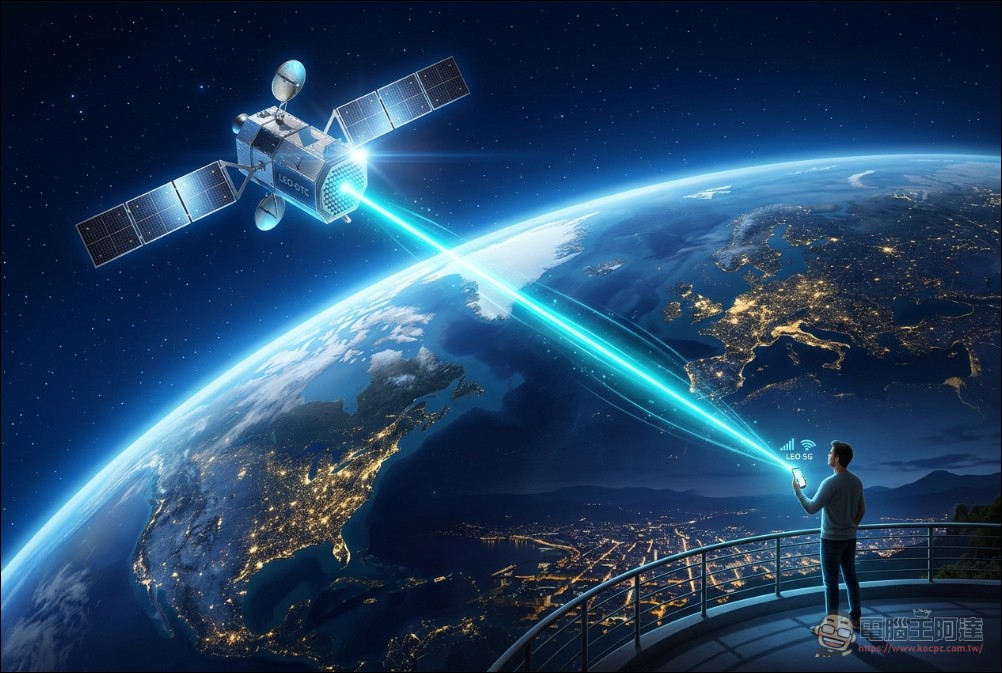
Starlink Satellite Internet Is About to Go Mainstream! SpaceX’s New Patent Solves the “Signal Overload” Obstacle for Direct-to-Cell Mobile Connections
To understand the value of this patent, one must first understand how existing 4G LTE networks operate. In traditional cellular networks, each base station broadcasts a fixed set of Tracking Area Codes (TACs). When a mobile phone detects that it has entered a new TAC area, it must initiate a “Tracking Area Update” (TAU) procedure to notify the network of its new location. The logic behind this mechanism is clear: by ensuring the network knows your location at all times, it can properly route voice calls and data traffic.
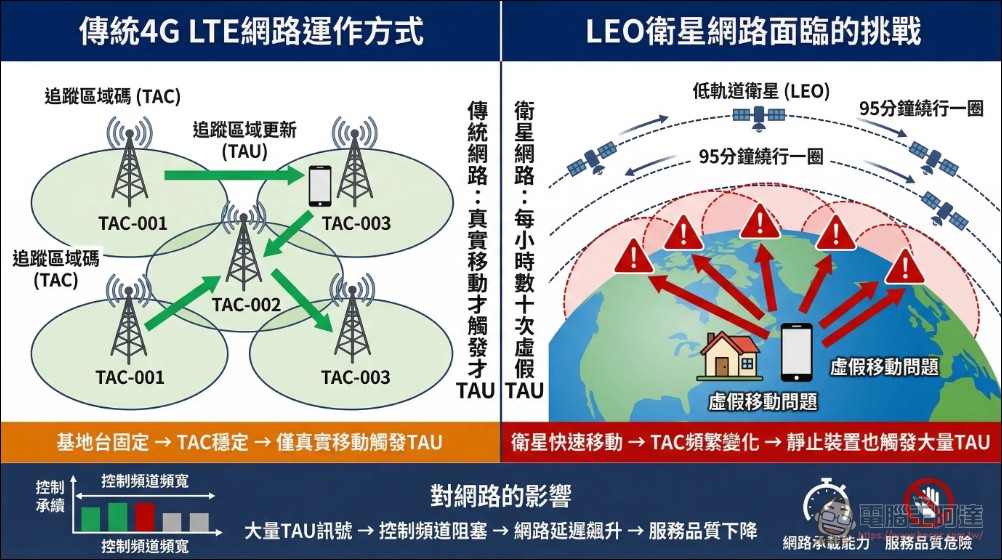
The problem is that LEO satellites are fundamentally different from geostationary base stations. A LEO satellite takes only about 95 minutes to orbit the Earth once, which means it provides coverage to any single location on the ground for just a few minutes. If the system operated according to traditional TAC logic, even if you were sitting at home without moving at all, your phone would be forced to repeatedly perform a TAU as the satellite directly overhead exits its coverage area and the next satellite takes over. According to estimates, the number of location updates triggered by this “false movement” could reach dozens per hour—far exceeding the network’s capacity.
For network operators, a massive influx of TAU signals consumes valuable control channel bandwidth, which can result in anything from a spike in latency to the near-total paralysis of network services across an entire region. This is why, to date, most LEO satellites’ Direct-to-Cell services have been limited to providing only the most basic functions—such as text messaging—and have struggled to support real-time voice or high-speed data transmission.
Virtual Identification Code Abstraction Layer: Makes the Phone “Think” the Satellite Is Stationary
The core innovation of the SpaceX patent lies in the introduction of a “Virtual Identifier Abstraction Layer.” The operating principle of this mechanism can be understood in terms of four layers:
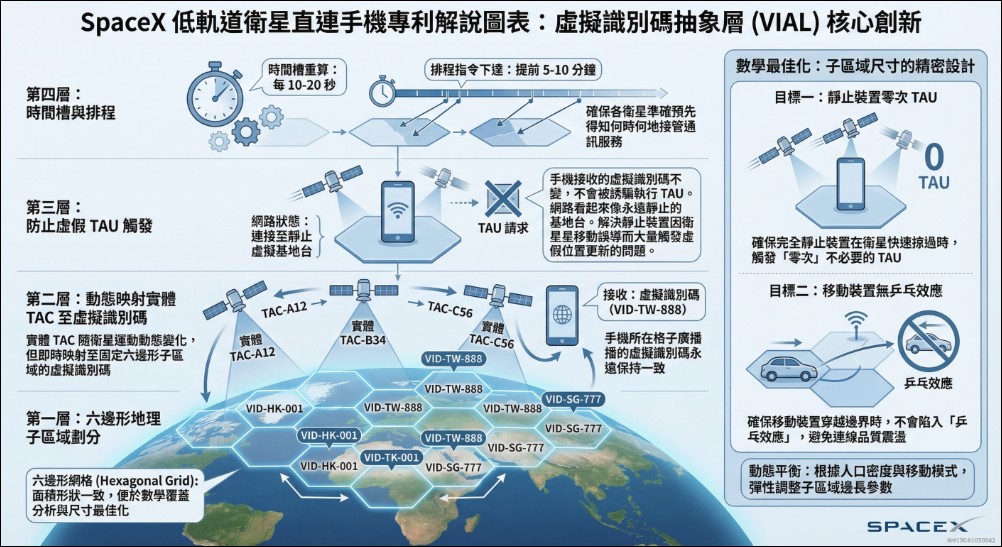
First Layer: The Earth’s surface is artificially divided into countless hexagonal geographic subregions with fixed boundaries, and each hexagonal region is permanently assigned a unique set of virtual identifiers from the very beginning. The advantage of this hexagonal grid is that all subregions have exactly the same area and shape, which facilitates mathematically uniform coverage analysis and size optimization.
Second Layer: The physical TACs of satellite beams change dynamically as the satellite moves along its orbit, but these physical TACs are mapped in real time to the virtual identifiers corresponding to each hexagonal sub-area. In other words, regardless of which satellite or beam is passing directly overhead, the virtual identification code broadcast by the hexagonal cell containing the mobile phone always remains consistent.
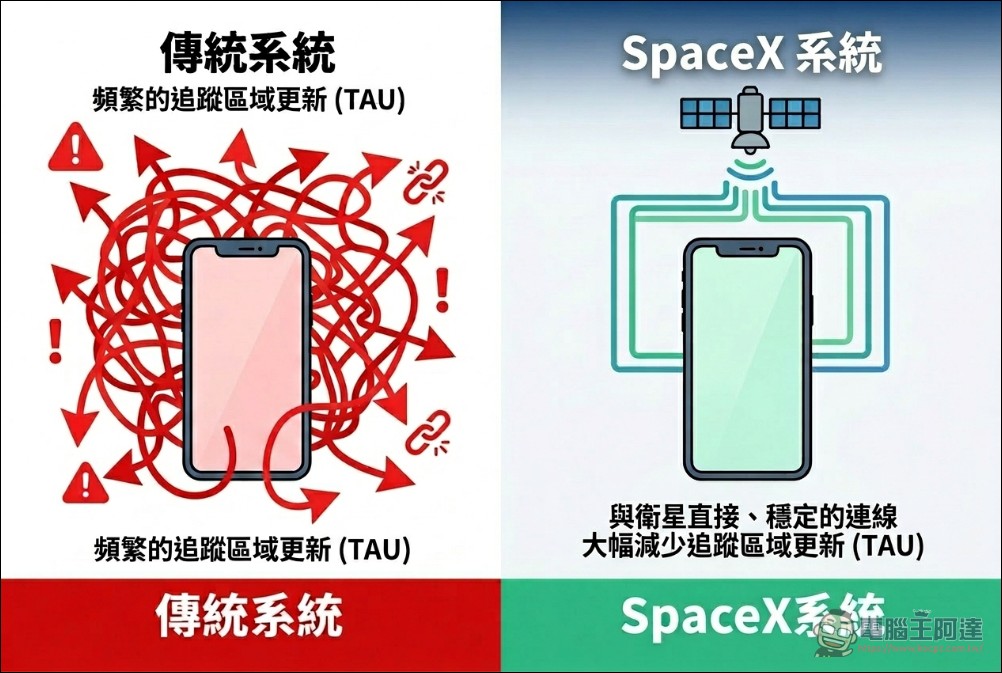
Third Layer: Since the virtual identification code received by the mobile phone does not change when switching satellites, the phone cannot be tricked into performing a TAU. To the mobile phone, the network overhead “appears” to be a base station that remains permanently stationary. This resolves the issue of stationary devices being misled by satellite movement, which would otherwise trigger a large number of false location updates.
Level 4: Time slots are recalculated every 10 to 20 seconds, and scheduling instructions for the satellites are issued 5 to 10 minutes in advance to ensure that each satellite knows exactly when and where it needs to take over communication services for a given hexagonal area.
Mathematical Optimization: Precision Design of Subregion Sizes
The technical depth of this patent extends beyond conceptual design to include a mathematical optimization model for the dimensions of the hexagonal subregions. This model has two optimization objectives: first, to ensure that a completely stationary device triggers “zero” unnecessary TAUs when a satellite rapidly passes overhead; and second, to ensure that devices that are actually in motion (such as moving cars) do not experience the “ping-pong effect”—caused by improperly designed boundaries—when crossing hexagonal boundaries: that is, repeatedly switching back and forth between two adjacent regions, resulting in severe fluctuations in connection quality.
While these two objectives may seem intuitive, they actually represent two fundamentally different approaches to dimension design: subregions that are too small will cause mobile devices to frequently cross boundaries, while subregions that are too large may result in delays in detecting actual roaming behavior. In its patent specification, SpaceX describes in detail how it uses mathematical models to dynamically balance these two objectives, flexibly adjusting the side length parameters of subregions based on population density and mobility patterns in different regions.
Patent Portfolio: 52 Claims Form a Strong Defense
According to official records on Google Patents, U.S. Patent No. 12,542,605 B1 was filed on September 29, 2023, with Brian Dunn and Owen Chiaventone listed as the inventors. The entire patent covers 52 claims, ranging from methods for dividing hexagonal geographic subregions, mapping logic for virtual identifiers, and satellite scheduling algorithms to mathematical optimization models for subregion sizes—all of which are included within the scope of the patent protection.
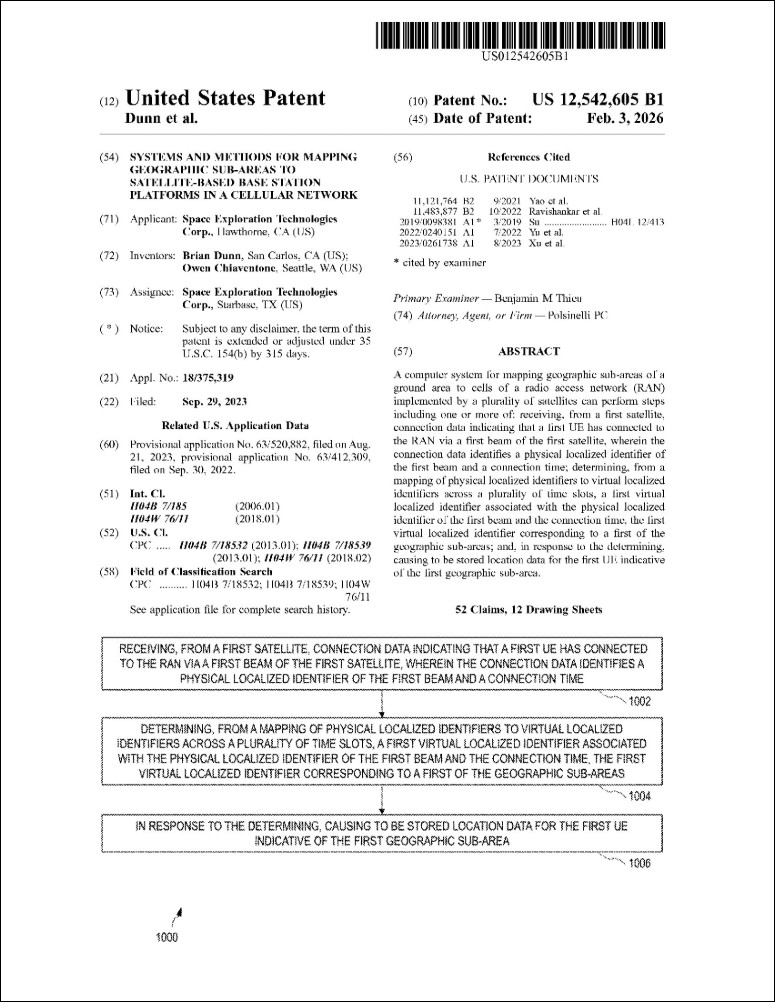
What does “52 claims” mean? It means that any competitor attempting to provide a similar service would find it practically impossible to completely circumvent this technical framework without falling within the scope of the patent. They would either need to invest significant R&D resources to find a completely different alternative or negotiate a technology licensing agreement with SpaceX.
For companies actively rolling out LEO Direct-to-Cell services, the existence of this patent undoubtedly presents a significant technical barrier. For SpaceX itself, it means that its leadership position in this emerging market is legally protected by the patent system.
Business Potential: From Solving Problems to Redefining Business Models
The economic logic behind the Direct-to-Cell service is actually quite simple: by enabling any standard cell phone to access the internet directly via satellite—without requiring any modifications or additional software—SpaceX has effectively expanded its potential user base overnight to every corner of the globe where telecom coverage is unavailable. According to official Starlink documents, the Direct-to-Cell service began rolling out in regions such as Japan in 2025.
However, in the absence of the aforementioned virtual identifier abstraction layer, the flood of TAUs generated by a large number of users simultaneously using the service would rapidly exhaust the network’s control channel capacity. Resolving the issue of location update signals effectively removes the most critical technical barrier to the large-scale commercialization of Direct-to-Cell. When the network does not have to waste bandwidth on meaningless location updates, more resources are available to support actual voice calls and data transmission, which directly translates into an improved user experience and reduced network operating costs.
In addition, this technology is crucial for telecom partners such as T-Mobile that are collaborating with SpaceX. T-Mobile employs an “existing spectrum sharing” strategy: it directly utilizes the mobile spectrum it already holds, rather than having to bid for dedicated satellite communication bands, as some competitors do. This strategy allows T-Mobile’s Direct-to-Cell service to be rolled out more quickly, but it also requires more sophisticated signal management mechanisms to prevent interference with its terrestrial network.
Competitive Landscape: Who Can Get Past SpaceX’s Wall of Patents?
The current LEO Direct-to-Cell market is primarily contested by three major players: AST SpaceMobile focuses on building large satellites capable of communicating directly with mobile phones; Amazon Kuiper is actively expanding its presence by leveraging the resources of its e-commerce and cloud empires; and Lynk Global employs a lighter satellite design, emphasizing the flexibility of rapid deployment. While these companies have different technical approaches, the core network challenges they face are highly similar: the challenges of signal control and position updates posed by the rapid movement of LEO satellites are a physical reality that all competitors must address. SpaceX’s patent strategy effectively secured the earliest patent solution to this shared problem.
Of course, patents are not an absolute barrier to market entry. Competitors can choose to invest in the research and development of alternative technologies, or find ways to achieve a similar user experience without infringing the scope of the patent. However, the “patent jungle” comprising 52 claims has undoubtedly raised the barrier to entry for this race significantly. From a broader perspective, US 12,542,605 B1 represents more than just a technical invention; it is a strategic move by SpaceX to define the rules of the game in advance in the soon-to-explode market for satellite-direct mobile phones. In this market, whoever can most efficiently manage the complex interactions between satellites and ground networks will gain a decisive competitive advantage in terms of cost and service quality.
Source: KOCPC Chinese