


Microsoft officially announced on June 16 the global release of Copilot Cowork, its AI agent tool, ending a three-month Frontier preview phase. Developed in partnership with Anthropic, this agent system can execute complex tasks across Microsoft 365 applications end-to-end and delivers completed results rather than just drafts or suggestions. Users simply describe their goals in natural language, and the system automatically integrates emails, meetings, files, and data to complete various business tasks on their behalf, marking a significant milestone for enterprise AI agents.
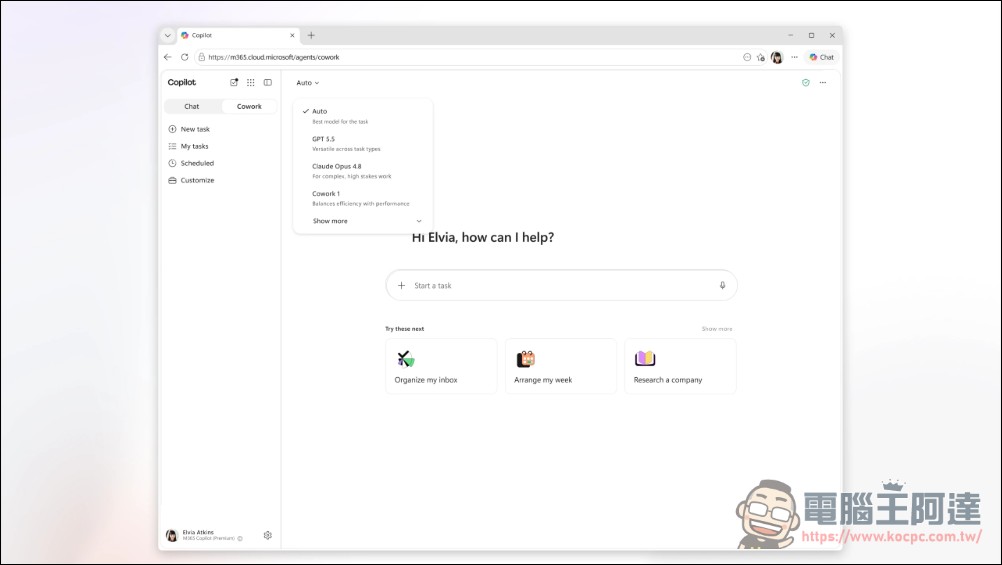
Microsoft Copilot Cowork Officially Launches Globally! Built with Anthropic Technology
Interestingly, Copilot Cowork uses the same underlying technology as Anthropic’s Claude Cowork, but Microsoft claims its per-use cost is 30% to 40% lower than Claude Cowork, creating a subtle competitive dynamic of “beating you with your own technology.” Microsoft has also announced it will launch its own Cowork 1 model in the coming weeks to further reduce operational costs and dependence on third-party models.
What is Copilot Cowork?
Unlike typical AI assistants that only generate summaries or suggestions, Copilot Cowork lets users define work tasks in natural language, and Cowork autonomously develops plans and coordinates workflows, completing end-to-end processes across tools like email, meeting notes, files, and spreadsheets to deliver finished results directly. Tasks run in a cloud environment and continue executing even when laptops are shut down, while staying within the Microsoft 365 trust boundary to ensure enterprise data security remains protected. For example, engineering teams have Cowork automatically edit batch operation spreadsheets and generate dependency flowcharts after each change, fully automating repetitive work that previously took days. Product teams use it to compare nearly 4,000 files between two versions, dramatically compressing weeks of work. Sales managers use it to review stalled sales pipelines and obtain risk-ranked opportunity lists, reducing a week’s worth of manual review to a single morning—a significant efficiency improvement.

Microsoft’s Executive Vice President for Copilot, Agents, and the Platform, Charles Lamanna, said in an official blog post that Cowork is the fastest-growing feature in the history of the Frontier program and has the highest user satisfaction among all launched Copilot and agent experiences. More than half of the Fortune 500 companies have already adopted it during the preview period, with customers including Accenture, Capital Group, Koch, and Zurich Insurance, among other well-known multinational corporations.
Multi-model strategy: Anthropic technology against Anthropic products
Copilot Cowork uses Anthropic’s Opus 4.8 and Sonnet 4.6 models in its general release, while the Frontier version additionally offers GPT 5.5 as an option. Microsoft has also announced that its self-developed Cowork 1 model will launch in the coming weeks—a secure, post-training optimized model designed to handle everyday Copilot tasks at lower costs, suited for cost-sensitive workloads. Users won’t be locked into a single model and can choose the most cost-effective or cutting-edge option based on their needs, which is one of Cowork’s core advantages in cost competition.
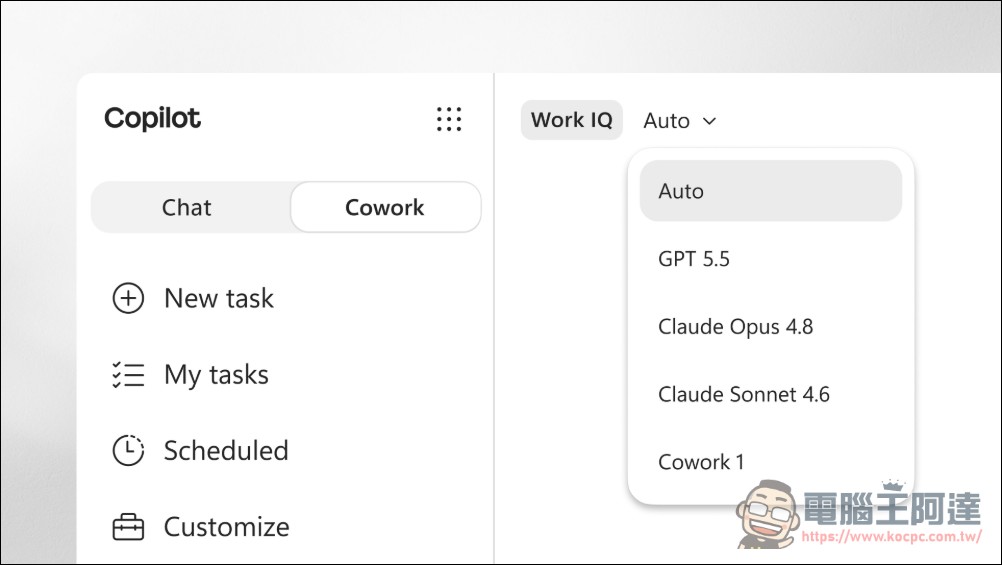
Microsoft’s core pricing strategy centers on “model selection”—Cowork automatically picks the cheapest model capable of handling each task. According to Microsoft’s internal testing (125 tests, 12 prompt sets, all using Opus 4.8), Copilot Cowork’s average cost per prompt is approximately 30% to 40% lower compared to Claude Cowork paired with the M365 connector.
Pay-as-you-go: Copilot Credits Pricing Model
Copilot Cowork uses a pay-as-you-go model, with Copilot Credits as the billing unit, at $0.01 per credit. Each task cost is calculated based on four factors: model usage, context retrieval, tool invocation, and execution time. Light tasks consume approximately 100 to 300 credits (about $1 to $3), medium tasks 400 to 700 credits (about $4 to $7), and heavy tasks exceed 700 credits (over $7). Enterprises can choose between PayGo pay-as-you-go or P3 pre-committed usage for discounts, allowing businesses of all sizes to find the billing plan that best suits them.
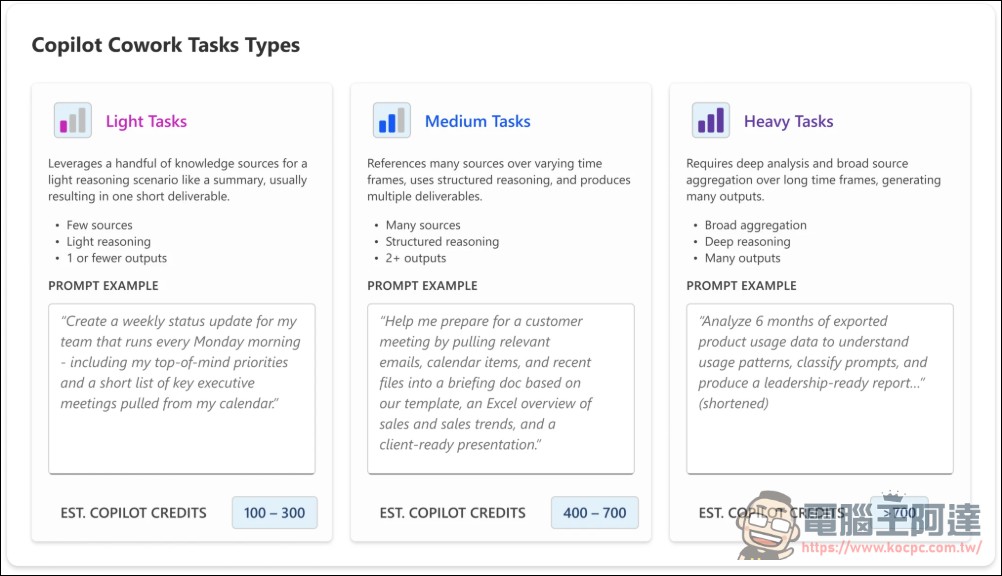
For cost control, Cowork is disabled by default, and administrators can decide when to enable it and which users to grant access to. Spending limits and alerts can be set at the tenant, group, and user levels. Per-task pricing at the user level will also be rolled out after general availability, allowing employees to see the estimated Credits cost before executing a task, which helps foster cost awareness. Users during the Frontier preview period will have a grace period and will not be charged for Cowork until July 1, 2026.
Enterprise Integration and Ecosystem
Copilot Cowork’s core technology, Work IQ, anchors tasks within a company’s existing systems, integrating emails, meeting notes, documents, and other contexts so that agents can make decisions aligned with real work scenarios. On the security front, prompts, responses, and outputs all flow through existing Microsoft 365 governance controls, supporting audit logs, eDiscovery, insider risk management, and other compliance features, with Data Loss Prevention (DLP) also on the roadmap. Additionally, Cowork deeply integrates with Dynamics 365’s Sales, Customer Service, and ERP applications, enabling enterprises to benefit from AI agent-driven automation in their CRM and ERP workflows, further enhancing operational efficiency.
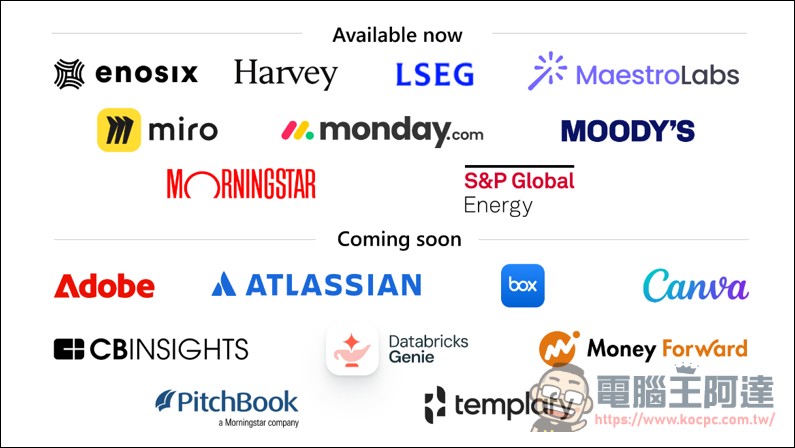
In terms of the add-in ecosystem, 9 partners are currently live: Enosix, Harvey, LSEG, Miro, monday.com, Moody’s, Morningstar, S&P Global Energy, and TeamsMaestro. Another 8 well-known software services will be joining soon, including Adobe, Atlassian, Box, Canva, CB Insights, Databricks, MoneyForward, and Templafy. Cowork can also browse the web through the local Edge browser, leveraging Edge’s enterprise browser governance framework and identity system, allowing AI agents to securely access external web resources.
Summary
The official launch of Microsoft Copilot Cowork marks enterprise AI’s formal transition from “conversational assistants” to the era of “autonomous execution agents.” Over half of the Fortune 500 companies adopted it during the preview period, demonstrating strong and growing enterprise demand for AI agents capable of completing complex tasks end-to-end. Most intriguing is the simultaneously cooperative and competitive relationship between Microsoft and Anthropic—Microsoft uses Anthropic’s technology to build products, then competes for market share with lower prices and broader distribution channels reaching hundreds of millions of Microsoft 365 office users. As industry commentary puts it: “Anthropic built the Agent, Microsoft built the distribution.” This AI agent war has just begun, and the developments ahead are worth watching closely.
Source
Source: KOCPC Chinese