


A while back, we reported on a piece of news that gave us hope:DDR5 memory prices, which had been soaring for nearly a year, finally began to ease in March 2026…with some products seeing price drops of as much as 30%; at the time, this must have been a boon for many people looking to build a computer or upgradeMemoryPlayers all thought, “Prices are coming back!”
But as it turns out, that hasn’t happened yet. According to the latest April memory price index released by the German hardware website 3DCenter, the entire DDR5 Not only did the market fail to continue the downward trend seen in March, but it actually rebounded somewhat. Currently, the average selling price of DDR5 in the German market stands at a full 410% of the July 2025 benchmark level. In other words, the price drop in March was not the beginning of a price collapse, but merely a brief technical correction.
DDR5 memory prices have gone up again! Prices in Germany are now 4.1 times higher than they were in July of last year.
A hardware website that has been tracking the German retail market for a long time 3DCenter.org, which compiles a monthly “Memory Crisis Price Index (Speicherkrise Preisindex)” tracking price changes for DDR5, DDR4, DDR3, SSDs, HDDs, graphics cards, and other product categories:
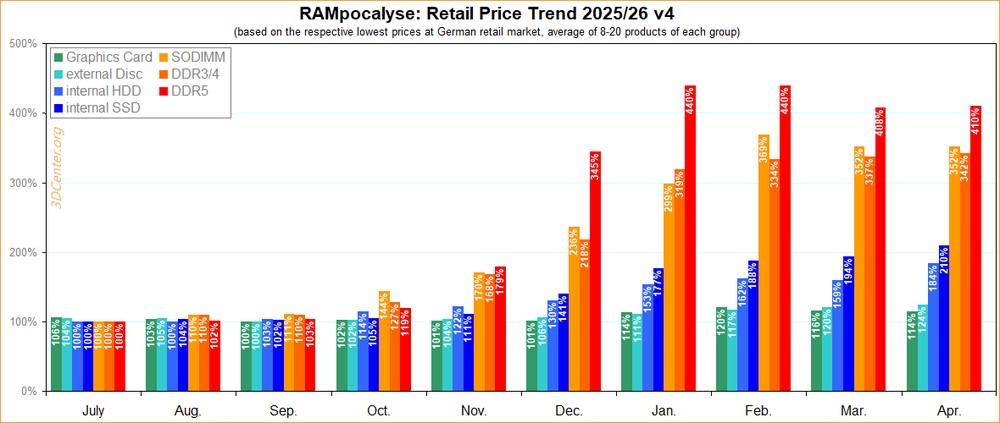
Image source: 3DCenter
According to 3DCenter’s April statistics, the lowest price for a mainstream DDR5-5600 (2×16GB) kit on the German market starts at 329 euros (approximately 11,500 New Taiwan dollars):
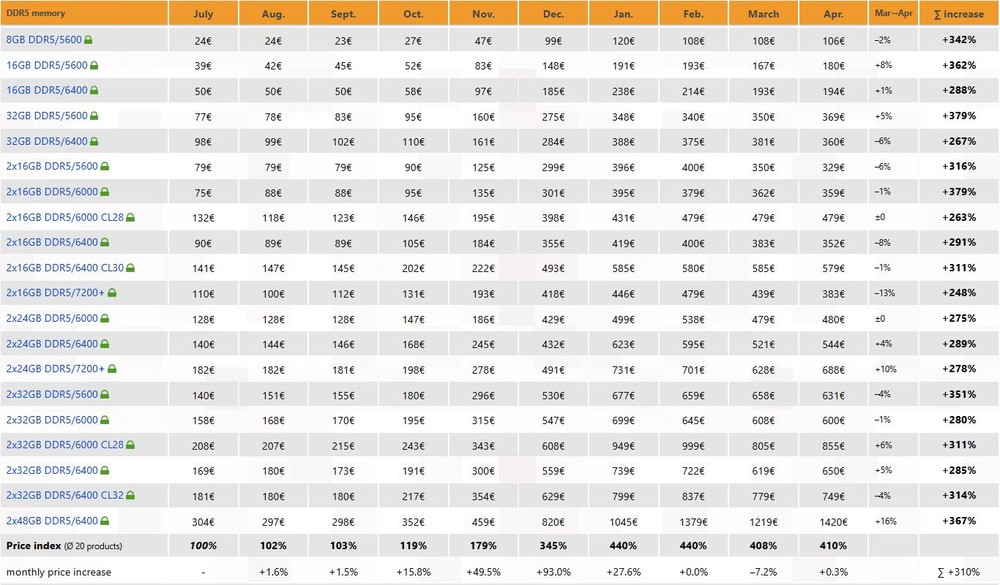
Image source: 3DCenter
The red line uses July 2025 as a baseline; compared to last year, the current price of DDR5 in April is still 4.1 times higher:
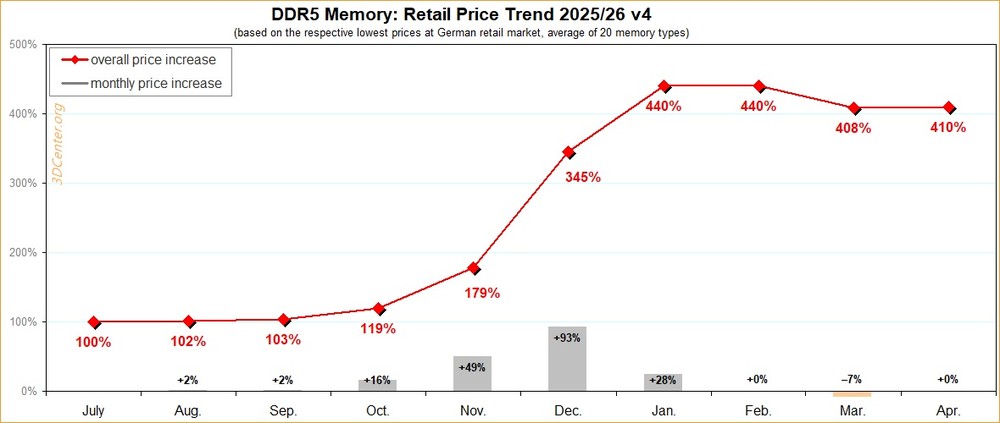
Image source: 3DCenter
Looking at monthly changes, DDR5 prices leveled off in February—neither rising nor falling—and then fell by 7% over the entire month of March, marking the first significant price drop since July 2025. However, this decline lasted only one month, and prices rebounded slightly (+0.3%) at the start of April.
Moreover, Germany has the most ample supplies in all of Europe and has historically been the cheapest country, which suggests that the situation in other countries—such as the United Kingdom, Spain, and France—will only get worse.
As for future trends, research firms such as TrendForce, Gartner, and IDC are almost unanimous in their views—none of them are optimistic. The main reason is that the three major manufacturers—Samsung, SK Hynix, and Micron—are prioritizing production capacity for AI data center customers, meaning the memory shortage in the consumer market is unlikely to be fully resolved until 2027.
Foreign media have even cited supply chain sources as indicating that there could be another round of price hikes ranging from 30% to 50% in every quarter of 2026.
As for DDR4, its price increase pattern differs slightly from that of DDR5. The most dramatic month for DDR5 was last December (+93% in a single month), but prices peaked and began to decline in January and February of this year. In contrast, DDR3/DDR4 prices peaked in January 2026 (a single-month increase of 46.3%) and continued to rise slightly in February, March, and April, without ever experiencing a downward month like DDR5 did:
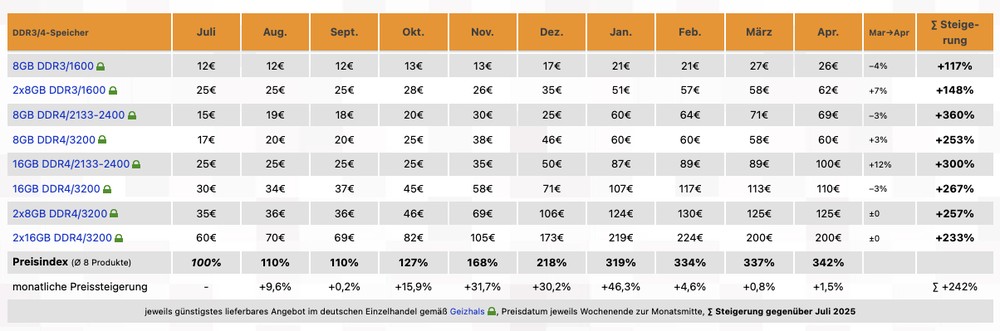
Image source: 3DCenter
So, for gamers, if your computer is still functioning properly and you don’t have any specific needs—such as playing new games or handling work-related tasks—that absolutely require an upgrade, it’s best to hold off for now. However, be prepared for prices to be even higher by the end of 2026; the situation isn’t expected to ease until 2027.
Source: KOCPC Chinese