


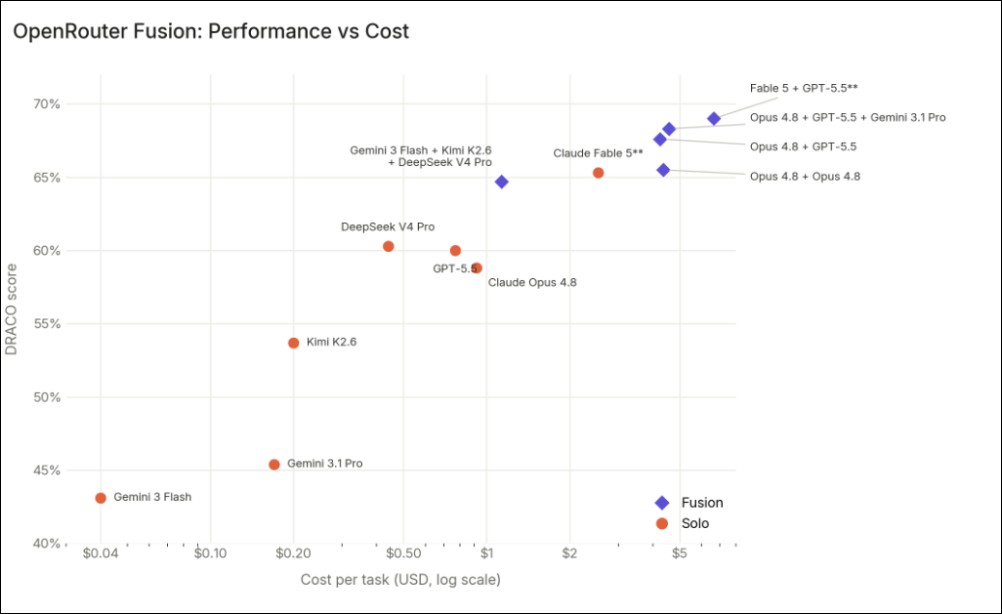
AI model provider platform OpenRouter recently launched an experimental feature “FusionThis approach lets multiple AI models answer the same question simultaneously, with a “judge model” then analyzing all responses to synthesize the best answer. According to OpenRouter’s benchmark results, the “budget panel” made up of three affordable models outperformed GPT-5.5 and Claude Opus 4.8 in deep research tasks, falling less than 1% behind the strongest single model, Claude Fable 5, while costing only about half as much. This suggests developers may no longer need to spend big on the most expensive models—cleverly combining a few cheaper models can match or even exceed top-tier performance. It’s essentially the AI world’s version of “many a mickle makes a muckle.”
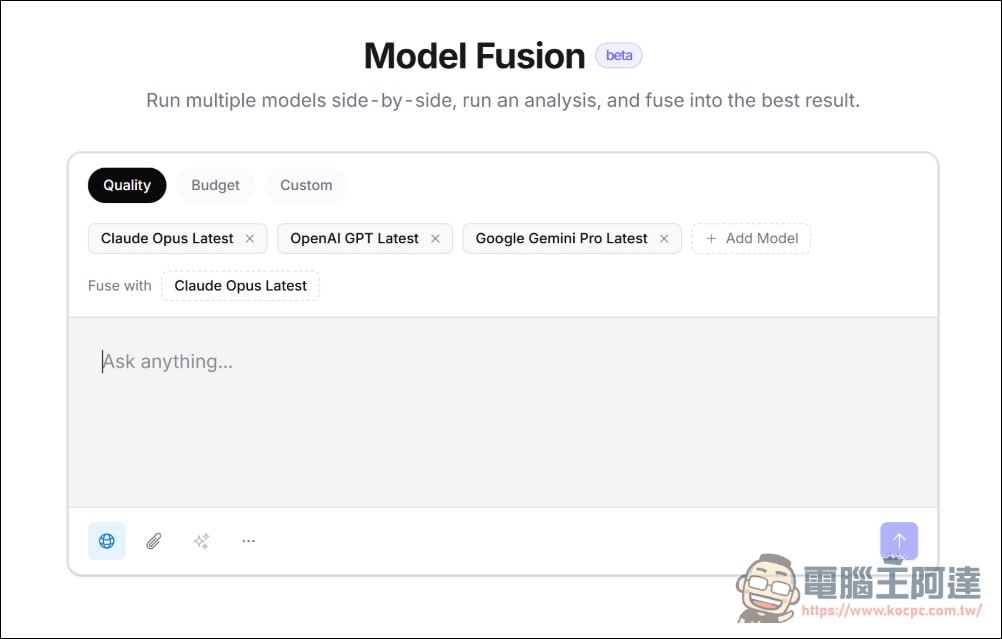
How OpenRouter Fusion Works: One Question, Multiple Models, Parallel Responses
Fusion’s core concept draws from the logic of human team collaboration: having multiple “experts” each present their perspectives, then a “moderator” synthesizes and analyzes them to deliver the best answer.
The specific process is divided into three steps: First, the user’s prompt is sent simultaneously to multiple models, each with web search enabled. Then, an independent “judge model” reads all the responses and structurally analyzes the consensus points, contradictions, unique insights, and gaps of each model. Finally, a synthesis model writes the final answer based on this analysis.
For developers, the entire process is completed on the server side, requiring only one API call, with usage that is exactly the same as calling a single model:
{
  "model": "openrouter/fusion",
  "messages": [{"role": "user", "content": "你的問題"}]
}
Users can also customize the panel layout, choosing which models to use for analysis and which model to handle synthesis.
DRACO Benchmark: Cheap Model Ensembles Beat Top-Tier Single Models
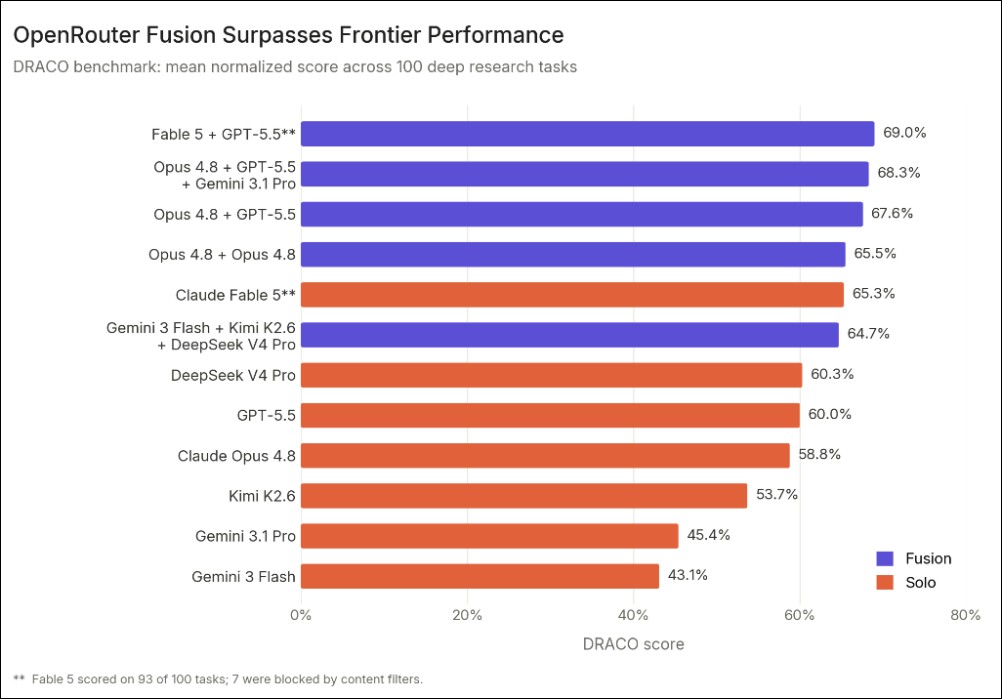
OpenRouter selected something developed by Perplexity AI DRACO Deep research benchmarks to validate Fusion’s capabilities. DRACO comprises 100 complex research tasks spanning 10 domains (legal, medical, financial, product comparison, etc.), each scored against approximately 39 weighted criteria covering factual accuracy, depth, presentation quality, and citation quality. Notably, DRACO applies negative scoring for incorrect answers, making it impossible to inflate scores simply by writing more.
The test results are as follows:
| Type | Model Combination | DRACO score |
|---|---|---|
| Fusion | Fable 5 + GPT-5.5 (Opus 4.8 Synthesis) | 69.0% |
| Fusion | Opus 4.8 + GPT-5.5 + Gemini 3.1 Pro (synthesized by Opus 4.8) | 68.3% |
| Fusion | Opus 4.8 + GPT-5.5 (synthesized by Opus 4.8) | 67.6% |
| Fusion | Opus 4.8 + Opus 4.8 (Self-Fusion) | 65.5% |
| single model | Claude Fable 5 | 65.3% |
| Fusion (Budget) | Gemini 3 Flash + Kimi K2.6 + DeepSeek V4 Pro (Opus 4.8 Synthesis) | 64.7% |
| Single model | DeepSeek V4 Pro | 60.3% |
| single model | GPT-5.5 | 60.0% |
| Single model | Claude Opus 4.8 | 58.8% |
There are two most striking results. First, the “budget panel” composed of three affordable models—Gemini 3 Flash, Kimi K2.6, and DeepSeek V4 Pro—scored 64.7%, not only beating GPT-5.5 (60.0%) and Opus 4.8 (58.8%), but also trailing the strongest single model, Fable 5 (65.3%), by less than 1 percentage point, while costing roughly half as much.
Second, even having the same model “fuse with itself” yields significant results. When Opus 4.8 is paired with its own copy and Opus 4.8 serves as the judge to synthesize the results, the score soars from 58.8% when running alone to 65.5%—a jump of 6.7 percentage points. This suggests that a substantial portion of Fusion’s benefits comes from the act of “cross-validation and synthesis” itself, rather than merely from mixing different model architectures.
Custom Panel: Flexibly Configure Your AI Dream Team
Fusion offers three usage modes. In the chat interface, users can directly select the “Quality” or “Budget” preset panels, or fully customize them.[1]。
The API configuration for custom panels is as follows[1]:
{
  "model": "openrouter/fusion",
  "messages": [{"role": "user", "content": "..."}],
  "plugins": [{
    "id": "fusion",
    "model": "google/gemini-3-flash-preview",
    "analysis_models": [
      "google/gemini-3-flash-preview",
      "moonshotai/kimi-k2.6",
      "deepseek/deepseek-v4-pro"
    ]
  }]
}
Additionally, Fusion can also be embedded as a “server tool” into existing workflows. Developers only need to add it to the tool array… {"type": "openrouter:fusion"}The base model already in use will automatically determine when it needs to invoke Fusion to handle problems requiring deep research or architecture analysis.
Usage Restrictions and Precautions
OpenRouter candidly lists Fusion’s limitations in its official documentation:
First is the cost issue. Fusion’s cost equals the total token usage of all panel models plus the judge model. Although OpenRouter doesn’t charge additional fees and bills at the provider’s original price, the cost of multi-model parallel inference is naturally several times higher than using a single model.
Next is speed. Due to the need to call multiple models in parallel plus the synthesis step, Fusion’s response time is approximately 2 to 3 times that of a single model.
The third issue concerns benchmark credibility. OpenRouter itself acknowledged that the Fable 5 score (65.3%) in the DRACO test was based on only 93 out of 100 tasks, since 7 tasks were blocked by its content filtering mechanism, making it not entirely fair compared to other models that completed all 100 tasks. Additionally, during testing, it was discovered that the model had used web search to find DRACO’s scoring criteria. OpenRouter later blocked the relevant websites and conducted retesting. The judge model used for scoring (Gemini 3.1 Pro Preview) also differs from the original DRACO paper, so the scores cannot be directly compared with those in the original paper.
MakerStack inReviewThe review gave Fusion a score of 7.7 out of 10, considering it best suited for research-oriented or high-risk prompt scenarios that require high-quality output, though it may not be cost-effective for daily high-volume production workflows.
OpenRouter Fusion Test Page (click here)
Implications for the AI industry
Fusion represents a paradigm shift: instead of pursuing a single more powerful model, the approach is to make multiple existing models work as a team. OpenRouter, in their official blog, likens this to “neurodiversity, but for models,” emphasizing that when different models complement each other’s respective strengths, the overall performance can exceed that of any individual.
The most practical takeaway for most developers is this: with limited budgets, consider using Fusion to combine multiple affordable models rather than relying on a single expensive top-tier model. In DRACO testing, a trio of budget models came close to matching Fable 5’s performance at roughly half the cost – a cost-to-performance advantage that simply can’t be ignored.
However, Fusion is still in the experimental stage (beta), and OpenRouter hasn’t marked it as an official product yet. For production environments that require stability, this is a factor worth considering.