


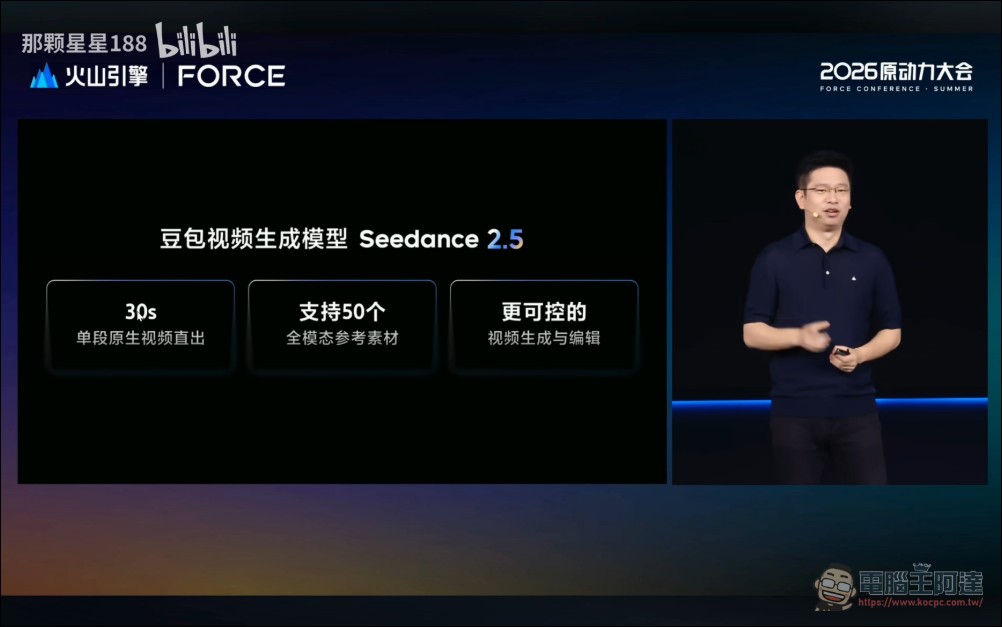
On June 23, 2026, Volcano Engine, the cloud services platform under ByteDance, held its annual FORCE conference in Beijing. During the event, Tan Dai, President of Volcano Engine, officially unveiled the latest version of their AI video generation model, Seedance 2.5. This new model, which skipped from 2.0 directly to 2.5, features three core upgrades: “generating a complete 30-second video in one take,” “50 full-modal reference materials,” and “controllable video editing.” Currently in the final stages of enterprise internal testing, it’s expected to be officially released to the public in early July.
After launching in February this year, Seedance 2.0 has sparked an unprecedented wave in the global AI video generation space, thanks to its native audio-video joint generation, multi-camera storytelling, and character consistency capabilities. AI video creators worldwide have used Seedance 2.0 to produce films rivaling professional productions, leaving competitors like Sora2 and Veo3 far behind. Remarkably, just four months later, ByteDance has chosen to skip versions 2.1 through 2.4, directly launching 2.5—a testament to the astonishing pace of Chinese AI model iteration.
30-Second Native Generation: The End of Stitching
Seedance 2.5’s most notable upgrade is its support for generating complete videos up to 30 seconds in a single pass. The previous 2.0 version, while claiming to produce videos up to 15 seconds long, still relied on multi-segment stitching techniques for longer clips, which often resulted in visual drift or structural inconsistencies at shot transitions.
Version 2.5 generates complete 30-second clips in a single continuous output process, without any stitching steps. This means the rhythm of camera movements, the physical states of characters, and the spatial relationships within scenes can all remain consistent throughout the entire video. For advertising production, short drama shooting, or any scenario requiring a coherent story, upgrading from “15-second stitching” to “30-second native generation” is more than just doubling the length—it’s a fundamental change to the workflow.
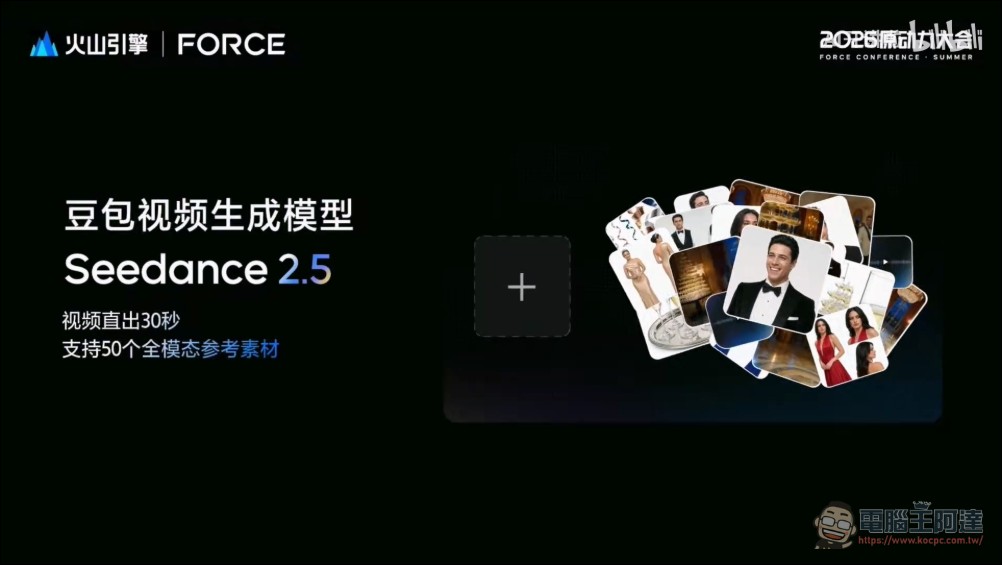
50 Full-Modality Reference Materials: From the “Director’s Toolbox” to the “Production Database”
Seedance 2.0’s multimodal reference system is already quite comprehensive, allowing users to input up to 9 images, 3 video clips, and 3 audio clips simultaneously, totaling 12 reference materials. This number far exceeded similar competing products at the time, enabling users to specify various elements such as character appearance, scene atmosphere, camera style, and sound effect rhythms.
By version 2.5, the limit for reference materials expanded to 50 at once. This isn’t just a quantitative increase—it transforms AI video generation from a “few reference images plus a prompt” creative approach into a complete production pipeline capable of simultaneously handling brand identity assets, 3D model white models, voiceover tracks, storyboard scripts, and multi-angle reference videos.
For example, an advertising team can simultaneously input a client’s brand manual, product 3D models, photos of brand ambassadors, music demos, and storyboards, allowing the model to integrate everything and generate a 30-second commercial that matches the brand’s identity in one go. This workflow was virtually impossible to achieve with previous AI video tools.
Controllable Video Editing and 3D White Model Support
Besides improved generation capabilities, Seedance 2.5 also adds depth spatial control and video editing features. According to the on-site demonstration at the event, the new version supports replacing subject elements in videos while preserving the original motion, camera position, and lighting conditions. This transforms AI video from a one-time generation tool into a post-production workflow that enables repeated modification and iteration.
Another noteworthy feature is the 3D white model input. Users can directly use rough models (white models) exported from 3D modeling software as reference material, allowing Seedance 2.5 to generate videos with realistic lighting, shadows, and textures based on these foundations. This provides direct productivity gains for previsualization and e-commerce advertising production.
Seedance 2.0 Upgraded to 4K with Expanded Family Lineup
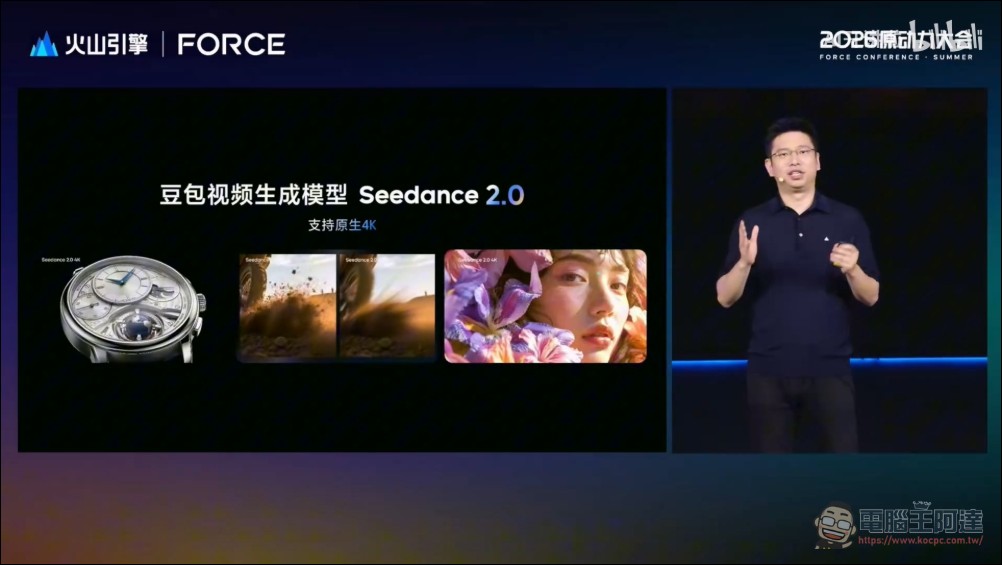
Alongside the 2.5 announcement, Volcano Engine also delivered a significant upgrade to the existing Seedance 2.0: native 4K resolution output. Previously, the 2.0 version had a maximum output spec of 1080p, and this upgrade now enables the same model to produce broadcast-quality video content.
Additionally, ByteDance also announced at the same conference:
- Seed 2.1 Pro Language ModelByteDance claims its capabilities match the level of Claude Opus 4.6, supporting the viewing of 2-hour videos and end-to-end video editing. This claim has yet to be verified by independent benchmarks.
- Seedream 5.0 Image ModelForming multimodal synergy with the Seedance series to achieve a seamless creative loop from image to video.
- Doubao LLM’s daily average token usage exceeds 180 trillionGrowing 1,500 times from the 120 billion initial scale in May 2024, indicating that AI applications are accelerating penetration across various industries.
Seedance 2.5 is currently in enterprise internal testing, with no official benchmark data, pricing plans, or API timeline released yet. The capabilities demonstrated at the conference are based on ByteDance’s own claims, with no independent third-party verification. ByteDance’s decision to launch 2.5 just four months after 2.0 reflects the intense competitive pressure in this space.
China’s AI Video Industry Reaches a Turning Point
Seedance 2.0 has had a substantial impact on China’s short drama industry since its launch in February this year. According to Caixin, “most short dramas on the market are now being directly generated by AI,” with production costs and cycles significantly reduced. Since the debut of Seedance 2.0, China’s live-action short drama market has rapidly contracted, with many Hengdian web series and short video production crews and actors already facing the dire situation of having no projects to work on.
And the arrival of Seedance 2.5 will further push AI video from “rapid iteration of short clips” to “industrial-scale production of longer content.” The combination of 30-second native generation with 50 reference materials perfectly matches the most common video lengths and material requirements in advertising, e-commerce, and short drama production.
After the event, Tan Dai, President of ByteDance’s Volcano Engine, told Caixin in an interview, “Film, TV, and short dramas are just narrow applications for AI video—Seedance is actually the foundation for building world models.” This comment suggests ByteDance’s ambitions for Seedance extend beyond a content creation tool, pointing toward a technological pathway toward larger-scale spatial intelligence and world models.
Launch Timeline and Follow-up Monitoring
Based on currently available information, Seedance 2.5 is expected to officially launch in early July 2026. Pricing plans and API access details have not yet been announced and will remain under wraps until the official release. For creators and enterprise users already using Seedance 2.0, the 30-second native generation capability and 50 reference materials will be the most direct productivity upgrade. As for the entire AI video industry, ByteDance’s iteration speed—jumping from 2.0 to 2.5 in just four months—undoubtedly puts greater pressure on global competitors.
Source: KOCPC Chinese