


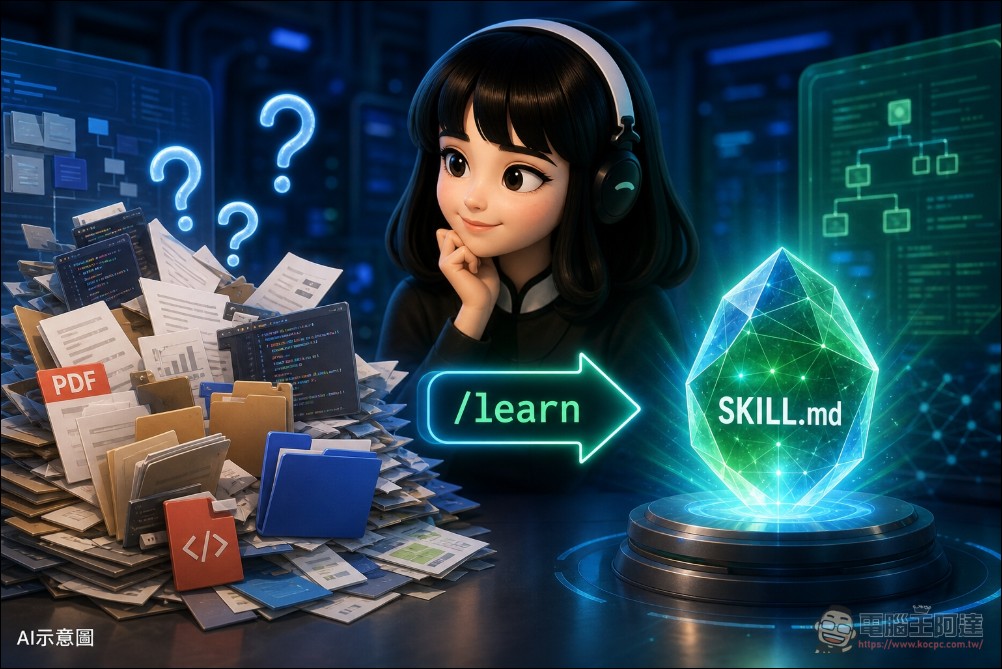
Open-source AI agent Hermes Agent launches another major new feature, with Nous Research announcing on June 23 on X that Hermes Agent has added /learn Instruction: Users only need to point to a directory, and regardless of whether it contains code, API documentation, product manuals, PDFs, or configuration files, the Agent can automatically digest and distill them into a verifiable, reusable Skill.
Hermes Agent can now /learn from anything: feed it directories of any source material (code, API docs, manuals, PDFs, configs) and it distills a verifiable reusable skill pic.twitter.com/oRznwCRF3E
— Nous Research (@NousResearch) June 23, 2026
This feature may seem simple, but it directly addresses a long-standing pain point for AI agents: every new conversation requires re-explaining the context. In the past, if users wanted an Agent to understand their APIs or workflows, they had to manually paste documents and repeatedly explain conventions in every conversation. Once the conversation ended, all that knowledge would disappear./learn Its emergence marks Hermes Agent formally completing this final stretch from raw data to persistence capability.

What is /learn? A complete guide to its functionality
Traditional AI assistants typically handle documents by stuffing the content into the current conversation’s context window. The model “sees” this data during that session, but once the conversation ends, everything resets to zero. The next time you need the same information, users have to paste it again.
/learn This approach is completely different. After the user points to a directory containing raw data, the Hermes Agent will perform the following steps:
- Read all filesSupports multiple formats including source code, API specifications, operation manuals, PDFs, and configuration files
- Extract key knowledgeIdentify truly useful procedures, rules, conventions, and pitfalls from massive amounts of data
- Generate Skill fileGenerate a structured SKILL.md file, including trigger conditions, step-by-step process, known pitfalls, and verification methods
- persistent storage: Skill stored locally
~/.hermes/skills/Directory, persists across sessions, no need to re-explain
In the words of Nous Research: “You build it once, you use it forever.” Build once, use forever.

Skill System: Hermes Agent’s Core Differentiation
to understand /learn Why it matters requires understanding the role of the Skill system in the Hermes Agent architecture. A Skill is not merely a prompt template, but a structured knowledge document. Each Skill follows a unified format: YAML frontmatter (name, description, trigger conditions) plus Markdown body content (procedure steps, pitfalls, verification methods). When an Agent encounters a relevant task in conversation, it automatically determines whether to load the corresponding Skill, using a progressive loading strategy to save tokens: first viewing the list (approximately 3k tokens), then loading full content only when needed.

This design makes Hermes Agent one of the few AI agents with “experience accumulation” capabilities. Most Agent frameworks reset their state after each conversation ends, while Hermes uses two mechanisms—Skill and Memory—to enable knowledge to persist across sessions. The official documentation on GitHub explicitly states: “It’s the only agent with a built-in learning loop.”
Coinciding with v0.17.0’s timeline
/learn The timing of the feature announcement happened to fall just after the release of Hermes Agent v0.17.0 (June 19). v0.17.0 was officially dubbed “The Reach Release,” a major update: over 1,475 commits, 800 merged PRs, 1,693 file changes, and 245 community contributors involved.
this version’sKey highlights includeSupport iMessage communication via Photon, add Raft agent network, major desktop app enhancements (sub-agent watch-window, VS Code theme support), background async sub-agents, and editable image generation./learn The launch of this feature can be seen as an extension of the current update cycle, further strengthening Hermes Agent’s leading position in knowledge persistence as a core selling point.
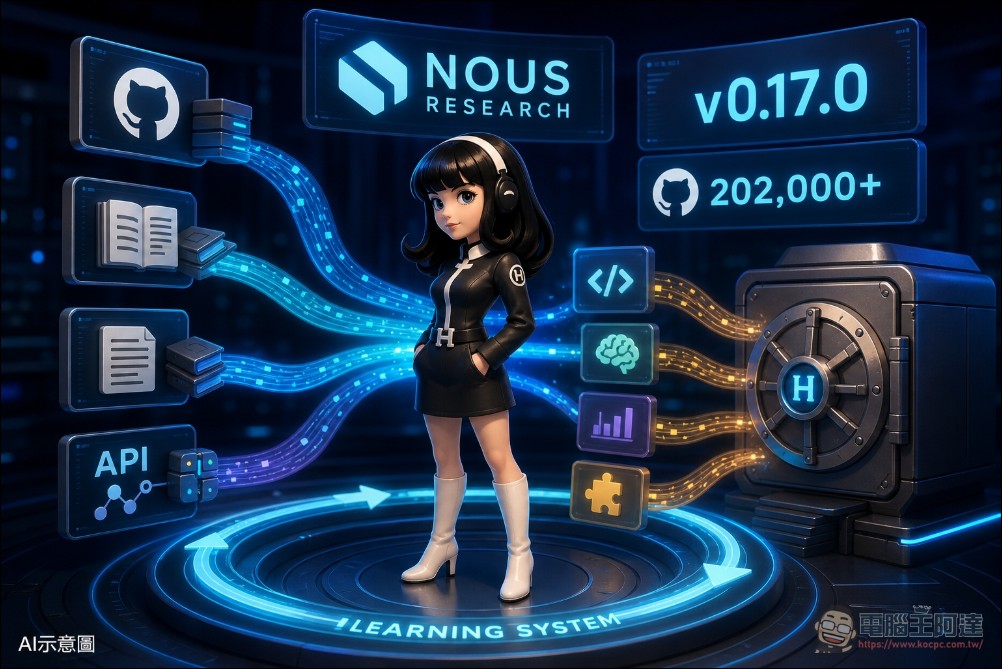
Hermes Agent has accumulated over 202,000 stars on GitHub, making it one of Nous Research’s most notable open-source projects. Nous Research was co-founded by Teknium, positioning itself as “a collective of geeks pushing toward open-source AI.” Alongside Hermes Agent, it also encompasses multiple open-source language models.
In the competition among AI agent frameworks, Hermes Agent’s differentiation strategy is quite clear: rather than pursuing the highest number of tool integrations, it focuses on the core capability of “self-improvement.” The Skill system allows the Agent to learn from experience, the Memory system enables it to remember user preferences, and /learn This significantly expands the input end of this learning loop, upgrading from “learning through dialogue” to “learning from any data.”
In contrast, most open-source agent frameworks (such as LangChain, AutoGen, and CrewAI) are more focused on toolchain assembly and task scheduling, lacking this kind of built-in knowledge accumulation mechanism. Hermes Agent’s approach is more akin to a “colleague that grows over time,” rather than a “tool that needs to be trained from scratch every time.” As/learn The launch of this feature marks the final piece of the puzzle for Hermes Agent’s knowledge management capabilities. From passively learning only through conversations in the past to now proactively ingesting raw data in any format and producing actionable skills, this leap takes Hermes Agent from an “intelligent conversational tool” to an “AI worker capable of building organizational knowledge.”
Source: KOCPC Chinese