


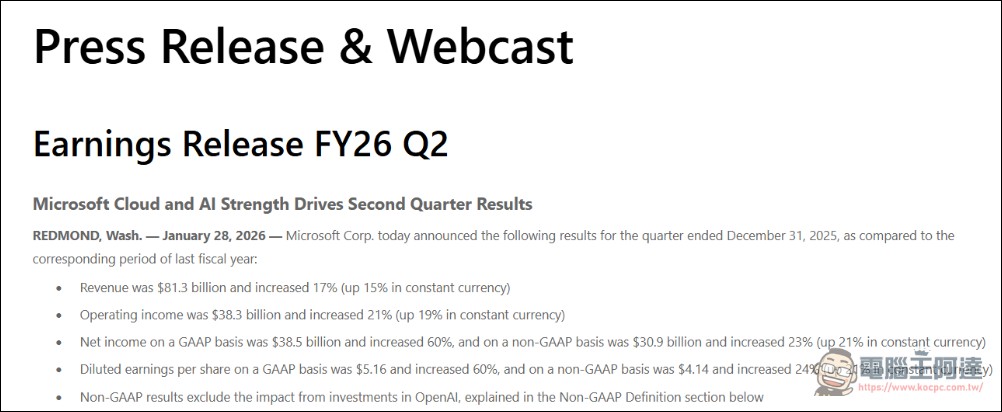
On January 29, 2026, after Microsoft (Microsoft) released its financial report for the second quarter of fiscal year 2026 (Q2 FY2026), its stock price plummeted nearly 10% in after-hours trading, writing its largest single-day decline since 2020. According to market data, Microsoft’s market value evaporated by US$357 billion (approximately NT$11 trillion) in one breath, shocking Wall Street and the global technology industry.

Core issues in Microsoft’s earnings report: Slowing Azure growth, doubtful return on AI investment
The main reason for the sharp decline in Microsoft’s stock price came from two major warning signs:
1. Azure cloud growth is slower than expected
The financial report showed that Microsoft’s cloud platform Azure revenue growth rate was only 39%, slightly lower than analysts’ expectations of 39.4%. This “slight gap” is a major concern for investors, as the market views Azure as a key indicator of Microsoft’s overall health. Microsoft Chief Financial Officer Amy Hood said frankly in the earnings call: “If we had not prioritized internal AI needs and allocated all the data center capacity to Azure customers, the growth rate could have exceeded 40%.” She pointed out that the company prioritized the GPUs put into production in the first and second quarters for internal AI projects and first-party products (such as Copilot), which indirectly limited the accelerated growth of Azure.

2. The return on investment in AI is unclear
What worries the market even more is whether Microsoft’s huge investment in AI can be converted into actual revenue. UBS analysts directly questioned: “The effect of Copilot in promoting the accelerated growth of Microsoft 365 revenue has not been seen, and multiple surveys have shown no signs of expansion in usage. The market is already overcrowded and capital-intensive, and Microsoft must prove that these investments are effective.”
Performance of Microsoft’s business units
| business department | revenue performance | market expectations | question |
|---|---|---|---|
| Azure Cloud | +39% | 39.4% | Growth slightly below expectations |
| Windows | $12.6 billion | $13.7 billion | well below consensus |
| Xbox hardware | 3 consecutive years of decline | – | continued recession |
| Xbox content and services (including Game Pass) | -5% | – | Subscription growth stalls |
The plight of Xbox hardware is particularly noteworthy. According to sources, Xbox hardware revenue has declined for three consecutive years, and this trend is expected to continue in fiscal 2026. Even Xbox Content and Services, which includes Game Pass, declined 5%.
Analyst view: long-term vs. short-term pull
Optimists: Long-term planning still has value
Ben Retires (Merius Research), a “buy” analyst on Microsoft stock, believes that investors focus too much on single-quarter Azure growth data and ignore Microsoft’s long-term strategy of “sustainable growth is better than short-term stock price gains.”
He suggested: “Microsoft should accelerate the construction of data centers. The challenge facing Azure is simple: it is not building buildings fast enough.”
Pessimists: AI strategy is vague and products are lagging behind
However, there are also criticisms in the market. Analyst Chubby♨️ said directly on
Microsoft shares plunged nearly 10% after earnings missed key expectations, wiping $357 billion off its market cap and marking its worst daily drop since 2020.
Slower-than-expected Azure cloud growth (39%), data center capacity constraints, and uncertain returns on AI… pic.twitter.com/RcHbnnHMnY
— Chubby♨️ (@kimmonismus) January 30, 2026
Microsoft’s AI bet: Behind the $13 billion investment
According to market data, Microsoft has invested more than $13 billion in OpenAI and hopes to monetize AI through Azure cloud services and the Copilot product line. However, Microsoft’s dependence on OpenAI is declining as it reaches $12 billion in revenue and begins to partner with competitors such as Amazon. The bigger question: Next-generation models like GPT-5 could make Microsoft’s existing cloud ($106 billion) and productivity tools ($121 billion) business pillars obsolete.
Should investors be worried?
The day after the earnings report was released (January 30), Microsoft’s stock price rebounded slightly before the market opened, rising 0.55%, indicating that market sentiment had stabilized slightly.
Overall, the challenge facing Microsoft is not the failure of the AI strategy itself, but rather:
- Capital allocation issues: Prioritizing internal needs results in limited Azure growth
- Short-term expectation management: Market patience with AI investment returns is wearing thin
- Product competitiveness: Copilot’s real-world benefits in Microsoft 365 have yet to be proven
Whether Microsoft can maintain its status as “the world’s second-largest company by market capitalization” in the AI era will depend on whether it can prove a substantial return on these investments in its next quarterly earnings report.
Source: KOCPC Chinese