


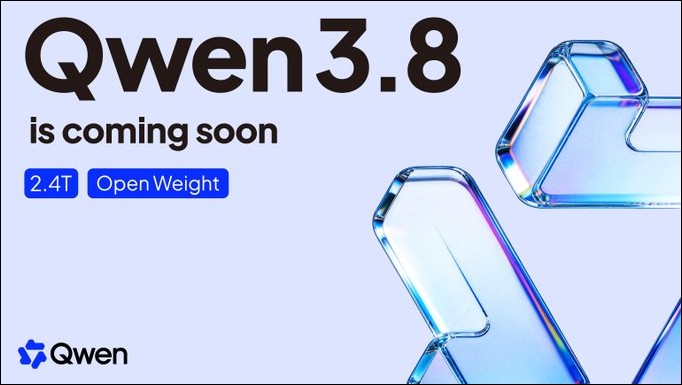
AlibabaTongyi QianwenThe team officially released Qwen3.8-Max-Preview on July 19, which is a multi-modal large-scale language model with 2.4 trillion parameters. The team announced on the X platform thatQwen3.8 It’s “one of the most powerful models out there, second only to the Fable 5,” Anthropic’s unreleased flagship model. This is the first multi-modal model in the Qwen series to break through the mega-parameter threshold, and it is also Alibaba’s response to Moonshot AI’s Kimi K3 in just three days.
Qwen3.8 is launching and going open-weight soon!🌐
With a massive 2.4T parameters, this model is continuously evolving. We believe it’s one of the most powerful model available today, compatible to leading frontier AI models , second only to Fable 5.
You don’t have to wait to… pic.twitter.com/JS3ID73IYS
— Qwen (@Alibaba_Qwen) July 19, 2026
Currently, Qwen3.8-Max-Preview has been launched on Qwen Cloud’s Token Plan, Qoder (AI programming IDE) and QoderWork (desktop assistant) platforms. The official version of the open source weight is also promised to be “released soon”, but the specific date, licensing terms and HuggingFace model library have not yet been announced.
Model specifications: 2.4 trillion parameters, millions of token contexts
According to Alibaba’s official announcement and early integration documents, the known specifications of Qwen3.8-Max are as follows:
- Parameter scale: 2.4 trillion (2.4T) total parameters, but whether the architecture is Dense or MoE (Mixed Expert), and the actual number of enabled parameters for each token are not disclosed.
- modal: Text, picture, and video input. It is the first multi-modal model in the Qwen series with more than 1 trillion parameters.
- context window: 1 million tokens (appears in the integration instructions of Qwen Code v0.20.0, but Alibaba has not yet confirmed it in the official model card)
- Training data deadline: Undisclosed
Qwen team member Shuai Bai said that compared with the previous generation Qwen3.7-Max, Qwen3.8 has significantly improved in terms of program code engineering and complex productivity tasks (such as full-end development, data analysis, office automation).
Pricing strategy: 10% discount, up to 92% off off-peak prices
The pricing of Qwen3.8-Max-Preview is based on Alibaba’s Token Plan Mainly based on subscription rather than traditional pay-as-you-go API. Token Plan is divided into three levels:
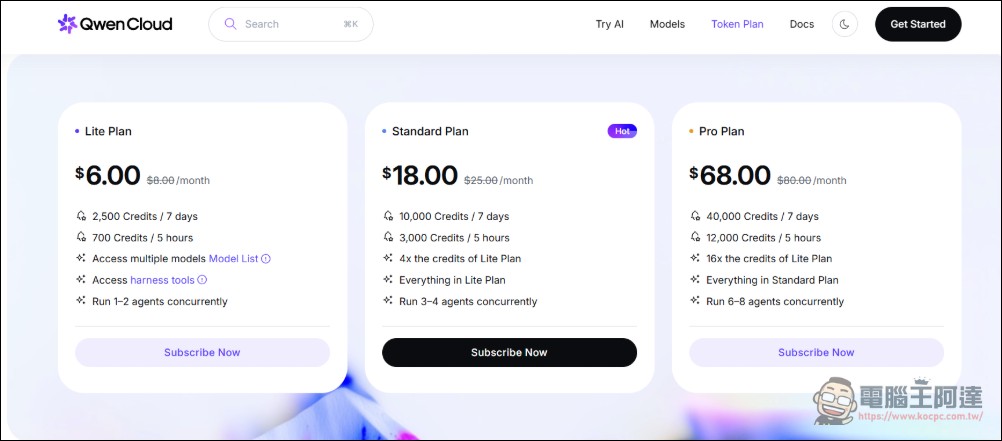
- Lite: US$6 per month (39 RMB in China)
- Standard: USD 28 per month (RMB 139 in China)
- Pro: USD 68 per month (RMB 499 in China)
To celebrate the launch, Alibaba has reduced the price of the Preview version to 10% of the standard price. The Qoder platform further launches off-peak discounts, with a discount of 98% (0.01 times the standard rate) for the daily period from 14:00 to 00:00 UTC, and a 90% discount (0.05 times) for general periods.
In addition, Token Plan is not an exclusive plan for Qwen. Alibaba positions it as a multi-model subscription center. The same plan includes three models: Qwen3.8-Max-Preview, GLM-5.2 and DeepSeek-V4-Pro. This cross-vendor bundling model is quite rare in the industry, showing that Alibaba is trying to make Token Plan a “one-stop entrance” to AI models rather than a closed ecosystem of a single brand.
Head-to-head with Kimi K3
The release time of Qwen3.8 attracted industry attention. Just three days ago, Moonshot AI just released the 2.8-megapixel Kimi K3, which also promised to open source the weights (expected to be open on July 27). The Hacker News community generally interprets the launch of Qwen3.8 as a direct response to Kimi K3.
Two Chinese AI laboratories launched open source models with trillion-level parameters within a week, an unprecedented pace. Kimi K3 reached annual recurring revenue of US$300 million (approximately NT$9.75 billion) in June and plans to go public within six months. The early preview of Qwen3.8 is to a certain extent to grab the attention of developers before the weight of Kimi K3 is released. The essence of this “Terascale Parameter Battle” is a battle for dominance among Chinese AI companies in the open source camp. Whoever releases it first, opens it up first, and attracts a developer ecosystem first will have a favorable position in the next round of competition.
However, there are key differences between the two: Kimi K3 has announced benchmark results, which are close to the level of GPT-5.6 Sol and Fable 5, while Qwen3.8 currently does not have any third-party benchmark data. Alibaba’s statement of “second only to Fable 5” is still an unverified self-assessment.
最強開源模型 Kimi K3 登頂前端程式碼競技場:網友反餽表現超越 Claude Fable 5 與 GPT-5.6 Sol
What it means to the open source AI ecosystem
If Qwen3.8 opens the weights as promised, it will form a new pattern in the field of open source AI together with Kimi K3: Chinese laboratories have surpassed most Western manufacturers in the opening speed of trillion-level parameter models. Currently, Anthropic’s Fable 5 does not have open weights, OpenAI’s GPT-5.6 Sol also remains closed source, and the same goes for Google’s Gemini series.
Alibaba is also trying a new business model through Token Plan’s multi-model bundling strategy: instead of competing with API charges for a single model, Alibaba provides cross-vendor model access on a subscription basis. The success of this approach depends on whether the actual performance of the official version of Qwen3.8 can fulfill the promise of “second only to Fable 5”. Before the benchmark results and open source weights are officially announced, the positioning of Qwen3.8 still carries a considerable degree of uncertainty. But one thing is certain: the pace of competition in China’s AI open source ecosystem has accelerated from “months” to “days”.
For developers and enterprise users in Taiwan, the emergence of Qwen3.8 means that in addition to OpenAI, Anthropic, and Google, when choosing a large language model, there is another high-parameter open source option. Token Plan’s subscription system lowers the threshold for trying, and the monthly fee starting at $6 is even lower than the free quota of most cloud services. If open source weights are eventually released with friendly licensing terms, the possibilities for local deployment will also be greatly expanded, giving teams that don’t want to send data to the cloud the opportunity to run 2.4-megapixel models on their own servers.
Source: KOCPC Chinese