


Tesla and X Platform CEO Elon Musk spoke at the X Platform on February 17Officially announced, the release candidate version (Release Candidate) of xAI’s latest large model Grok 4.2 has been opened for public testing. This is xAI’s fastest ever upgrade cycle, coming just about three months after the release of Grok 4.1.
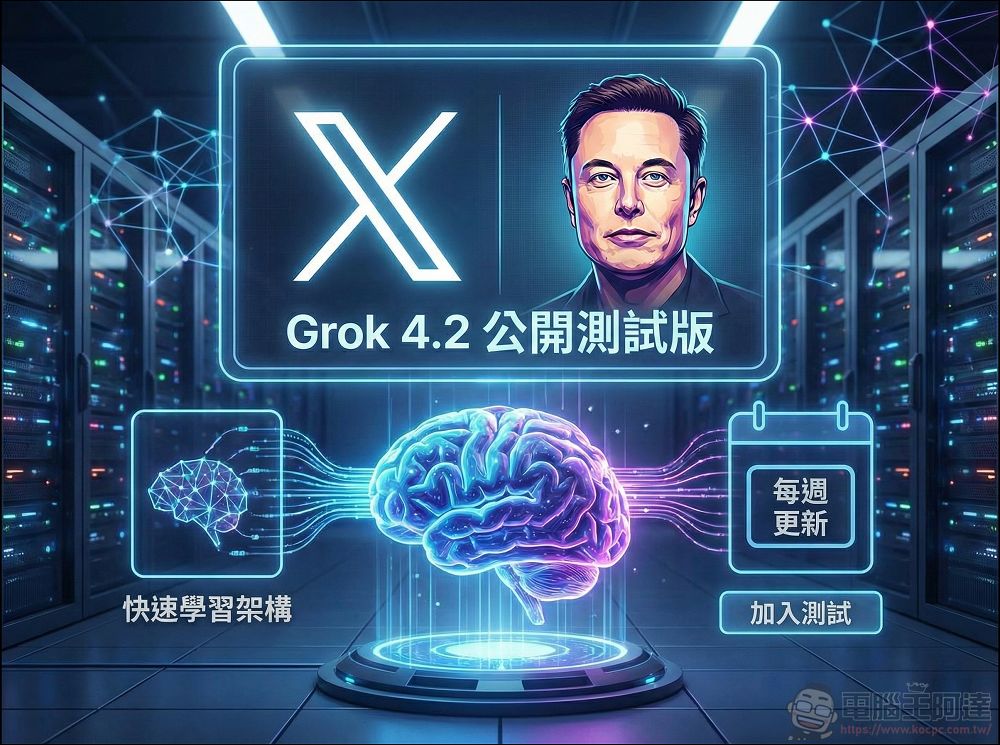
Grok 4.2 public beta version is online: with rapid learning capabilities and weekly updates
The biggest difference from previous versions is that Grok 4.2 has “rapid learning” capabilities. Musk emphasized in his tweet that this is the first time that the Grok series has adopted this architecture and willUpdates rolled out weekly with release notes. Users need to manually select Grok 4.2 in the interface to enable it, which is an opt-in public test mode.
The Grok 4.2 release candidate (public beta) is now available for use. You need to select it specifically.
Critical feedback is appreciated. Unlike prior versions of Grok, 4.2 is able to learn rapidly, so there will be improvements every week with release notes.
— Elon Musk (@elonmusk) February 17, 2026
Musk specifically requested “critical feedback” from users, indicating that this beta test adopts a strategy similar to Tesla FSD: driving rapid iteration through actual use by early users.
Alpha Arena test: beat GPT-5.1, Gemini 3 Pro
according toreport, Grok 4.2 performed well in the Alpha Arena stock trading simulation test: increasing the value of $10,000 to $12,193 in 14 days,Profit up to 12.11%. In comparison, OpenAI’s GPT-5.1, Google’s Gemini 3 Pro, and Anthropic’s Claude 3.5 Sonnet all lost money in the same test. While stock trading is not directly relevant to the average user’s day-to-day use, this test demonstrates Grok 4.2’s capabilities in high-stakes continuous decision-making situations: a core skill required for automated AI systems.
The first test users spoke highly of Grok 4.2’s programming capabilities. Some users have successfully used Grok 4.2 to build and run a simple tower defense game without additional environment configuration. Multimodal capabilities have also been significantly improved, including the ability to generate movies related to SpaceX missions. Some people also reported their blood to Grok and the analysis results were quite correct (Editor’s note: It’s better to show it to a doctor).
Grok 4.20 is insanely good and quick at analyzing blood tests!
You can literally upload your lab results — even an MRI — and Grok breaks it down for you. pic.twitter.com/IWDQ6La37o
— DogeDesigner (@cb_doge) February 17, 2026
In addition, the industry expects that the context window of Grok 4.2 may reach 2 million tokens (generally 200,000 tokens in the industry, a few flagship models only have 1 million tokens), if true, it will be the leading level in the industry.
Behind the delayed release
Grok 4.1 was released on November 17, 2025. Grok 4.2 was originally expected to be launched at the end of December 2025 or early January 2026. However, rumors indicate that xAI’s data center in Memphis encountered extreme cold weather and construction accidents, causing the release to be delayed until mid-February. Nonetheless, the three-month upgrade cycle is still the fastest in xAI’s history, and compared to the usual 6 to 12-month update cycles of competitors such as OpenAI and Google, xAI is clearly catching up.
Potential Impact on Tesla
xAI and Tesla have long-term shared technical resources and talents. If the fast learning architecture of Grok 4.2 proves effective, similar technology is likely to be applied to the neural network development of Tesla FSD (fully autonomous driving) to accelerate the processing of edge cases and system iterations. This also means that Tesla owners may enjoy more frequent AI feature updates in the future, and the Grok voice assistant in the car will become smarter (but not available in Taiwan).
summary
Grok 4.2’s “weekly update” strategy is an important change in the AI model development model. Traditional large-scale language models usually require months or even years of retraining cycles. If xAI can truly achieve continuous learning without affecting stability, it will set a new benchmark for the industry. However, this also places higher demands on users—the need to adapt to an ever-changing AI system. Musk adopted the opt-in beta model this time, which not only retains the stability of existing users, but also provides early adopters with the opportunity to participate in model evolution. It is a relatively stable product strategy.
Source: KOCPC Chinese