


On October 16, security company Calif posted four tweets in succession, all about perfect jailbreak exploits for the latest iPhone 18 Pro running iOS 27: one-click compromise via Signal, iMessage intrusion, a special iPhone operation, and APT standing for Apple Persistent Threat. The most shocking was the third: on an iPhone 18 Pro running iOS 27.0.1, they achieved an untethered jailbreak (Untethered Jailbreak; untethered jailbreak), which remained jailbroken after reboot, and they rebooted it live in front of the audience. The company said in the tweet: “The demo presented today at Hexacon in Paris—everything will be released at the appropriate time.”
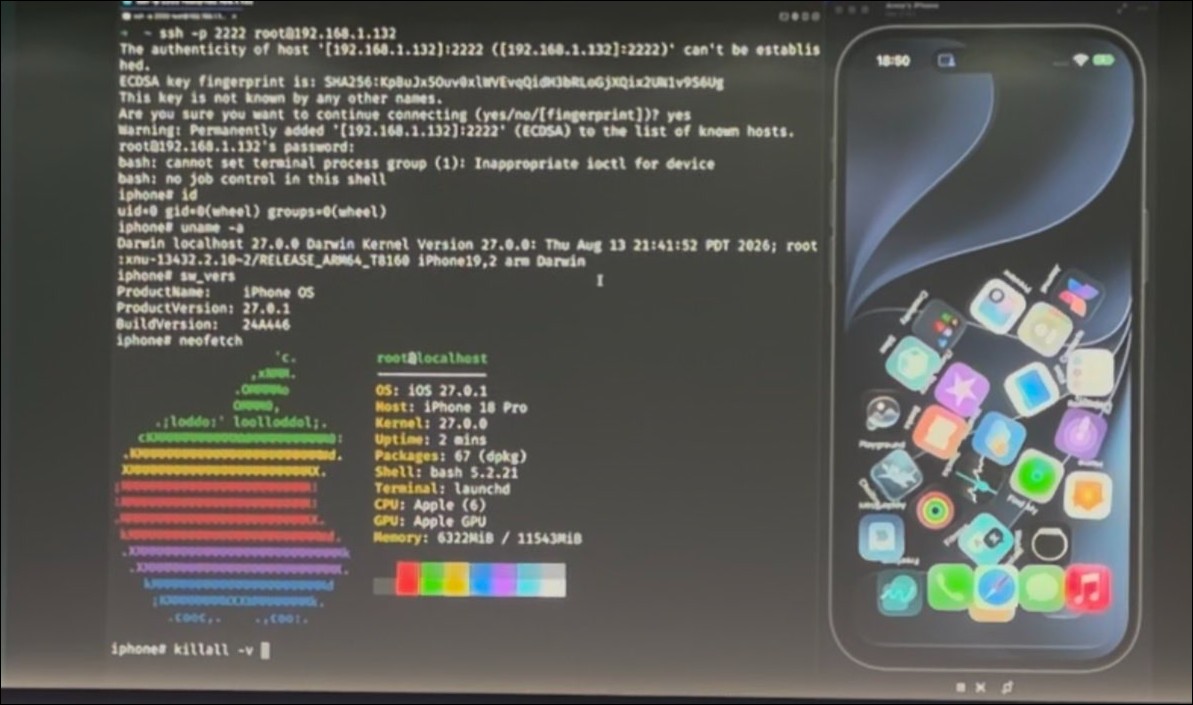
iPhone 18 Pro perfect jailbreak: jailbreak status persists after reboot.
Jailbreak researcher Billy Ellis filmed the scene.The team rebooted the phone, unlocked it with the normal passcode, opened an SSH connection, and got root access directly; the terminal showed iOS 27.0.1 and an uptime of about two minutes. “Untethered jailbreak” means the jailbroken state persists after a reboot, with no need to reconnect to a computer to run the jailbreak program. This is the first time the latest hardware plus the latest system has been defeated by a perfect jailbreak. Calif did not say which vulnerabilities were used and did not release any tools.
To get root on the latest iPhone, you usually have to chain together a full exploit chain: escape the App sandbox, take over the kernel, and bypass hardware-level protections such as Pointer Authentication Codes. Surviving a reboot is even harder, because Apple’s boot chain verifies signatures at every layer. This live reboot essentially lays the entire chain out for everyone to verify at once.
On Hexacon’s opening day, everyone in attendance witnessed it.
Hexacon is an offensive security conference in Paris, held over two days on October 16 and 17, with talks focused on vulnerabilities in commonly used platforms such as phones and browsers. Calif chose to take the stage on opening day, effectively putting the year’s most important demonstration on the first day. The live video is the strongest evidence: reboot, enter the password, SSH root, boot in two minutes, all in one continuous take, with no room for editing.
Four demonstrations: Signal, iMessage, jailbreak, APT
Calif’s X List four demonstrations. The first is Signal one-click intrusion:
Demos we presented at Hexacon in Paris today. Everything will be released in due time. 1/ Signal 1-click https://t.co/ZGnb0uVg4K
— Calif (@calif_io) October 16, 2026
The second one snarked, “Who cares about third-party apps? Everyone uses iMessage anyway, right?” Then came the iMessage version of the vulnerability:
The third “Can your iPhone do this?” is a jailbreak demonstration:
The fourth reinterprets APT as Apple Persistent Threat—Apple as a persistent threat—with the sarcasm cranked all the way up.
Some people online guessed that the Signal breach wasn’t in Signal itself but in the system’s PDF rendering library, yet Signal has no built-in PDF rendering code at all. Others, upon seeing PDF, thought of JailbreakMe from back in the day—open a webpage, swipe a bit, and you’re jailbroken—a whiff of Saffron. JailbreakMe also relied on a rendering engine flaw back then; more than a decade later, the same kind of attack surface is still here, and iOS PDF and font parsing have long been favorites of bounty hunters. This time Calif presented both the Signal and iMessage paths at once, effectively telling the whole room that this kind of flaw is still an active exploit vector to this day.
Who is Calif: BEAST discoverer, Stuxnet analyst, and on the same team as Pwn2Own champions
The company behind this demonstration, Calif, is no unknown outfit that got lucky with a crack. Calif is a California cybersecurity company with 60 people across five continents; its clients include OpenAI, Anthropic, Google, Cursor, and xAI, and it specializes in AI red teaming and security engineering. At the helm is Thai Duong, who spent 12 years at Google and is a co-discoverer of the three major TLS vulnerabilities BEAST, CRIME, and POODLE. The team includes Michal Zalewski, author of AFL-fuzz; Bruce Dang, who analyzed Stuxnet and worked at Apple; and Dion Blazakis, co-author of the iOS Hacker’s Handbook and winner of the Pwn2Own 2011 iPhone category. Even Google’s Security Princess Parisa Tabriz is listed as an advisor. With a lineup like this, it’s no surprise they’re going after the latest hardware.
Why have perfect jailbreaks been gone for years?
Younger users may not realize it, but untethered (perfect) jailbreaks have been extinct for a long time. checkm8 on iPhone X and earlier was an unpatchable hardware vulnerability, and it also gave rise to semi-tethered tools like palera1n, where after a reboot you have to connect to a computer to re-jailbreak. App-based jailbreaks like Dopamine are semi-untethered; if the signature expires, you have to start over, and support is limited to certain chips and firmware. For models after iPhone 16, public tools are basically nonexistent. This time Calif achieved an untethered jailbreak on A19 with iOS 27.0.1 that comes back by itself after a reboot—the first time since checkm8 that anyone has achieved this on the latest hardware. No wonder the jailbreak community says it’s like New Year.
Under the tweet: 3,600+ likes and 400+ retweets. TrollStore author opa334 dropped by saying Hexacon FOMO was kicking in; people asked whether the iPhone 17 Pro Max had also been compromised, and whether it supports 27.2 or you can only stay on 27.0.1. The three most-asked questions were: does Lockdown Mode block it, has the vulnerability been reported to Apple, and will it be released after 90 days. Someone outright called for opening a Patreon, saying the jailbreak community is willing to pay to support it.
No one knows whether Lock Mode can stop it.
The most frequently asked question under the tweet was whether turning on Lockdown Mode does any good. Two people asked the same thing in different ways, and Calif didn’t answer either. Lockdown Mode is Apple’s last line of defense for high-risk users; it shuts down attack surfaces such as message attachments and link previews. Calif’s one-click Signal and iMessage demo go through exactly these paths. Theoretically, turning it on can block them, but until the vulnerability details are made public, no one can guarantee it. Rather than agonizing over the toggle, ordinary users should first make sure their system is on the latest version. The demo uses 27.0.1; older versions are only more vulnerable.
Where did the vulnerability go: has it been reported, and when will it be released?
Calif only said it would be released in due course, without giving a timetable. By convention, responsible disclosure means reporting to Apple first and going public after a patch; the community’s guess of 90 days is a reasonable estimate, but officials have not confirmed it. The supported range was not nailed down either: the demo device was an iPhone 18 Pro running iOS 27.0.1, the A19 chip was also asked about, and whether older devices and 27.2 can use it remains entirely unknown. Before the tool is released, the point of this demonstration is proof, not a giveaway: proof that the defenses Apple spent heavily to build can still be breached on its latest hardware.
Conclusion
On Hexacon’s opening day, Calif used four demonstrations to take apart the iPhone security myth: Signal can be breached, iMessage can be breached, and even the boot chain can’t hold. The jailbreak community is waiting for tools, Apple is waiting for vulnerability details, and for ordinary users worried about security, there is only one thing they can do: install updates as soon as the update notification arrives, don’t delay—this is currently the only way to protect yourself.
Source: KOCPC Chinese