


The chip war between Samsung and Qualcomm has ushered in a new chapter. Galaxy S26 The series is about to debut, the flagship processors of the two semiconductor giants:Exynos 2600 Geekbench 6 benchmarks against the Snapdragon 8 Elite Gen 5 have been revealed one after another, kicking off this performance battle. Judging from the existing data, Qualcomm maintains the lead in CPU performance, but Samsung’s GPU equipped with AMD RDNA 4 architecture has unexpectedly achieved a counterattack and gained a slight advantage in the field of graphics processing.
CPU performance: Qualcomm continues to lead the way
In the Geekbench 6 CPU test, the Snapdragon 8 Elite Gen 5 showed the expected dominance. Single-core scores fall between 3,670 and 3,724 points, while multi-core scores range from 10,981 to 11,237 points. On the other hand, the Samsung Exynos 2600 has single-core scores ranging from 3,105 to 3,197 points and multi-core scores from 10,444 to 11,012 points.
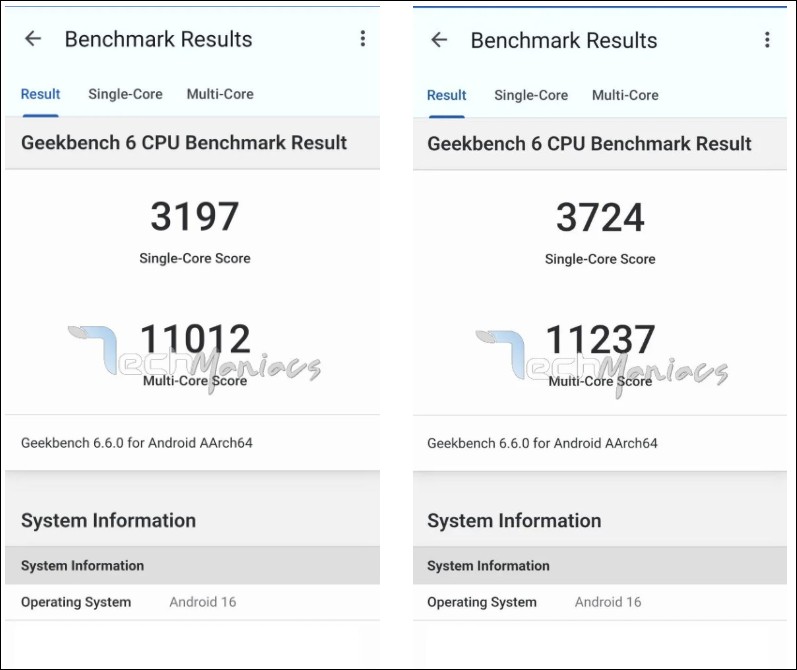
Translated, Qualcomm leads by about 18% in single-core performance and about 5% in multi-core performance. This gap is in line with market expectations. After all, Qualcomm has established a significant CPU advantage over the past few generations of products, and Snapdragon 8 Elite Gen 5 It continues the high-performance positioning of this codename “Elite”.
Single-core performance is crucial to the smoothness of daily applications, including application startup speed, web browsing experience, etc. Qualcomm’s lead in this regard means that the Galaxy S26 version equipped with a Snapdragon processor may be smoother in general usage scenarios. The gap in multi-core performance is small, which shows that Samsung has gradually caught up in multi-thread workloads. There is not expected to be a big gap between the performance of the two in heavy multi-tasking scenarios.
GPU Showdown: Samsung AMD Architecture Shows Its Power
However, the battle took a dramatic turn in the GPU tests. According to Geekbench 6’s OpenCL benchmark, the Exynos 2600 scored 24,240 points, slightly ahead of the Snapdragon 8 Elite Gen 5’s 24,152 points.
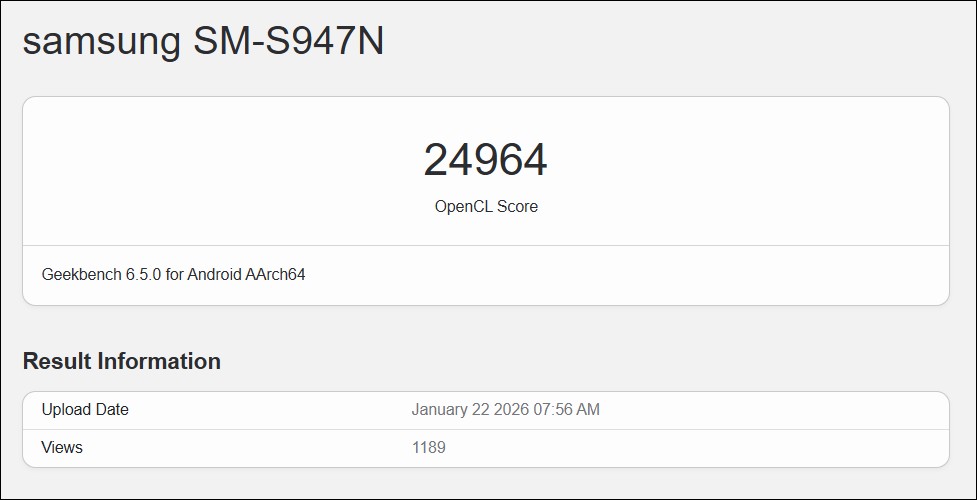
But if it is slightly inferior to the Honor mobile phone that is better tuned, let’s take it as arefer toThat’s it. To put it simply, there is no obvious gap between the two:
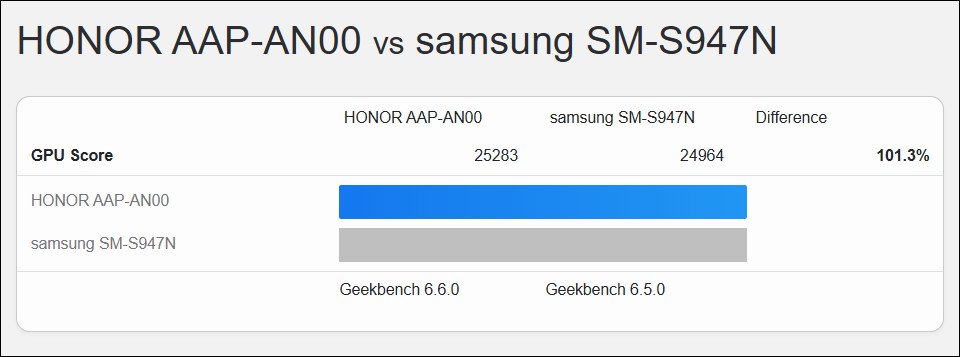
This is no accident. Since its partnership with AMD, Samsung has continued to integrate the RDNA architecture into Exynos processors. The RDNA 4 architecture carried by Exynos 2600 is AMD’s latest generation graphics technology, which also explains why Samsung can achieve overtake in GPU performance. This data is a big plus for users who value gaming, image processing, or any graphics-intensive application.
It’s worth noting that the difference in GPU scores between the two is minimal, only about 0.4%. In actual usage scenarios, such differences may be difficult to detect, and may be due to poor game compatibility (high scores but low performance). But this means that Samsung has the strength to compete head-on with Qualcomm in the field of graphics processing, and is no longer the “CPU is strong, GPU is weak” Exynos in the past.
Tradeoffs of a dual-version strategy
The Galaxy S26 series is expected to continue Samsung’s dual-version strategy: powered by Exynos 2600 in some markets and Snapdragon 8 Elite Gen 5 in others. Judging from the running score data, both chips have their own strengths:
– Pursuing CPU performance: Snapdragon 8 Elite Gen 5 leads in both single-core and multi-core tests, making it suitable for users who value application performance and multitasking.
– Pay attention to graphics performance: Exynos 2600’s GPU is slightly ahead and may be a better choice for mobile gamers and image creators.
However, the running scores are only for reference. The actual experience also depends on multiple factors such as thermal design, system optimization, battery management, and game compatibility. Samsung has been criticized in the past for thermal issues with its Exynos processors, and it remains to be seen whether it can improve this time around in the Galaxy S26 series.
Market Significance: Samsung’s Road to Redemption?
PhoneArena describes the performance of Exynos 2600 as “redemption”, which is not unreasonable. The past few generations of Exynos processors have been criticized for their energy efficiency and heat control, leading Samsung to abandon self-developed chips in some markets and fully embrace Qualcomm.
Now, Exynos 2600 has proven itself to be competitive at least in terms of paper performance, especially the breakthrough in the GPU field, showing that the cooperation between Samsung and AMD has entered the harvest period. If Samsung can simultaneously improve heat dissipation and power consumption control, the Exynos version may no longer be the despised “second choice.”
Conclusion
The battle between Samsung Exynos 2600 and Qualcomm Snapdragon 8 Elite Gen 5 is essentially an offensive and defensive battle of “CPU vs GPU”. Qualcomm holds the fortress of CPU advantage, while Samsung counterattacks in graphics processing. For consumers, this means that no matter which version you choose, you can get a top-level performance experience: the difference is only in the focus. As the official release date of the Galaxy S26 series approaches, more measured data will gradually surface. At that time, the true strength of these two flagship processors will be fully revealed.
Source: KOCPC Chinese