


Finnish startup Donut Lab recently announced the second batch of independent third-party test results of its solid-state batteries, this time focusing on high-temperature performance. Tests performed by the Finnish National VTT Technology Research Center have shown that the Donut Battery can not only operate stably in a high temperature environment of 80 degrees Celsius, but also operate normally in the face of extreme temperatures of 100 degrees Celsius, and has a higher discharge capacity than at room temperature. This result breaks through the long-standing temperature limitation bottleneck of traditional lithium-ion batteries and may have a revolutionary impact on the electric vehicle industry.
Testing agency: VTT Technology Research Center
This test is the same as the first batch of fast charging tests and was performed by the VTT Technical Research Center of Finland. VTT is the largest multi-field research institution in Northern Europe. Founded in 1942 and headquartered in Espoo, VTT has rich testing experience and international certification qualifications in battery technology, energy storage and other fields. According to the report published by VTT, this test adopted a standard discharge capacity test process, using constant current discharge to a cut-off voltage of 2.7V as a benchmark for comparison.

Temperature bottleneck of traditional lithium-ion batteries
Traditional lithium-ion batteries are extremely sensitive to temperature and require very precise temperature control to avoid damage and accelerated aging, as well as to avoid the worst-case thermal runaway. This means that lithium-ion batteries have a very narrow operating temperature range, typically limited to a maximum of 60°C to 70°C. This limitation makes fast charging in hot environments a huge engineering challenge and is the main reason why electric vehicles must be equipped with complex cooling systems. The setup for this test was similar to the previous fast charge test, with the test using a standard 1C discharge capacity test, discharging at a constant current to a 2.7V cutoff voltage. The test team has touched the equipment safety limit of 90°C in previous fast charging tests, but this is not the limit of the battery itself, but the conservative setting of the test equipment. This time they decided to challenge a higher temperature target to verify the true limits of the battery.

80°C high temperature test
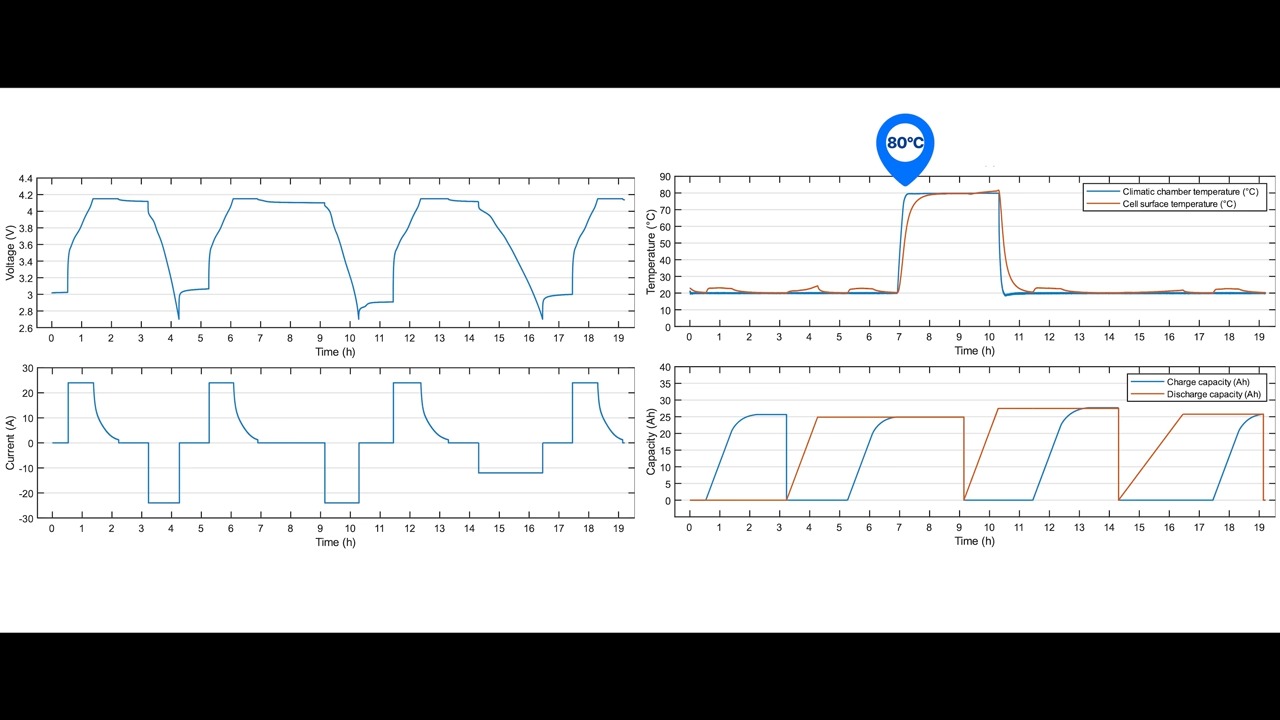
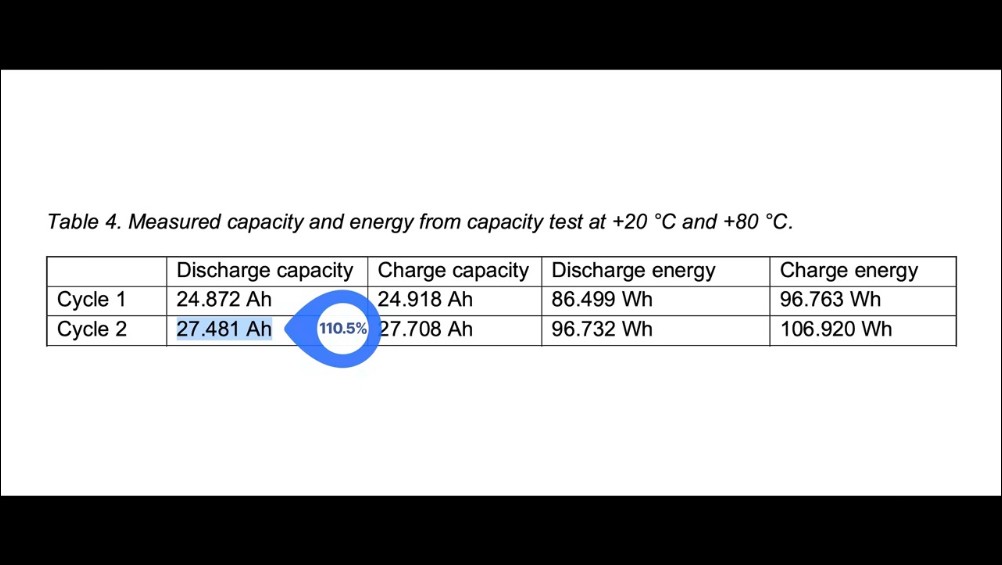
The test team placed the battery in an environment of 80 degrees Celsius for 2 hours to allow the battery temperature to stabilize before conducting a 1C discharge capacity test. Test results show that at 80°C, the battery can obtain about 10% more usable energy before reaching a cutoff voltage of 2.7 volts compared to room temperature. This is because high temperatures reduce the internal resistance of the battery, allowing for a lower voltage drop during discharge, allowing more of the available capacity to be used. It is worth noting that the battery behavior at 80°C was completely stable and no abnormal changes were observed, showing that this temperature range is well within the safe range.
100°C extreme high temperature test
The test team further increased the temperature to 100 degrees Celsius, an extreme condition that far exceeds the operating temperature limit of traditional lithium-ion batteries. After being maintained in a 100-degree environment for 2 hours, the Donut solid-state battery was still able to discharge normally, and its discharge capacity was about 7% greater than at room temperature. Post-test inspection showed that the active material still functioned normally, even though the outer packaging bag lost its vacuum in the high temperatures. More importantly, during these two high-temperature tests, the temperature of the battery itself almost did not rise, showing that solid-state batteries have excellent thermal management properties.
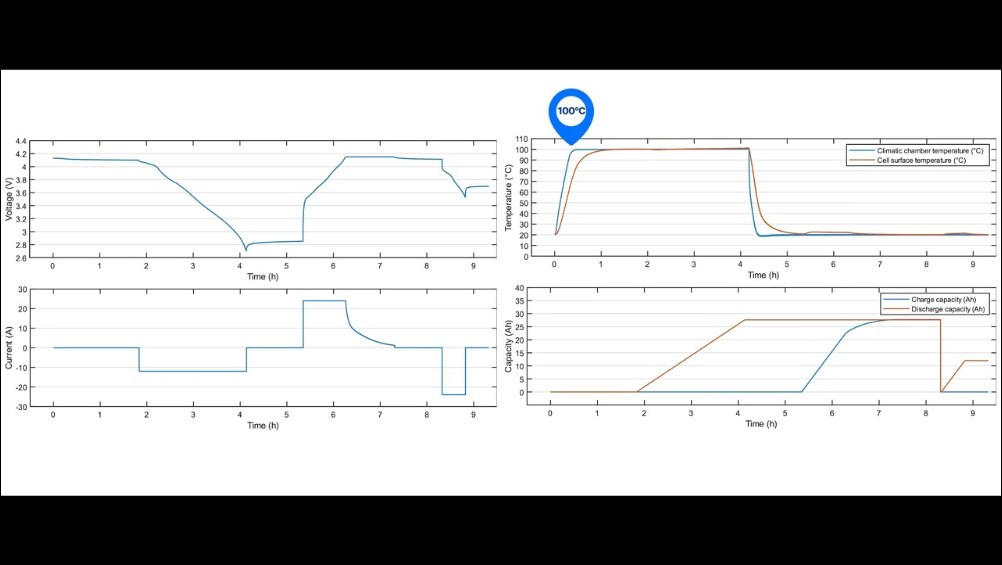
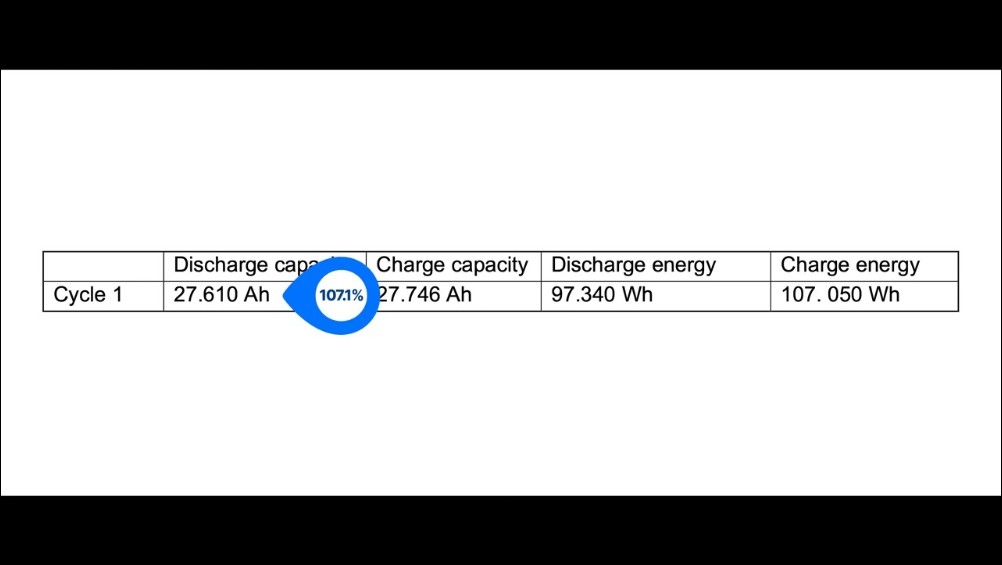
The test concluded that the comfort zone of Donut batteries reaches much higher temperatures than conventional lithium-ion batteries. It continues to operate in a stable manner at 100°C and reaches more capacity than the room temperature nominal capacity at 100°C. This is a major breakthrough for the electric vehicle industry, which means that future electric vehicles can operate in harsher environments, and the requirements for the cooling system may also be significantly reduced, and the cooling system may even be omitted in some application scenarios.
Friends who are interested in the detailed test content and results can also watch the video. However, I personally think it is better to wait until the products are actually sold in the consumer market before verifying them. Although they are currently handed over to an impartial third party for testing, it is still unknown whether the content of the samples is the “solid-state battery” they claim:
Test data overview
| Test temperature | Capacity change | stability | Battery temperature changes |
|---|---|---|---|
| Room temperature (baseline) | 100% | normal | — |
| 80°C | +10% | completely stable | No rise |
| 100°C | +7% | Stablize | No rise |
Industrial significance and prospects
The stable performance of Donut solid-state batteries in high-temperature environments has far-reaching significance for the electric vehicle industry. First of all, this means that future electric vehicles can operate in harsher environments, and the requirements for cooling systems may be significantly reduced. The cooling system may even be omitted in some application scenarios, which will significantly reduce manufacturing costs and vehicle weight. Secondly, traditional lithium-ion batteries are limited to an operating temperature limit of 60-70°C, and their performance is often greatly compromised in hot climates. The emergence of Donut solid-state batteries may change this dilemma.
From an industrial perspective, Donut Lab has now announced independent test results of two batches of VTT, verifying fast charging performance and high temperature performance respectively. These third-party test data confirm the credibility of at least some technical indicators. However, other core indicators that the industry is concerned about, including cycle life (claimed 100,000 times), energy density (claimed 400 Wh/kg), low-temperature performance (claimed -30°C to 100°C operating range), mass production feasibility (cost, supply chain, production scale), are yet to be revealed in subsequent test reports.
The full VTT test report is available on the official website idonutbelieve.com Download and obtain. Donut Lab stated that it will continue to announce subsequent test results, including cycle life testing and actual product application and other related data.
Source: KOCPC Chinese