


The world’s first consumer-grade Wi-Fi 8 router is counting down to launch. On September 1, TP-Link unveiled the world’s first complete Wi-Fi 8 product line at IFA 2026 in Berlin. Leading the lineup, the Archer 8 Ultra (model Archer BN800, codename BN19000) tri-band flagship router will open pre-orders in some regions starting September 30 and go on sale gradually from October. The spec sheet has also arrived in Taiwan with the press materials, but Taiwan pricing and launch schedule have not yet been announced. This product line is equipped with Wi-Fi 8 chips from Broadcom, Qualcomm, and MediaTek, while TP-Link itself is responsible for hardware and software design.
What’s the Buzz Around Wi-Fi 8: The Focus Shifts from Speed to Stability
The official name of Wi-Fi 8 is IEEE 802.11bn, and its official subtitle “Ultra High Reliability” (UHR) points out the focus of this generation. The specification targets list three items: under the same signal conditions, throughput increases by 25%, 95th percentile latency decreases by 25%, and packet loss rate decreases by 25%; theoretical peak speed remains at the same level as Wi-Fi 7. In engineering terms, Wi-Fi 8 raises the floor while keeping the ceiling unchanged. According to TP-Link, over the past decade, “better Wi-Fi” has almost meant “faster Wi-Fi”; Wi-Fi 8 shifts the engineering focus to performance at the edge of signal coverage, through walls, under interference, and during multi-device congestion.

This standard is still in draft form: 802.11bn is not expected to be finalized until 2028. The first products will ship according to the draft specification, with feature gaps to be filled in later through firmware updates. TP-Link placed its bet very early, completing the world’s first Wi-Fi 8 connection in October 2025 and holding its first live demo at CES in January 2026. TP-Link Systems President Jeff Barney said modern users value a stable, consistent connectivity experience, and the Archer 8 series was designed from the outset to eliminate the pain points of latency and disconnections.
Archer BN800: 19Gbps tri-band, 18 built-in antennas
The Archer BN800 is a tri-band model: 11,528 Mbps on the 6 GHz band, 5,764 Mbps on 5 GHz, and 1,376 Mbps on 2.4 GHz, totaling about 18.7 Gbps, which the manufacturer refers to as 19 Gbps class. The 6 GHz band uses the clean channels newly opened with Wi-Fi 6E; only 320 MHz bandwidth plus high-order modulation can achieve the 11,528 Mbps figure, and interference is much lower than on 2.4 GHz. The unit packs 18 built-in high-performance antennas, and with Multi-Floor mode and Range Boost, the manufacturer claims a single unit covers 3,600 square feet, about 101 ping, and can connect 200 devices simultaneously.
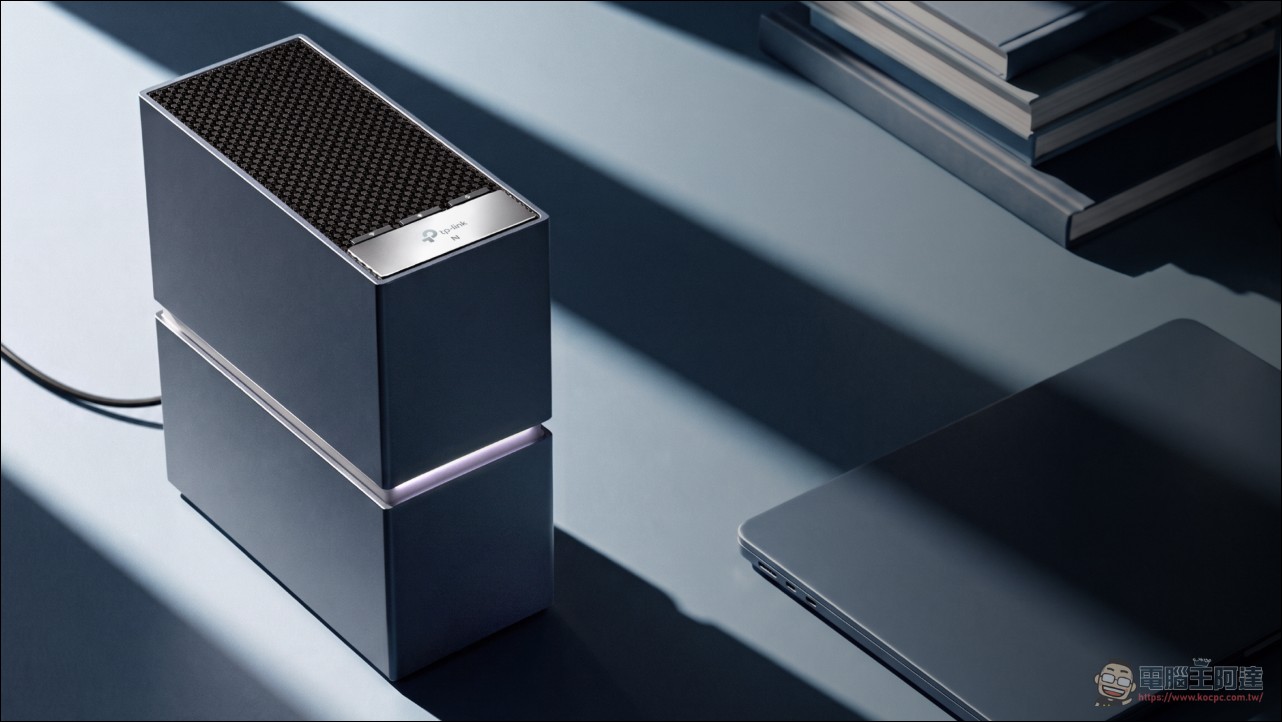
TP-Link lab data compares it with its own comparable Wi-Fi 7 models: at the same signal strength, throughput is up to 33% higher, performance consistency in interference-heavy environments is 24% higher, cross-floor performance is 30% better, and Mesh coordination is 15% better. Appearance is also one of its selling points: the company deliberately designed the chassis to sit directly on a living room shelf, encouraging users not to shut it inside a low-voltage box or corner, so the signal won’t be at a disadvantage from the start.
StabilityEngine: packaging the technology from the 802.11bn draft
The Archer BN800 features a technology suite that TP-Link calls Wi-Fi 8 StabilityEngine, corresponding to several key mechanisms in the 802.11bn draft: DRU distributed resource units spread the signal across a wider frequency band, bypass power density limits, and extend effective range; ELR enhanced long-range transmission adds redundancy to uplink packets so remote devices can decode successfully on the first try; New MCS and UEQM unequal modulation maintain throughput under interference; DSO dynamic sub-band operation and NPCA non-primary channel access let devices find another path when the primary channel is congested; and MAPC multi-access point coordination lets multiple access points divide the work without competing with one another.
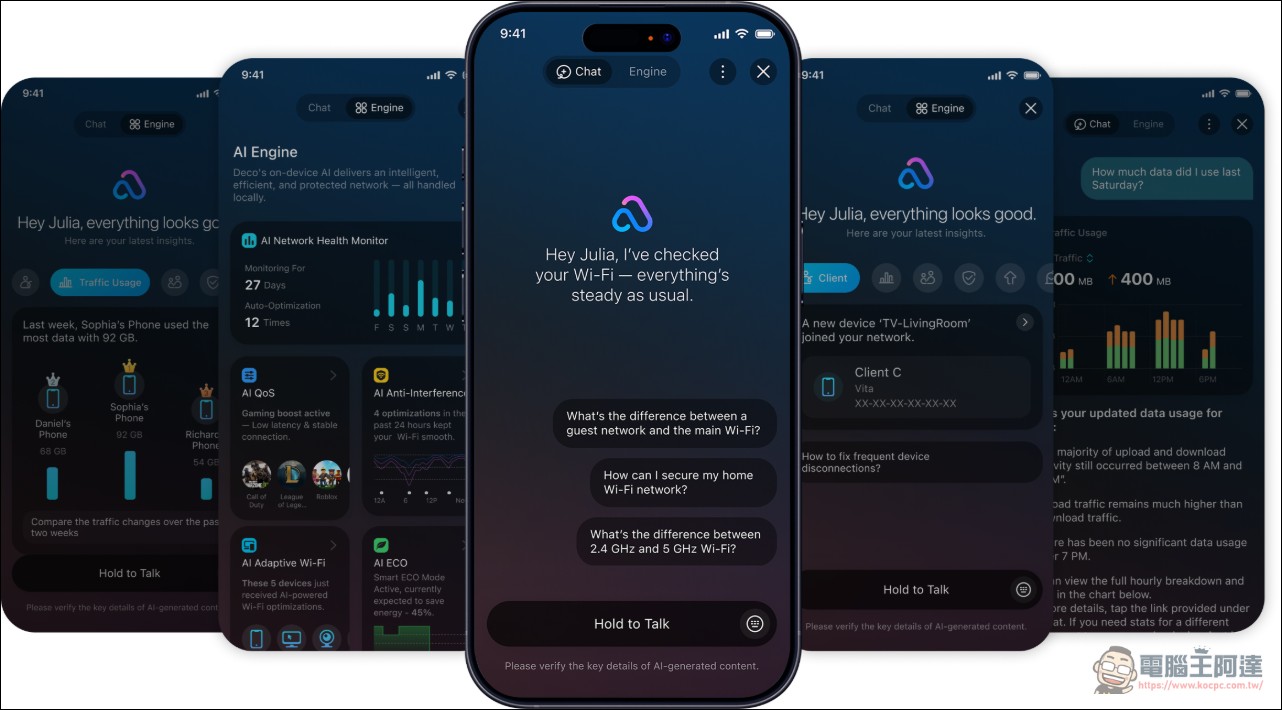
On the software side, the Aireal AI Assistant also provides real-time tuning, with built-in self-diagnosis and repair. It continuously monitors the network, identifies the causes of interference or congestion, and automatically corrects them, plus AI QoS and AI anti-interference.
Dual 10G network ports and software features
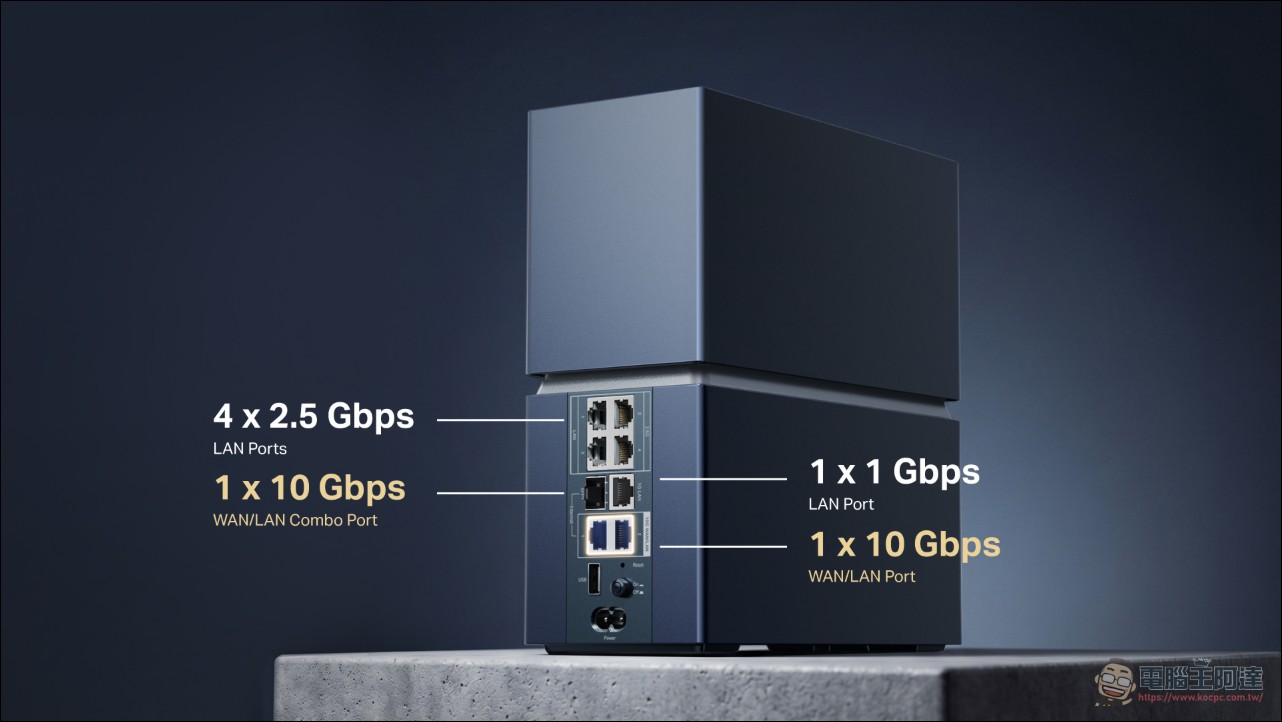
The wired specs are just as solid: one 10Gbps SFP+/RJ45 combo port and one 10Gbps RJ45 port, with both ports automatically detecting whether to connect to WAN or LAN, plus four 2.5Gbps and one 1Gbps LAN ports, so it can handle 10G fiber or Ethernet cable coming into the home. VPN server and client support OpenVPN, WireGuard, L2TP, and PPTP, so devices don’t need to install VPN software individually—encryption happens at the router level.
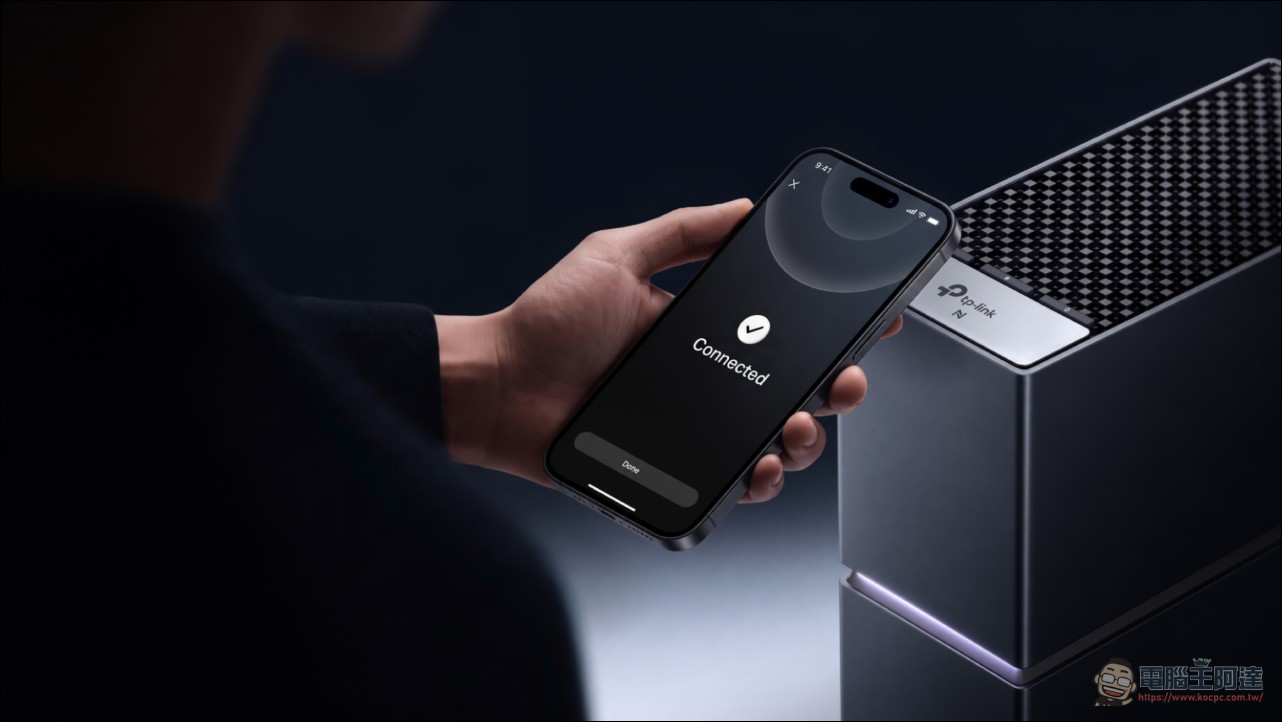
Security includes WPA3 and HomeShield family protection, with parental controls, IoT device identification, and regular network security scans; each of the three bands has an independent guest network. QoS offers three modes: per-device, per-app, and AI. It can also join a Mesh system in EasyMesh agent mode, or switch to router or access point mode; when upgrading from an old router, the two can be used together. A phone tap with NFC completes setup, or you can share Wi-Fi with guests without entering a password; it supports Alexa and Google Assistant voice control. Dimensions are 226 x 98 x 245.6 mm, and the package includes a power cord, RJ45 network cable, and quick installation guide. The spec sheet also lists transmit power for each band: FCC 2.4GHz and 5GHz each ≤30dBm, 6GHz ≤25dBm; 6GHz receive sensitivity at 320MHz bandwidth and the highest modulation is −45dBm, for those who want to calculate their own signal budget.
Launch timeline: pre-orders on September 30, Taiwan will have to wait.
TP-Link’s schedule is tight: full details will be announced at the September 30 global online launch event, the Archer 8 Ultra will open for preorder in some regions the same day and go on sale in October, with other regions gradually following in 2027; the same series’ Deco 8 Ultra Mesh system is slated for Q1 2027, while the Roam 8 travel router and Wi-Fi 8 extender are slated for Q2. The Deco 8 Ultra Mesh system (BN22000), also unveiled, has a total wireless speed of 22Gbps; a three-pack covers 9,800 square feet, about 275 ping, and can connect more than 200 devices. Those who want to be first in line should be sure to catch the September 30 global online launch event; regional on-sale schedules are subject to TP-Link’s official announcements. The press materials sent this time include the Japan-certified version’s specification sheet (VCCI, JATE, PSE, JRF); pricing and launch timing for the Taiwan version are yet to be announced.
Conclusion
Wi-Fi 8’s value proposition is clear: put engineering resources into the floor of connection quality while keeping peak numbers unchanged. The upside is that existing Wi-Fi 6 and Wi-Fi 7 devices can also benefit from some reliability improvements; the caveat is that the standard won’t be finalized until 2028, so buying now means paying upfront for draft specs, and how complete the later features turn out to be will depend on the vendor’s commitment to firmware updates. For heavy users with over a hundred devices at home and bandwidth already above 2.5G, this unit’s 10G Ethernet port and 18 antennas will have room to be fully utilized; for ordinary small households, it’s fine to wait and see for a round and decide once Taiwan launch information is clearer.
Source: KOCPC Chinese