


OpenAI only launched it last Tuesday. GPT-6 Sol and GPT-6 LunaBut in just one week, GPT-6 Sol got an upgraded version. OpenAI earlier announced GPT-6.1 Sol at the DevDay 2026 developer conference. It is priced exactly the same as GPT-6 Sol, but its ability to code, operate computers, and handle professional documents has almost caught up with the most powerful GPT-6 Astra.
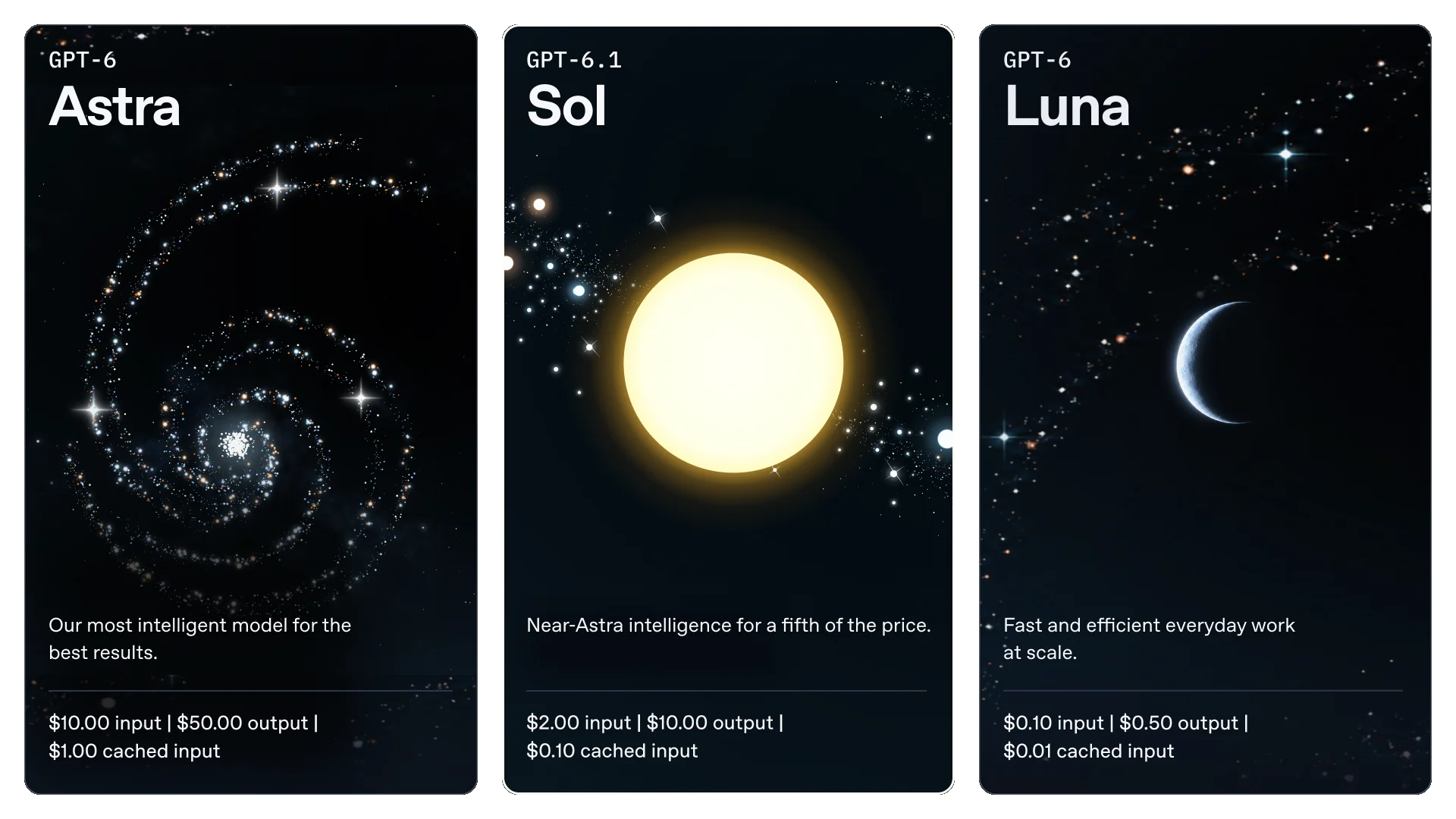
GPT-6.1 Sol debuts: price unchanged, performance approaching GPT-6 Astra, with comprehensive upgrades across coding, computer operation, and scientific research.
GPT-6.1 Sol It is a major upgrade to GPT-6 Sol and the first GPT-6.1 model to launch. It is now available in ChatGPT Work mode, Codex, and the OpenAI API. GPT-6.1 Sol’s API pricing remains $2 per million input tokens and $10 per million output tokens, just one-fifth that of Astra; OpenAI describes it as “Astra-like performance at Sol’s price.”
The improvements in GPT-6.1 Sol this time roughly fall into six areas.
- Coding: It substantially outperforms GPT-6 Sol in coding and debugging, and does so at lower reasoning effort.
- Professional documents and business processes: better at reading reports and completing an entire workflow.
- Computer operation: significant improvement on computer operation workflows that require spanning multiple applications and take a relatively long time, narrowing the gap with GPT-6 Astra to only 2.1 percentage points.
- Scientific research: this includes research work such as data analysis, running simulations, and theorem proving that requires writing code while operating in the terminal. This is the area where GPT-6.1 Sol has improved the most, with its score jumping to more than double that of GPT-6 Sol.
- Factual accuracy: When answering questions prone to errors, GPT-6.1 Sol had a lower rate of stating incorrect facts than GPT-6 Sol, most notably at low reasoning effort.
- More obedient, more honest: OpenAI says GPT-6.1 Sol is more willing to candidly explain what it can’t do—for example, when a search tool is broken, it will honestly tell you instead of just guessing an answer. When it encounters clear limitations in agentic tasks, it is also less likely to try to work around them.
GPT-6.1 Sol has a context length of 1.05 million tokens and can output up to 128,000 tokens. It supports text and image input and text output, and its knowledge cutoff date is April 30, 2026. Reasoning effort can be set to one of five levels: low, medium (default), high, very high, and Max.
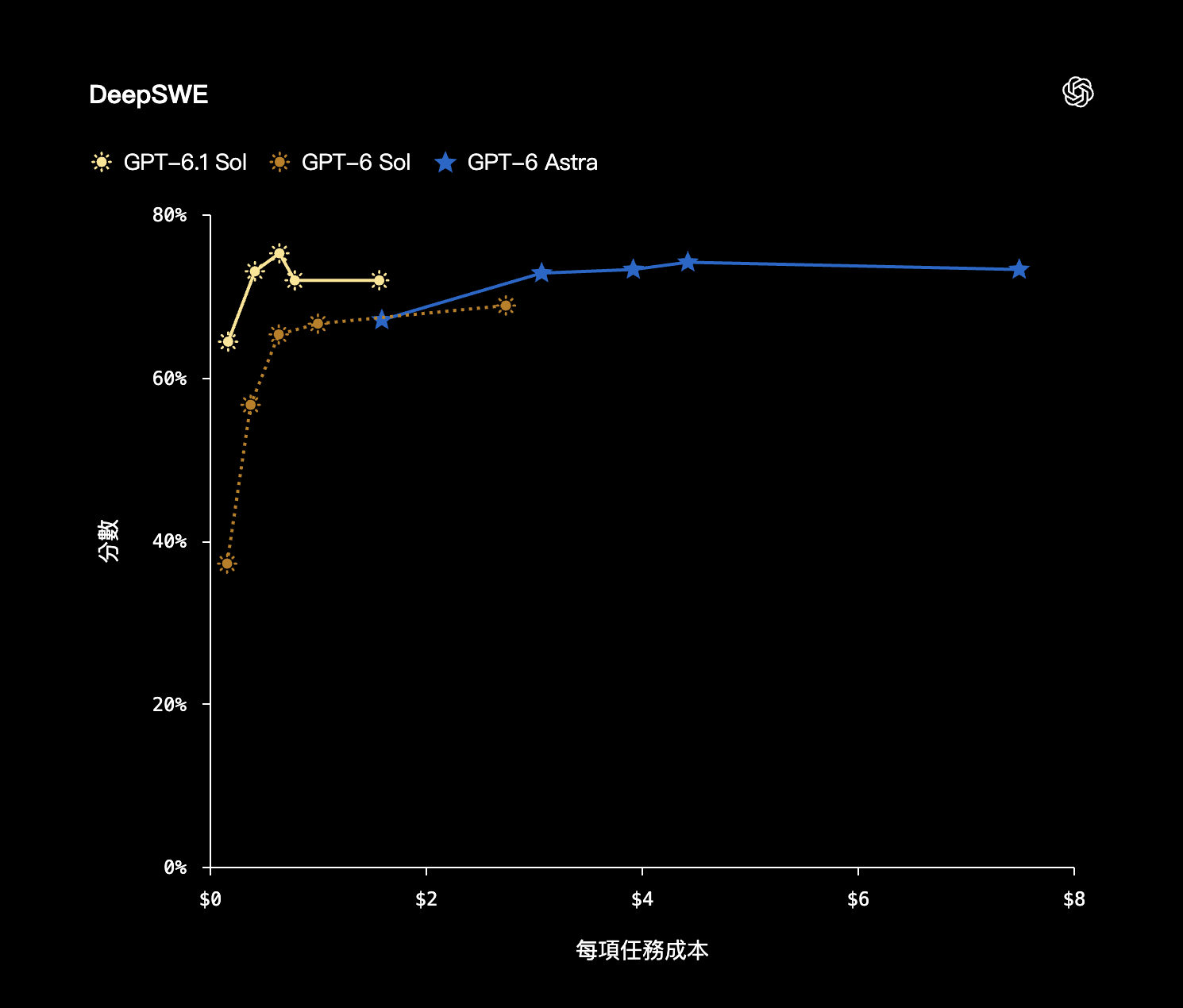
In the benchmark section, for DeepSWE v1.1, when both are set to low reasoning effort, GPT-6 Sol scores only 37.2% while GPT-6.1 Sol gets 64.4%, with nearly identical cost per task ($0.16 vs. $0.17). At medium reasoning effort, it’s also 56.6% vs. 73.0%. GPT-6 Sol has to be set to Max and spend $2.74 to reach 68.8%, whereas GPT-6.1 Sol reaches 75.2% at high reasoning effort for $0.65, which is what the official statement means by “with lower reasoning effort and cost, it beats GPT-6 Sol’s best result by 6.4 percentage points”:
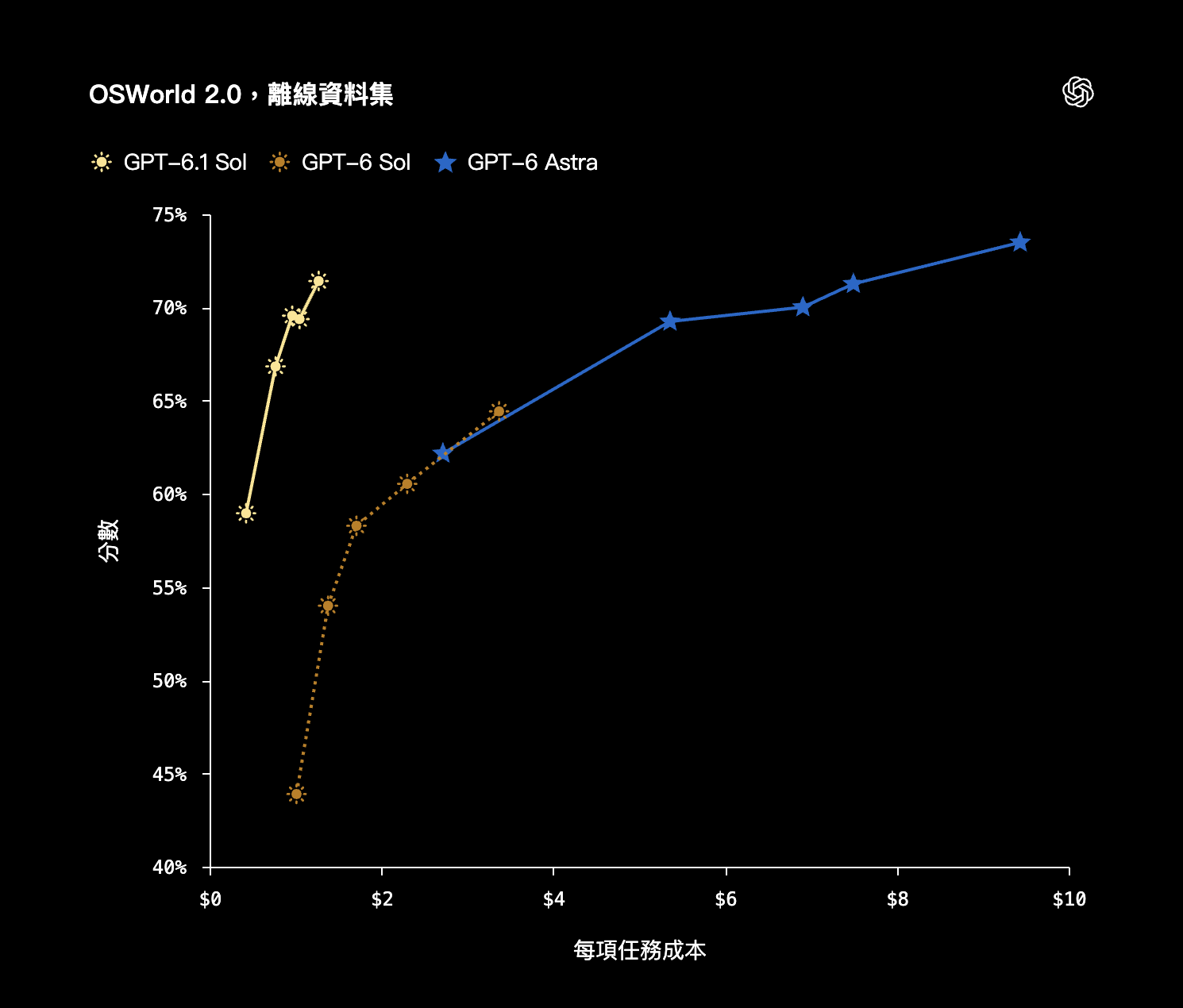
On OSWorld 2.0 for computer use, when both are set to Max, GPT-6.1 Sol scores 71.4%, while GPT-6 Sol scores 64.4%, a 7% improvement, yet the cost per task drops from $3.37 to $1.27. Compared with GPT-6 Astra’s Max score of 73.5%, it leads by only 2.1%, but costs $9.44 per task, roughly seven times that of GPT-6.1 Sol, so it saves a great deal:
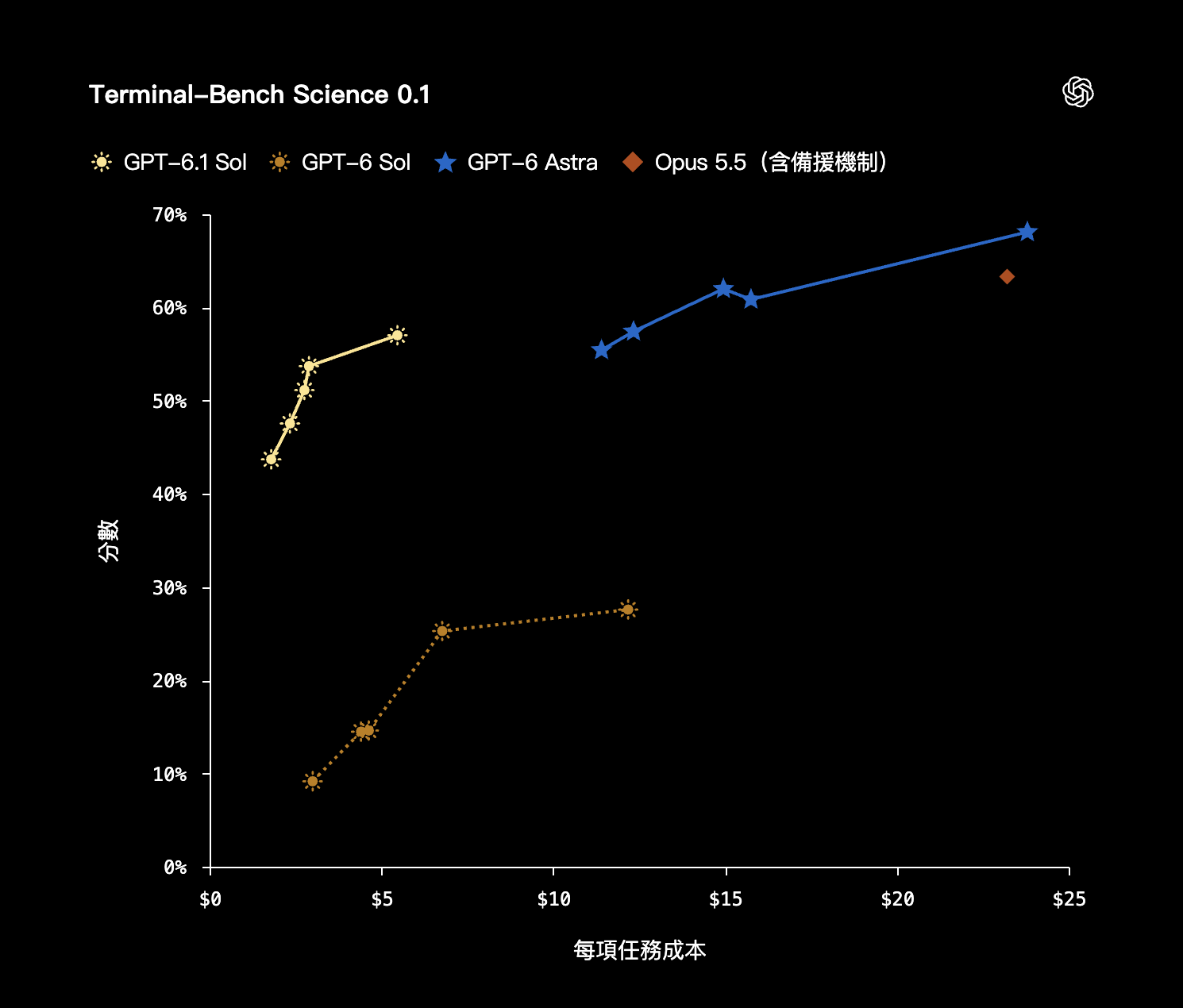
On Terminal-Bench Science 0.1 for scientific research, GPT-6.1 Sol with Max enabled scored 57.0%, while GPT-6 Sol scored only 27.6%, and the cost also dropped from $12.18 to $5.47:
Reading the complex PDF GDP.pdf, GPT-6.1 Sol’s best score is 32.0%, GPT-6 Sol is 28.0%, and GPT-6 Astra is 32.2%, almost tied. Claude Opus 5.5’s best score is 28.8%:
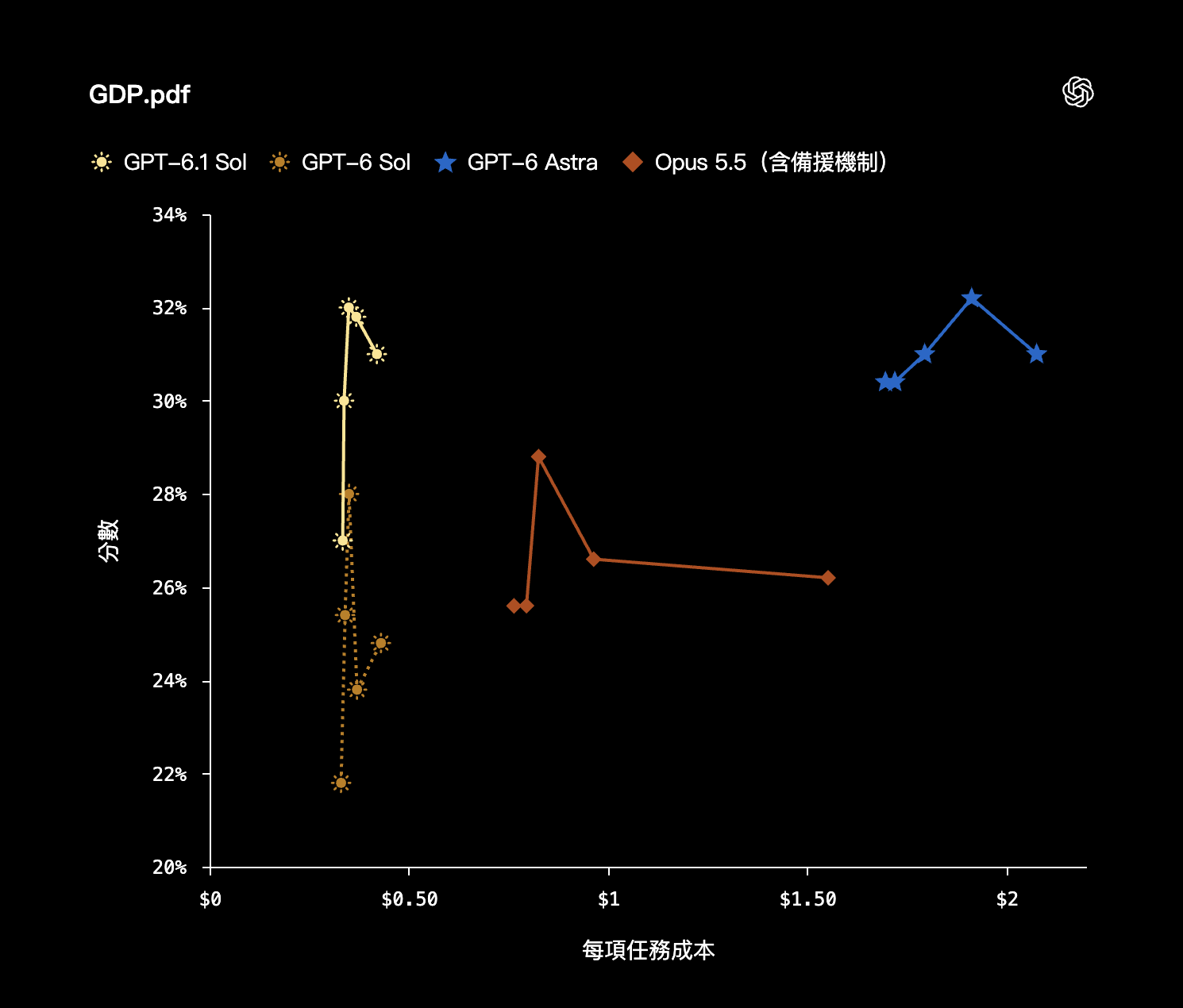
The table below shows the test data officially shared:
| Test items (best scores per model) | GPT-6 Sol | GPT-6.1 Sol | GPT-6 Astra | Claude Opus 5.5 |
|---|---|---|---|---|
| DeepSWE v1.1 (programming) | 68.8% (Max,$2.74) |
75.2% (High, $0.65) |
74.1% (Extra high, $4.43) |
Not listed |
| OSWorld 2.0 (computer operation) | 64.4% (Max,$3.37) |
71.4% (Max,$1.27) |
73.5% (Max,$9.44) |
Not listed |
| Terminal-Bench Science 0.1 (Scientific Research) | 27.6% (Max,$12.18) |
57.0% (Max,$5.47) |
68.1% (Max,$23.80) |
63.3% (Max,$23.21) |
| GDP.pdf (Read Professional PDF) | 28.0% (High, $0.35) |
32.0% (High, $0.35) |
32.2% (Very high, $1.91) |
28.8% (High, $0.83) |
| AutomationBench 1.0.6 (Business Process) | 33.2% (Extra High, $0.27) |
36.1% (Max,$0.30) |
41.4% (Max,$1.73) |
42.5% (Max,$1.44) |
Starting today, GPT-6.1 Sol is available to ChatGPT Plus, Pro, Business, Enterprise, and Edu users. It can be used in ChatGPT’s Work mode and Codex—just select GPT-6.1 Sol from the model menu. Note that it is not yet available in the regular ChatGPT “chat,” and the free tier and Go plan are also not included this time.
Developers can call the gpt-6.1-sol model through the OpenAI API. Pricing is shown in the table below. Compared with GPT-6 Sol, the input and output prices remain unchanged, but cached input drops from $0.20 per million Token to $0.10, cutting it in half:
| model | Input | Cache input | Output | Knowledge cutoff |
|---|---|---|---|---|
| GPT-6 Astra | $10 | $1 | $50 | — |
| GPT-6.1 Sol | $2 | $0.10 | $10 | April 30, 2026 |
| GPT-6 Sol | $2 | $0.20 | $10 | April 20, 2026 |
| GPT-6 Luna | $0.10 | $0.01 | $0.50 | — |
Source: KOCPC Chinese