


Recently, according to people familiar with the matter, Meta has encountered major setbacks in the development of self-developed AI chips. It has abandoned its most advanced training chip project and shifted its development focus to alternatives with simpler structures. The decision marks a setback in the technology giant’s years-long pursuit of chip autonomy and also highlights the importance of external suppliers such as Nvidia and AMD.

Meta’s dream of self-developed chips is broken, and it will give up the development of its own advanced AI training chips
Meta’s self-developed chips belong to the “Meta Training and Inference Accelerator” (MTIA) project, which aims to reduce dependence on external suppliers, while reducing data center operating costs and enhancing infrastructure control capabilities.

However, Meta’s chip development path has not been smooth. According to reports, Meta has abandoned a version of its second-generation training chip code-named “Iris” and subsequently initiated the development of a more advanced chip “Olympus”, but the project also suffered an aborted fate. One person involved in chip development said there was skepticism within the company about being able to develop a chip that could match Nvidia’s performance, for reasons including:
- Development cycle is too long
- Extremely high design complexity
- Power consumption control is difficult
The person further pointed out: “If power consumption cannot be effectively controlled, the competitiveness of the chip relative to Nvidia products will be weakened.”
Differences in technical architecture: The debate between SIMD and SIMT
In terms of technical architecture, Meta’s chip development has gone through different design directions:
| Chip code | Architecture type | Features | state |
|---|---|---|---|
| Iris | SIMD (Single Instruction Multiple Data) | Hardware design is easier, but software development is more difficult | Some versions have been cancelled |
| Olympus | SIMT (Single Instruction Multiple Threads) | Similar to Nvidia chips, hardware implementation complexity is higher | Canceled |
Olympus uses a SIMT architecture similar to Nvidia chips, which is more suitable for AI training software, but the hardware implementation complexity is greatly increased.
Rivos technical support failed: Olympus’s GPU originally planned to use Rivos technology acquired by Meta in 2025. This technology is compatible with Nvidia’s Cuda software ecosystem, and Cuda is the current industry standard for AI training. However, when the project was cancelled, the technology integration plan also fell through.
Meta adjusts chip strategy: fully relies on external suppliers
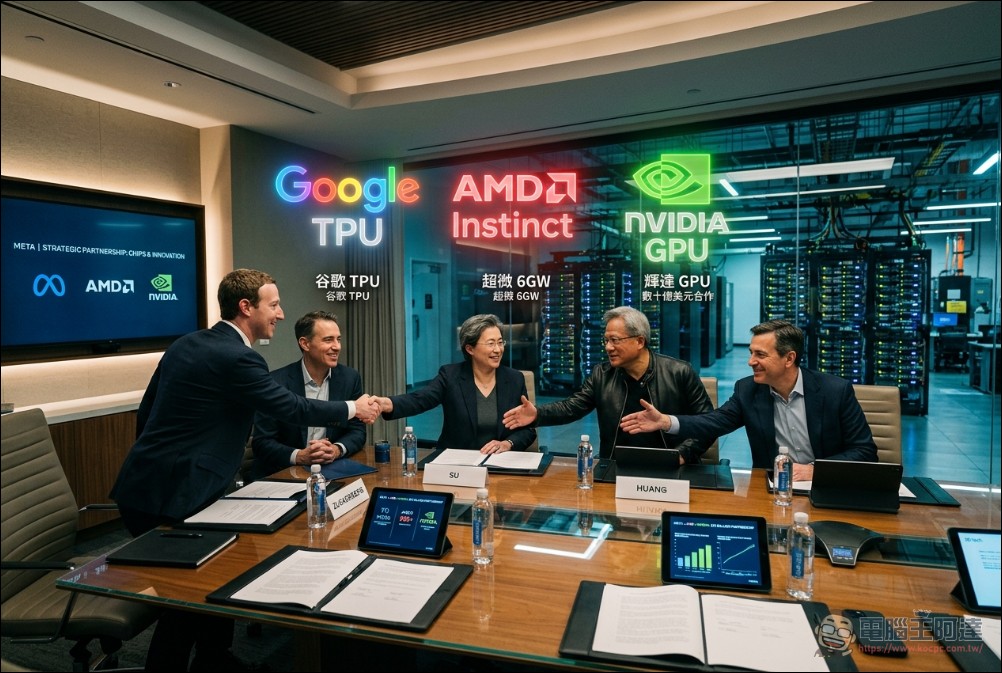
As the self-developed chip project fails, Meta is strengthening cooperation with existing chip suppliers (Google, NVIDIA and AMD). The projects include:
- Meta signs multibillion-dollar deal to lease AI chips from Google
- Google’s Tensor Processing Unit (TPU) will be deployed
- AMD said this week it will work with Meta to deploy the most 6GW Instinct AI chips to support Meta’s next-generation AI infrastructure
- Meta this month announced a multi-generational partnership with Nvidia to continue deploying Nvidia chips in data centers
- This is yet another recognition of Nvidia’s technological prowess
According to the original plan, Meta originally planned to launch as early as Q4 2026 Complete Olympus design. However, after the chip design is completed, it usually still requires at least 9 monthsMass production is required, which means that even if the project proceeds smoothly, mass production chips will not be available until 2027 at the earliest.
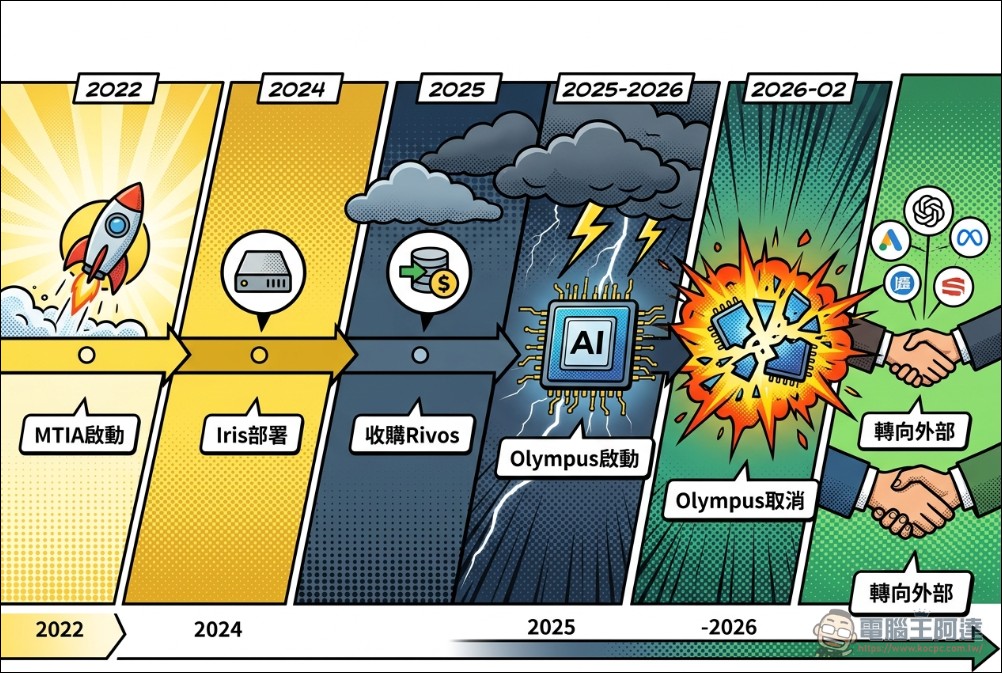
Related development timeline
| time | event |
|---|---|
| 2022 | Meta launches MTIA project |
| 2024 | Iris inference chips begin deployment |
| 2025 | Meta acquires Rivos |
| 2025 | Olympus project launched |
| 2026.02 | Olympus project canceled |
| 2026.02 | Cooperation with Google, AMD, Nvidia |
In addition, Meta initially planned to build a large-scale AI training server cluster based on Olympus, but management believed that there were the following risks:
- Difficulty in mass production: Complex design may increase the difficulty of mass production
- Software maturity: Probably not as good as the Nvidia ecosystem
- schedule risk: May affect the company’s progress in training new models as it competes with OpenAI and Google
Analyst View: Nvidia, AMD will benefit
Regarding Meta’s decision to abandon self-developed chips, market analysts generally believe that it will benefit existing GPU suppliers.
Wedbush Securities Analysispointed out:
- “Designing advanced AI accelerators requires significant capital and technical complexity, and many high-profile projects in the semiconductor industry have been scaled back or canceled in recent years.”
- “Meta’s decision highlights the difficulty of competing with existing chipmakers that have invested heavily in building software ecosystems, developer tools and manufacturing partners.”
- For GPU vendors, this development is “seen as supportive” as it reduces the risk of major hyperscale customers vertically integrating parts of their AI computing operations
The impact on Broadcom is mixed: Although custom chip opportunities related to Olympus may be lost, network or connectivity requirements may arise due to increased TPU deployment.
summary
Meta’s abandonment of self-research of the most advanced AI chips is not only a major setback for the company, but also a warning for the entire technology industry’s self-research of AI chips. It is safer to purchase ready-made AI cluster solutions from NVIDIA and Google in a short period of time. It also means that it is difficult for the AI circle to get rid of its dependence on Huida solutions. Although Meta is also about to have in-depth cooperation with AMD, it is not yet known whether the actual use situation will be better than that of NVIDIA.
Impact on Meta:
| For | Influence |
|---|---|
| cost | Billions of dollars in external chip purchases annually |
| technology | Still dependent on Nvidia, AMD, Google |
| compete | Competing with OpenAI and Google is at a disadvantage |
| Talent | May lead to a loss of chip talent |
Implications for industry:
- Nvidia’s position strengthens: In the field of AI chips, Nvidia’s dominance will be difficult to shake in the short term.
- Self-developed chips are risky: Even with rich resources like Meta, it will be difficult to catch up with Nvidia’s technology accumulation in the short term.
- Software ecology is the key: The strength of the Cuda ecosystem is Nvidia’s core competency
Issues worthy of attention:
- Will Meta re-evaluate its self-developed chip strategy?
- Will other technology giants speed up the pace of self-developed chips?
- Will the supply chain of AI training chips change as a result?
Source: KOCPC Chinese