


Skipping M5 and jumping directly from M4 to M6, Apple made a surprise launch on August 25, 2026, of the new M6 Mac mini with an M6 processor, starting at NT$29,900 in Taiwan, about NT$3,000 more than the previous M4 model. This is the first Apple Silicon chip to use TSMC’s 2nm process, with comprehensive upgrades to the CPU, GPU, and NPU. The Bilibili tech channel Geekerwan immediately got the actual device and published complete review data.
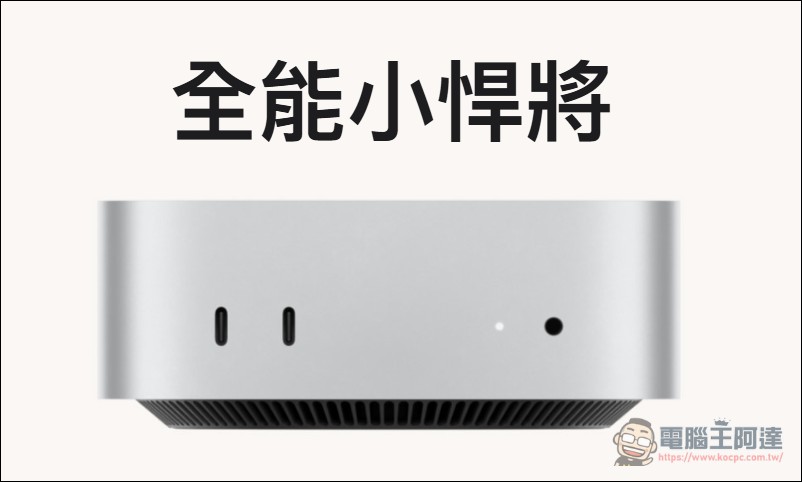
M6 Mac mini specs overview: tri-cluster CPU debuts
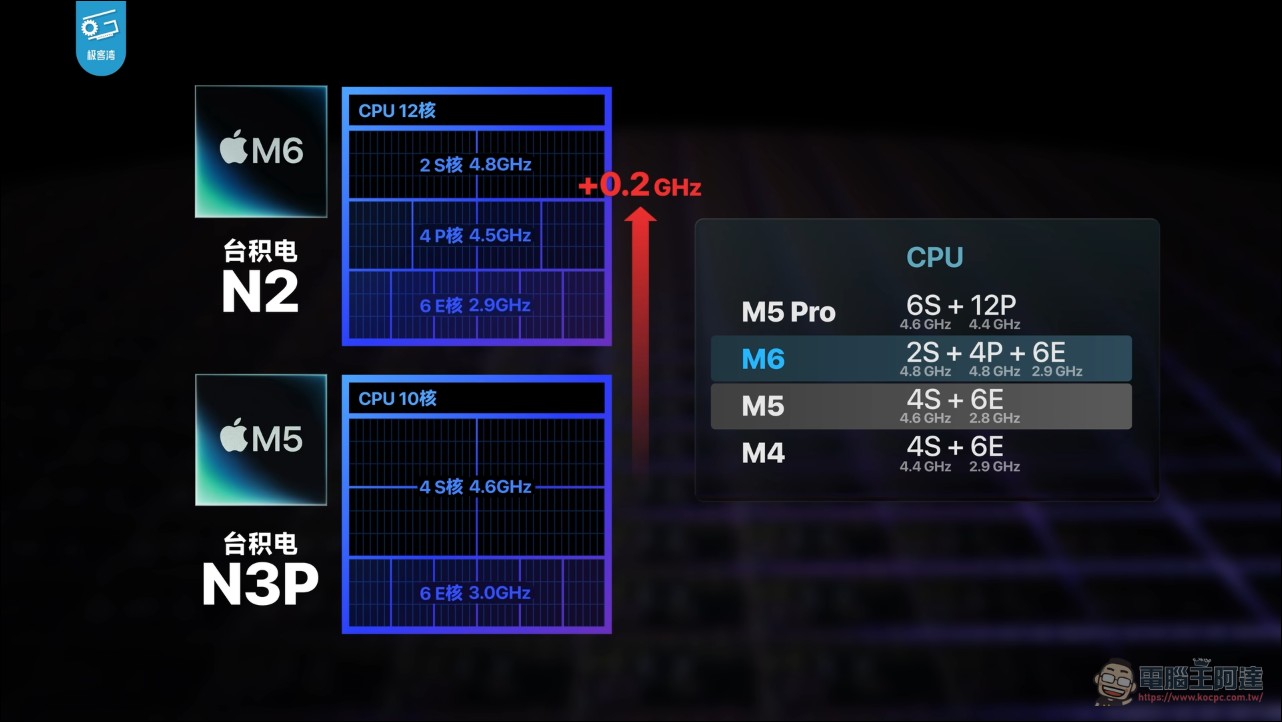
The M6 CPU has changed from the previous generation M4’s 4+6 cores to a 2+4+6-core three-cluster design. The most notable change is replacing two of the super cores (S cores) with the P cores (performance cores) first introduced in the M5 Pro / M5 Max. Thanks to TSMC’s N2 process, all core frequencies have increased in tandem:
- S core (super core):4.8GHz
- P-core (performance core):4.5GHz
- E-core (Efficiency-core):2.9GHz
The GPU retains the Apple Family 11 architecture, with the core count increasing from 10 to 12 and the clock speed rising slightly from 1.6GHz to 1.7GHz. Memory still maintains a 128-bit bus width, with the frequency increased to 10667MHz, resulting in limited bandwidth improvement. The NPU is twice as large as the previous generation, on par with the A20 Pro.
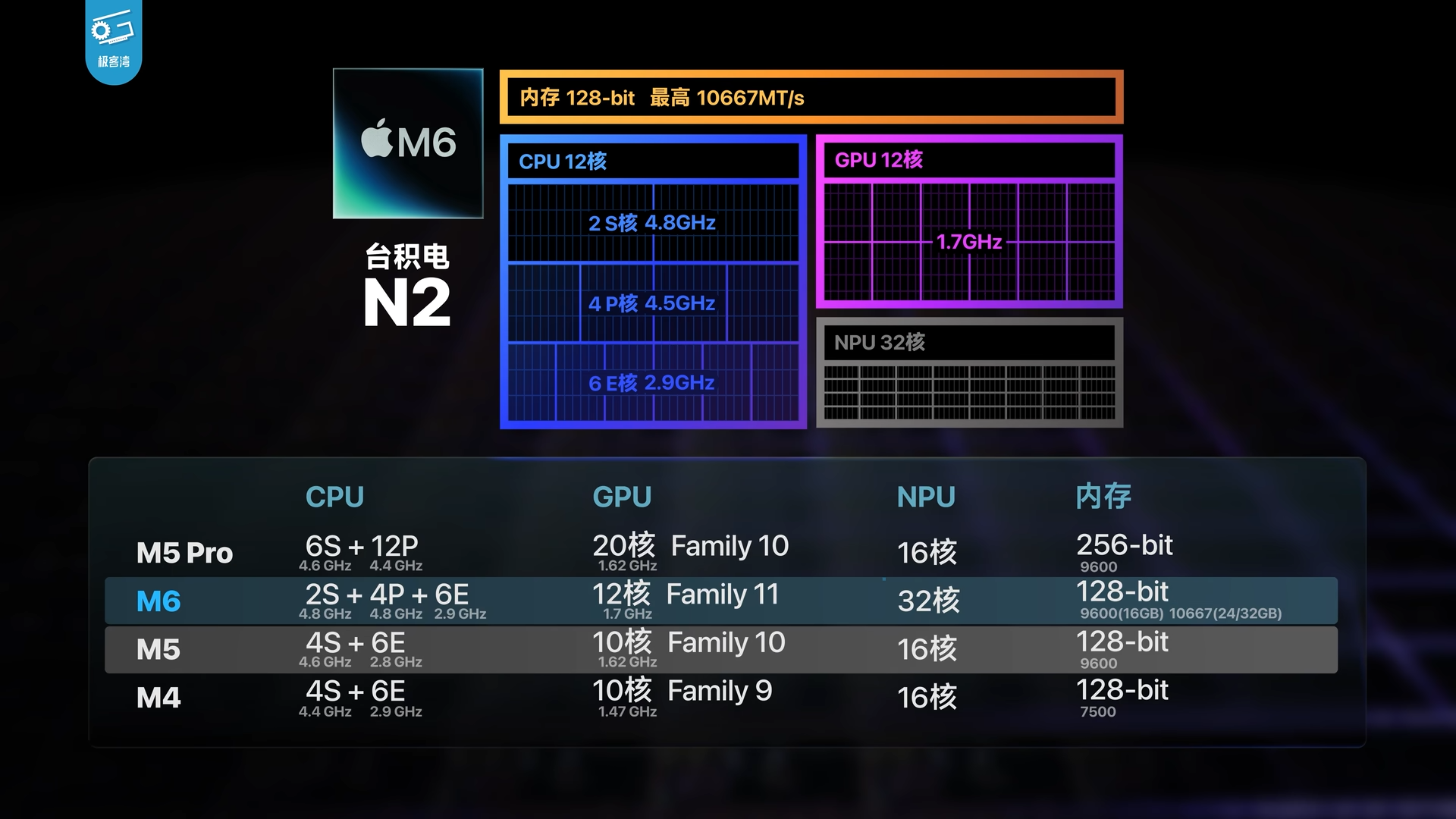
The three-cluster design is used for the first time in the base M series, marking Apple bringing Pro-level core architecture down to its entry-level product line. However, the 128-bit memory bus width has not been upgraded, which remains a bottleneck for local AI inference requiring high bandwidth.
S core real-world test: IPC far ahead of Intel
Geekerwan used SPEC 2026 to test the actual performance of three cores. The S core runs at 4.8GHz, slightly lower than the A20 Pro’s super core, and its integer score is slightly behind, but its floating-point score pulls ahead. Architecturally, it continues the M5 super core scale with minor adjustments; the execution unit and decoder scale remain unchanged, but floating-point IPC is clearly higher than the A20 Pro’s.
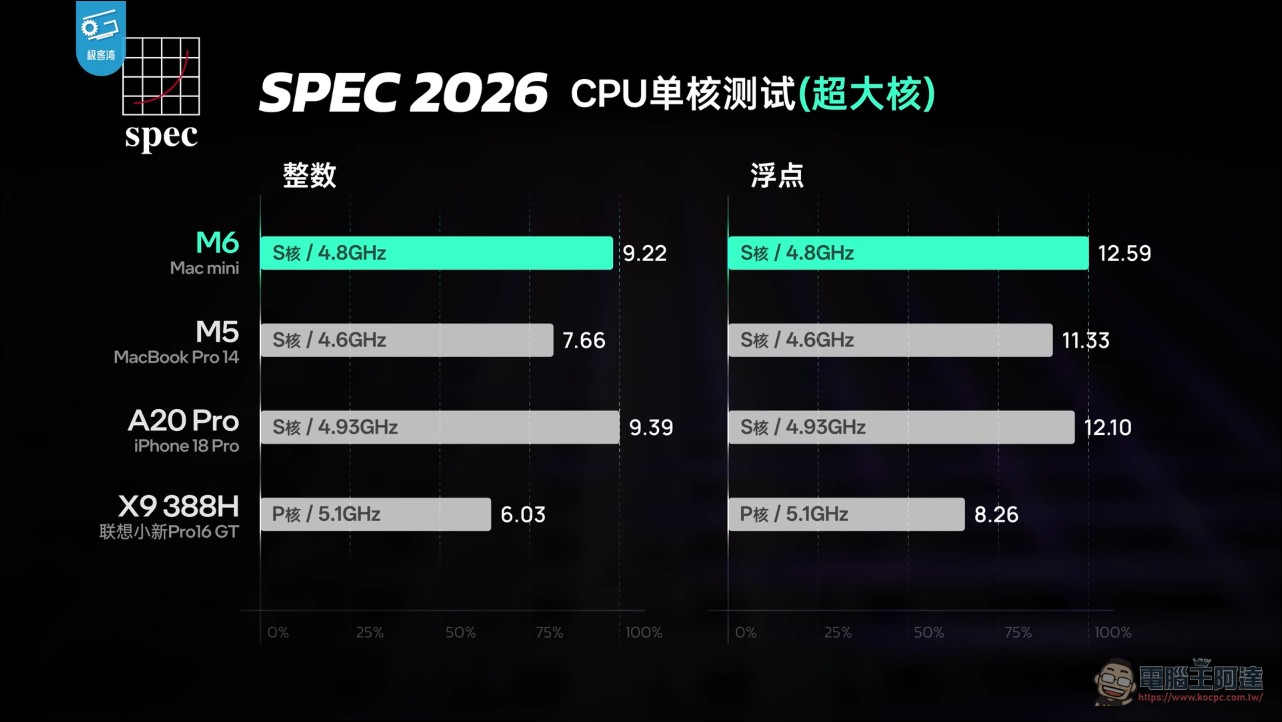
Compared with the super core of Intel Panther Lake’s Core Ultra 9 388H, the two are already on the same level in frequency, but the M6’s super core performance leads by more than 50%. The video bluntly states, “The super core performance of the two no longer looks like products from the same era.”
This also shows that Apple’s core designs for phones and desktops are starting to diverge: phones prioritize higher clock speeds to pursue integer performance, while desktops continue with brute-force scale to pursue maximum IPC. This strategy allows the M6 to remain far ahead in single-core performance.
P-core tested: medium-sized yet delivers super-core performance.
What truly impressed Geekerwan was the P-core. In the SPEC 2026 test, this 4.5GHz P-core was already slightly faster than the P-core in the Core Ultra 9 388H, and its IPC was higher than that of the rival Lion Cove big core. Comparing the 4.6GHz big core of Qualcomm’s Snapdragon 8E5 with the 4.2GHz C1-Ultra big core of MediaTek’s Dimensity 9500, their performance was about the same.
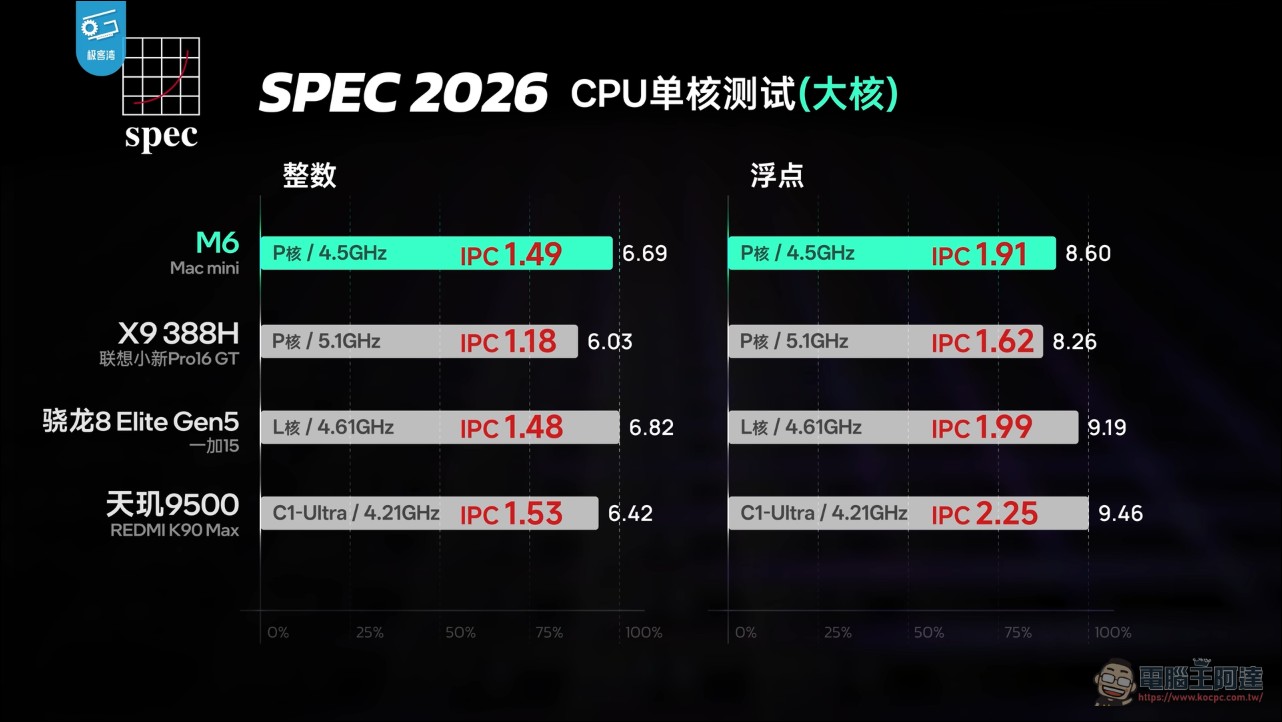
The P-core’s architectural choices are precisely targeted: a slightly wider decoder than the E-core, a deeper scheduler and out-of-order queues, and more Store units, but its integer and floating-point execution units are closer in scale to the E-core’s. The result is higher IPC than the E-core, along with characteristics that are clearly better suited to high frequencies. However, this generation’s P-core did not get the benefit of a larger L1 cache as the E-core did, and Geekerwan speculates that the M7’s P-core will most likely make changes to the L1 cache.
Using medium-sized cores to match the performance level of other vendors’ ultra-large cores shows that Apple’s lead in core design efficiency is astonishing. The introduction of P-cores also allows the M6 to effectively improve multi-core performance without significantly increasing chip area.
Memory Latency: Unified Memory Architecture Advantages
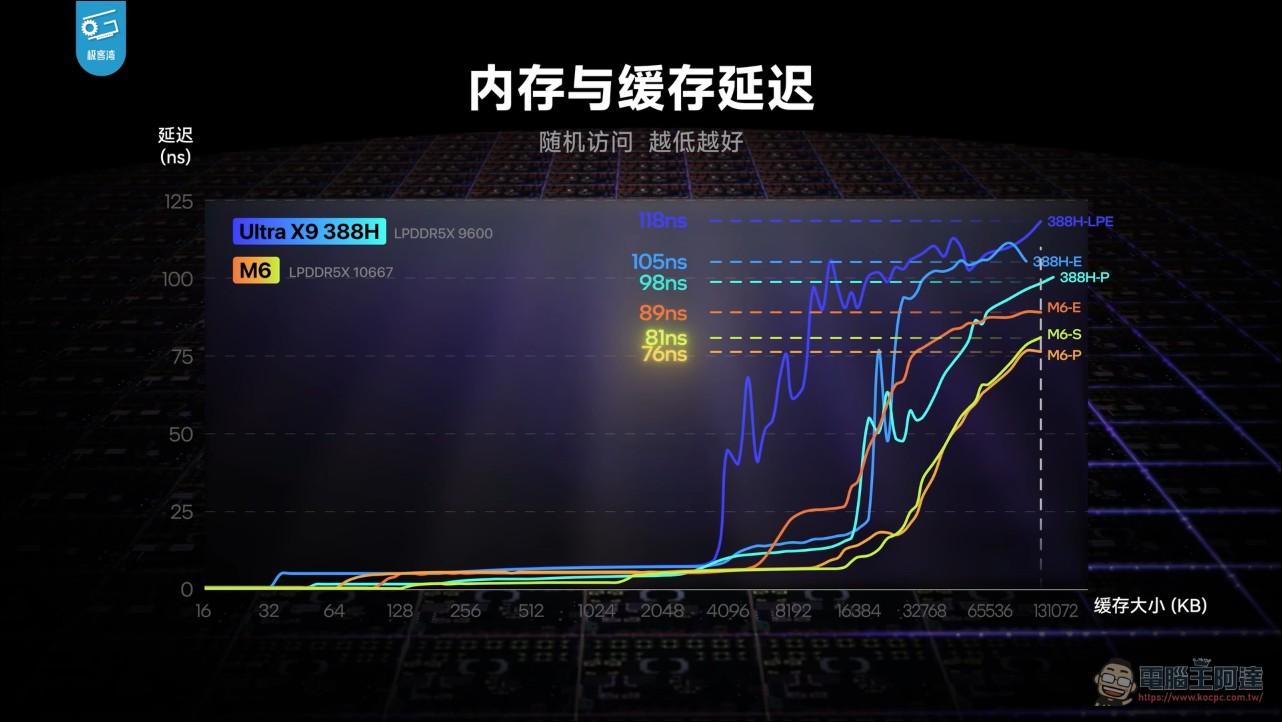
The memory latency performance of each M6 core is astonishing: both the S cores and P cores are only in the 70s ns, far better than the Core Ultra 9 388H, which also uses LPDDR5X. Even the E cores have memory latency under 90 ns, lower than the P-core latency of the 388H. The unified memory architecture gives Apple a decisive advantage in latency, which is also one of the reasons the M series performs particularly well in local AI inference scenarios.
Productivity tested: comprehensively outperforms M4
Geekerwan tested several productivity applications, and the results are as follows:
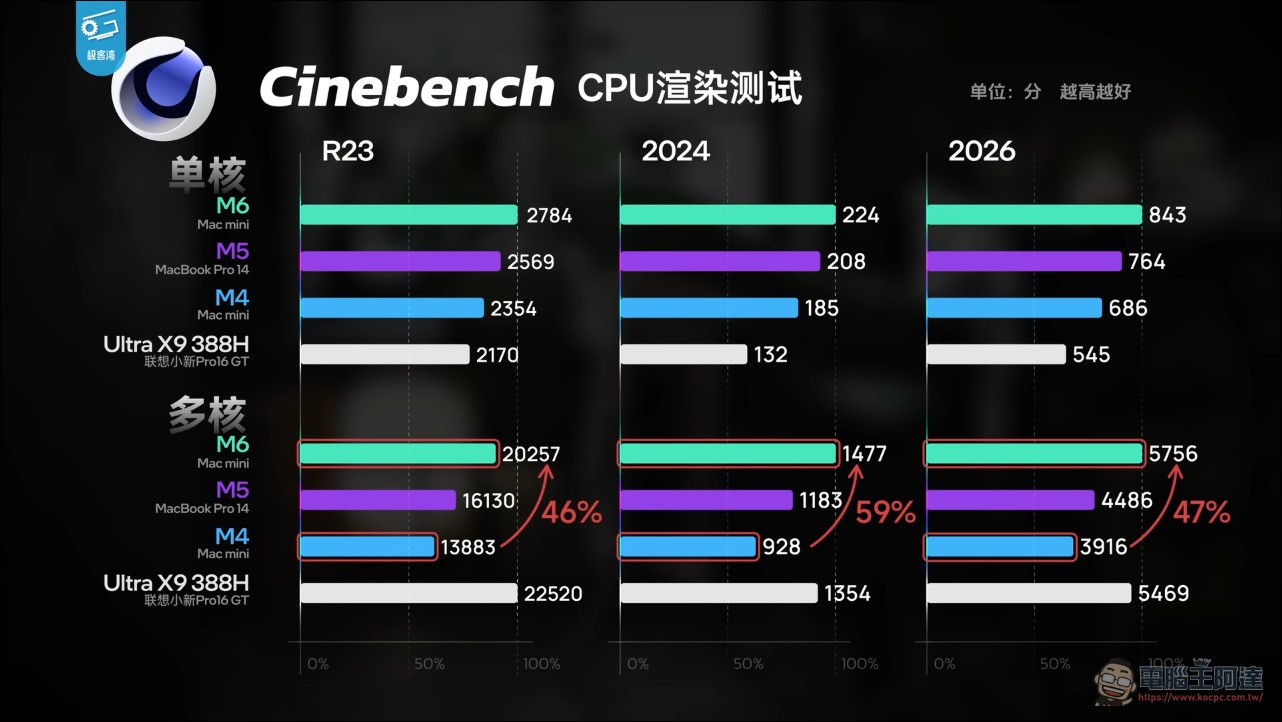
- Cinebench 2024Multi-core performance is on par with the Core Ultra 9 388H, an over 50% improvement over the M4.
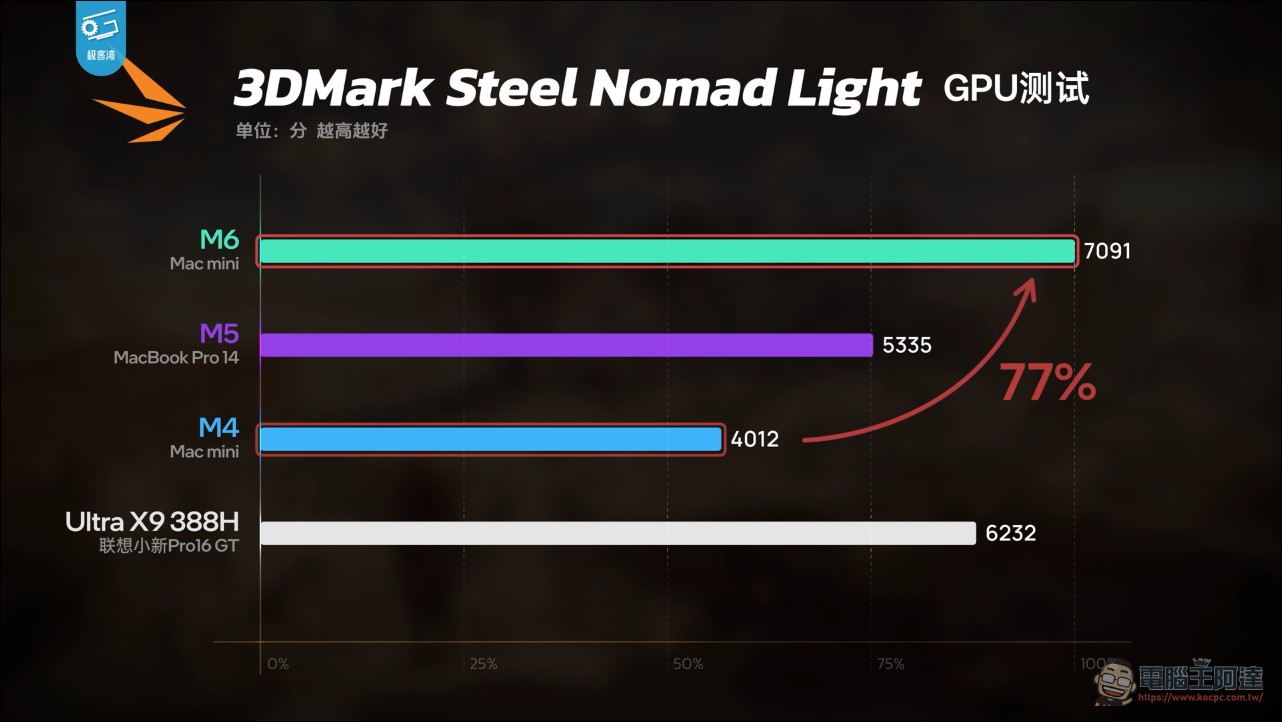
- 3DMark SNLGPU performance is up another 33% over M5, and nearly 80% higher than M4 cumulatively.
- 3DMark Solar Bay ExtremeRay tracing performance is 25% higher than M5 and 85% higher than M4.
- BlenderCPU rendering is about 25% faster than the M5, while GPU ray-tracing rendering improves by more than 30%.
- 7-ZipCompression and decompression are on par with 388H.
- Xcode BenchmarkCompilation speed has improved significantly.
- PhotoshopThanks to its single-core advantage, it leaves the 388H far behind.
- Premiere: much higher than the 388H model, which also has 32GB of memory
The M6’s multicore performance can already go toe-to-toe with Intel’s H45 platform flagship, but the base M series actually competes at the Lunar Lake level. For most Mac users, the M6 should already handle the vast majority of work, and there seems to be no reason they must buy a Pro-class processor.
Local AI inference: 32GB of memory is the bottleneck
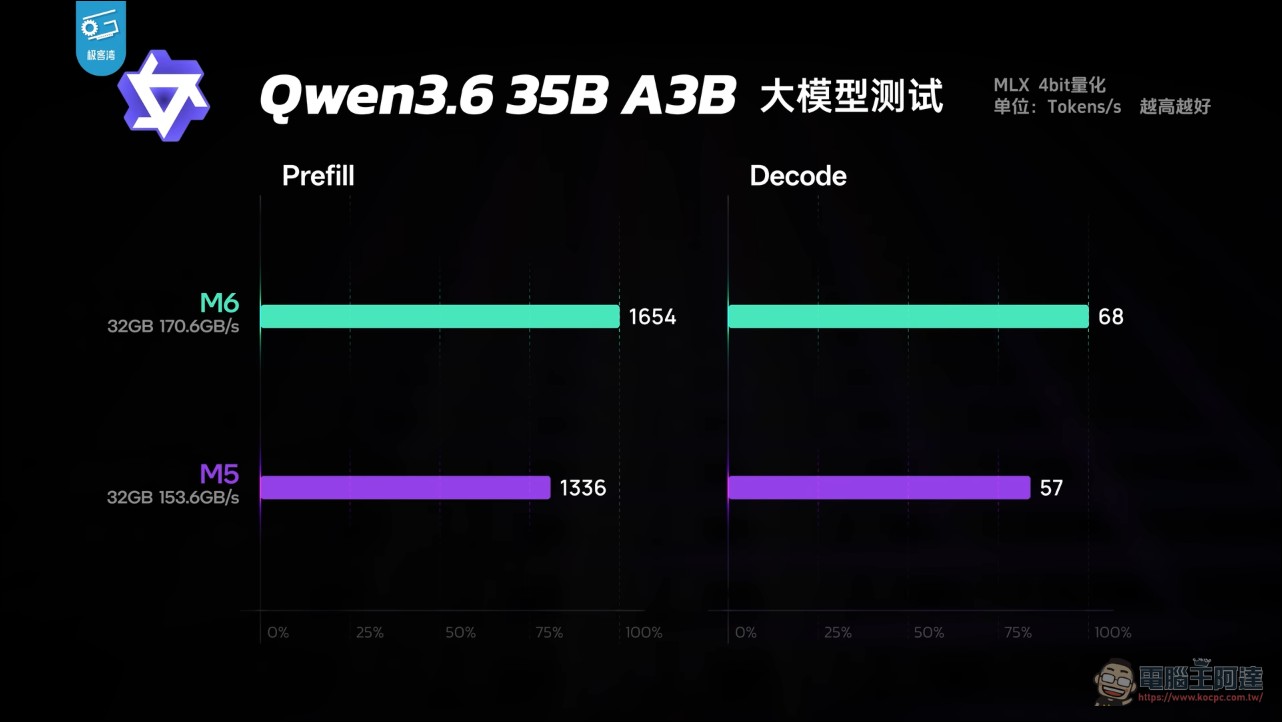
For local large model deployment, the biggest bottleneck of the M6 is its maximum 32GB of memory and 128-bit bandwidth. Geekerwan tested two models:
- Qwen 3.8 27B (dense model, 4-bit quantized): Prefill about 200 Tokens/s, Decode only 8 Tokens/s, limited practicality
- Qwen 3.6 35B A3B (sparse MoE model)Decode reaches 68 Tokens/s, making it sufficiently usable even for local Agent deployment.
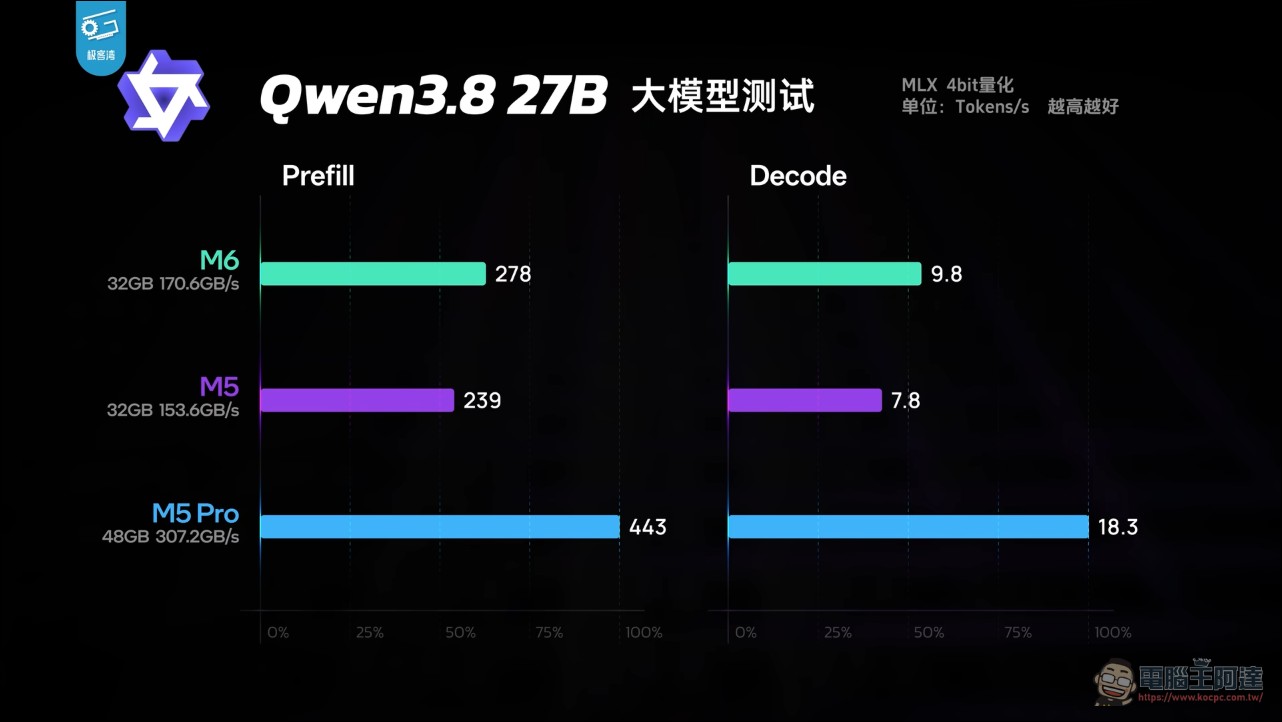
Unified memory allows 32GB to deploy 27B models, but 128-bit bandwidth limits inference speed. MoE architecture models, because they activate fewer parameters, are actually better suited to base M-series.
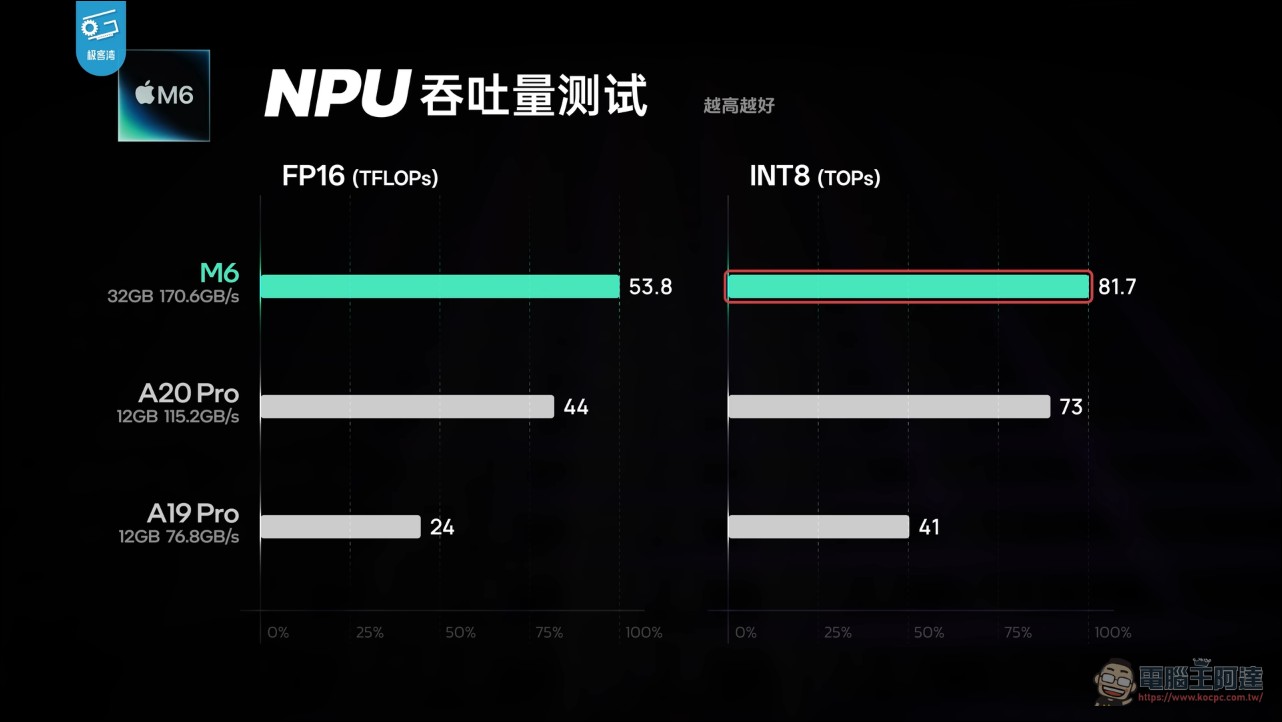
The NPU’s FP16 compute measures 53.8 TOPs, and INT8 is 81.7 TOPs. However, the NPU can only run the INT8 format, so it is slower than running MLX 4-bit quantization on the GPU. The NPU’s greater use should be running small models in the background.
Gaming performance: close to double that of the M4
Gaming has always been a weak spot for the Mac, but with its increased scale and ray-tracing advancements, the M6 delivers satisfying performance:
- Cyberpunk 2077 (2K Ultra HD): About 20% improvement over M5, and with ray tracing enabled the gap widens to over 30%.
- Baldur’s Gate 3Frame rate is 42% higher than M5, double that of M4, and beats 388H.
- Control (2K Ultra Ray Tracing)After enabling ray tracing, it ties with the 388H.
- Resident Evil 9 (Translation Run)Nearly twice the frame rate of the M4
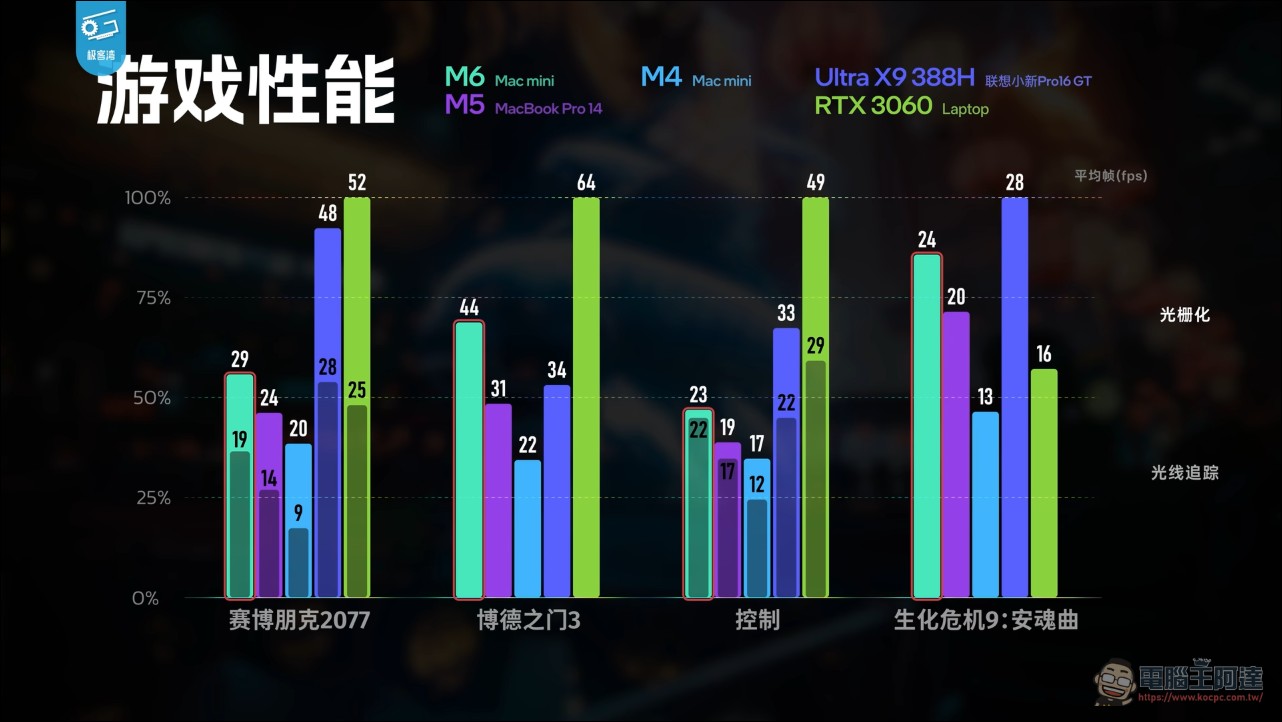
Gaming performance is still not a Mac strong suit, but the M6 delivers a significant improvement in ray tracing performance. As Apple continues to improve its gaming ecosystem, the M series is becoming increasingly viable for gaming.
Power consumption and temperature
Under full load in Cinebench R23, CPU power consumption is about 25W, comparable to the previous-generation M5, with total system input power at 55W. In the 3DMark SNL test, the GPU is about 19W, and the whole system is just over 50W. During dual stress testing, the CPU and GPU each drop to around 15W, total system power is 65W, and core temperatures are not particularly high. Power control is on par with the previous generation, meaning the performance gains come entirely from architecture and process improvements, rather than raising power consumption to buy performance. The Mac mini’s small chassis can still deliver stable output under heavy load.
Geekerwan’s review is quite detailed and very useful as a reference for anyone looking to buy an M6 Mac mini. Since it isn’t up on YouTube yet, those interested can watch it on Bilibili:
Geekerwan concluded that the greater value of the M6 lies in demonstrating Apple’s composure in chip design: without introducing an entirely new core architecture, it achieved considerable performance simply by combining existing elements. Even with 4 fewer cores than the Core Ultra 9 388H, its multi-core performance still matches. As for pricing in Taiwan,M6 Mac mini starts at NT$29,900.(education pricing starts at NT$26,590), about NT$3,000 more than the M4 model. The M5 Pro version starts at NT$59,900.
Source: KOCPC Chinese