


The M6 Mac mini will officially go on sale on September 22, and anyone interested will surely be curious about the actual performance of the Apple M6 chip it packs. Recently, results for this chip finally appeared in the Geekbench database. Its improvement over the previous-generation M5 is fully in line with expectations, except that compared with the recently announced A20 Pro, it actually loses in single-core score.
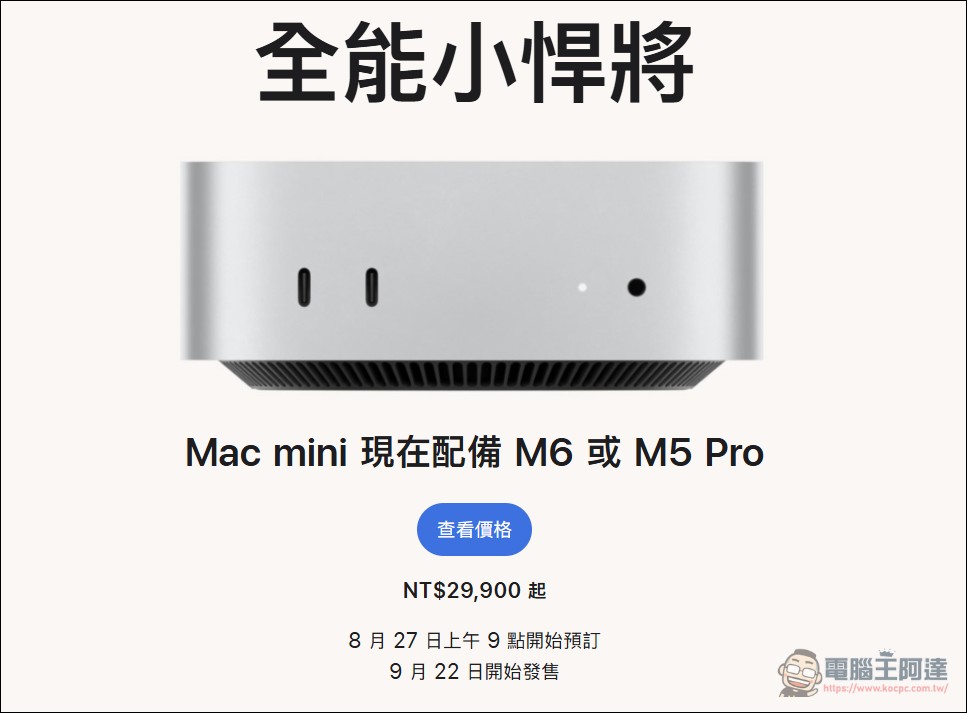
The M6 Mac mini scores 4,610 single-core, 10% faster than the M5, but the A20 Pro in the iPhone 18 Pro is even higher at 4,725 single-core.
According to foreign media Notebookcheck According to reports, Apple M6 benchmark results have recently appeared in the Geekbench database, in both Geekbench 6.3 and Geekbench 7. The model identifier is Mac18,5 for both, so it’s almost certainly the M6 Mac mini.
In Geekbench 6.3 benchmark tests, the M6 scored 4,610 in single-core and 20,676 in multi-core. The test machine was equipped with 32GB of memory (the highest capacity available for the base M6), ran macOS 27.0 build 26A428, and had a core configuration of 2+4+6, meaning 2 super cores, 4 performance cores, and 6 efficiency cores, for a total of 12 cores, matching the three-tier architecture Apple announced at its August launch:
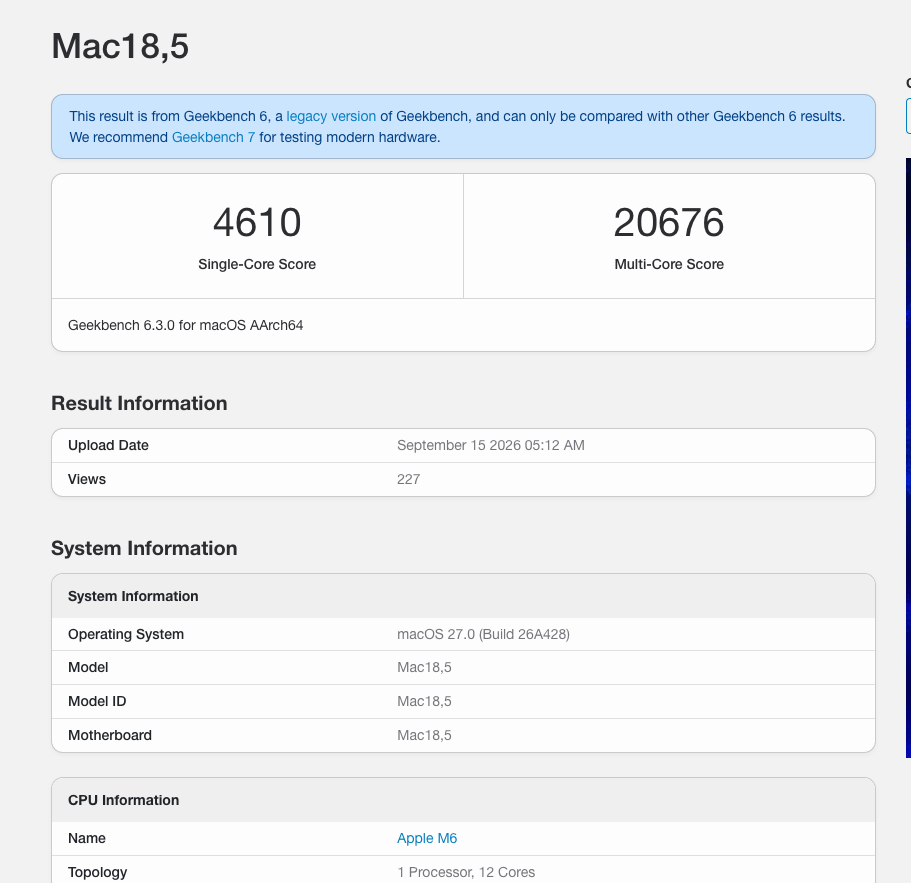
Compared with the previous-generation 10-core M5, after tallying 5 M5 benchmark scores, the median was 4,195 single-core and 17,072 multi-core, so this M6 result is roughly a 10% single-core improvement and a 20% multi-core improvement. Apple also previously stated that “multithreaded performance is up to 1.2x faster than M5,” which is consistent with this result.
Compared with the just-announced A20 Pro, the iPhone 18 Pro series had already appeared on Geekbench earlier: the iPhone 18 Pro Max scored 4,725 single-core and 12,575 multi-core, while the iPhone 18 Pro scored 4,719 single-core and 12,677 multi-core—the two are almost identical. The M6’s single-core score of 4610 is clearly a bit lower, but that’s understandable, since the A20 Pro’s 4.93GHz clock speed is higher, about 3% higher than the M6:
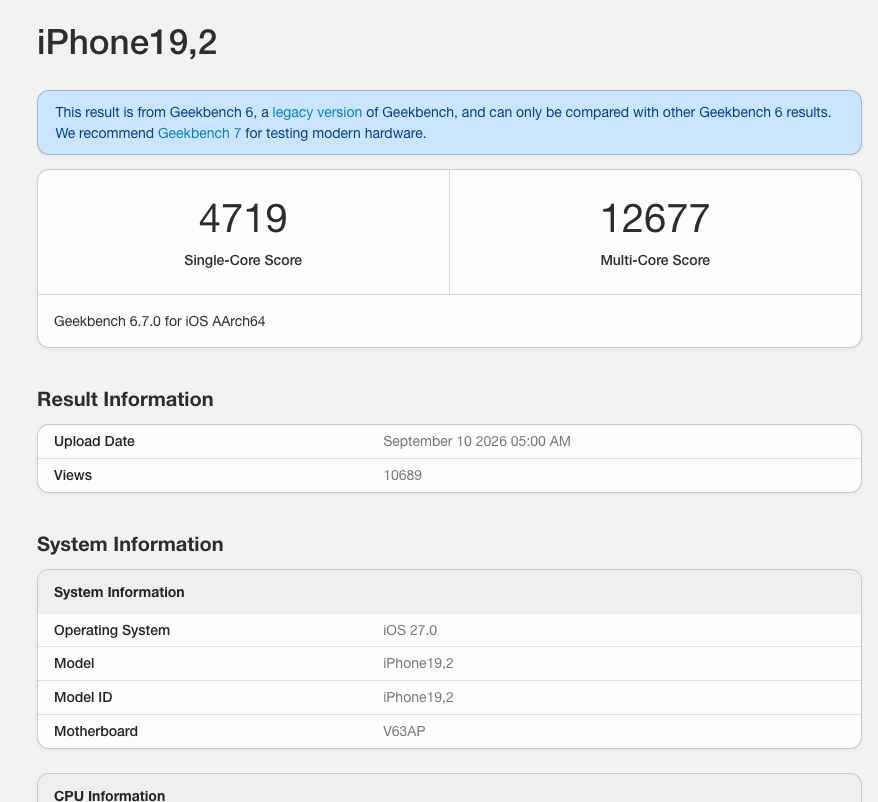
Interestingly, when Apple announced the M6, it claimed it had the “world’s fastest single-threaded performance,” but at least based on the current pre-release Geekbench 6 results, the A20 Pro’s single-core score is actually slightly higher.
Now let’s look at the Geekbench 7 results: the M6 scored 4,071 in single-core and 22,783 in multi-core:
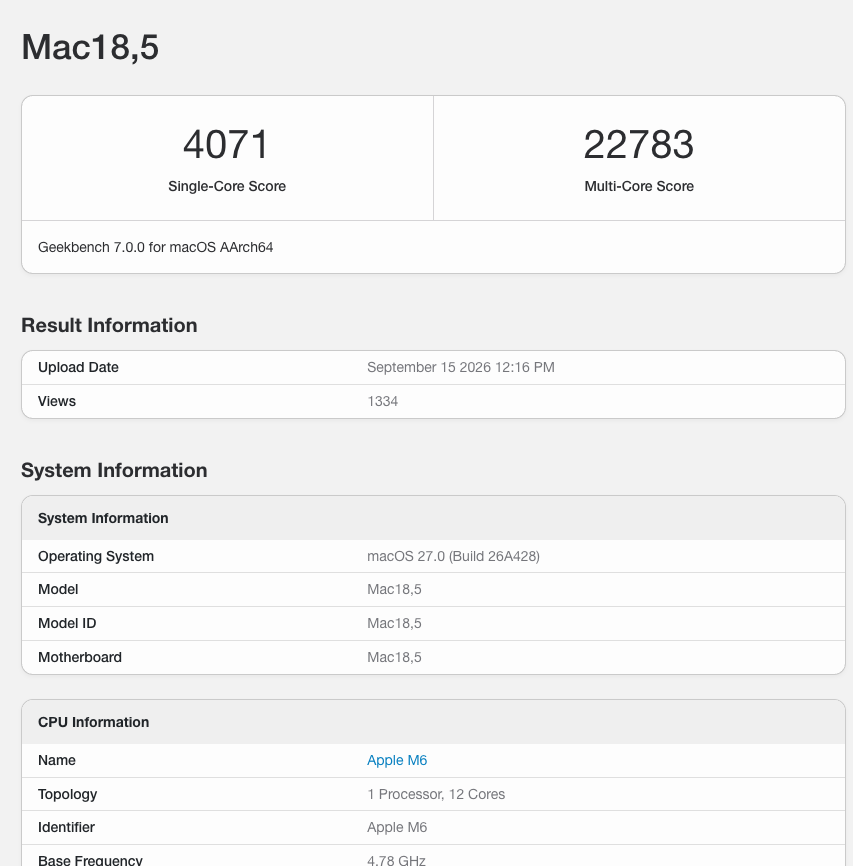
foreign media MacRumors Statistics show that the M5’s average Geekbench 7 scores are 3,641 for single-core and 17,948 for multi-core.
This means the M6 has about a 12% improvement in single-core performance and about a 27% improvement in multi-core performance. Also note that the M5 benchmark is based on a 14-inch MacBook Pro, so it’s not a Mac mini, but it shouldn’t be too different.
Lastly, a reminder: the M6 Mac mini isn’t officially on sale yet, so these kinds of results mostly come from engineering samples, and the scores for retail units after launch may be different.
The M6 Mac mini starts at NT$29,900 in Taiwan, with the base model featuring 16GB of memory and 256GB of storage. The M5 Pro version starts at NT$59,900, with pre-orders opening on August 27 and shipments beginning on September 22.
Source: KOCPC Chinese