


At 12:00 noon Beijing Time on September 10, China’s DeepSeek officially released DeepSeek-V4.1-Flash, simultaneously lowered API pricing for the Flash series, and directly took the previous-generation V4 Flash and V4 Flash Vision Exp offline. In its announcement, the company also announced one more thing: after 12:00 noon on September 14, until V4.1 Pro goes live, all requests sent to V4 Pro will be handled entirely by V4.1 Flash and billed at Flash’s unit price. DeepSeek said V4.1 Flash comprehensively surpasses V4 Pro on metrics such as performance, cost, speed, and total elapsed time, and therefore plans to retire V4 Pro in an orderly manner.
DeepSeek V4.1 Flash official positioning: the smallest member of the new architecture family, natively able to understand images.
V4.1 Flash is the smallest model in DeepSeek’s all-new model architecture series (a 552B MoE architecture model), with native multimodal visual understanding capabilities. Its design goals are stated plainly: a higher capability ceiling, faster inference, greater throughput, and the ability to scale to larger-parameter models. Put plainly, this Flash is the first model built on the new architecture, and larger models to follow will scale up along the same structure.
🚀 Introducing DeepSeek-V4.1-Flash: smarter, faster, more efficient.
🔹 Introducing the smallest model in our new architecture family, with native visual understanding.
🔹 Designed for greater capability, faster inference, higher throughput, and scaling to larger models.1/6 pic.twitter.com/wxJGiyX56o
— DeepSeek (@deepseek_ai) September 10, 2026
On the ecosystem side, Tencent’s WorkBuddy and CodeBuddy, as well as OpenCode, have announced full integration with V4.1 Flash.
Speed test: 427 tokens per second, 6x the previous generation.
The most intuitive upgrade in V4.1 Flash is speed. In hands-on tests by multiple tech bloggers and developers, generation speed in deep long-text reasoning scenarios can reach 420 tokens per second, with end-to-end throughput reaching 409.5 tok/s. In tests by some media outlets, peak speeds even hit 427 tok/s.
Compared with the previous generation V4 Flash Vision-Exp, the speedup for various tasks is as follows:
- 49k ultra-long context retrieval: 5.2 times
- SVG code generation: 6.0 times
- Manacher palindrome algorithm problem: 4.6 times
- Large-Scale SQL Query Generation and Optimization: 5.0 times
- asyncio asynchronous architecture refactoring: 3.9 times
Some developers are Share on Hacker NewsWhen using V4.1 Flash preview to run a large number of tasks, the model generates so quickly that it is “faster than the latency of the tool call itself.” When performing a .metal to .cu kernel conversion refactor in a terminal environment, V4.1 Flash required less guidance than Opus and also wrote better code comments.
As for capabilities, the officially published benchmark numbers are as follows:
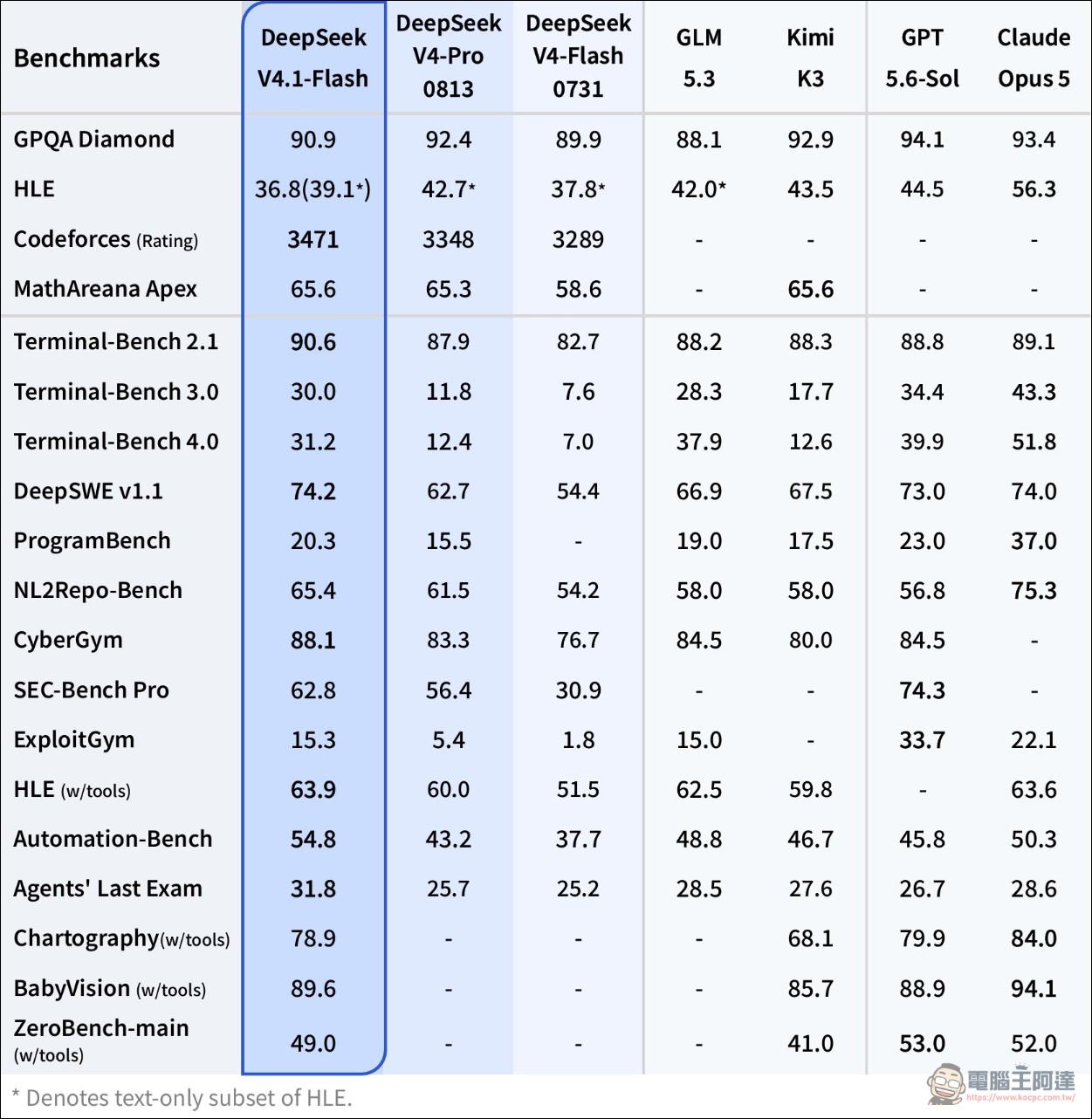
- GPQA Diamond:90.9
- HLE (no tools): 36.8; the official notes additionally state that 39.1 is the score on the plain-text subset.
- Codeforces rating: 3471
- MathArena Apex:65.6
- Terminal-Bench 2.1:90.6;Terminal-Bench 3.0:30.0;Terminal-Bench 4.0:31.2
- DeepSWE v1.1:74.2;NL2Repo-Bench:65.4;ProgramBench:20.3
- CyberGym:88.1;SEC-Bench Pro:62.8;ExploitGym:15.3
- HLE (with tools): 63.9; Agents’ Last Exam: 31.8; Automation-Bench: 54.8
- Chartography (with tools): 78.9; BabyVision (with tools): 89.6; ZeroBench-main (with tools): 49.0
Compared with its own previous generation, Terminal-Bench 2.1 scores 90.6 versus V4 Pro’s 87.9, V4 Flash Vision Exp’s 83.9, and V4 Flash’s 82.7; on the agent side, Agents’ Last Exam rose from V4 Pro’s 25.7 to 31.8, CyberGym from 83.3 to 88.1, and Automation-Bench from 31.8 to 54.8—a sizable improvement.
Leading Technology: Asymmetric Causal Encoder-Decoder and KV Cache Reduction
The architecture disclosed in the technical report and model card is the substantive change this time. V4.1 Flash uses a Causal Encoder-Decoder structure, splitting a 40-layer Transformer into 20 layers of Causal Encoder plus 20 layers of Decoder. The Decoder’s global KV Cache is projected from the Encoder’s final hidden state and is no longer generated layer by layer on its own. The number of activated parameters for input and output is therefore asymmetric: during prefill, each token activates only 8B parameters, while during decode it activates 16B. The model’s backbone is a 552B-parameter mixture-of-experts architecture.
The improvement in KV Cache compression is even more striking. The main KV uses an FP4 cache (E2M1 format, with one E4M3 scale per 16 channels), bringing the global KV footprint down to about 890 bytes per token, roughly one quarter that of V4-Flash. SWA Bounded Replay only replays tokens in the most recent window to reconstruct the KV state for sliding window attention, without writing this part to SSD, further reducing the resident KV footprint to about one eighth. Officially, the amount of HBM required is reduced to one quarter, SSD to one eighth, and the KV Cache is 437 times smaller than that of the first-generation model.
Price: Off-peak input is approximately NT$4.72 per million tokens.
The new prices take effect at noon on September 10, maintaining two-tier peak and off-peak pricing, with off-peak at half the peak rate. Official USD pricing shall prevail (using an exchange rate of USD 1 = NT$31.47):
- Input (cache hit): Off-peak US$0.003 per million tokens (about NT$0.09), peak US$0.006 (about NT$0.19).
- Input (cache miss)Off-peak: US$0.15 (about NT$4.72), peak: US$0.30 (about NT$9.44)
- OutputOff-peak: US$0.6 (approx. NT$18.88), peak: US$1.2 (approx. NT$37.76).
RMB pricing is 0.02 yuan for input cache hits, 1 yuan for misses, and 4 yuan for output, doubled during peak hours. Peak hours are defined as 9:00–12:00 and 14:00–18:00 Beijing Time, Monday to Friday; all other times are off-peak.
Third-party platforms have also listed it. On OpenRouter, deepseek/deepseek-v4.1-flash is priced at $0.3 per million input tokens and $1.2 per million output tokens, matching the official website’s peak pricing.
MIT Open Source License
As for the weights, DeepSeek is taking the open route as usual this time. The ones on HuggingFace… deepseek-ai/DeepSeek-V4.1-Flash Uploaded in the early morning of September 10 under the MIT license, with an accompanying technical report PDF, and GGUF quantized versions have already appeared in the community.
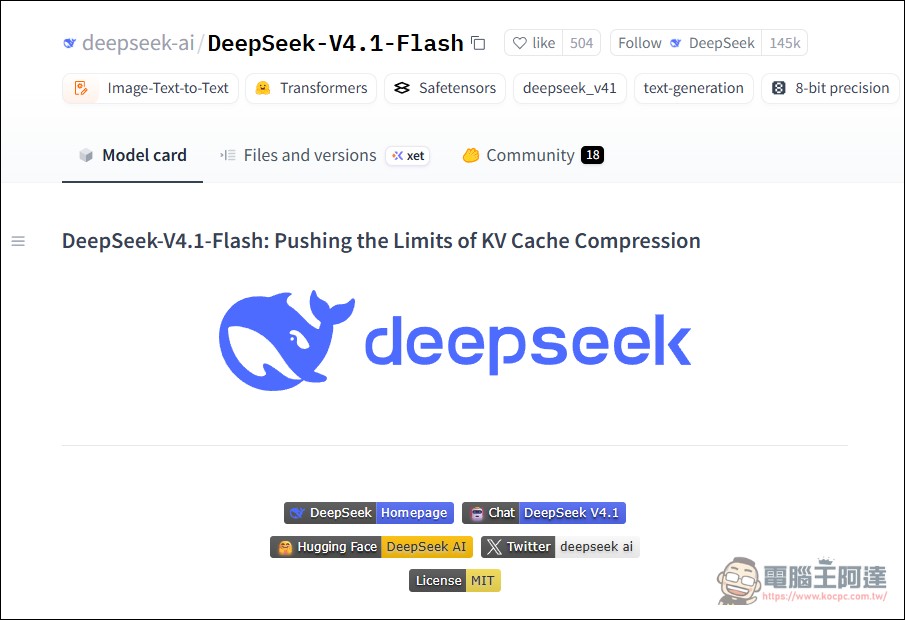
The weights on the model card are stored in FP8 quantization format, and the total parameter count alone is close to 484.6 billion, putting it in a class that can’t run on a single machine or consumer-grade GPU. In general, it’s still more reasonable to call it through an API.