


I really didn’t expect that Gemini 3.6 Flash would be here even before Gemini 3.5 Pro was launched. Google earlier launched three new models in one go, including Gemini 3.6 Flash, which is responsible for complex work, Gemini 3.5 Flash-Lite, which focuses on speed and mass deployment, and Gemini 3.5 Flash Cyber, which specializes in finding and patching program vulnerabilities. The first two new models are currently available on Gemini.
Google launches Gemini 3.6 Flash, 3.5 Flash-Lite and Flash Cyber: output tokens are reduced by 17%, and Flash-Lite can output 350 tokens per second
Google has updated the new Gemini 3.6 Flash model in a short time. The most obvious improvement this time is Token efficiency.
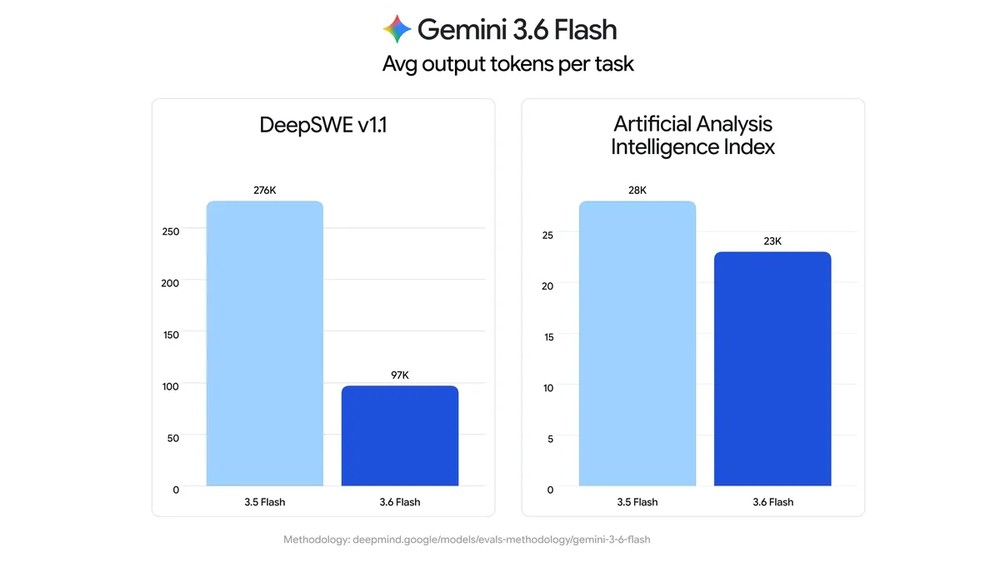
According to information published by Google, Gemini 3.6 Flash achieves 17% less Token output than 3.5 Flash in the Artificial Analysis Index when completing the same work. In specific tests such as Datacurve’s DeepSWE, the reduction is as high as 65%. Google also said that when the new model handles multi-step work, it requires fewer inference steps and fewer tool calls. This may not be noticeable for general chat, but if a business is running dozens or hundreds of agents at the same time and skips a few steps at a time, the difference in accumulated wait time and billing can be considerable.
Not only that, the price of 3.6 Flash has also been reduced. The standard price of the API is US$1.50 per 1 million input tokens and US$7.50 per output token. Compared to the 3.5 Flash which costs $1.50 input and $9 output, the input price remains the same but the output is about 16.7% cheaper. In addition, the model may use fewer output tokens to complete its work, and this price reduction can be said to be even more impressive.
There has also been a slight improvement in programming. Gemini 3.6 Flash scored 49% in DeepSWE, and 3.5 Flash scored 37%. The MLE Bench, which tests machine learning research capabilities, increased from 49.7% to 63.9%. Google specifically emphasized that the new model can reduce code modifications that are not requested by users, and can also shorten the cycle of repeated executions to complete tasks.
Another upgrade is Computer Use. Gemini 3.6 Flash’s OSWorld-Verified score increased from 78.4% of 3.5 Flash to 83.0%. Google has also integrated Computer Use into Gemini API and built-in client tools in Gemini Enterprise. Developers no longer need to connect a separate set of computer operation models to allow agents to click buttons, fill in fields, and complete multiple steps with other tools.
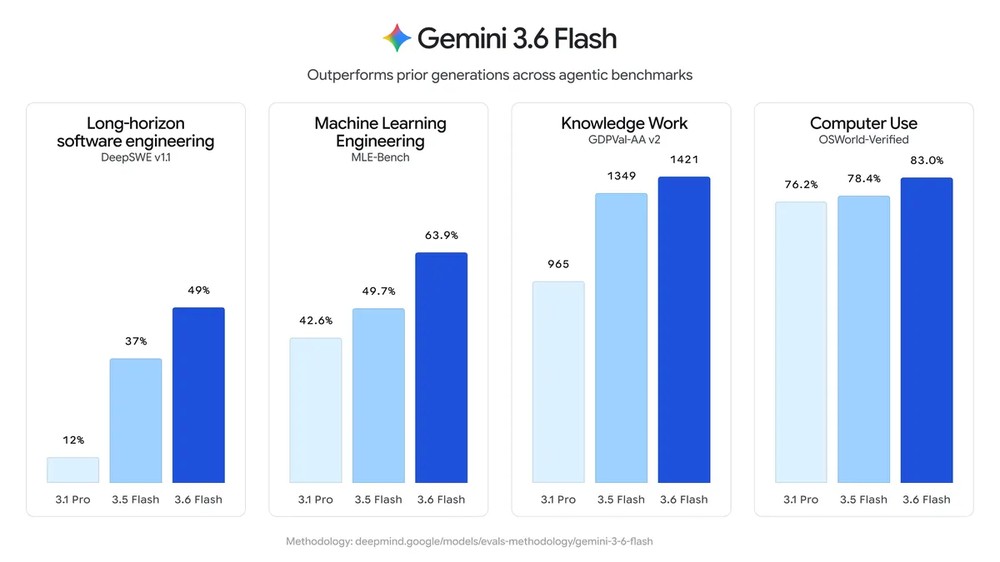
Gemini 3.6 Flash also improved in knowledge work, with GDPval-AA v2 improving from 1,349 points to 1,421 points. Google partners Hebbia and Harvey specifically mentioned its ability to handle multimodal work, including parsing long documents, reading charts and data, and writing reports based on analysis results.
In the security section, Gemini 3.6 Flash also adds more complete cutting-edge security protection, mainly targeting areas that may be abused, such as chemical, biological, radioactive, nuclear energy, and network attacks. Google says these measures make the model more resistant to jailbreak prompts, while also training against false rejections for normal use.
Gemini 3.5 Flash-Lite part is suitable for agent search, document processing, data extraction, translation and other tasks that value low latency and high throughput. According to Artificial Analysis testing, Gemini 3.5 Flash-Lite can output 350 Tokens per second and is the fastest model in the Gemini 3.5 series.
Its API price is also very low, only $0.30 per 1 million input tokens and $2.50 for output tokens. Google also offers cheaper Batch and Flex options, with input and output prices dropping to $0.15 and $1.25 respectively, suitable for services that don’t require immediate results but process large amounts of data every day.
Gemini 3.5 Flash-Lite also supports adjustable thinking levels. When developers deal with simple classification, content extraction, or format conversion, they can use lower thinking levels such as Minimal and Low, prioritizing speed and cost. When encountering sub-agent work that requires multiple steps, they can raise the thinking level to allow the model to invest more reasoning.
This design is very suitable for multi-agent systems. For example, Gemini 3.6 Flash serves as the main agent, responsible for troubleshooting problems and allocating tasks. Flash-Lite performs a large number of smaller tasks at the same time, without using the higher-priced main model for everything.
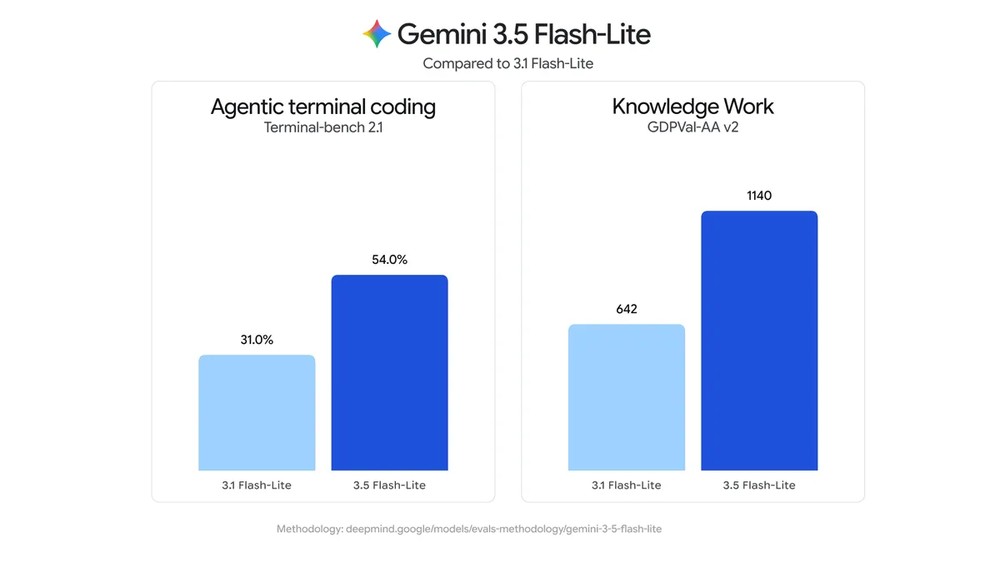
In the test data section, Gemini 3.5 Flash-Lite scored 54% in Terminal-Bench 2.1, while the previous generation 3.1 Flash-Lite scored 31%; the long content test GDM-MRCR v2 increased from 60.1% to 72.2%; GDPval-AA v2 increased from 642 points to 1,140 points:
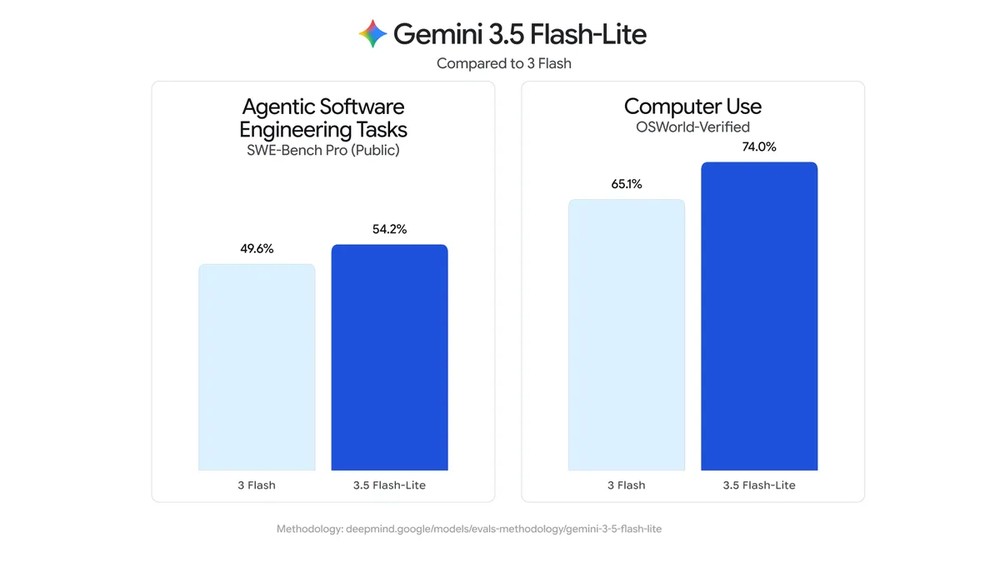
Compared with Gemini 3 Flash, 3.5 Flash-Lite scored 54.2% in SWE-Bench Pro, which was higher than the former’s 49.6%; OSWorld-Verified scored 74.0% vs. 65.1%:
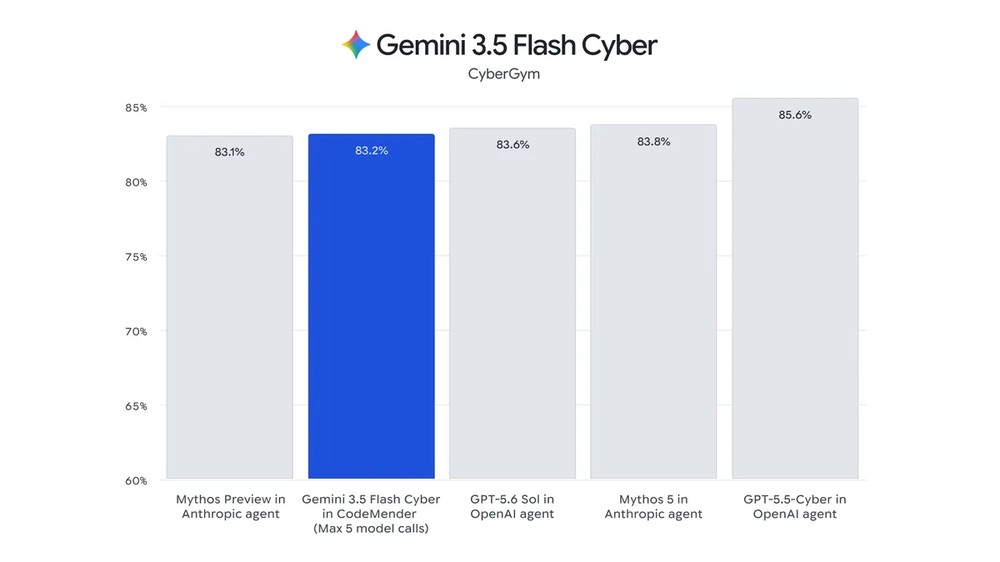
As for the new Gemini 3.5 Flash Cyber model, which is specially designed for information security, it is based on 3.5 Flash and is specially tuned to find, verify and patch security vulnerabilities in programs. Google will put multiple Flash Cyber agents into CodeMender to work together and finally generate a consolidated report. Officials stated that this combination has reached the competitiveness of the cutting-edge model level in the CyberGym test:
Since the security model has dual purposes of defense and attack, Gemini 3.5 Flash Cyber will not be fully open directly like the other two models. Google plans to first provide it to governments and trusted partners in a limited trial through CodeMender, allowing defenders to find and patch vulnerabilities early while reducing the risk of models being used for attacks.
In addition to the new model, Google also updated the progress of Gemini 3.5 Pro. The model is currently undergoing closed testing with partners and will be expanded to open after adjustments are completed. Google didn’t give an exact date, saying it would launch it as soon as the model is ready.
Google DeepMind also confirmed that the team has started pre-training for Gemini 4 and described it as the “most ambitious” pre-training work yet. However, the official has not yet announced the model size, functions, test results or expected launch time. Therefore, at this stage, it can only be confirmed that Gemini 4 has started training, and it cannot be further inferred when it will be unveiled.
Gemini 3.6 Flash and Gemini 3.5 Flash-Lite were launched on July 21, 2026. Developers can use it through Gemini API, Google AI Studio and Android Studio, and 3.6 Flash has also joined Google Antigravity. The enterprise side can be used from the Gemini Enterprise Agent Platform, and 3.6 Flash enters the Gemini Enterprise App at the same time.
General users can experience these two models in the Gemini App, and 3.5 Flash-Lite will gradually be imported into Google search.
Source: KOCPC Chinese