


With the rise of AI video generation technology, amplified by numerous KOLs promoting slogans like “zero cost, fully automated hands-free generation, and earning passive income from home,” a new AI short drama (also called AI comic drama) now launches on Douyin every 36 seconds on average in China. Over six months, the cumulative total has surpassed 220,000 productions, with views exceeding 515.7 billion—yet only 1 in every 77 new dramas manages to recoup its costs. These figures sketch the truest picture of China’s AI short drama market in the first half of 2026: explosive production capacity, collapsing returns.
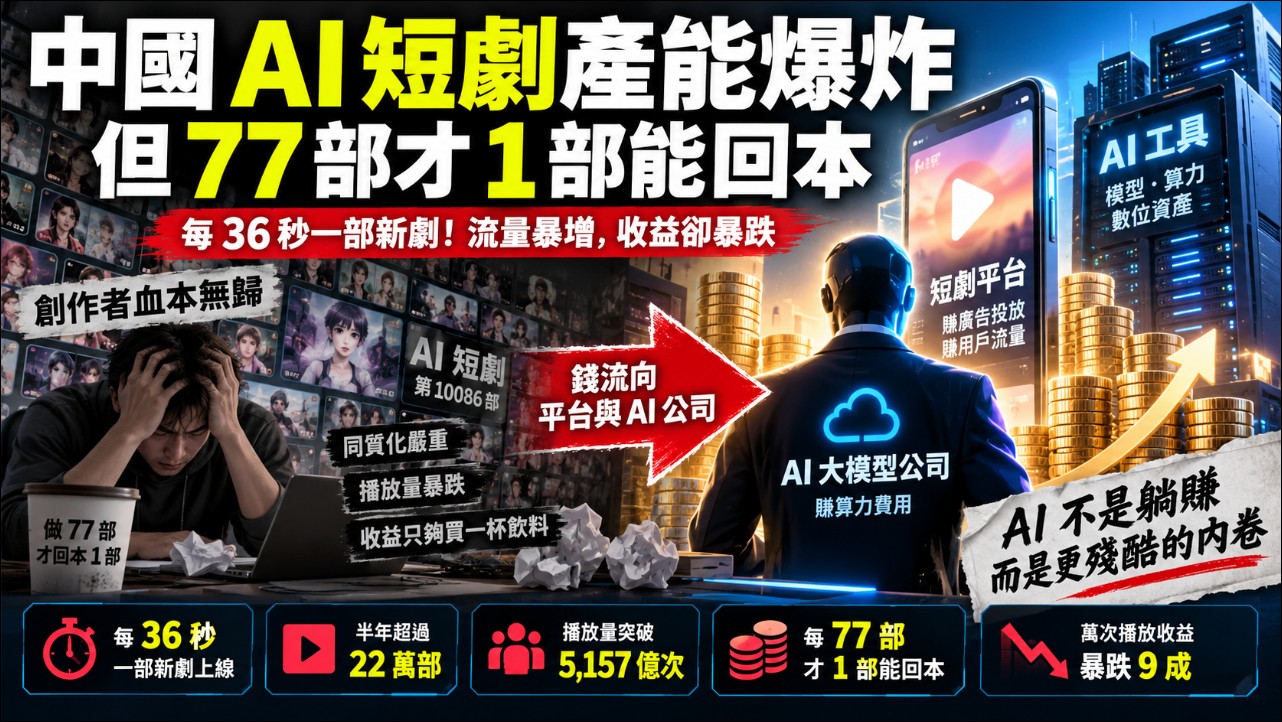
In reality, the low costs brought by AI have not translated into profits. Instead, they have fueled extreme internal competition and generated a flood of low-quality content. It is the large model companies that are raking in massive profits. These figures are not exaggerated — they come from advertising data firm DataEye’s “2026 H1 AI Drama/Animation Data Report,” and are fully consistent with cross-reports from multiple Chinese media outlets.
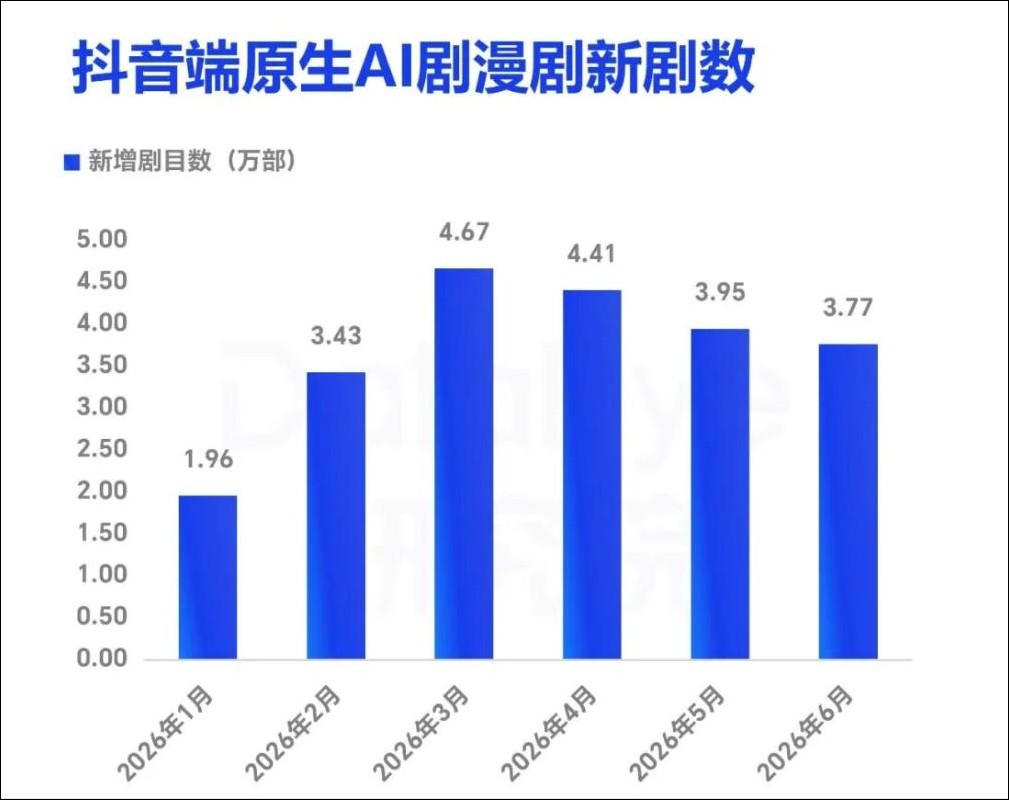
Production capacity surges: a new drama launches every 36 seconds.
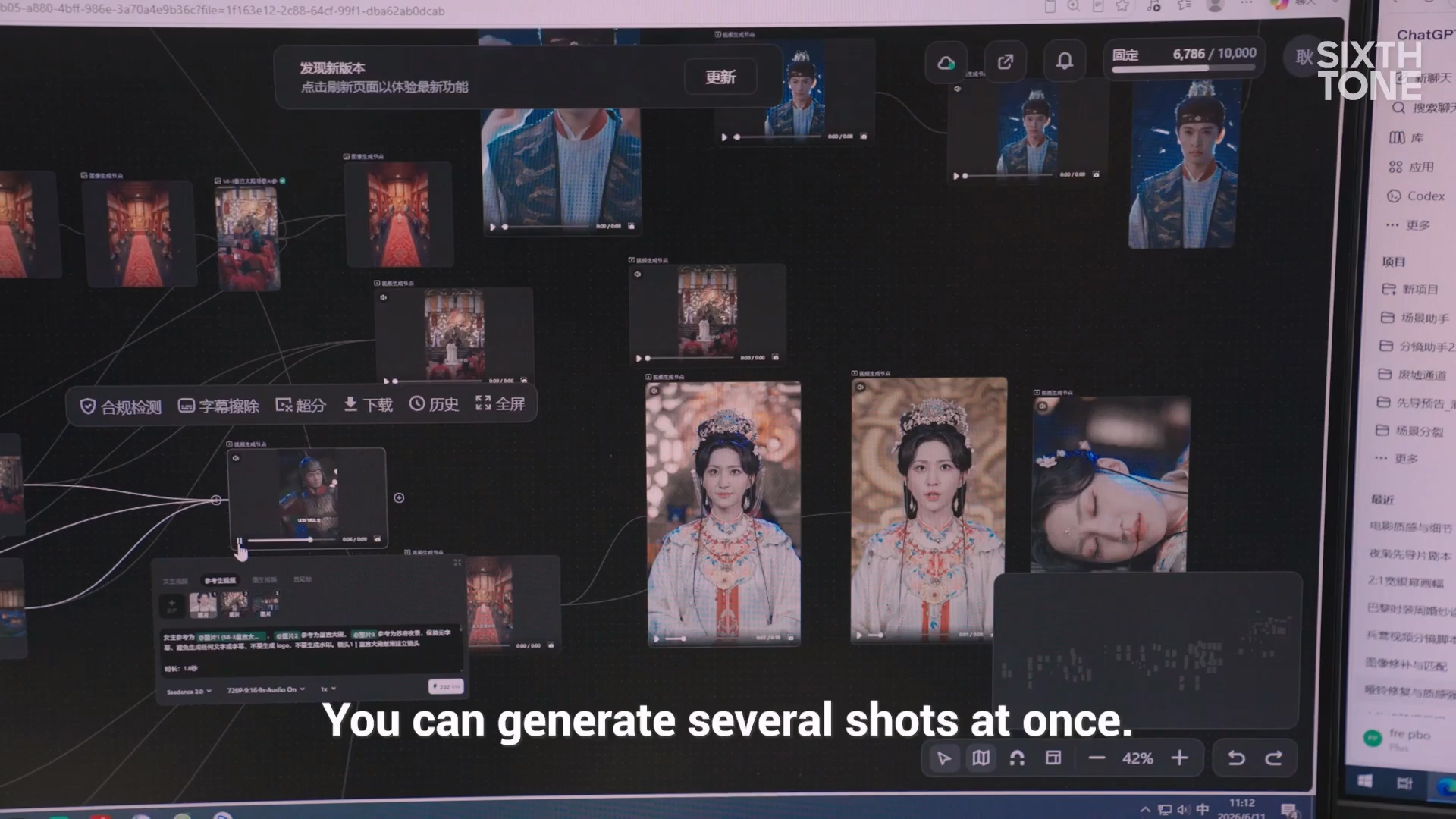
The impact of AI technology on short drama production costs is devastating. A traditional live-action short drama requires a crew, actors, makeup and costumes, locations, and post-production—dozens of people collaborating for weeks—with costs typically starting at 400,000–500,000 RMB and premium productions often reaching millions. AI short dramas have restructured this entire pipeline: scripts get first drafts from large language models, characters and scenes rely on reusable digital assets, visuals are generated in batches through video generation models, and voiceover is completed with a single click.
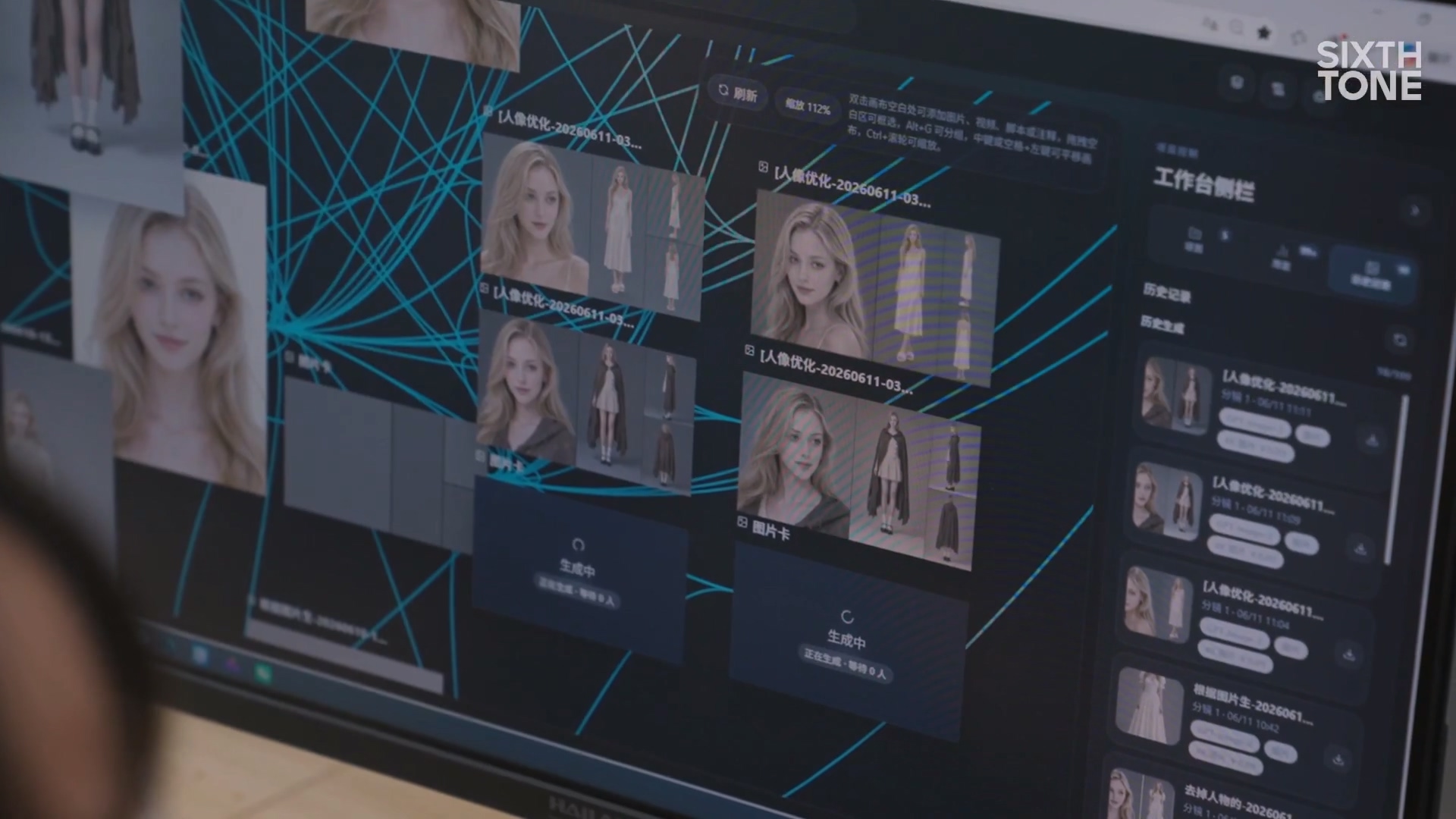
According to industry statistics, the production cost of a quality AI short drama is approximately 800 to 1,200 RMB per minute (about NT$3,500 to NT$5,200), bringing the total cost of a 100-minute production to around 100,000 RMB (about NT$430,000)—only one-fifth to one-seventh of the cost of a live-action short drama. The production cycle has also been compressed from 25 to 40 days down to 7 to 15 days, and in extreme cases, a single person can complete an entire production from home.
Once the floodgates are opened, the flood comes rushing in. According to data from the China Netcasting Services Association, platforms released a total of 367,000 micro-dramas in the first half of the year, with AI content accounting for over 74%. DataEye further found that on Douyin alone, more than 221,900 original new AI short dramas were launched. If each one runs 100 minutes, a person would need to watch nonstop for 42 years to finish them all. By comparison, only 33,000 live-action micro-dramas were released in China for the entire year of 2025.
Revenue Collapse: Earnings per 10,000 Views Plummet 90%
The explosion of supply directly dilutes the limited attention available. Short-drama deduplicated users have already reached 851 million, meaning two out of every three netizens have watched short dramas, but users’ total viewing time is fixed. When supply increases a hundredfold within a year, the traffic each individual work can capture can only be exponentially diluted.
In the first half of this year, among 221,900 AI short dramas on Douyin, only 1,055 surpassed 100 million views—a hit rate as low as 0.47%; 12,000 exceeded 10 million views, accounting for 5.8%. Based on a break-even line of 50 million views, fewer than 1.3% managed to recoup costs, meaning roughly only 1 in every 77 new dramas barely broke even. AI comic dramas fared even worse, with a hit rate below 0.1%, about a one-in-a-thousand chance.
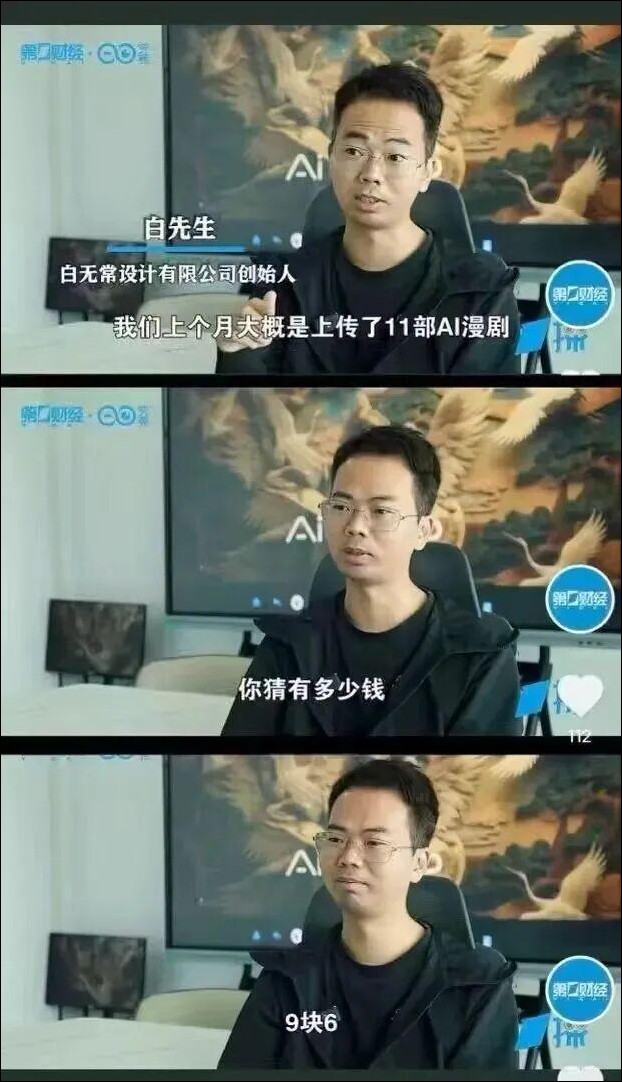
More fatal than the drop in hit rate is the collapse in value per unit of traffic. According to multiple media reports, revenue per 10,000 plays for AI short dramas has fallen from 30 to 100 RMB at last year’s peak to 5 to 10 RMB this year, a decline of over 90 percent at the high end. One industry insider revealed in an interview that after uploading 11 AI comic dramas, each with 16 episodes, total revenue came to just 9.6 RMB (approximately NT$42).
Whose pockets did the money flow into?
A thought-provoking question follows: since AI has clearly slashed production costs, where did the money saved actually go?
The answer lies in the traffic acquisition stage. Industry data shows that traffic acquisition for AI human-like short dramas accounts for about 70% of the total cost across the entire chain. Lin Qiwen, vice president of DataEye’s Juchacha, once publicly stated: “The production cost of AI short dramas has dropped by about 90%, but traffic costs have risen by more than 100% year-on-year, while revenue has declined by over 50%.”
This has created an ever-tightening scissors gap. AI short-drama companies are working for traffic platforms: their revenue comes from platform revenue sharing, and most of it is returned to the platforms through traffic-buying.
In this game, the ones guaranteed to profit are the platforms and AI tool vendors. Take ByteDance, for example—it has formed a complete closed loop: upstream, Tomato Novel provides a massive IP reserve, and the Seedance series of AI video models charges computing power fees; midstream, it has two major content distribution channels in Hongguo and Douyin; downstream, it has a mature advertising system to absorb promotional budgets. Creators are responsible for producing content and bearing the risk of whether something goes viral, while the platform profits from computing power, advertising, and simultaneously captures user traffic through its free model.
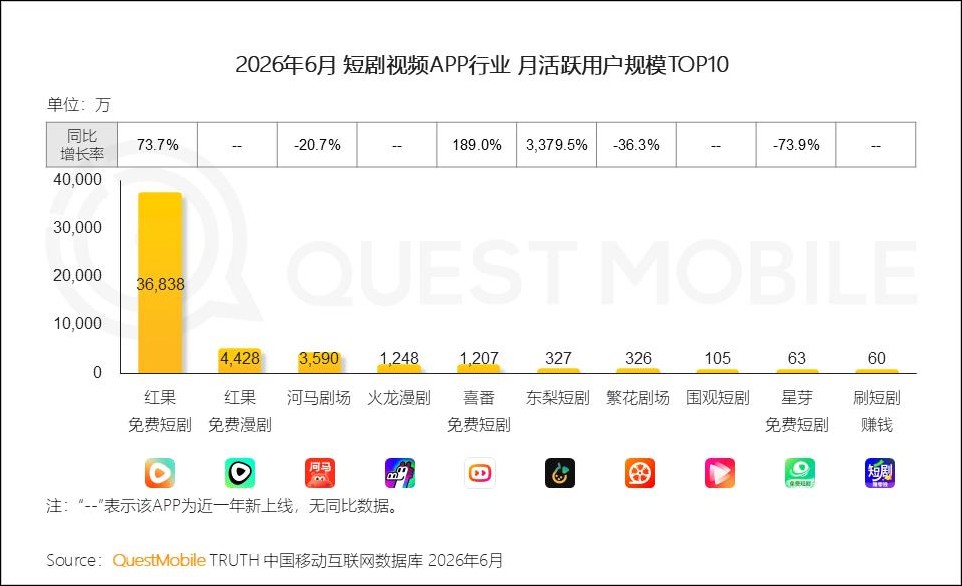
Hongguo Free Short Drama is a perfect example. This app, launched less than three years ago, surpassed 100 million daily active users in January 2026, becoming ByteDance’s fifth standalone application to exceed 100 million DAU. By June of this year, its monthly active users reached 368 million, up 73.7% year-over-year.
Audience aesthetic fatigue, live-action short dramas make a comeback
When the bubble grows large enough, the industry shakeout comes faster than expected. In the second quarter of 2026, the winds quietly shifted. According to data from the China Netcasting Services Association, 239,000 micro-dramas were released in Q2, of which 153,000 were AI-generated short dramas, with their share falling to 64%; live-action short dramas rose from 6,000 in the first quarter to 86,000.
A large number of works use similar AI-generated characters, with protagonists’ appearances, expressions, and even character settings becoming increasingly alike, causing audience novelty to decline. A striking contrast: in the first quarter of this year, AI micro-dramas accounted for over 95% of production output but only brought in about 4% of total online viewership.
Chen Ruiqing, chairman of Dianzhong Technology, said bluntly: “Cheaper things actually cost more. Anyone can make short dramas, but the barrier is getting higher. Owning IP, scriptwriting ability, and aesthetic sensibility are the real core competitiveness.” In fact, as long as the script is good and production is polished enough, there are plenty of AI videos with over ten million views and booming reputations and revenues. The problem is that there is too much shoddy AI slop following the same formulas, causing audiences to turn away.
Regulators act: New rules take effect from September 1.
Chinese official regulation has now officially hit the brakes. The “Micro-Drama Development Management Measures” will take effect on September 1, 2026, marking China’s first departmental regulation specifically governing the micro-drama industry. The new rules implement tiered management based on investment amount and subject matter: works with investments of 800,000 RMB or more must be reviewed and licensed by the National Radio and Television Administration; those between 300,000 and 800,000 RMB are reviewed by provincial broadcasting authorities; and works below 300,000 RMB are reviewed by the broadcasting platform.
New regulations explicitly require micro-dramas generated using AI technology to display a notice marker in a prominent position in each episode. Major platforms have also begun proactive governance: Hongguo Short Drama has launched a “special governance initiative for high-frequency AI faces, homogenized content, and material violations,” implementing measures such as “zero traffic” for highly repetitive series; Douyin Short Drama Creator Center has introduced a pre-check tool that allows AI drama rights holders to check for portrait rights and copyright risks before their works go live.
Conclusion
AI short dramas have covered in one year the distance that took other industries a decade to traverse. From the get-rich-quick myth of “a 50,000 yuan investment yielding 10 million in returns” at the start of the year, to now, when ninety percent of productions are losing money and the revenue from ten thousand plays can’t even buy a cup of milk tea, this sector’s expansion and cooldown have both been extraordinarily rapid. The large model companies at the far upstream of the industry chain and the traffic platforms in the middle have reaped the biggest profits, while the creators who took the risk of producing content have shouldered the heaviest losses.
AI hasn’t created new demand—it has simply flooded the existing market with an extremely low barrier to entry.
Source: KOCPC Chinese