


Artificial intelligence (AI) is reshaping the global industrial map at an unprecedented speed. NVIDIA founder and CEO Jensen Huang recently published an article to further elaborate on the “five-layer cake” AI architecture first proposed at this year’s World Economic Forum (WEF) in Davos. Huang Renxun clearly pointed out in the article that the industry must abandon its old understanding of software in the past and regard AI as an indispensable “modern infrastructure” like electricity and the Internet. This article analyzes the five key aspects that constitute the AI economy: Energy, Chips, Infrastructure, Models, and Applications. Huang Renxun emphasized that the development and restrictions between these five levels are profoundly shaping the overall AI economic landscape, and the momentum of “mutual reinforcement” between each level is becoming increasingly significant.
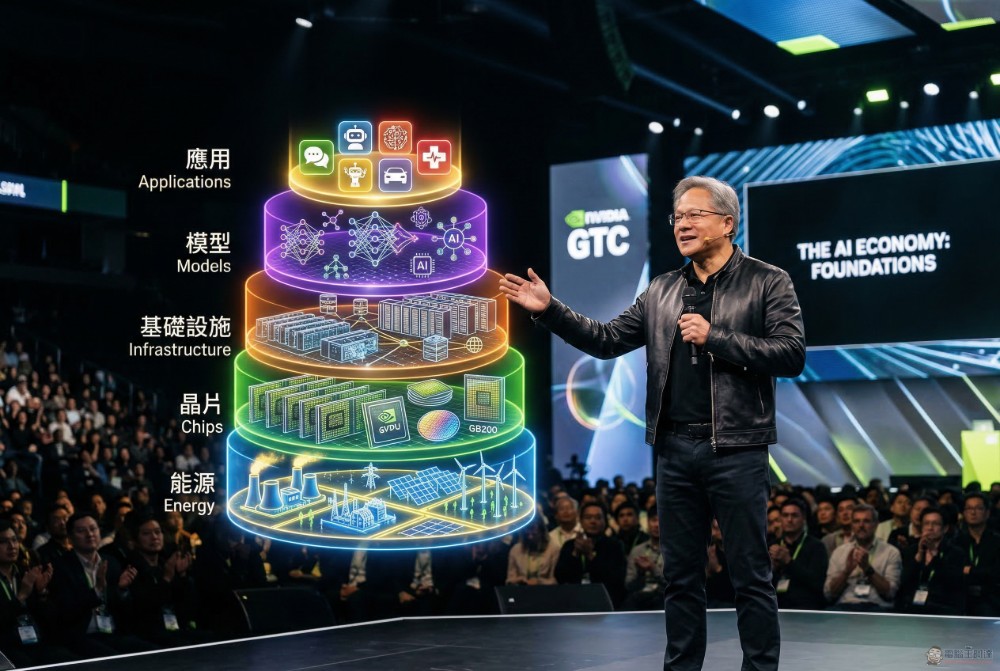
Deconstructing the AI economy: a five-layer cake framework
Huang Renxun accurately analyzed the reconstructed AI industry chain into a bottom-up, closely connected “five-layer cake” architecture. Every successfully implemented AI application is absolutely dependent on the support of every layer of architecture below it, and its influence even reaches down to the physical power plant. The following is his full text:
Artificial intelligence (AI) is one of the most powerful forces shaping the world today. It is not just a smart application or a single model, but an essential infrastructure like electricity and the Internet. AI operates on real hardware, real energy, and real economic systems. It transforms raw materials into intelligent capabilities that operate at scale. Every company will use AI, and every country will build AI. To understand why AI develops the way it does, it helps to think from first principles and see what fundamental changes have occurred in computing.
From pre-recorded software to real-time intelligence
For most of the history of computing, software was “pre-recorded.” Algorithms are written by humans and executed by computers. Data must be carefully structured, stored in tables, and retrieved through precise queries. SQL is indispensable because it makes this computing world work.
AI breaks this mold.
For the first time, we have computers that can understand unstructured information. It can recognize images, read text, listen to sounds and understand their meaning; it can also reason about situations and intentions. More importantly, it generates wisdom instantly.
Every reply is generated fresh, and every answer depends on the context you provide. This is no longer software retrieving from stored instructions, but software reasoning on the fly and generating intelligence on demand. Since wisdom is generated instantly, the entire underlying computing stack must be redesigned.
AI i.e. infrastructure
When looking at AI from an industrial perspective, it can be parsed into a five-layer stacked architecture.
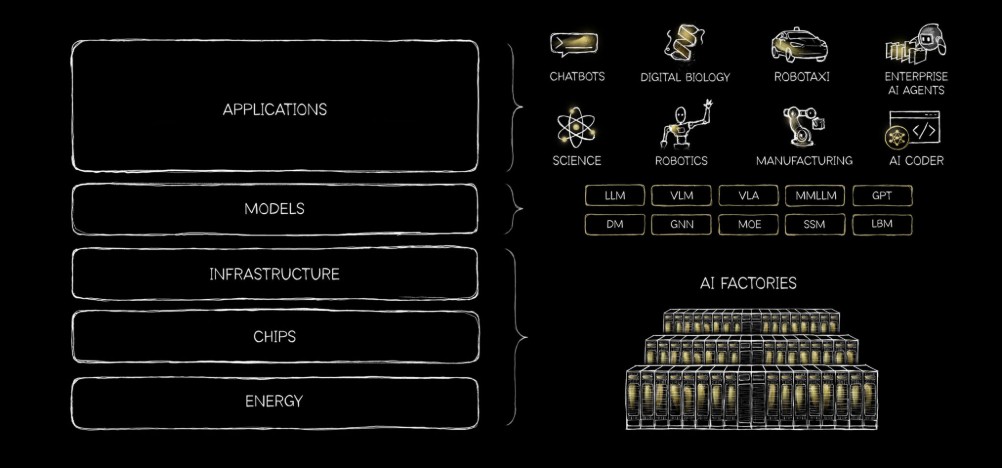
energy(Energy)
The bottom layer is energy. Instantly generated wisdom requires instant electricity. Each generated token is the result of electrons flowing, heat energy being managed, and energy being converted into computing power. There is no abstraction layer below this. Energy is the first principle of AI infrastructure and the fundamental constraint that limits how much intelligence the system can produce.
chip(Chips)
Sitting on top of the energy source is the chip. These processors are designed to convert energy into computing power on a large scale and efficiently. AI workloads require massive parallel computing capabilities, high-bandwidth memory, and high-speed interconnect technology. The progress of the chip layer determines how quickly AI can expand and how low the cost of intelligence can be reduced.
Infrastructure (Infrastructure)
On top of the wafer is the infrastructure. This includes land, power delivery, cooling, construction, networks, and systems that coordinate tens of thousands of processors into a single machine. These systems are AI factories. They are not designed to store information, but to produce wisdom.
Model(Models)
Above the infrastructure is the model layer. AI models can understand many types of information, including language, biology, chemistry, physics, finance, medicine, and the real world itself. Language models are just one type. The most transformative progress currently is taking place in the fields of protein AI, chemical AI, physical simulation, robotics, and autonomous systems.
application(Applications)
The top layer is the application layer, where economic value is generated. For example, drug research and development platforms, industrial robots, legal assistants (copilot), autonomous vehicles, etc. Self-driving cars are an AI application embodied in machines; humanoid robots are AI applications embodied in the body. Same stack, different results.
This is the five-layer cake: energy → chip → infrastructure → model → application
Every successful application relies on every layer of architecture beneath it, all the way down to the power plants that support its operations. And this construction has only just begun. We have invested only a few hundred billion dollars so far, but there are still trillions of dollars of infrastructure to be built. Around the world, we are seeing chip factories, computer assembly plants, and AI factories being built on an unprecedented scale. This is becoming the largest infrastructure construction project in human history.
The manpower required to support this wave of construction is extremely large. AI factories need electricians, plumbers, plumbers, steelworkers, network technicians, installers and operators. These are highly skilled and well-paying positions, and demand currently outstrips supply. Participating in this revolution does not require a PhD in computer science.
At the same time, AI is improving the productivity of the overall knowledge economy. Take radiology, for example. Artificial intelligence can now help interpret scans, but the need for radiologists continues to grow.这并不是矛盾现象。放射科医师的职责是照顾病人。解读影像只是其中一项工作。 When AI takes over more daily tasks, radiologists can focus on judgment, communication and care. Hospitals become more productive, serve more patients, and hire more staff.

Productivity creates production capacity, and production capacity creates growth.
What has changed in the past year?
Over the past year, AI has crossed an important threshold: for the first time, models have become powerful enough to be used at scale. Reasoning ability is improved, hallucination phenomenon is significantly reduced, and grounding ability is also greatly improved. AI-based applications have also begun to generate real economic value for the first time. In fields such as drug research and development, logistics, customer service, software development and manufacturing, AI applications have demonstrated strong product-market fit. These applications place high demands on every layer beneath them.
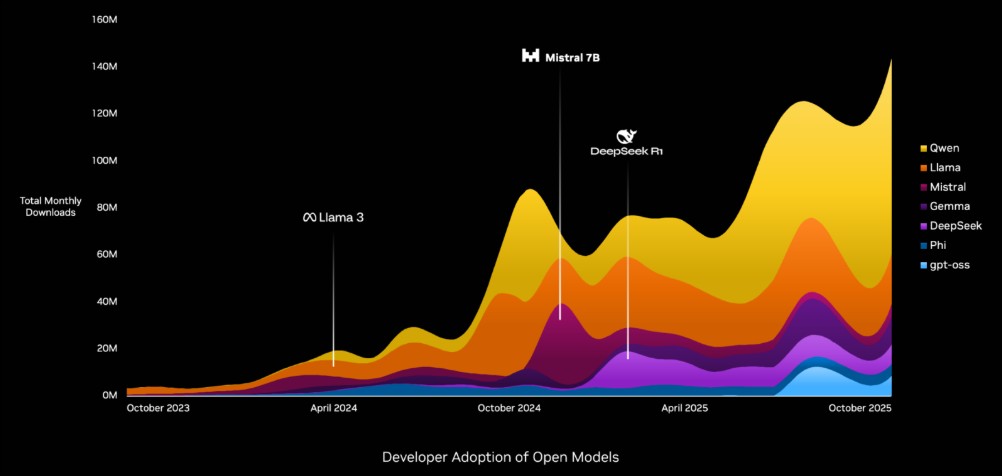
The open source model plays a key role in this. Most of the world’s models are free, and researchers, startups, businesses, and even entire countries rely on open source models to participate in the development of advanced AI. When open source models reach the technological forefront, they not only change the software, but also initiate requirements for the entire technology stack. DeepSeek-R1 is a powerful example. By making powerful inference models widely available, it accelerates application layer adoption while also increasing the demand for underlying resources such as training computing power, infrastructure, chips and energy.
what does this mean
The implications are obvious when you think of AI as a necessary infrastructure. The starting point of AI may be a large language model (LLM) based on the Transformer architecture, but it is much more than that. This is an industrial transformation that is reshaping how energy is produced and used, how factories are built, how work is organized, and how economies grow.
AI factories are being built because intelligence can now be generated instantly. Chips are being redesigned because efficiency determines how quickly intelligence can expand. The reason why energy becomes the core is that it determines the upper limit of the overall producible intelligence. The accelerated development of applications is because the underlying model has crossed the threshold and is finally truly practical on a large scale.
Each layer is mutually reinforcing with the other layers
This is why construction is so massive, why it touches so many industries simultaneously, and why it is not limited to a single country or industry. Every company will use AI, and every country will build AI.
We’re still in the very early stages. Much of the infrastructure has yet to be built, much of the workforce has yet to be trained, and many of the opportunities have yet to be realized. But the direction is clear.
AI is becoming the most fundamental infrastructure of the modern world. The choices we make now, the speed we build, the breadth of our involvement, and the way we deploy AI responsibly will shape the future of this era.
Conclusion: A comprehensively reinvented future
The far-reaching implications of redefining AI as the “necessary infrastructure” of modern society are self-evident.
Huang Renxun concluded that the development of AI may start with large-scale language models based on the Transformer architecture, but its ultimate form is far more than that. This is an ongoing comprehensive industrial transformation: it is reshaping the global energy production and consumption model, subverting factory construction standards, redefining the organizational structure of the human workforce, and injecting new momentum into global economic growth.
Each layer of the five-layer cake structure is having a strong “mutual reinforcement” effect with other layers. The demand for instant generation of intelligence has given rise to AI factories; the pursuit of computing power expansion efficiency has promoted the redesign of chips; and energy, as a hard ceiling, determines the total upper limit of overall intelligence output; ultimately, the maturity of the underlying technology crosses the threshold, allowing top-level applications to truly achieve large-scale commercialization.
This is why the scale of the current infrastructure is so staggering, why it can disrupt so many vertical industries simultaneously, and why this revolution is destined not to be limited to a single country or company. As Jen-Hsun Huang said: “Every company will use AI, and every country will build AI.”
The world is still in the very early stages of this transformation – a large amount of underlying infrastructure has not yet been completed, a huge workforce has not yet completed skills transformation, and countless business potentials remain to be developed. But the way forward is crystal clear. AI is establishing its place as the most fundamental infrastructure of the modern world. The strategic choices made by the industry and governments, the speed of infrastructure construction, the breadth of cross-sector participation, and whether AI systems can be deployed responsibly will all become the decisive force in shaping the future of the next technological era.
Source: KOCPC Chinese