


Previously, the most time-consuming part of planning a trip was comparing prices across a dozen or more tabs. Airfares change from one day to the next, hotel pages leave your eyes strained, and figuring out whether points can be applied means digging through each company’s rules. But soon, that may no longer be necessary. On the 27th, Google announced that its search engine’s AI Mode has added a full suite of travel planning features: users can directly track airfare prices in conversation, check points or mileage costs for flights and hotels, and even complete hotel bookings.
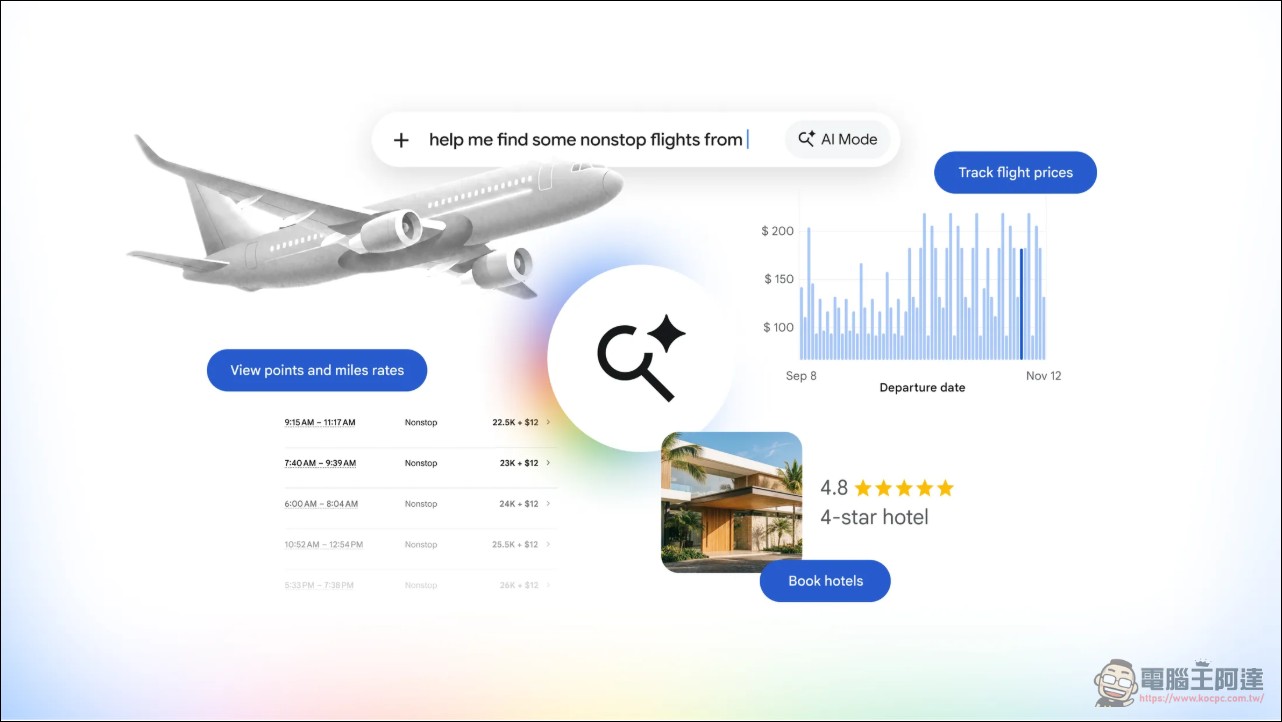
AI Mode flight price tracking, now built directly into the conversation.
In this round of AI Mode updates, Google has directly integrated Google Flights’ price tracking feature into AI Mode. Users simply describe their departure point, destination, and dates, and the system provides the latest fares from over 300 partner airlines and travel websites. If they don’t want to book right away, they can also ask AI Mode to keep tracking, and Google will notify them by email when prices change. Users can directly ask commands like “Track these flight prices and notify me when they drop.” This feature is currently available in more than 180 countries and regions.
For frequent flyers, this solves the most troublesome part of flight price tracking: previously, you had to set up tracking case by case in Google Flights and then wait for email notifications. Now you can simply say it in a conversation, and the fare data comes from real-time integration of over 300 airlines and travel websites. For those who haven’t decided whether to fly yet, “track first, decide when the price drops” becomes an option you can set without leaving the conversation. Once set up, the tracking status is tied to your Google account, and you can see which flights are being monitored in AI mode or Google Flights, without having to remember what conditions you set.
Points and Mileage Costs at a Glance
AI mode has also added the ability to view travel prices in points or miles. Users can directly ask how many miles or points a particular flight or hotel stay requires, and the system will display the corresponding cost based on data provided by partners. Currently supported partners include Alaska Airlines, Hawaiian Airlines, Choice Hotels International, Hilton, and Wyndham Hotels & Resorts. Google says more partners will be added in the future.
Travel rewards points have long been one of the most fragmented areas of information: each airline and hotel group has different rules for points, and whether you can book a particular flight with points and how many points it takes often means scouring each company’s official website or forum threads. By consolidating this data into a single chat interface, Google has effectively turned “checking points” from a multi-platform task into a simple Q&A.
Hotel booking: Google serves only as a channel, not as the merchant.
Hotel booking is another major focus of this update. Users can first use AI mode to describe their itinerary and accommodation preferences, and the system will list hotel options with guest reviews and comparison highlights. After making a selection, a “Continue on Google” option appears, allowing users to choose room type, review the cancellation policy, and complete payment with Google Pay. Google emphasizes that the actual transaction and customer service are still handled by the hotel or booking platform. For platforms like Booking.com and Expedia, Google’s role is that of a traffic gateway rather than a competitor; but for consumers, the difference is that the entire booking process can go from a search conversation all the way to payment, without switching between multiple tabs.
This feature is rolling out first in the US in English, and will expand over the next few weeks, with partners including Booking.com, Expedia, Hilton, Marriott International, Priceline, Trip.com, and other providers.
The impact on the travel industry
This update deepens Google’s position in the travel decision chain, allowing users to stay within a single conversation from “searching for hotels” to “paying for bookings.” For hotels and OTAs, this means traffic structures may be redistributed—clicks on search results pages could decline, but orders driven through Google conversations may increase. Who can capture these orders and who will lose organic traffic are questions worth watching as the rollout expands over the coming weeks.
For consumers, the most direct change is lower decision-making costs. In the past, planning a trip might have taken an afternoon of price comparison; now, from asking “which flight to Tokyo next month is cheapest” to completing hotel payment, it can theoretically be compressed into a single conversation. Currently, hotel booking is only available in the U.S. and in English, and the points feature only covers five partner hotels, so there’s still a gap to true “one-stop” service.
Source: KOCPC Chinese