


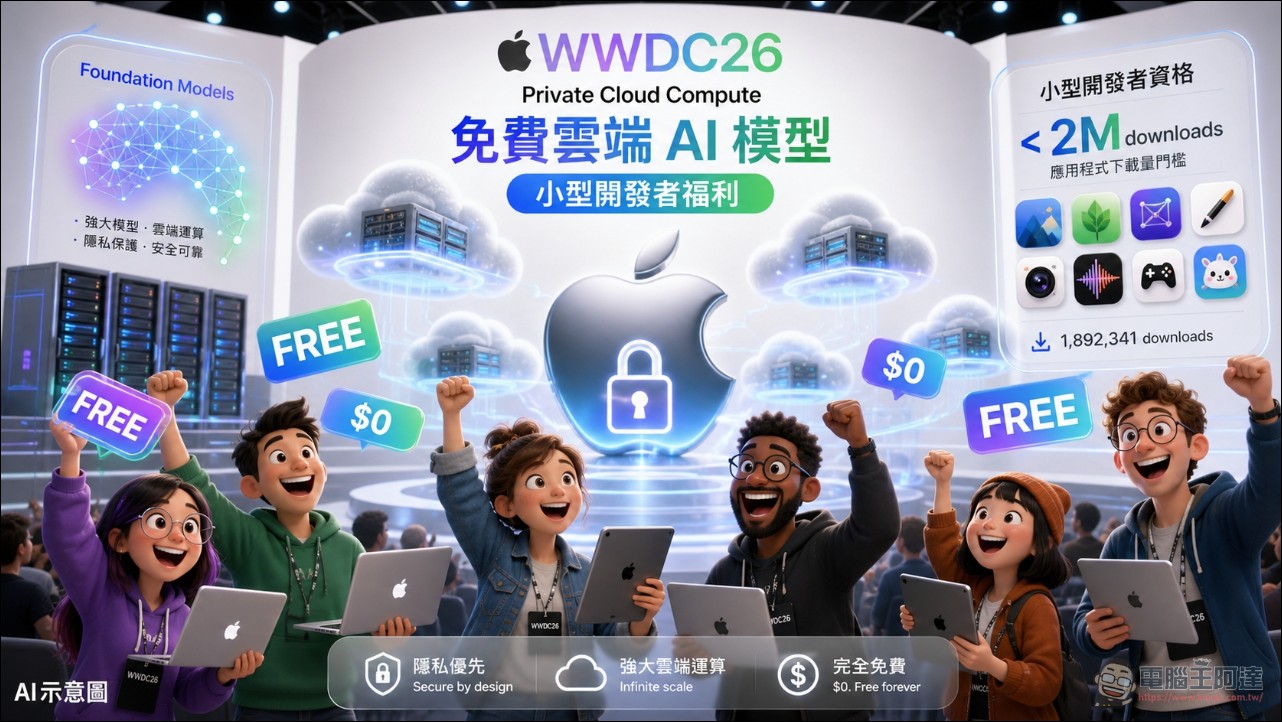
If last year’s WWDC shock was “running models on phones,” this year’s shock is “delivering cloud models to developers for free.” Apple announced at WWDC26 that eligible developers can call Apple Foundation Models running in the cloud free of charge through Private Cloud Compute (PCC), without paying any cloud API fees. Recently, Apple finally opened applications to small developers, and the news instantly exploded in the indie developer community. Some developers even shared their experience of “application approved in seconds, Apple handing out money,” exclaiming that they plan to add AI features throughout their apps because “the cost is zero.” Today, let’s break down this policy: where it can be used, what the restrictions are, how you can apply and use it, and the real-world examples we’ve seen so far.
What is this: Apple’s cloud-based large model, free for small developers.
Private Cloud Compute is Apple’s confidential cloud computing environment built for Apple Intelligence, an infrastructure that previously served mainly complex tasks for Apple’s own systems. Now Apple is opening the same infrastructure to developers: as long as an app’s download volume is small enough, it can call server-scale Foundation Models running on PCC through the Foundation Models framework, with Apple directly absorbing the underlying compute and API costs.
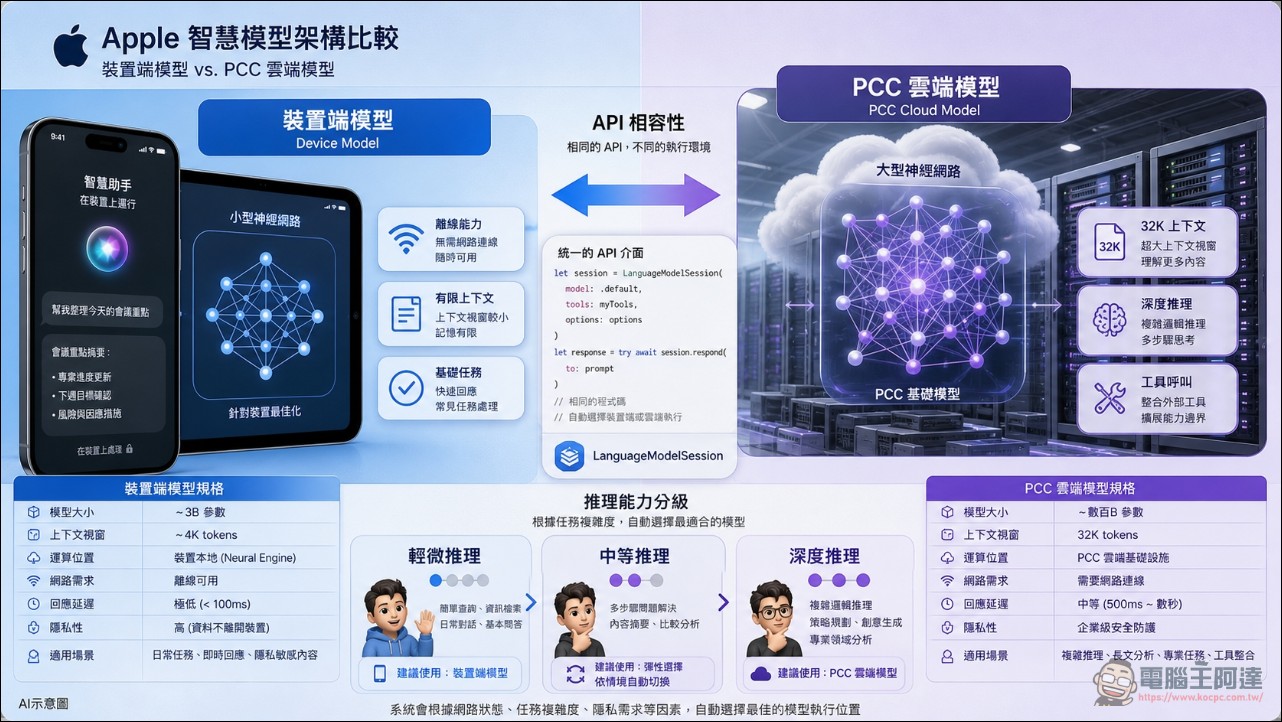
Compared to the on-device System model previously available with iOS 27, the PCC model is a “bigger brother.” Both share the same Swift API, the same `LanguageModelSession`, and the same `Generable` and `Tool` protocols. The only differences are that the PCC model has a larger 32K context window and three levels of reasoning capability—light, medium, and deep—making it ideal for scenarios like long-document summarization, multi-turn deep conversations, or heavy tool calling. For developers, switching from on-device to cloud often only requires a one-line code change.
Behind the Benefits: Apple Bets on Low-Price Experimentation and Ecosystem Stickiness
This policy has been interpreted externally as a deliberately crafted developer incentive by Apple. For independent developers or small teams, the biggest hurdle to integrating cloud AI into an app has often been the bills for tokens and cloud resources—build one feature, and the monthly fees could eat up most of the profit. By reducing that cost to zero, Apple is effectively absorbing the most sensitive “early trial-and-error costs” for small and medium-sized teams, giving AI features that were previously shelved because of billing concerns a real chance to actually get off the ground.
For Apple, this is a two-birds-with-one-stone calculation: on one hand, it lowers development costs and attracts more small developers to build AI features into the App Store, strengthening the ecosystem; on the other, it locks developers into the Foundation Models framework early, deepening their reliance on Apple’s own cloud infrastructure. Some analysts point out that this logic is essentially offering sweeteners precisely to developers with low download volumes, in exchange for ecosystem scale and stickiness.
Who qualifies: two thresholds
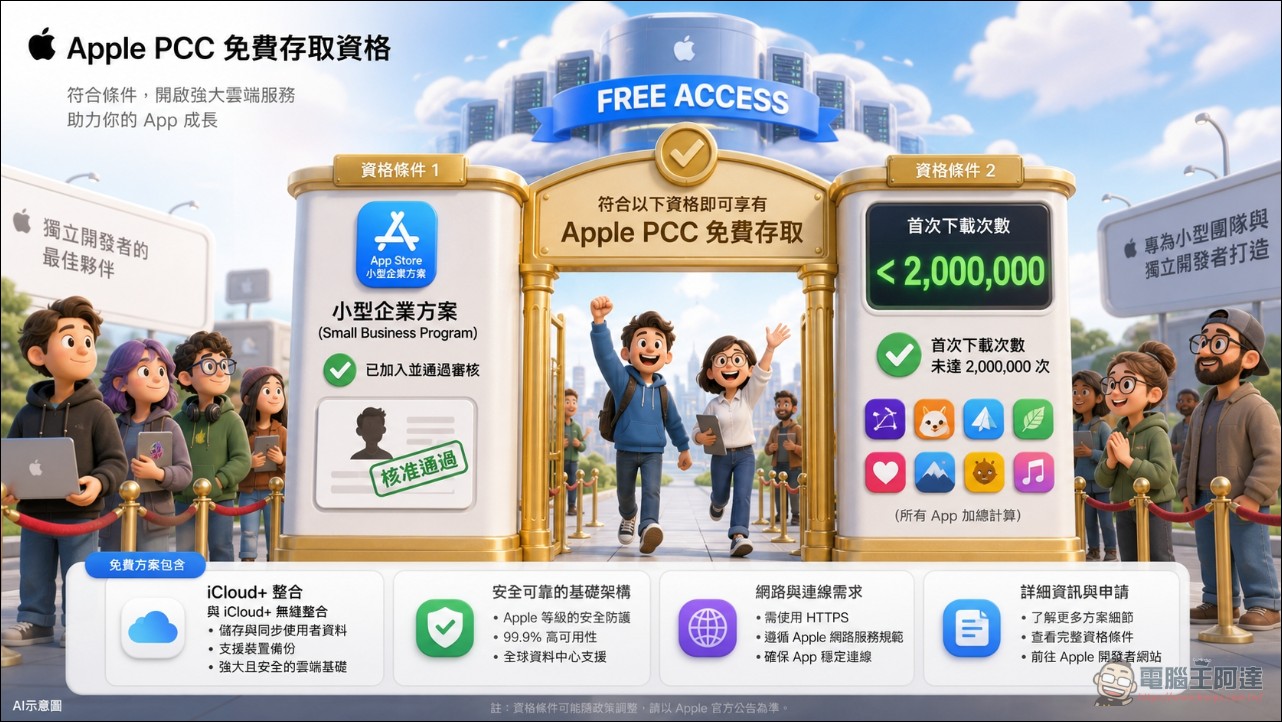
To use the PCC model for free, you must meet two conditions at the same time:
- Joined the App Store Small Business Program(Small Business Plan): For developers with low annual revenue, free to apply, mainly must meet the revenue threshold.
- The app’s first-time downloads on the App Store were below 2 million.: This is the scale cap Apple has explicitly set, ensuring this benefit is reserved for independent developers who haven’t yet blown up (something more than 99% of apps would struggle to achieve with 2 million downloads).
Once you qualify, there’s no need to set up any additional API keys or accounts. PCC is integrated into the system alongside iCloud; user data is never stored and is used only for the current request, and it has been independently verified by researchers. On the developer side, there are no keys to rotate or authentication flows to integrate—just call the Foundation Models framework directly.
How to Apply and Use: Process Breakdown
The application and usage can be divided into several steps:
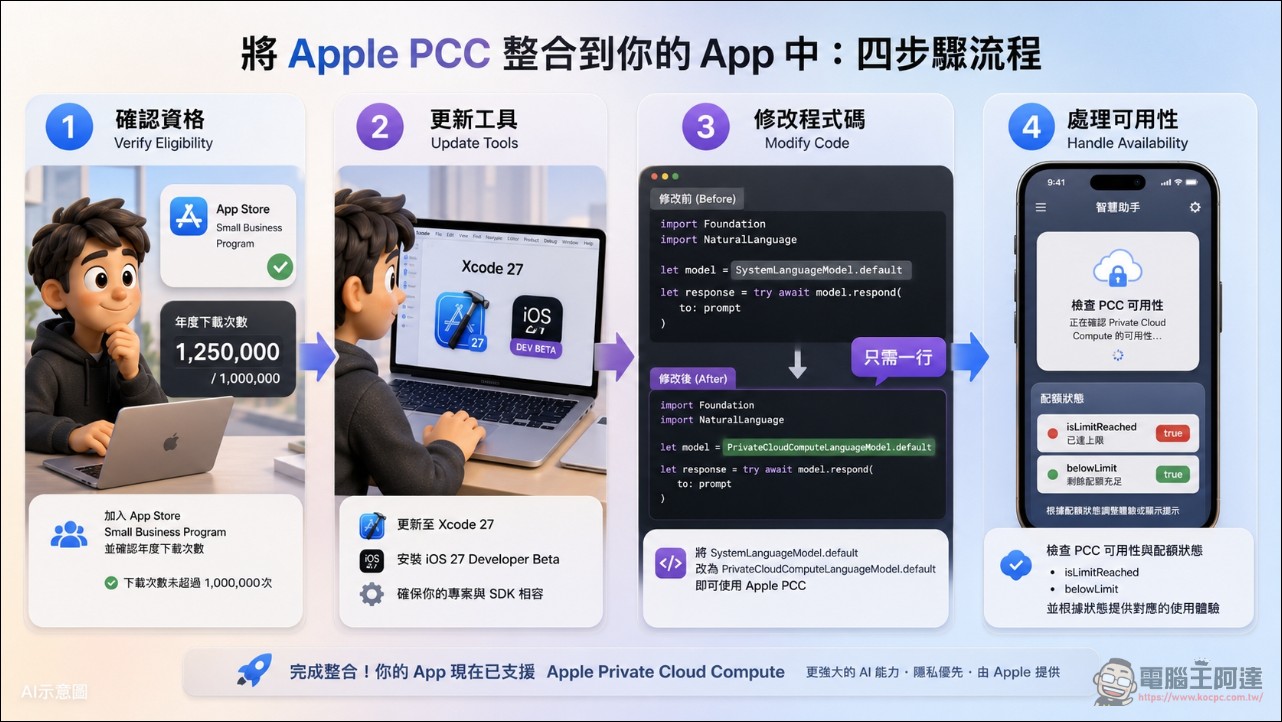
- Step 1: Confirm EligibilityFirst, make sure you’ve joined the App Store Small Business Program, and that your app’s downloads are under 2 million. If you qualify, Apple will grant you PCC access.
- Step 2: Update the toolsUsing Xcode 27 developer beta and iOS 27 developer beta, these versions have built-in Foundation Models framework and PCC support.
- Step 3: Change one line of code.Change the model of `LanguageModelSession` from `SystemLanguageModel.default` to `PrivateCloudComputeLanguageModel.default`, with the rest of the prompts, structured outputs, and tool calls completely unchanged. Example:
let cloud = LanguageModelSession(model: PrivateCloudComputeLanguageModel.default)。 - Step 4: Handle Availability and LimitsPCC can only run on devices that support Apple Intelligence, so remember to keep the availability check. Additionally, each user has a daily request limit counted against their iCloud account, so the UI should query the quota status (`isLimitReached`, `belowLimit`) and show a persistent upgrade control rather than interrupting the user with an alert. Xcode also provides a debugging option, “Simulate Foundation Models Availability,” for testing throttling scenarios in the simulator.
The official also has tutorial videos, and the WWDC website source has Chinese subtitles:
Limitations and Trade-offs: The Boundaries You Need to Know
Although this benefit is tempting, it is not an unlimited free lunch. Here are a few key restrictions:
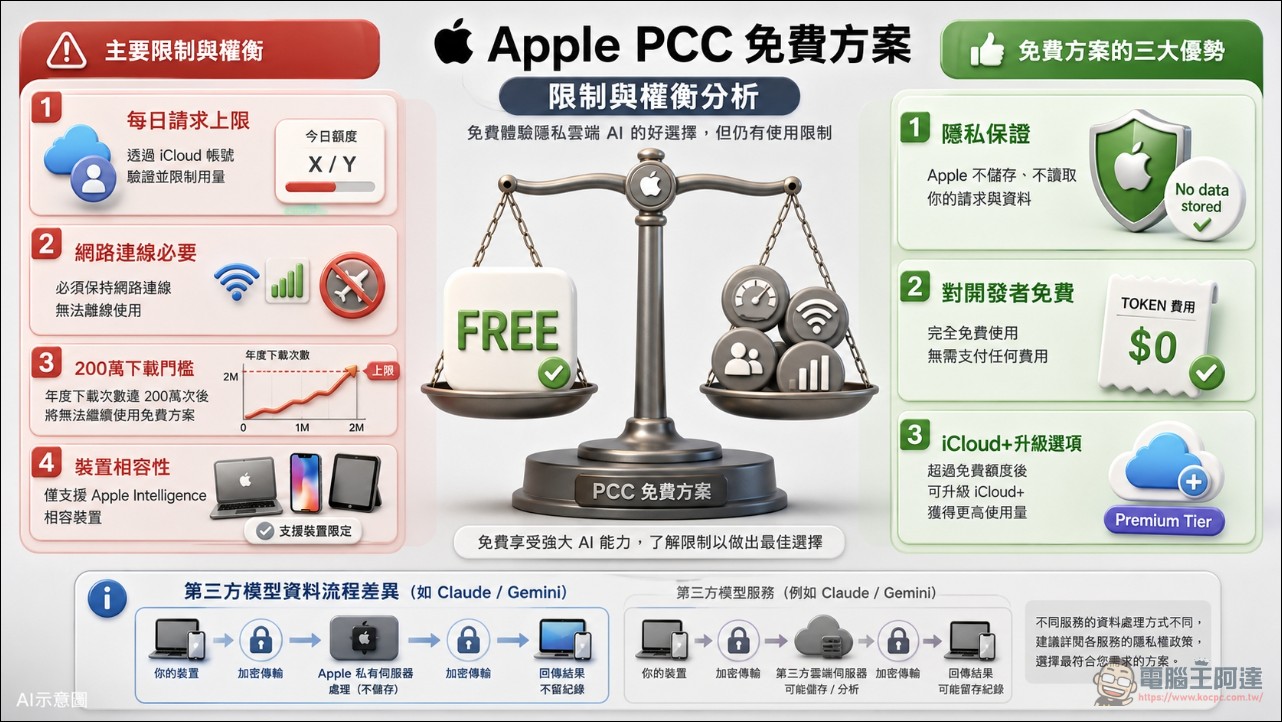
- Daily request limitEach user’s requests are counted against their iCloud account with a daily limit, which can be raised by upgrading to iCloud+. In other words, it’s free for developers (no token bills for developers), but each end user will still hit quota limits.
- Requires an internet connection and an Apple Intelligence–capable device.The PCC model requires an internet connection to function and only supports devices with Apple Intelligence, unlike on-device models that can operate offline.
- 2 million download thresholdOnce the app goes viral and downloads surpass 2 million, the eligibility may no longer apply, and you’ll have to arrange your own paid plan or switch to another model.
- Privacy guarantee applies only to first-party models.PCC’s five privacy commitments apply only to Apple’s own System and PCC models. If third-party providers (such as Claude, Gemini) are integrated via a framework, data flow and disclosure fall back on the developer, who must handle them according to provider terms and disclose them in App Store privacy labels.
- Preview Period Guarantee ChangesThis service is currently still in summer preview, with privacy and performance guarantees to be progressively completed. When releasing features, be aware that the guarantees inherited are still in flux.
Actual use case
From a technical perspective, the PCC model is identified as best suited for scenarios including: summarizing long documents with images (32K context makes large-document summarization feasible), planning-type tasks that require multi-step reasoning, and assistant features that trigger heavy tool calls with large outputs. Apple also demonstrated a three-stage handwritten app workflow: using the PCC model with high temperature for brainstorming, deep reasoning for planning, and then on-device models for routine review to save server calls—showcasing the flexibility of “switching models within a single session based on the task.” Additionally, the Foundation Models framework can integrate open-source Hugging Face models via MLX, and will also support Anthropic’s Claude and Google’s Gemini in the future, letting developers switch between different models using the same Swift API.
Conclusion
Apple’s move essentially stuffs “free cloud AI” directly into the toolkit of independent developers. It comes with clear eligibility criteria, daily usage caps, and device compatibility limits, making it practically free money for apps that haven’t blown up yet. What’s worth watching next: whether this free incentive can actually nurture a wave of small, polished AI-native apps, and whether developers will stick with Apple’s framework and cloud ecosystem once they blow past the download threshold. For indie developers, this is genuinely a good time to bake AI features into their apps.
Source: KOCPC Chinese