


A few days ago, Alibaba’s latest open-source model The Qwen3.8 family officially debutsAMD also announced Day 0 support across the board, covering both consumer and data center product lines. Developers can run the 27B dense version locally on systems with Ryzen AI Max processors and Radeon AI PRO R9700 graphics cards, and can also immediately deploy and evaluate the full MoE version on Instinct MI300X, MI325X, and MI355X GPUs via the ROCm platform.
The Qwen3.8 series marks the first generation where the Tongyi Qianwen team brings Qwen-Max level capabilities to open-source releases, with enhancements across coding, professional work, research, and long-horizon agentic tasks. The official release also provides adjustable thinking control capabilities, allowing the model to maintain a high degree of task completion in complex multi-step scenarios. Both the Qwen3.8-27B dense model and the Qwen3.8-2.4T-A95B large MoE model are now available on Hugging Face for developers to download and integrate directly.
Local real-time availability: Ryzen AI Max and Radeon AI PRO R9700 support Qwen3.8 27B.
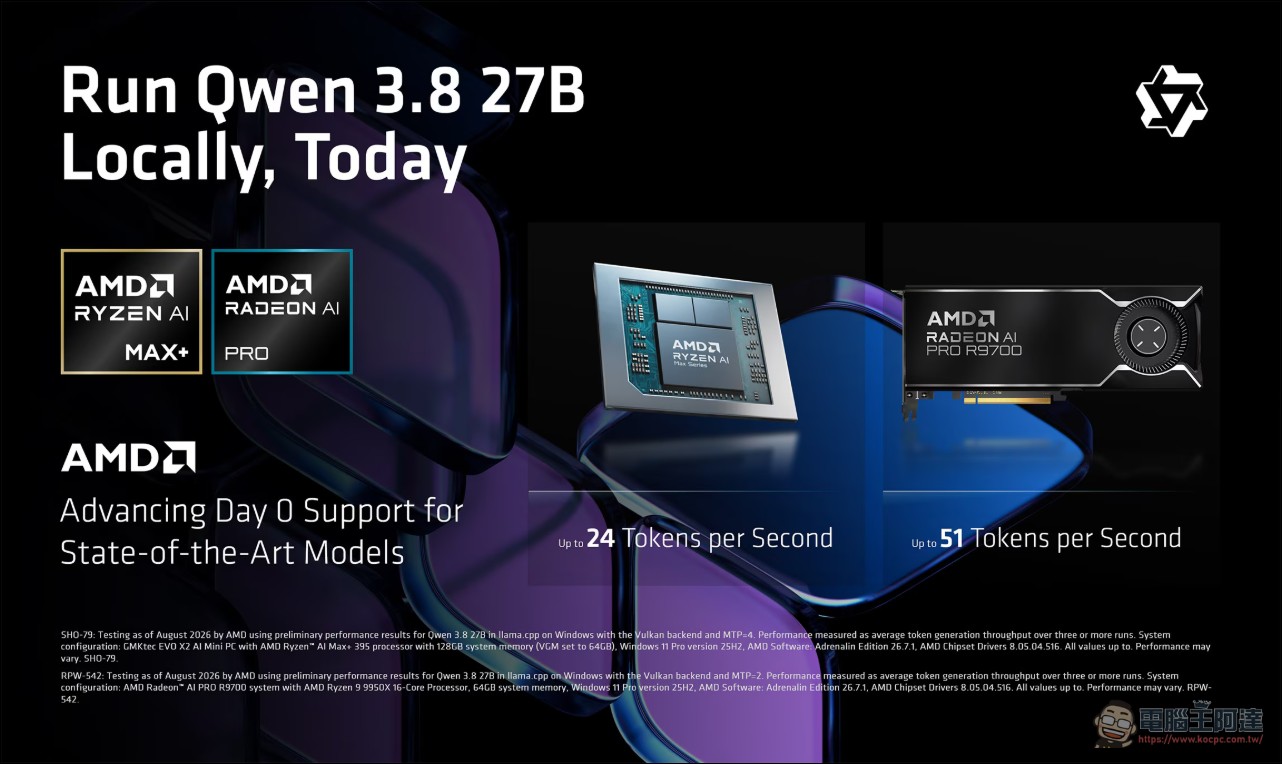
For PC and workstation scenarios, AMD explained in an August 14 blog post that it has provided Day 0 support for Qwen3.8 27B. This 27B version uses a dense architecture, with model size and memory requirements falling within a range suitable for local development. Developers can run it directly on systems equipped with Ryzen AI Max+ processors or a single Radeon AI PRO R9700 32GB graphics card, without relying on cloud resources.
Officials noted that Qwen3.8 27B can also run on supported hardware with more than 24GB of variable display memory or VRAM, including certain older-generation AMD platforms with sufficient memory capacity. This support was available at the time of the model’s release and is compatible with widely used open-source toolchains.
- Ryzen AI Max+ 395In early testing on Windows, using llama.cpp with the Vulkan backend and MTP=4 setting, the average generation throughput reached up to 24.5 tokens per second.
- Single Radeon AI PRO R9700Under the same test conditions with MTP=2, it can reach up to 51.8 tokens per second.
- Test conditionsThe data represents the average token generation throughput of llama.cpp on Windows, calculated from the average of three or more runs. AMD notes that as software and models continue to be optimized, there is still room for performance improvement.
As a dense model, Qwen3.8 27B has high demands on memory capacity and computing power, which in turn highlights the importance of local hardware capabilities. AMD emphasizes in its article that increasingly powerful AI models are accelerating adoption on local PCs and workstations, allowing developers to build, test, and deploy real-world applications on the same machine they use daily, helping to shorten the preparation time from model release to actual deployment.
One-Click Local Experience: llama.cpp, LM Studio, and Lemonade
On the toolchain front, AMD has prepared multi-tiered local execution paths for Qwen3.8 27B. For developers familiar with open-source inference frameworks, the model can be loaded directly via llama.cpp on Ryzen AI Max and Radeon hardware; for advanced users seeking a quick experience, LM Studio offers a graphical interface to explore, download, and test the model in dialogue on supported AMD systems, without writing any code.
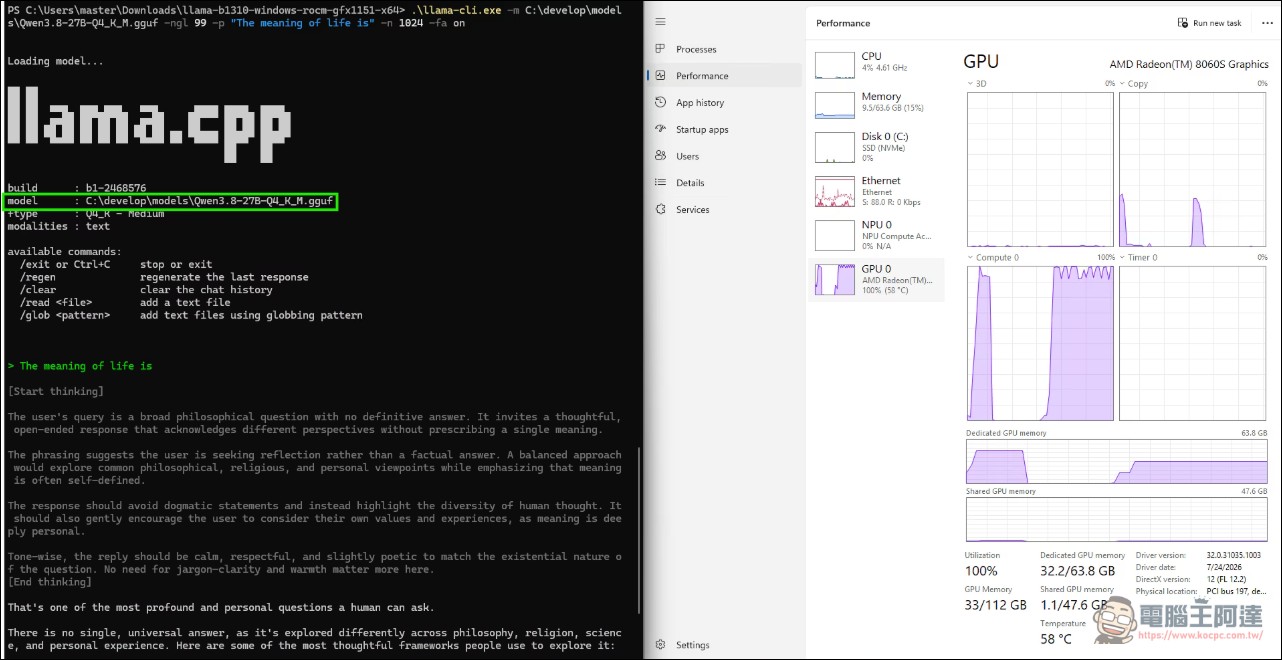
According to the official documentation, LM Studio now supports running Qwen3.8 27B on Ryzen AI Max+ systems and the Radeon AI PRO R9700 32GB. The model requires approximately 24GB of variable graphics memory, or VRAM, to run smoothly, and it can also operate on other supported AMD platforms. This path is positioned as the shortest route from download to inference, making it suitable for initial validation of prompts and workflows.
For developers looking to integrate local AI into their applications, AMD’s Lemonade serves as a lightweight local inference layer. Lemonade can be packaged alongside an application, allowing it to communicate with Qwen3.8 27B through familiar API formats, while Lemonade handles the underlying AMD platform integration—so developers don’t need to maintain hardware-related inference stacks themselves. AMD’s official description of the division of labor across the three is: Ryzen AI Max and Radeon provide the local compute foundation, LM Studio offers a quick entry point for experimentation, and Lemonade provides an integration path toward application development.
Data Center Instant Deployment: Instinct MI300X, MI325X, MI355X Support Full Qwen 3.8 Family
On the data center side, a technical article released by AMD on August 12 announced that Instinct MI300X, MI325X, and MI355X GPUs now provide Day-0 support for the Qwen 3.8 model family, allowing developers to immediately deploy and evaluate it through the AMD ROCm open software platform combined with SGLang and vLLM. The core features listed in the article include Day-0 support across Instinct GPUs, optimized ROCm enablement, and readiness for SGLang, vLLM, and ATOM, along with performance references and a quick-start guide.
For deployment, the official release provides multiple precision and framework combinations. The vLLM path offers deployment examples for FP8 and MXFP4 checkpoints, including corresponding Docker images and startup parameters. For the SGLang path, recommended configurations are differentiated between MI355X and MI300X—for example, using the AITER attention backend on MI355X and enabling unified attention and FlyDSL to fully leverage the inference capabilities of the new hardware. The ATOM path also provides an MXFP4 deployment workflow.
- FP8 checkpointQwen/Qwen3.8-2.4T-A95B-FP8: multi-node deployment example for vLLM and SGLang
- MXFP4 checkpointQwen3.8-2.4T-A95B-Quark-MXFP4, converted from FP8 via AMD Quark quantization toolchain, selectively quantizes MoE routing experts to MXFP4 while keeping the remaining layers in BF16, using a shard-by-shard processing flow to avoid loading the full model at once.
- Parallel configurationThe official examples include single-node TP8 and dual-node combinations such as TP8 and PP2, along with corresponding serve commands, host, and port settings.
Qwen 3.8 Architecture Update: 512 Experts, 92 Layers, and Hybrid Attention Design
According to AMD’s technical article on Qwen 3.8, this generation builds on the architectural foundations of Qwen 3.6 and Qwen 3.5, introducing a significantly expanded sparse mixture-of-experts architecture featuring 512 expert models, a deep network with 92 layers, and a hybrid linear attention and full attention design optimized for long-text workloads.
The feature-oriented updates cover four key areas: overall capability improvements in programming, professional work, research, and long-horizon agent tasks; enhanced agent execution capabilities, including stronger autonomous planning and handling of environmental feedback; expanded downstream compatibility with mainstream development tools and testing frameworks; and flexible thinking control, where developers can adjust reasoning depth via reasoning_effort and preserve thinking context from historical messages through preserve_thinking. AMD noted that Qwen 3.8 is designed with a greater focus on executing complex multi-step tasks to completion, rather than merely answering a single difficult question.
Summary
Looking at the layout of this Day 0 support, AMD clearly distinguishes two tiers of Qwen 3.8 enablement: for local PCs and workstations powered by Ryzen AI Max and Radeon AI PRO R9700, the focus is on the 27B dense model, with llama.cpp, LM Studio, and Lemonade providing a path from hands-on experience to application integration; for data centers built around Instinct MI300X, MI325X, and MI355X, the full MoE family including 2.4T-A95B is supported, with ROCm combined with SGLang, vLLM, ATOM, and the Quark quantization workflow offering deployment-ready guidance.
The two official blog posts cover performance reference data, tool compatibility, and step-by-step deployment instructions, enabling developers of all scales to choose suitable hardware and frameworks for evaluation as soon as the model is released. For teams looking to use the new model directly on local systems, the reference figures of 24.5 tok/s and 51.8 tok/s, the clear 24GB memory requirement, and the out-of-the-box LM Studio experience form an immediately verifiable starting point. For teams that need to handle long-context and agent workloads in production, the multi-precision and multi-framework support on the Instinct platform provides a basis for later expansion. This is quite useful for individuals and teams who want to research or set up models on AMD platforms, no longer limited to the more expensive NVIDIA platforms.
Source: KOCPC Chinese