


In the summer 2026 box office, an unexpected dark horse emerged in China’s animated film market. It wasn’t driven by polished production or backed by a major IP—it succeeded through sheer “terribleness.” The domestic Chinese animation *Niulai*, released on August 5, quietly hit theaters with zero promotion, earning just 3,420 yuan (approximately NT$16,000) on its opening day, with only 122 viewers. Over the first nine days, cumulative box office reached just 7,169 yuan with around 236 viewers, setting the lowest box office record for a theatrically released Chinese animated film in 2026. However, just as the film was about to fade into obscurity, it went viral on social media for its “disaster-level animation quality.” Box office surged over 300-fold in just 12 days, and by August 16, cumulative earnings had surpassed 3 million yuan (approximately NT$14.2 million). Screenings skyrocketed from fewer than 5 sessions at its lowest point to over 10,000.
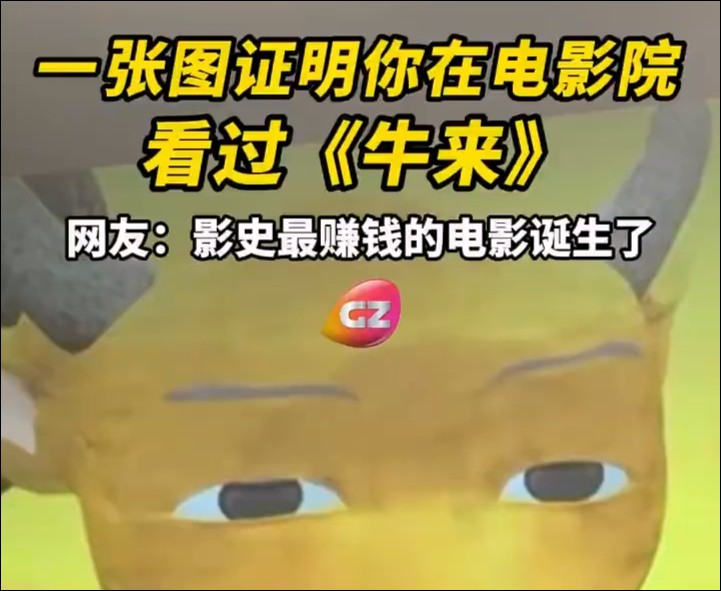
The worst animated film ever, “Niu Lai,” is flooded with bad reviews, yet its box office has skyrocketed 300-fold.
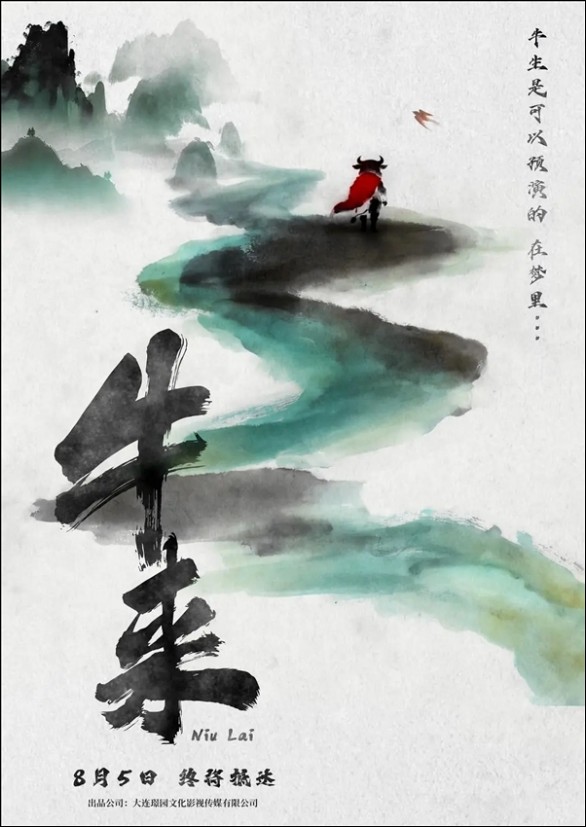
The poster has an ink-wash Chinese aesthetic, but the actual film is “disaster-level” 3D.
“The Ox Comes” runs 86 minutes in total, promoted with the taglines “Chinese-style cute healing” and “ink-wash hand-drawn production.” Only one ink-wash-textured poster in the Chinese aesthetic has been released to the public. On the poster, a character wearing a red cloak and an ox-horn-shaped helmet rides a motorcycle through verdant ink-wash mountains and waters, with handwritten calligraphy on the right reading, “Life can be wasted, in dreams…” The overall visual is exquisite and richly atmospheric.
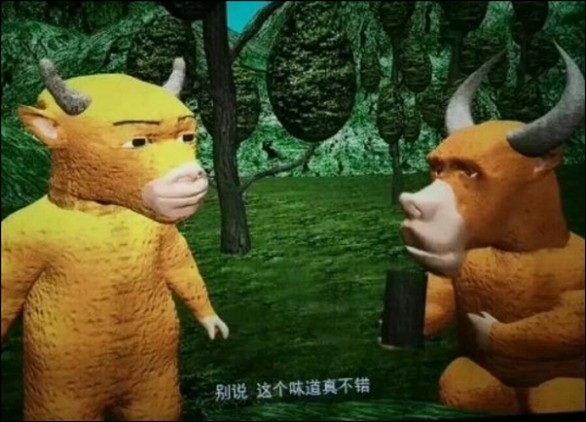
However, audiences who went to see it called it a scam. The film is full of stiff, lagging 3D models, low-quality special effects with frequent clipping, awkward character movements, scenes lacking detail, and flat, monotonous voice delivery. After watching, some viewers said, “It took me three minutes to recover,” and even joked, “The most refined visuals in the entire film are limited to the promotional poster.” In 2026, when AI technology is highly widespread, this animation’s level of detail doesn’t even match typical AI-generated animations, leading netizens to describe it as “beginner-level 3D” and “PowerPoint quality.”
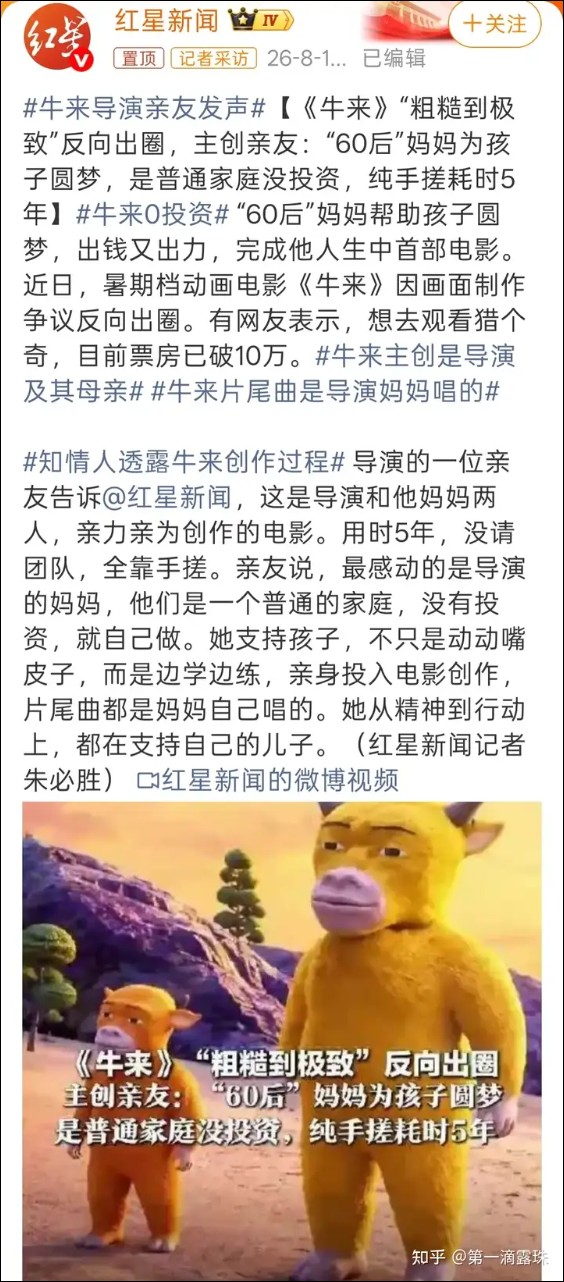
The mother-son duo’s five-year handcrafted dream project.
As “Niu Lai” surges in popularity, the creative story behind the film has also come to light. The entire cast and crew consists of only two people: director Xin Yumeng, who takes on multiple roles including director, actor, voice actor, and producer, and screenwriter Sun Lifang, who also works as a voice actor. Sun Lifang is none other than Xin Yumeng’s mother, an ordinary mom born in the 1960s.

According to Chinese news reports, relatives of Xin Yumeng revealed that the film went from its initial planning in 2021 to its release in 2026, with the mother and son spending a full five years completing it “purely by hand” with no investment and no professional team. Sun Lifang personally participated in writing the script and also learned animation production from scratch, polishing the film frame by frame with her son, and even sang the end-credit song in full support of her son’s filmmaking dream. Relatives remarked with emotion that her support for her child was “not just paying lip service,” but truly involved participating in the creative process.
According to Tianyancha information, the production company of “Niu Lai” is Dalian Jingyuan Culture Film and Television Media Co., Ltd., established in 2016, formerly a decoration engineering company, and only renamed to cross into the film and television industry in 2021; the company’s registered capital is only 100,000 yuan (about 470,000 New Taiwan dollars), and the legal representative is none other than director Xin Yumeng. From the company’s background, it is not hard to see the “family workshop” nature of this film.
The distributor once advised the director, “Don’t release it.”
This film made it to theaters thanks to a friend of the director. The distributor admitted in an interview with Litchi News that after seeing the final cut, they initially advised the director not to release it due to quality concerns, but Xin Yumeng insisted on going ahead, saying “it was too hard to make.” In the end, the distributor helped out of friendship and got the film, which had already legally obtained its public screening license (Film Review Animation [2024] No. 33), into theaters.
A one-line comment from the distributor captured the helplessness of many independent creators: “If we don’t go through the theatrical release process, no one may ever see it.” Yet ironically, what ultimately made this film “seen” was not the work itself, but how bad it was.
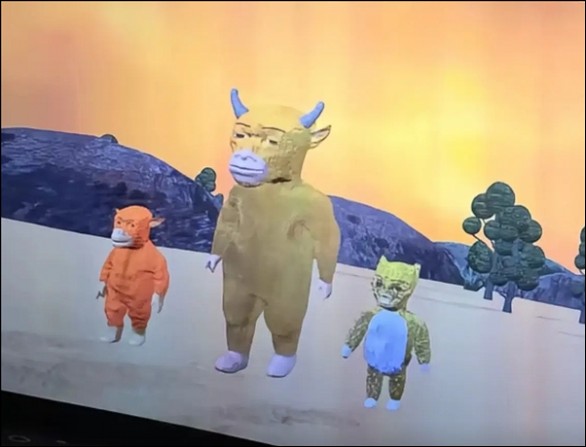
“Utter trash” going viral in reverse
The box office comeback of “Niu Lai” is the most surreal market sample of the 2026 summer season. On August 14, cumulative box office had just exceeded 10,000 yuan; on August 15, single-day box office soared to 760,000 yuan (approximately 3.6 million Taiwan dollars), and cumulative box office broke past 1 million yuan; on the morning of August 16, cumulative box office had already surpassed 3 million RMB (the latest news reports it has passed 5 million RMB).
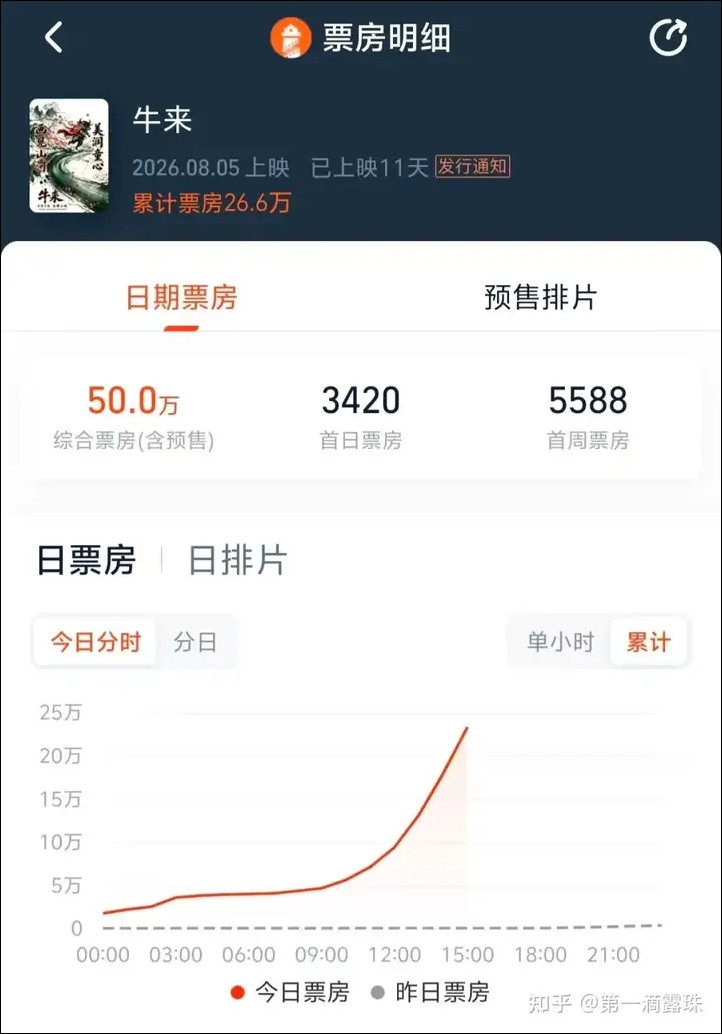
Behind this box office surge are three driving forces. The first is the fermenting mockery on social media. The topic “worst animated film in history” hit Weibo’s hot search, and with reports from Red Star News to Litchi News, from Guangming Net to Yangcheng Evening News, multiple media outlets pushed this “cow” from the cold bench of cinemas to the hot search. On the Maoyan app, over 37,000 people have marked it as “want to watch,” while Douban has even seen a flood of sarcastic five-star reviews, with netizens watching it as “performance art.”
影史投報率最高電影:牛來 pic.twitter.com/TvT463i5Mc
— 電腦王阿達 (@kocpc) August 16, 2026
Second, theaters took the opportunity to add screenings. The number of showings surged from just 21 nationwide on August 14 to more than 359 on August 15, with some cinemas even arranging screenings in Dolby theaters. A theater manager said that ticket sales for the noon showing of “Niu Lai” had exceeded 60%, “It sells out as soon as it opens, even better than the major blockbusters in the same period.”
The third driver was completely unexpected: “牛來” (niú lái) sounds like “牛市來了” (bull market is coming), making it a “metaphysical lucky charm” that A-share investors use to pray for stock market gains. Many investors have bought tickets specifically to check it out, with netizens joking: “As a veteran losing investor, just for the words ‘牛來,’ I have to go see it.”
Controversy and cooling under the heat
Yet this frenzy was not without discord. On August 16, a cinema in Dalian reportedly received notice to pull *Niu Lai* from screens and stop showing it. A theater staff member said bluntly in an interview: “That film is so bad, why would anyone watch it?” Public opinion was also divided. Some viewers were moved by the creative story of the mother and son who had depended on each other for five years, commenting, “Even though the film is terrible, the mom’s end-credits song broke me.” But others felt that flocking to a low-quality work out of morbid curiosity was unfair to animators who take their craft seriously. *Yangcheng Evening News* commented that this was not the usual box-office reversal driven by a word-of-mouth hit, but a market anomaly fueled by the psychology of appreciating the ugly and seeking the bizarre.
The director Xin Yumeng himself appeared calm. In an interview, he said he had fulfilled his original wish. And his mother, Sun Lifang, had only ever wanted to help her son realize a dream. Some netizens accurately summed up the complex feelings the film evokes: “If you watch it, you’ll regret it for 80 minutes, but if you don’t, you’ll regret it for a lifetime.」
Source: KOCPC Chinese