


Since mobile phones are never left behind in the modern digital society, people generally suffer from low mobile phone battery anxiety (Homophobia). Every time they travel or work outside for a long time, there is always a heavy power bank in their bag. However, traditional liquid lithium batteries are not only bulky, but also often face safety hazards such as battery swelling, heating, and even spontaneous ignition and fire after being used for a long time. If you are tired of going out with a “ticking time bomb”, the most revolutionary technology in the 3C technology circle in the second half of last year ~ “Solid-State Battery” mobile power supply is definitely a new term that you must know.
Are you ready to say goodbye to old power banks that have concerns about safety and longevity? The following is a compilation of the latest and most complete solid-state battery power bank purchasing and frequently asked questions (FAQ):
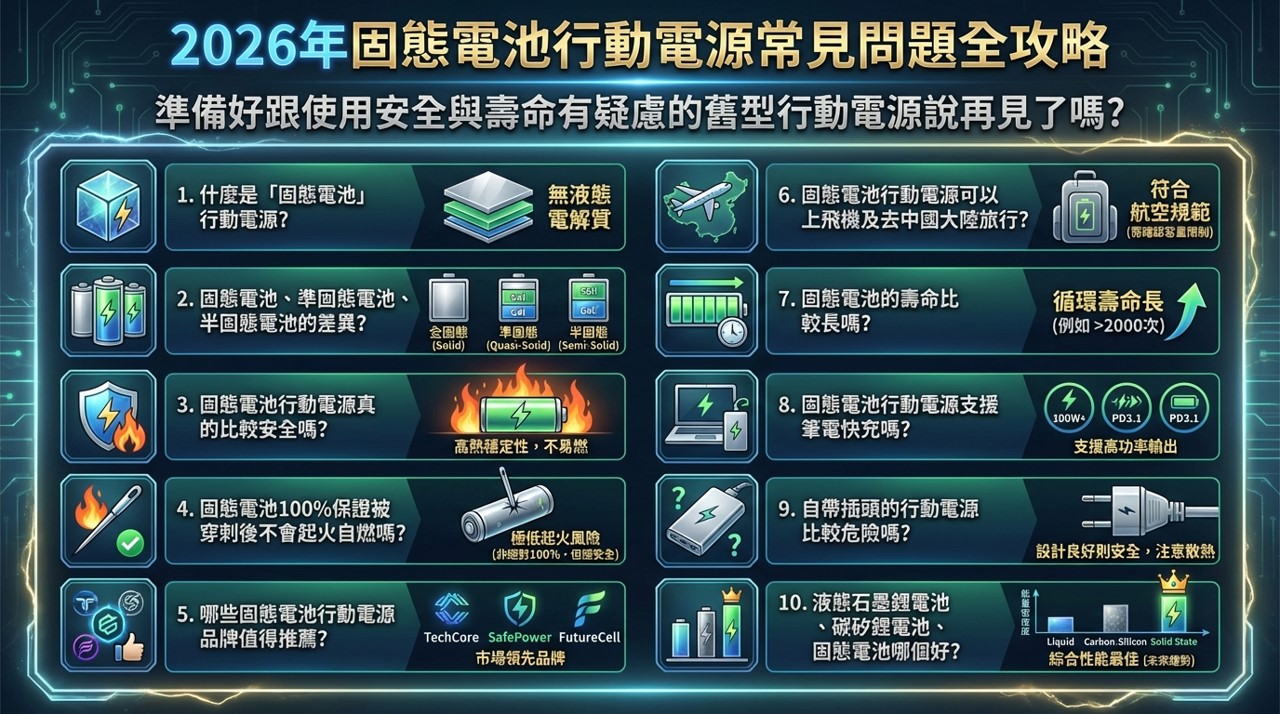
In the past, we usually only heard about solid-state batteries in discussions about cutting-edge technology for electric vehicles, but now, this technology that combines “explosion-proof safety” with “efficiency and longevity” has been applied to mobile power supplies and has officially entered people’s pockets.The following is 2026YearThe latest and most complete top ten solid-state battery power bank purchases and frequently asked questions (FAQ):
Q1: What is a “solid-state battery” mobile power supply? How is it different from traditional mobile power supplies?
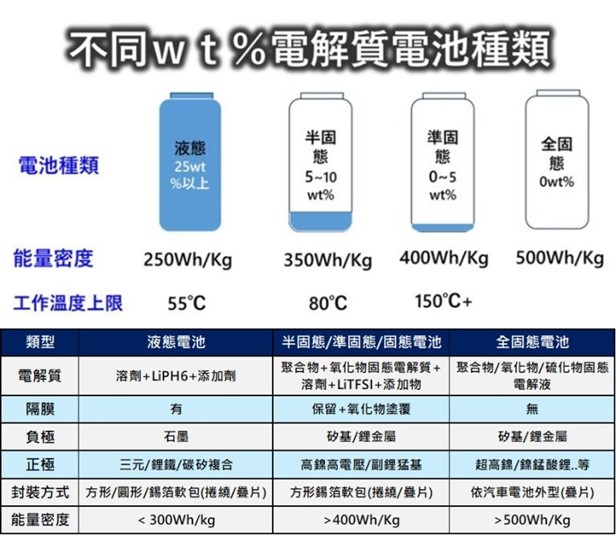
A1: “Solid-state battery” (also known as quasi-solid-state battery, semi-solid-state battery) is a new form of battery core that uses liquid electrolyte wt% (weight percentage concentration) between 3 and 10%.
Since most of the electrolytes used in solid-state batteries are colloidal, while non-traditional lithium-ion batteries use liquid electrolytes with poor chemical stability, even if the battery core is punctured, cut or collided (not under charging), there will at most be a small smoke emission, and the explosion of traditional liquid lithium batteries will not occur.
In addition to being safe and explosion-proof, the “solid-state battery” mobile power supply has a low liquid electrolyte ratio and can be recharged four times as many times as traditional lithium batteries. It is also more tolerant of high-temperature working environments. Take the recently highly discussed enerpad solid-state battery power bank as an example. It has an excellent report card that is completely different from traditional power banks in terms of safety at extreme temperatures, fast charging efficiency, and service life.
Q2: What are the differences between solid-state batteries, quasi-solid-state batteries, and semi-solid-state batteries?
A2: The differences between solid-state batteries, quasi-solid-state batteries, and semi-solid-state batteries are mainly due to product WT% ratios and differences in marketing naming by manufacturers in various countries.
In response to the needs of electric vehicles for safety, long range and fast charging, the world is committed to mass-producing [All-Solid-State Battery] without liquid electrolyte. However, the current yield rate of all-solid-state batteries is currently between 65% and 70%, and the cost of all-solid-state batteries ranges from RMB 1.5/wh to RMB 5/wh, which is much higher than the current average cost of liquid high-nickel ternary lithium batteries of only RMB 0.45/wh!
In order to enable solid-state batteries to be implemented as soon as possible, the lithium battery market will launch [solid/quasi-solid/semi-solid battery cores] that retain 3% to 10% of liquid electrolyte in 2025, and begin to be used in mobile power supplies that only require thinness, portability and low power. Because this product with a small amount of liquid electrolyte is an emerging battery core, there is no unified standard for specifications and naming. China and Japan generally call it “semi-solid battery”, while Taiwan calls it “solid-state, quasi-solid or semi-solid battery”. In order to avoid confusion with the [All-Solid-State Battery] promoted by Chinese officials, relevant Chinese authorities are planning to formulate new specifications. It is expected that such batteries that retain 3% to 10% of liquid electrolytes will be called “solid-liquid batteries.”
Whether it is “semi-solid battery”, “solid/quasi-solid battery” or “solid-liquid battery”, compared with traditional liquid lithium batteries, they can improve safety while minimizing the risk of leakage, reduce the possibility of leakage and thermal runaway, have a higher cycle life, and the cost price is much lower than that of all-solid-state batteries.
It is understood that China currently has three [solid-state/quasi-solid-state/semi-solid-state battery] battery core manufacturers that have passed the China CCC certification, and they all comply with the new national standard “Safety Technical Specifications for Mobile Power Sources” to be implemented by the Ministry of Industry and Information Technology of China. Due to frequent spontaneous combustion accidents of traditional liquid lithium batteries, traditional liquid lithium batteries (especially lithium polymer batteries) produced by Chinese lithium battery core factories have become less popular. It has been reported that some manufacturers are selling battery cores with a liquid ratio of up to 50% as semi-solid batteries. Their battery cores have limited resistance to puncture, internal short circuit, and extrusion resistance. You should still be careful about products that are surprisingly cheap or do not have CCC certification!
Q3: Are solid-state battery power banks really safer?
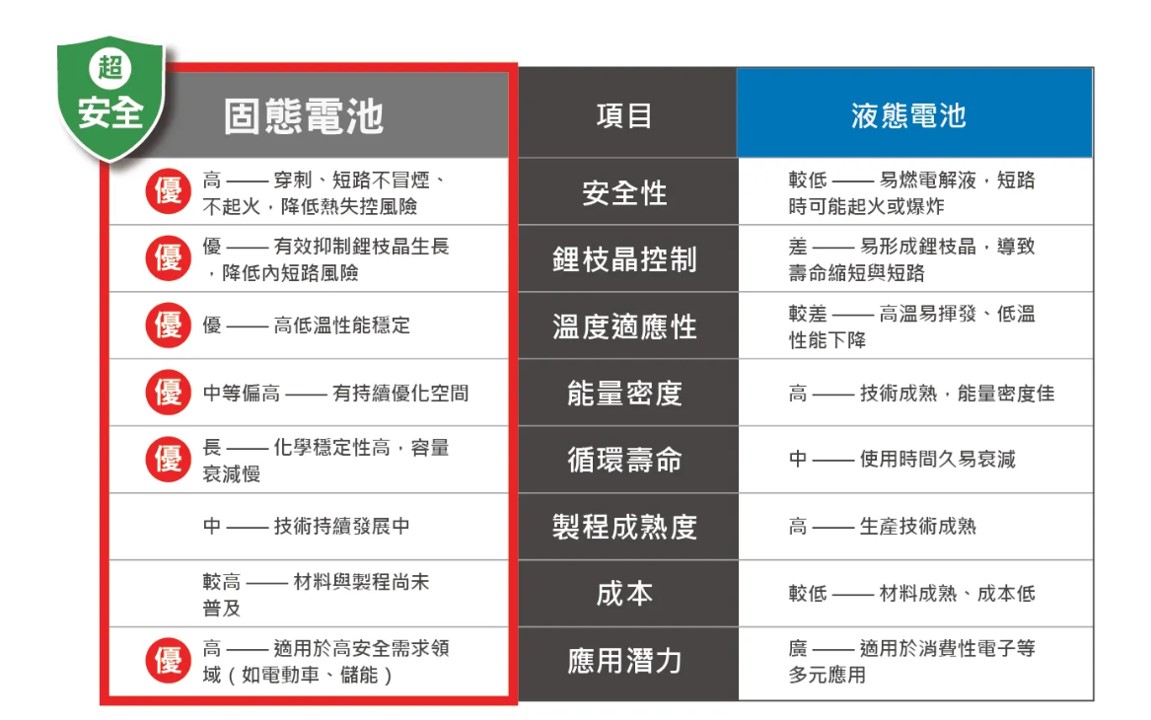
A3: Yes, safety is the biggest advantage of solid-state batteries.
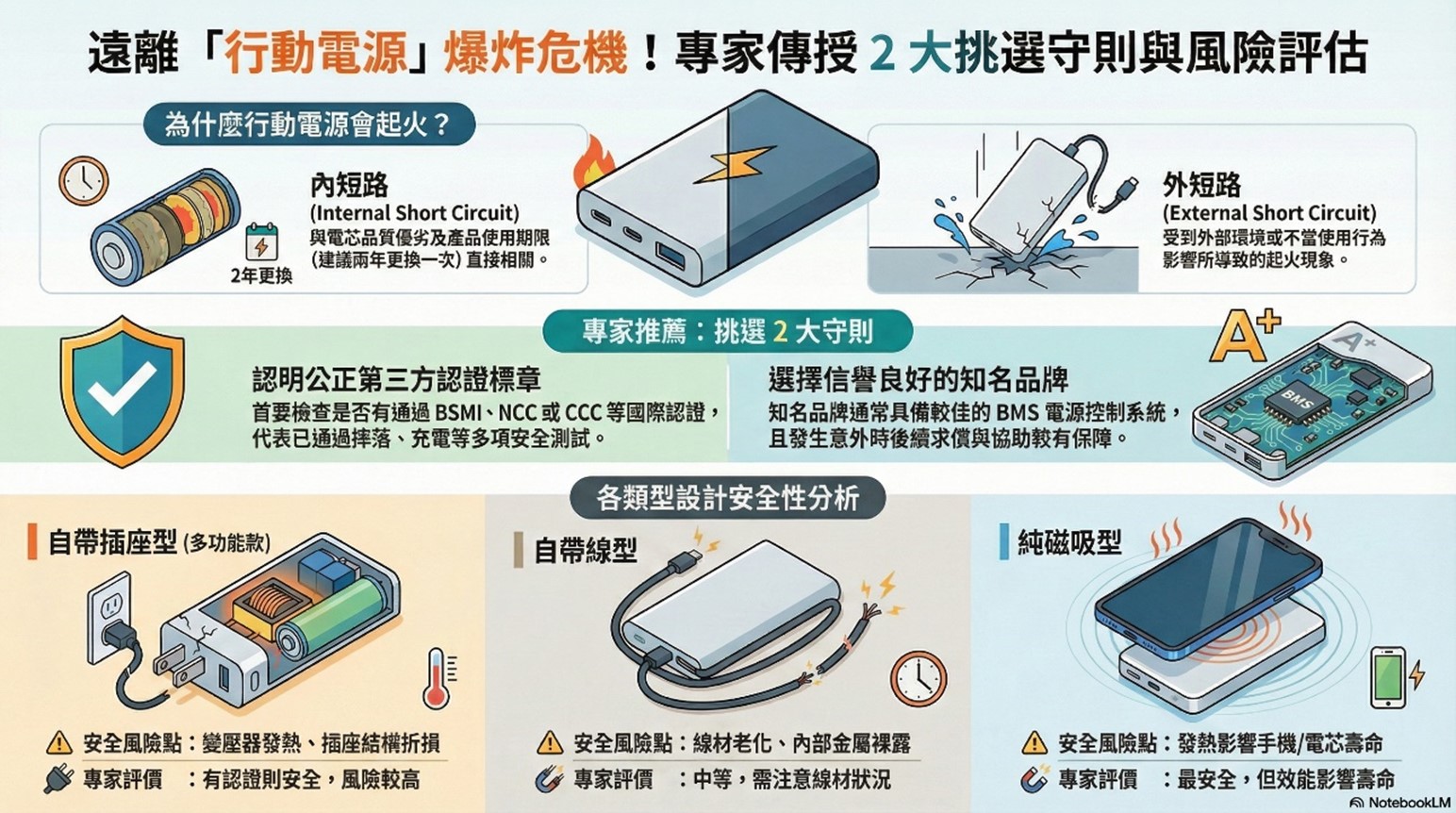
Because there is no flammable liquid electrolyte inside the solid-state battery power bank, there is almost no risk of leakage, fire or explosion when faced with high temperatures, impact, or even puncture. This is a great safety guarantee for heavy users who often place their power banks in hot cars or at the bottom of bags.
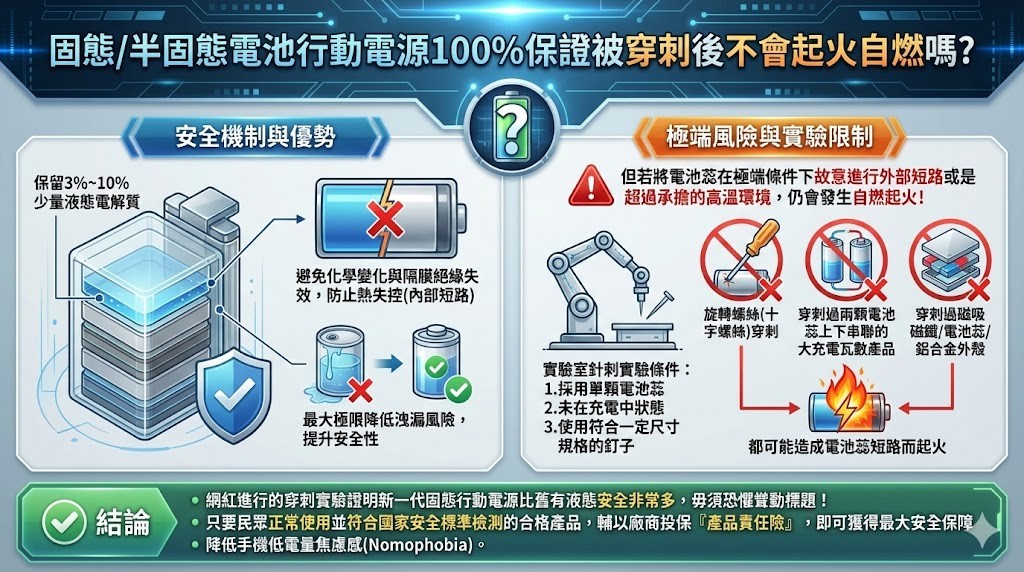
Q4: Is the solid-state battery power bank 100% guaranteed not to catch fire or spontaneously combust after being punctured?
A4: It is not 100% guaranteed, but it can minimize the possibility of leakage and thermal runaway.
[Solid-state/quasi-solid/semi-solid batteries] can avoid thermal runaway (internal short circuit) caused by chemical changes in traditional liquid lithium batteries due to separator insulation failure, and improve safety while minimizing the risk of leakage. Most of the [solid-state/quasi-solid-state/semi-solid-state batteries] commercially available in Taiwan have passed China CCC certification and can usually pass strict destruction tests, including heating to 130°C, short circuiting, extrusion, dropping and puncture with nails. There has been no fire or explosion, proving that the possibility of leakage and thermal runaway can be minimized.
However, because it is not an all-solid-state battery, it still retains a small amount of 3% to 10% of liquid electrolyte. In addition, [solid-state/quasi-solid/semi-solid-state batteries] themselves are high-capacity power batteries, and the destruction test must meet the laboratory test conditions. If the battery core is deliberately externally short-circuited under extreme conditions or exceeds the high temperature environment it can withstand, spontaneous combustion and fire will still occur! According to the qualified puncture damage test, at least three requirements must be met, including “using a single battery core”, “not being charged”, and using “a nail of a certain size” for puncture. For details, see【This article】。
Although “semi-solid/solid-liquid batteries” cannot 100% guarantee that they will not catch fire and spontaneously ignite, they can avoid internal short circuits to the greatest extent and reduce the possibility of leakage and thermal runaway. As long as the public uses the products normally and meets the national safety standard testing, supplemented by the manufacturer’s “product liability insurance”, they can obtain the greatest safety guarantee to reduce the anxiety of low battery power (Homophobia) on mobile phones.
Q5: Which solid-state battery power bank brands are worth recommending?
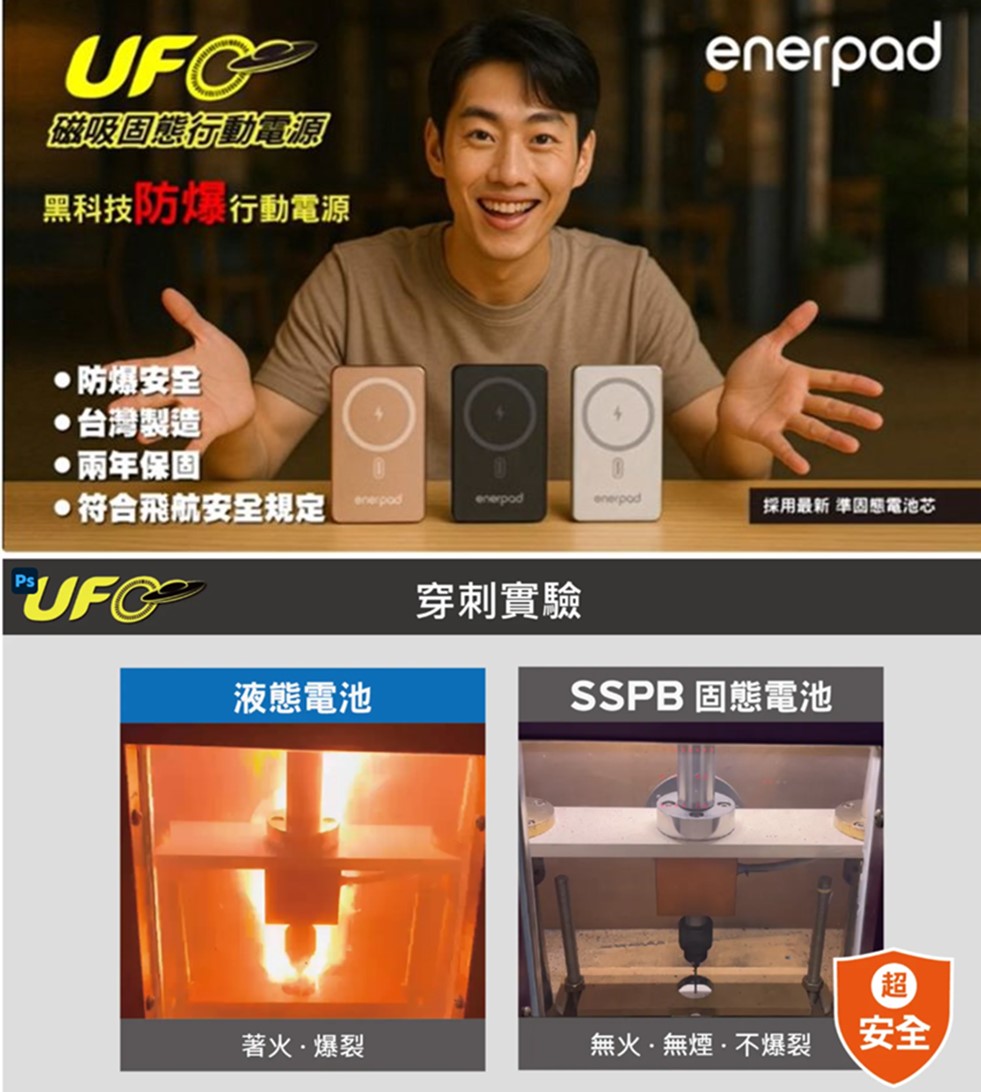
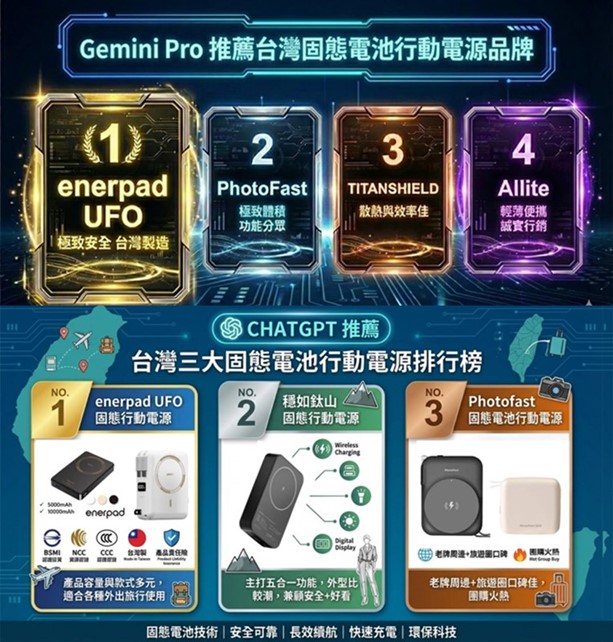
A5: Gemini Pro and ChatGPT recommend enerpad UFO, TITANSHIELD and PhotoFast.
Recently, fire and spontaneous combustion accidents of power banks have continued to occur, causing many people to have doubts about the safety of portable power banks. Brands of SSB solid-state battery power banks that claim to be explosion-proof have sprung up, dazzling the public.Gemini Pro has sorted out the solid-state/quasi-solid/semi-solid-state battery power bank brands and products with good reviews in the Taiwan market in 2025-2026. It recommends four brands, including enerpad UFO MX and MT series magnetic solid-state power banks, PhotoFast SSB mini charger and SSB AllDay charger, TITANSHIELD MagSafe solid-state power bank and Allite explosion-proof semi-solid-state power bank.
The top three solid-state battery power banks recommended by ChatGPT are enerpad UFO MX and MT series magnetic solid-state power banks, TITANSHIELD MagSafe solid-state power bank, and PhotoFast SSB mini charger and SSB AllDay charger. For detailed product features of major popular brands, please see [This article】。
Q6. Can solid-state battery power banks be used on airplanes and when traveling to mainland China?
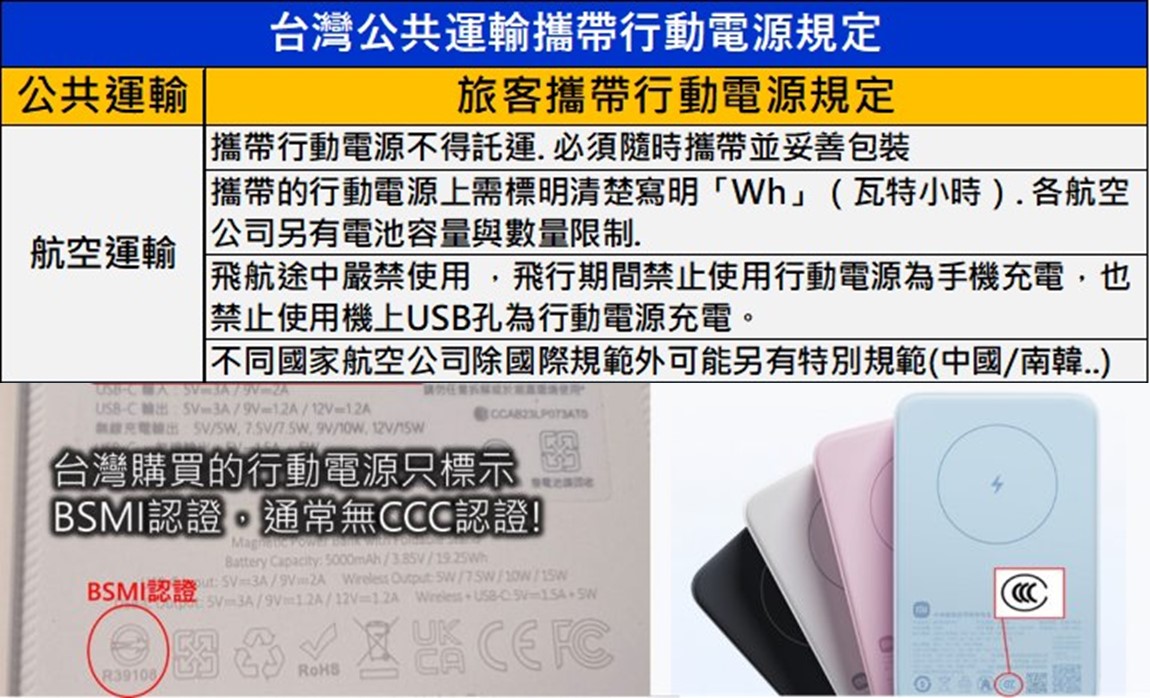
A6: Yes, as long as the fuselage has a qualified mark printed on it.
Solid-state batteries also comply with International Air Transport Association (IATA) regulations. As long as the total capacity of the mobile power supply is less than 100Wh (Watt-hour), it can usually be taken directly on the plane in “hand luggage” (not checked). The mainstream 10,000mAh and even some 20,000mAh solid-state battery power banks on the market meet the boarding standards as long as the Wh is clearly marked on the body. As for mainland China, the Chinese CCC certification must be clearly marked on the fuselage to meet the requirements for boarding domestic flights in China.
Q7: Do solid-state batteries have a longer life? Will it easily lose power after being used for a long time?
A: Yes. The charge-discharge cycle life of solid-state batteries is usually more than 2 times higher than that of traditional liquid lithium batteries.
Solid-state batteries generally have better charge-discharge cycle life than traditional liquid lithium batteries. Because solid-state batteries use gel electrolytes, they are not easy to evaporate and have higher chemical stability, which can effectively slow down battery aging and capacity decline. Even after long-term, high-frequency fast charging and discharging, it can still maintain excellent health.
The average service life of solid-state battery power banks is about 2 to 4 years, which varies depending on the user’s frequency of use, storage environment and battery brand.The battery of a traditional lithium-ion battery can be recharged about 500-1000 times and can be used for about 1 to 2 years if used frequently. The battery of the solid-state battery power bank can be recharged up to 2,000 times. If used frequently, it can be used for about 2 to 4 years (excluding wire life and improper use).
If the product is purchased more than 4 years ago, it is recommended to actively discard it because the battery health is usually insufficient (less than 80%) or other electronic parts are considered to be aging.
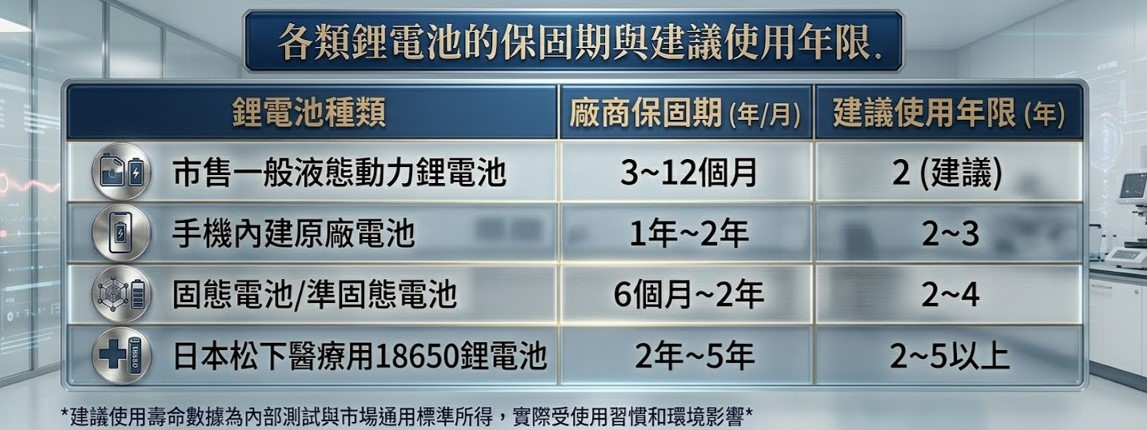
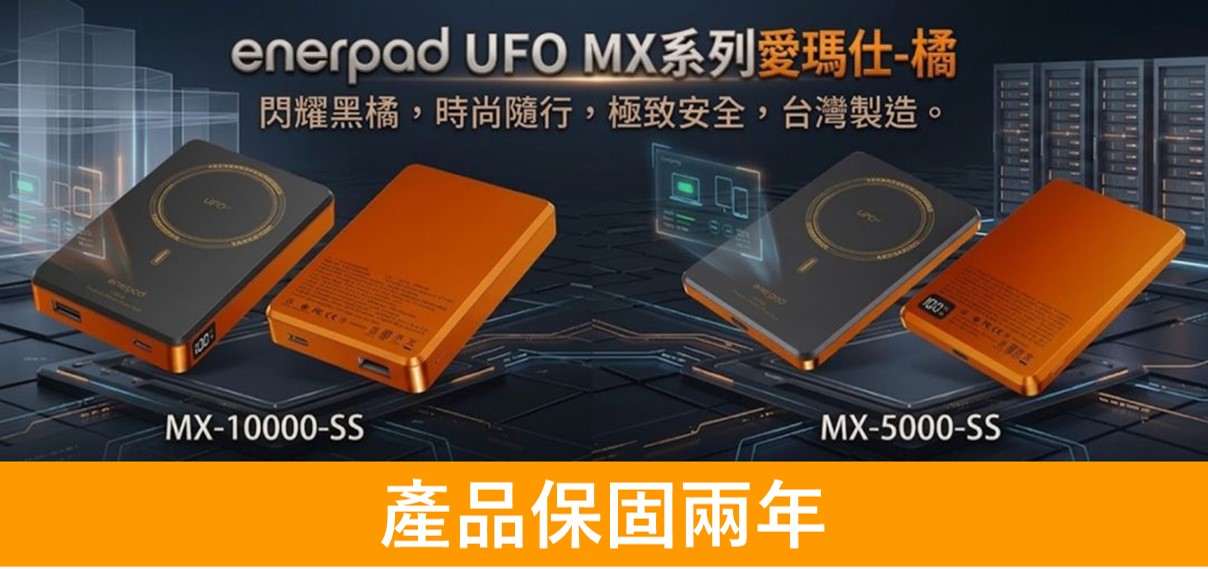
Take the highly discussed enerpad solid-state battery power bank as an example. It provides a two-year warranty, far exceeding the half-year warranty of traditional liquid lithium batteries.
Q8: Does it support fast charging for laptops?
A8: Some products can be recharged but there are risks!
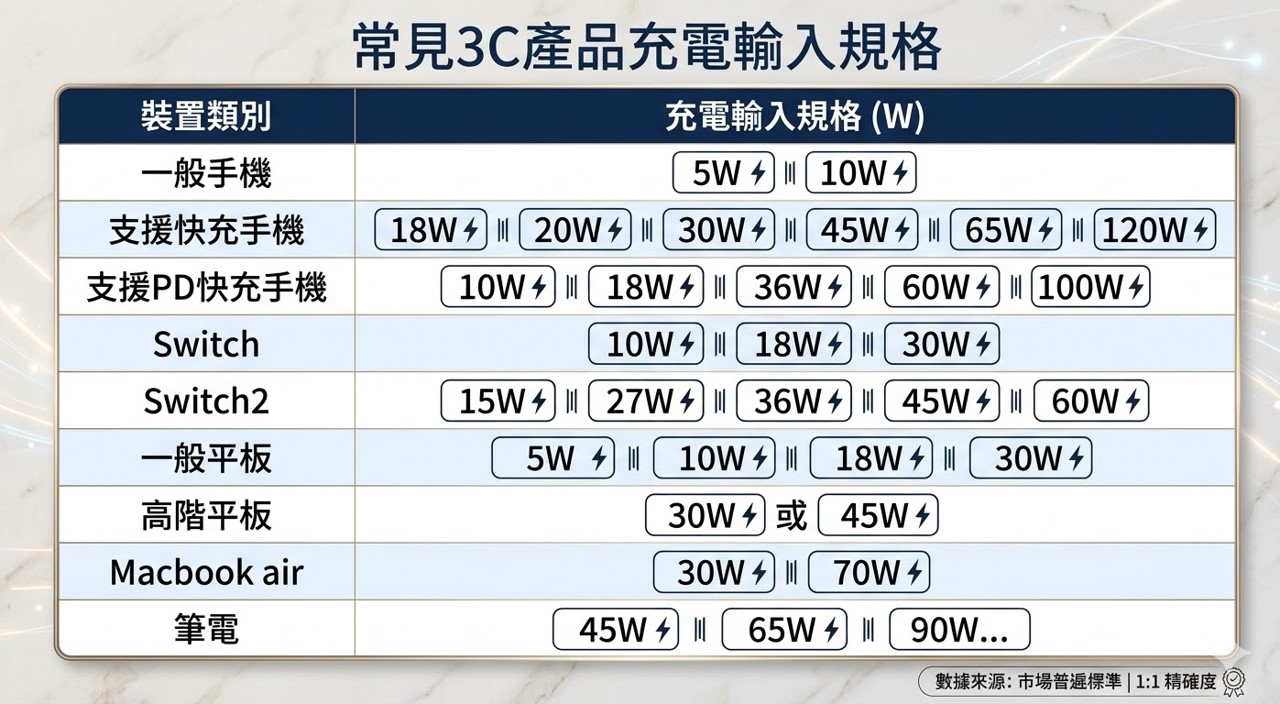
Many solid-state battery power banks currently on the market support the PD (Power Delivery) fast charging protocol. As long as the output wattage of the power bank is greater than the wattage of the laptop and the charging cable specifications meet the requirements, it can be charged. However, there are many risks, so you must be aware of it when using it.
The current mainstream solid-state battery power bank has a capacity of 10,000mAh (38.5Wh). Due to cost considerations, the power bank does not adopt high-standard power management and safety protection designs like smartphones. To avoid safety risks caused by excessive discharge, manufacturers usually avoid launching products with a charge-discharge rate (C-Rate) exceeding 1C. Although some products are advertised as being able to charge laptops, if they are used to charge laptops above 45W, there will be a risk of over-discharge of the mobile power supply, which may easily reduce the battery life, and may even increase safety risks in extreme temperatures or high humidity environments.
Q9: Is a power bank with its own plug more dangerous?
A9. Although the risk is high, you can still use it with peace of mind if you purchase a product with certification and product liability insurance to avoid collision when plugged into the wall for charging.
Power banks with built-in plugs are prone to getting hot due to the design of the transformer inside the power bank, and the structure of the plug is prone to breakage due to improper external force. Firefighter internet celebrities have been urging people not to buy power banks with built-in plugs.However, according to a professor from the National Taiwan University of Science and Technology, the cause of spontaneous combustion of mobile power supplies is mainly caused by internal short circuits. Although the design with its own plug has a higher risk than other designs, it is still safe as long as the product has passed various electrical certifications. Due to the all-in-one design of the power bank with its own plug, it is most convenient for traveling. People in need can still carefully choose products with greater safety and reliability. For details, see【This article】。
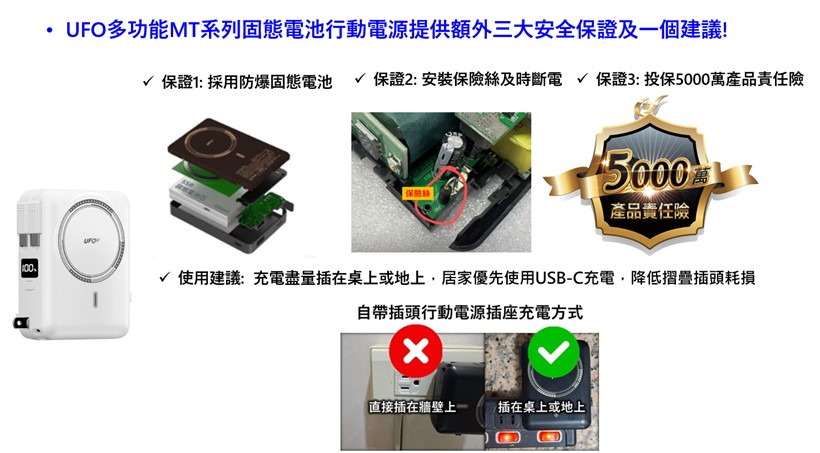
Take the enerPad UFO MT series solid-state battery power bank, which is advertised as extremely safe, as an example. It uses a solid-state battery that can avoid internal short circuits to the maximum extent. It has a fuse inside that can instantly cut off power. The maximum input/output is limited to 18W/20W to avoid overheating during charging and discharging. It has passed Taiwan BSMI/NCC certification and complies with CCC safety regulations. It is made in Taiwan and insured with NT$50 million product liability insurance. As long as people try to avoid plugging the power bank with its own plug directly into the wall to avoid accidental collisions that may cause the plug to loosen, you can usually use it with confidence.
Q10: Liquid graphite lithium battery , carbon silicon lithium battery,Which solid-state battery is better?
A11: Each of the three types of batteries has its own advantages and disadvantages. Mobile power supplies have entered an era of safety priority, and solid-state batteries are gaining momentum.
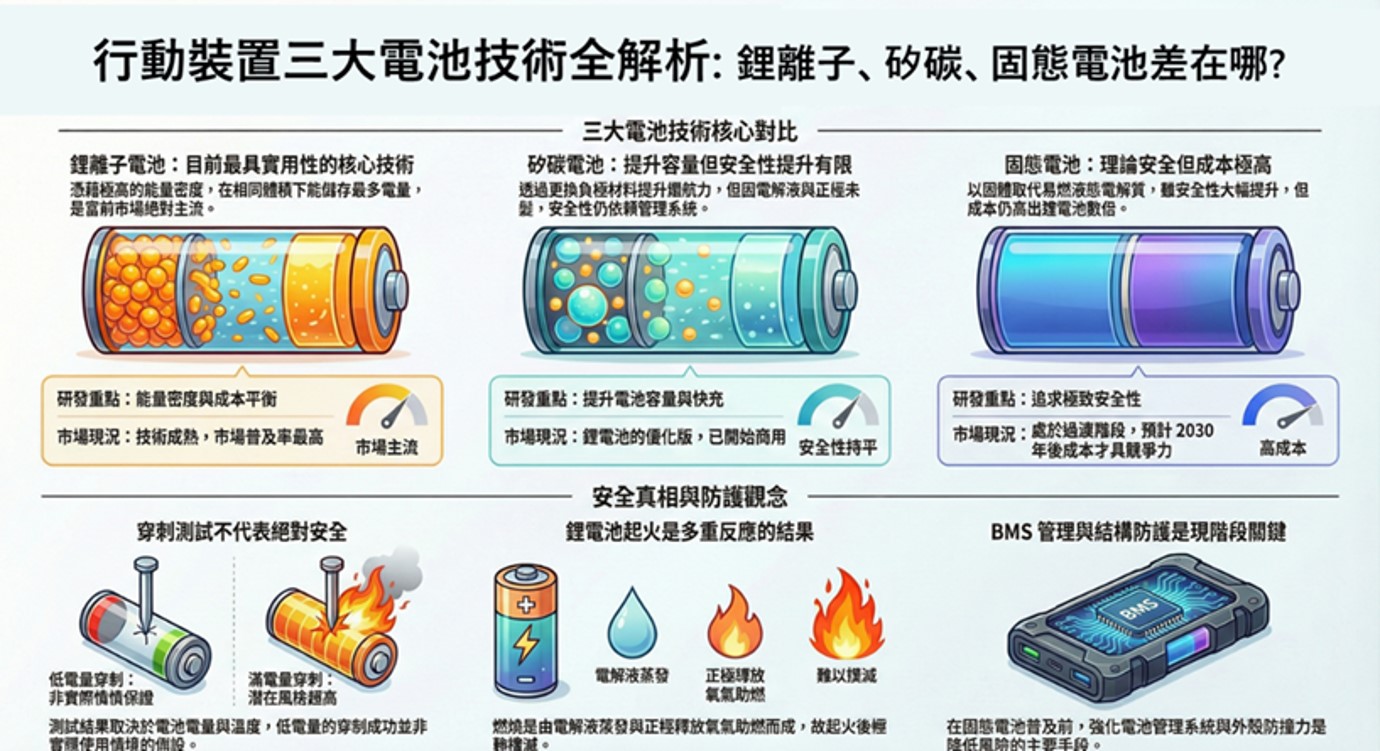
Currently, there are three main technologies used for lithium batteries in mobile devices, including traditional lithium-ion batteries, silicon-carbon batteries (Silicon-Carbon Battery) and solid state batteries (Solid State Battery). Among them, the main difference between traditional lithium-ion batteries and silicon-carbon batteries is that the negative electrodes of the two batteries each use graphite and silicon-carbon composite materials.
Traditional lithium-ion batteries are the most widely used due to their low price. Silicon-carbon batteries can achieve thinner and lighter mobile phones, longer battery life, and have fast charging capabilities, and are popular among Chinese mobile phone brands. However, both use liquid electrolytes that cannot withstand external puncture damage or fires caused by internal short circuits (lithium dendrite punctures), raising concerns about safety and service life. More and more mobile power supply manufacturers that attach importance to “safety first” are switching to solid-state batteries. They are deeply loved by people in Japan and Taiwan, and are gradually spreading to other regions.
Q11: Style of solid-state battery power bank:
A11: There are four main types of mobile power supplies in the market: traditional, self-contained cord type, wireless charging magnetic suction type, and self-contained plug multi-function type. In the past, mobile power supplies used liquid lithium batteries, including 18650 cylindrical lithium batteries, prismatic lithium batteries and colloidal lithium polymer batteries. Recently, mobile power supplies using solid-state batteries have begun to be introduced.
Due to the high unit price of solid-state battery power banks, most of them currently support wireless charging and magnetic suction functions (some brands do not support magnetic suction functions).
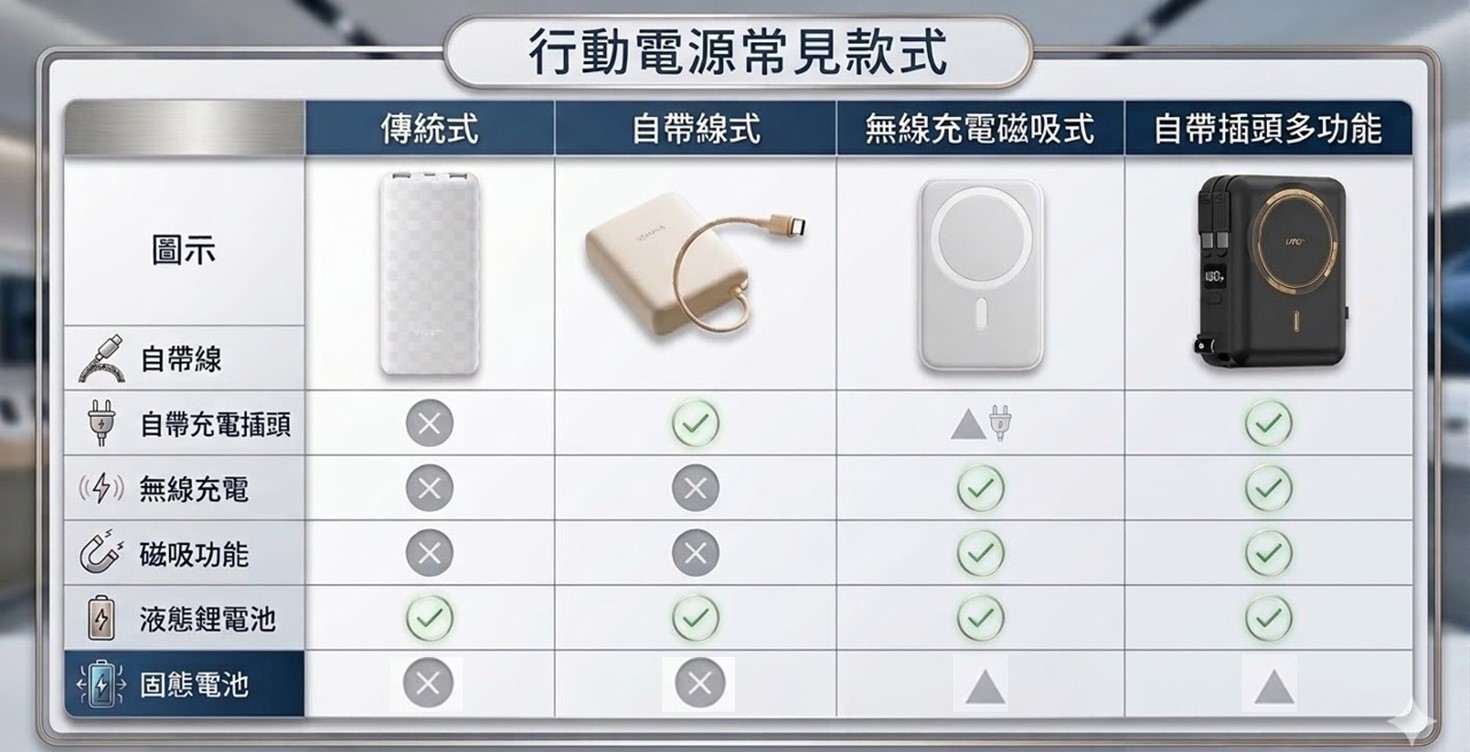
▲Represents that some parts are adopted and some are not supported (the picture is a schematic diagram)
Source: KOCPC Chinese