


Anthropic on May 28Released without warning Claude Opus 4.8 arrived just 41 days after its predecessor, Opus 4.7, marking the shortest upgrade cycle on record for the company’s flagship model. The new model delivers across-the-board improvements in coding, agentic tasks, and professional work, while introducing a new feature called “Dynamic Workflows” that can coordinate hundreds of parallel sub-agents to tackle large-scale tasks.
Anthropic Unveils Claude Opus 4.8 Without Warning
Rushed 41-day replacement: The main reason is the poor reception of Opus 4.7.
Opus 4.8 is rolling out at a noticeably faster pace than Anthropic’s usual cadence. Opus 4.7 launched on April 17, while the latest versions of Sonnet and Haiku have been out for three and seven months, respectively. TechCrunch notes that such an aggressive release cycle may be linked to some users finding Opus 4.7’s performance “disappointing” after launch.
During the same period, OpenAI rolled out a major update to Codex, and Google also released a new version of its Gemini Flash model, keeping competitive pressure high. Both Anthropic and OpenAI are planning to go public (IPO) this year, and model competition has become central to the valuation battle.
Core Upgrade: More Honest, Better at Coding
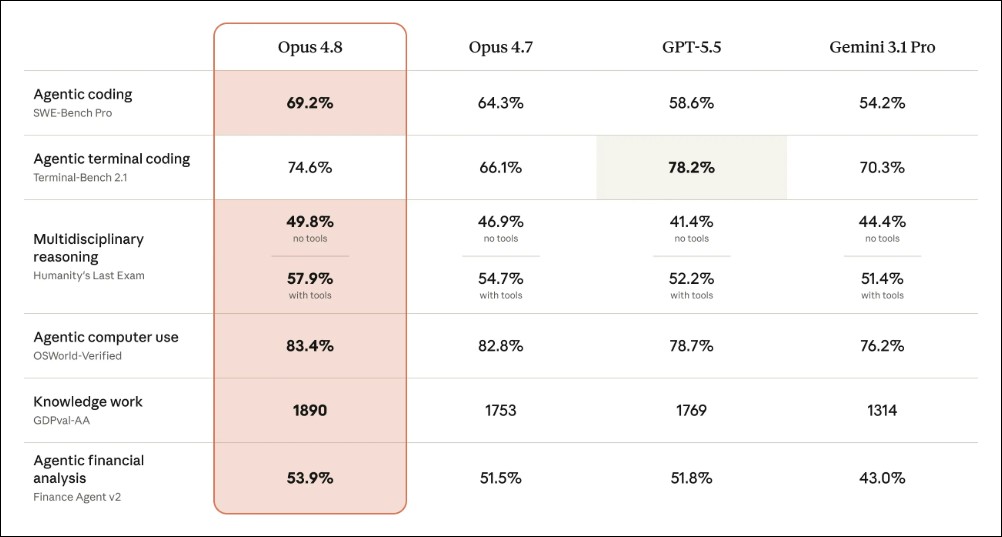
According to Anthropic’s official announcement, Opus 4.8’s benchmark score for agentic coding improved further from 64.3% in the previous generation to 69.2%. The more critical change lies in how the model handles uncertain data: Anthropic stated that Opus 4.8 is “more inclined to actively flag uncertainty in its work, and less likely to make groundless claims.”
Bridgewater Associates stated during a witness test that the biggest difference after the upgrade was that “Opus 4.8 proactively flags issues in inputs and outputs during analysis—problems that other models often overlook and leave for users to discover on their own.”
Dynamic Workflow: Hundreds of Sub-Agents Working Simultaneously
Opus 4.8 also launches Dynamic Workflows, now available as a Research Preview. This feature enables Claude to manage large-scale, complex tasks spanning hundreds of parallel sub-agents in Claude Code.
Anthropic explained in an official blog post: “Claude Code paired with Opus 4.8 can now complete full codebase migrations spanning hundreds of thousands of lines of code, from start to merge, using the existing test suite as a validation benchmark.”
Added “Effort Level” control and updated the stop command.
Opus 4.8 also brings two practical updates:
First, the model defaults to “high effort” mode; Anthropic notes that this is comparable to Opus 4.7 in terms of token consumption. Users can opt for “extra” (labeled xhigh in Claude Code) or “max” tiers, where the model will consume more tokens to produce better results. Anthropic recommends the “extra” setting for difficult tasks and long-running asynchronous workflows.
Second, developers can now update Claude’s instructions mid-task without breaking the prompt cache or requiring updates to pass through a user turn.
Pricing unchanged, Claude Code rate limits increased.
Opus 4.8 is priced the same as the previous generation, so the version upgrade didn’t add any cost. Anthropic has also raised Claude Code’s rate limits to match the increased token consumption that comes with higher effort levels.
Mythos model to be fully opened “within weeks”
Anthropic’s initial preview of the Mythos model in April this year drew attention due to cybersecurity concerns, and the company has so far only granted access to stakeholders at select key software platforms. In the Opus 4.8 release announcement, Anthropic hinted that the Mythos preview period may be coming to an end: “We are rapidly developing these safeguards and expect to make Mythos-class models available to all customers within the coming weeks.”
Source: KOCPC Chinese