


Good news for open source developers! OpenAI’s “Codex for Open Source” program is now accepting applications. Maintainers of public open source projects have a chance to receive a free six-month ChatGPT Pro subscription (normally USD 200 per month, valued at about NTD 39,000 for six months), which also includes the Codex code review tool and API credits. Unlike Anthropic’s similar program, OpenAI has no hard GitHub star requirement this time—even small projects maintained by a single person may be approved as long as you submit the project link.
OpenAI is giving open-source maintainers 6 months of free ChatGPT Pro membership.
Plan details: Three benefits, one claim.
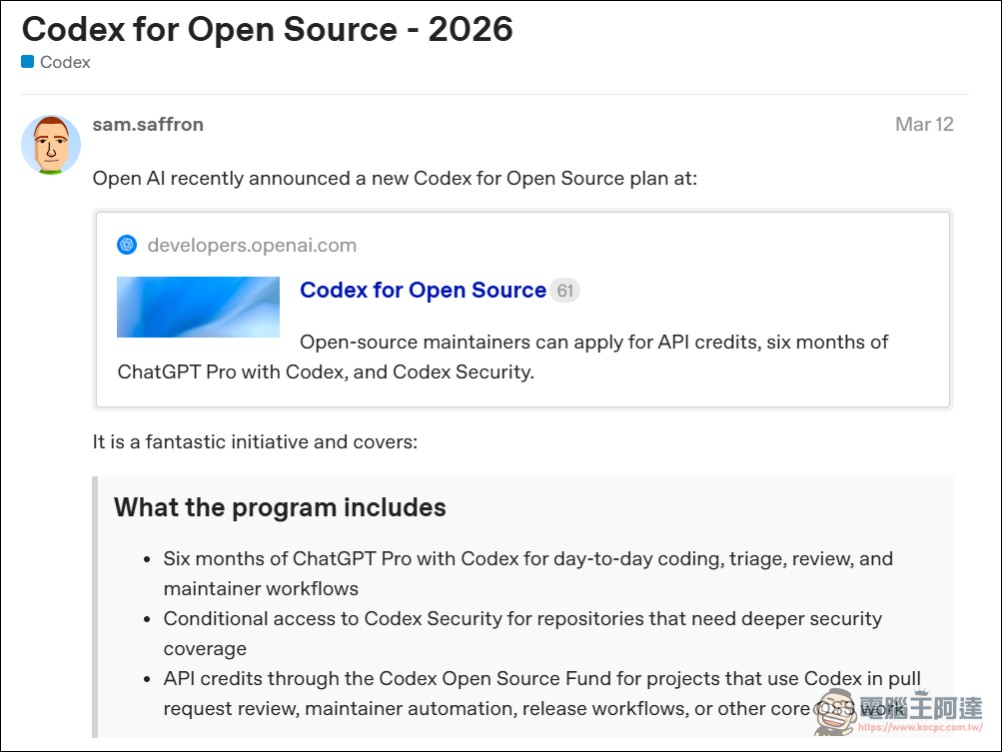
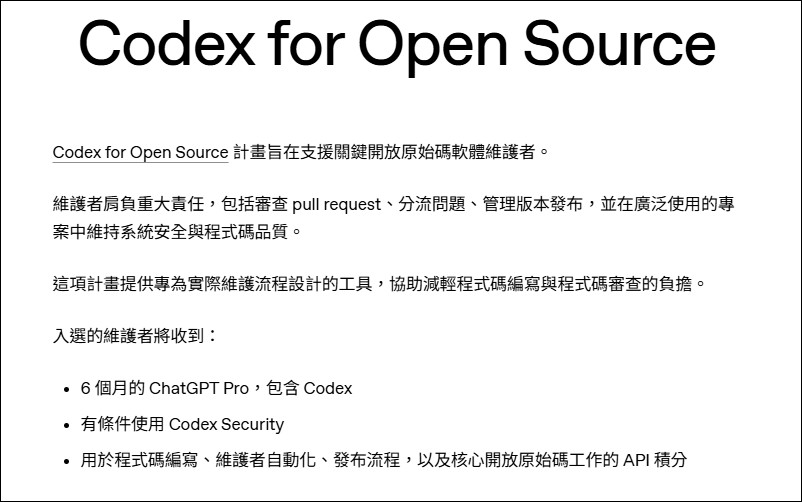
According to OpenAI Official Statement, selected maintainers can receive the following three benefits:
- 6 months of ChatGPT Pro + CodexAI assistance for maintainer workflows, including daily coding, issue triage, pull request review, and version releases.
- Codex Security access rightsFor projects requiring deeper security coverage, provide conditional access security tools.
- API quotaProvide API credits through the Codex Open Source Fund, usable for PR review automation, maintainer workflows, release processes, or other core open-source work.
ChatGPT Pro costs $200 per month (about NT$6,500), which adds up to $1,200 (about NT$39,000) over six months. For independent maintainers, that’s a meaningful amount of support.
Who can apply: No minimum star count required.
This is the most appealing aspect of the program. OpenAI has not set any minimum star count or download threshold; the core eligibility requirement is:
- You are a…core maintainers of public open source projects(regardless of project size)
- The project must be public (public repository).
- You can still apply even if only one person is maintaining it.
In contrast, Anthropic’s ‘Claude for Open SourceThe threshold for the plan is much higher:
- Requirements for Public GitHub Projects Over 5,000 Stars, or
- npm package monthly downloads must reach More than 1 million times
- Applicants must be the primary maintainers or core team members of the project.
- Must be at least 18 years old and a resident of a country where Claude services are available.
Anthropic offers 6 months of Claude Max 20x (with the same monthly fee of $200, for a total value of $1,200), with 10,000 slots in total. OpenAI’s approach is clearly more lenient, with no hard star-count threshold, lowering the barrier for small open-source projects to apply.
How to Apply: Complete in 3 Steps
The application process is quite simple:
- First step: Go to OpenAI’s Codex for Open Source application page (openai.com/form/codex-for-oss/)
- Step 2Enter your GitHub project link
- Step 3Describe your maintenance role and workflow in the project.
Applications are reviewed on a rolling basis; spots are limited and available until filled.
Tips to improve your pass rate
Although there are no hard requirements, OpenAI will evaluate a project’s impact and maintenance activity during review. The following points can help improve your approval rate:
- Data-backed evidenceGitHub stars, forks, number of contributors, package manager (npm, PyPI, crates.io, etc.) download counts, and number of downstream dependencies
- Maintain activity levelActivity records for PRs, Issues, and Releases over the past 3-6 months
- Explain the uses of AIDescribe how you plan to integrate Codex into your daily maintenance workflows, such as using AI to assist with code reviews, automatically classifying issues, and generating changelogs.
OpenAI and Anthropic’s Battle for Open Source Maintainers
This wave of “giving benefits to open-source maintainers” began in March 2026. Anthropic was the first to announce six months of free Claude Max accounts for maintainers of popular open-source projects, provided the project had 5,000 or more stars.
OpenAI followed up by launching Codex for Open Source, but its strategy is clearly different: no star-count threshold, with a focus on “small projects can apply too.” Both companies share the same goal—using free plans to get key users of the open source ecosystem (maintainers) into the habit of using their tools, thereby influencing tool choices across the broader developer community. If you’re maintaining any public open source project, regardless of size, it’s worth spending a few minutes to apply. Even if you’re the only maintainer, you still have a chance of getting approved—go apply and check it out!
Source: KOCPC Chinese