


In an era where game graphics are becoming increasingly sophisticated and demand for graphics card memory (VRAM) continues to rise, Intel officially announced a neural texture compression technology called “Texture Set Neural Compression” (TSNC) at the 2026 GDC conference. This technique reduces texture files up to 18 times, significantly reducing the game’s installation capacity and VRAM occupancy burden. Intel expects to release the Alpha version of the SDK to developers in 2026.
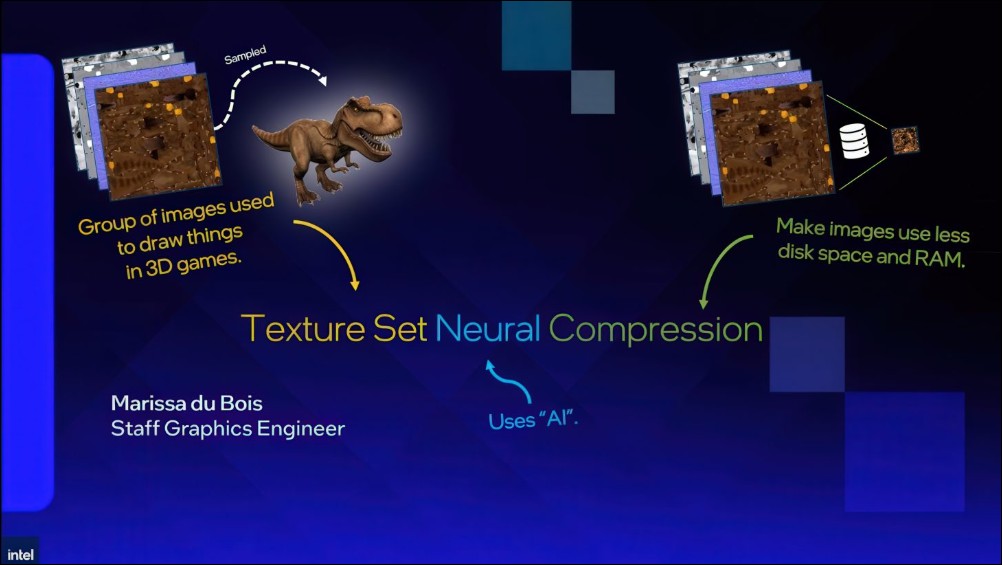
Why do you need neural texture compression?
As the new generation of GPUs heavily integrates AI acceleration architecture, and NVIDIA actively applies AI technology to graphics enhancement, the demand for fineness and capacity of texture files is growing at an unprecedented rate. Traditional GPU block compression formats (such as BC1 to BC7) use fixed mathematical rules to reduce texture size, and although they are fast and widely supported, their compression potential is limited. In this VRAM-starved era, neural texture compression technology could be the key innovation that saves gamers.
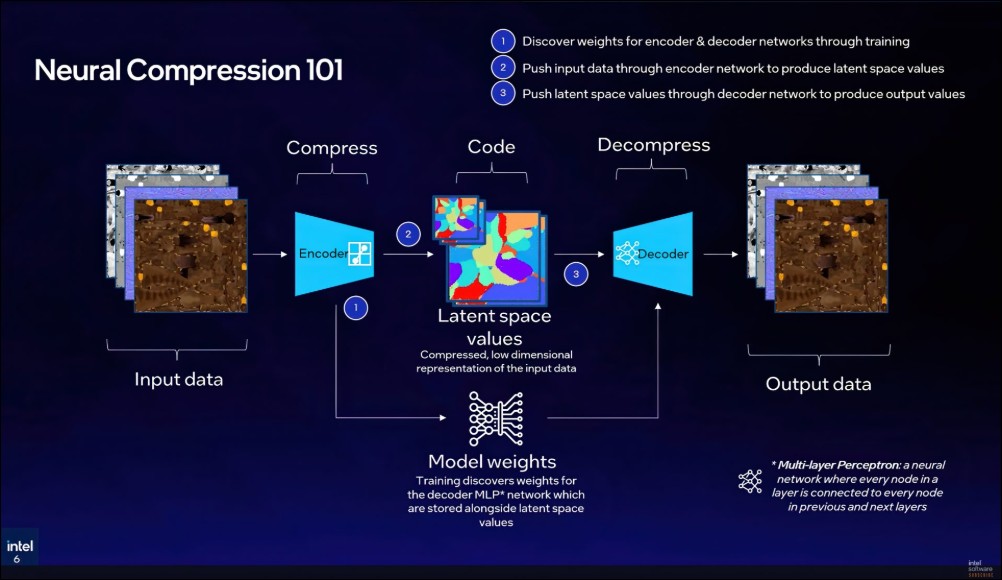
TSNC technical principle: deterministic neural network + shared structure
The concept of TSNC is similar to the NTC (Neural Texture Compression) technology proposed by NVIDIA, both of whichDeterministic neural network technology rather than generative technology. The core principle of TSNC is to use the “Stochastic Gradient Descent” training method to train a small neural network to specifically learn to encode and decode a specific texture set. The final result is a compact “latent space representation” that can be instantly reconstructed into the original diffuse, normal, roughness, metallic, ambient occlusion (AO) and emissive data during the execution phase by executing a small multi-layer perceptron (MLP).
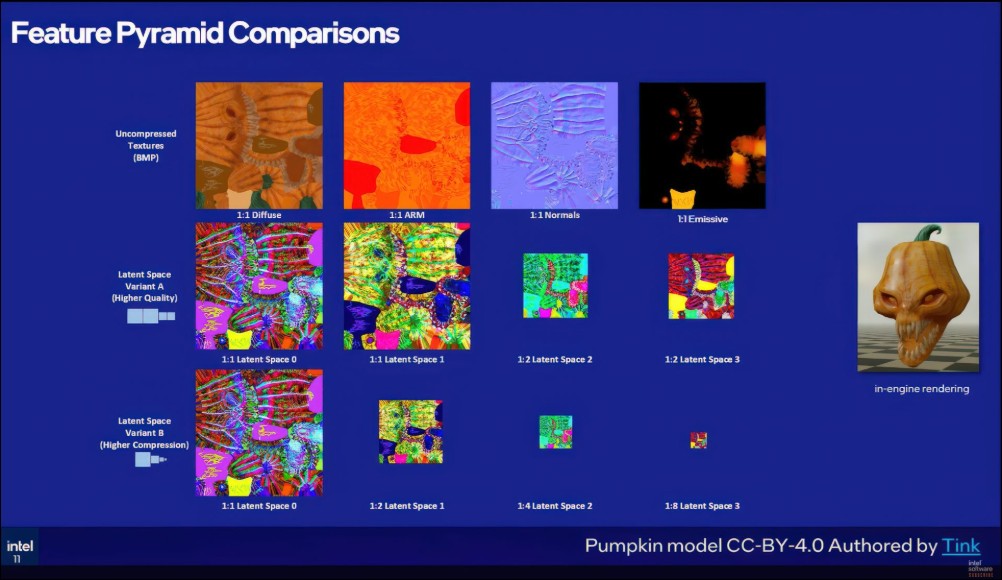
The key to this technology is:The individual channels of the texture set for all PBR maps of a single material have a large amount of redundant structure, TSNC significantly reduces file size by sharing these structures.[1]
Feature Pyramid: Two Compression Schemes
The core of TSNC’s compression scheme is the “Feature Pyramid”, which is composed of 4 BC1 encoded latent space texturescomposition, distributed across different resolution configurations.[1][2] Intel currently offers two variants:
Option A (image quality first)
- use 2 full-resolution latent images + 2 half-resolution latent images
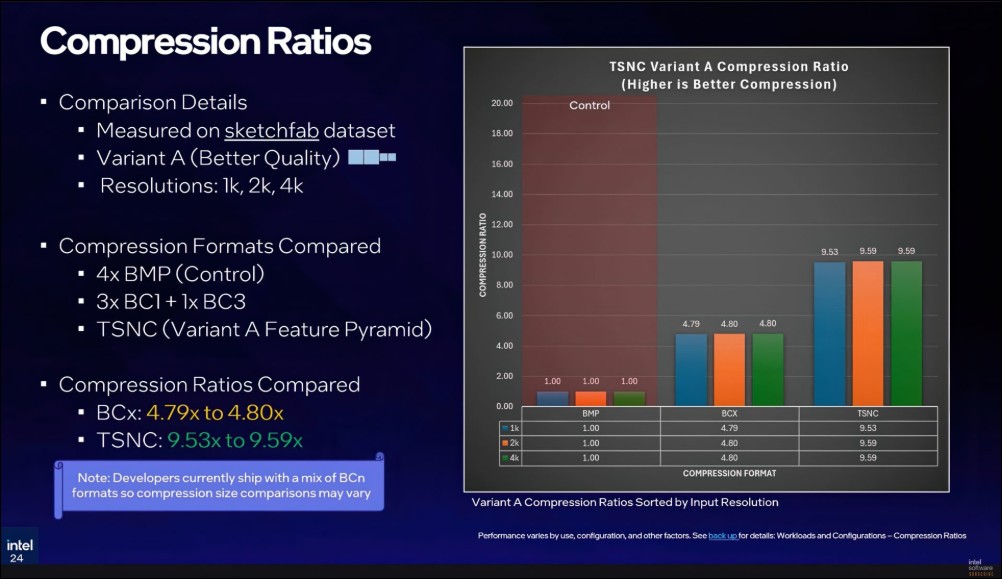
- Taking 4K resolution as an example: an uncompressed bitmap originally 256MB can be compressed to approximately 26.8MB
- More than 9x compression, nearly doubled compared to traditional BC block compression (approximately 4.8 times)
- According to NVIDIA’s FLIP analysis tool, only 5% perceived quality loss
Option B (compression rate priority)
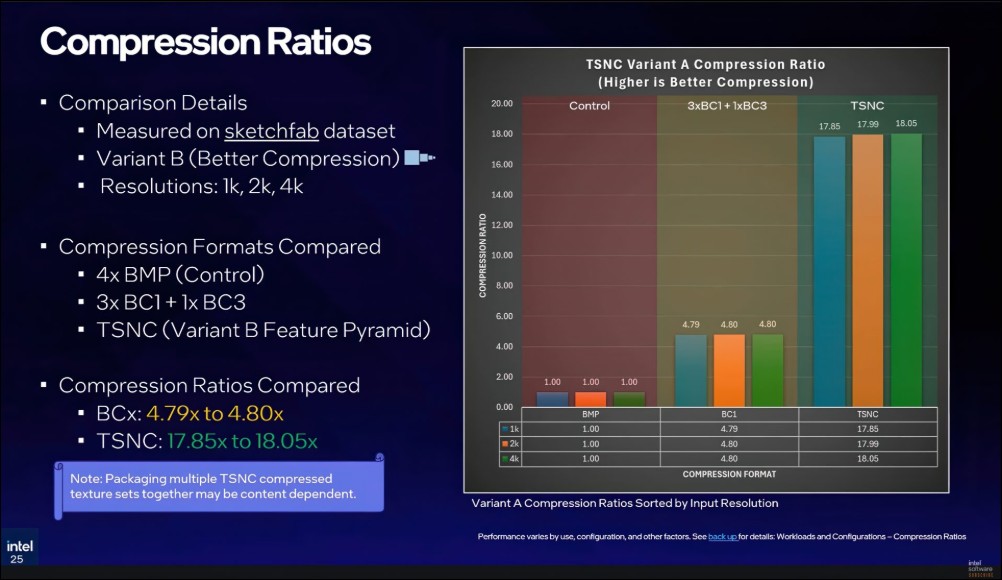
- Latent image resolution is further reduced to the original 1/2, 1/4 and 1/8
- Compression ratio approaches 18x, more than twice as much as plan A
- Perceived quality loss approx. 6-7%, Intel admitted that this loss is “enough to be noticed by players”
Intel’s solution can achieve 9x compression ratio, which is similar to NVIDIA’s NTC technology positioning.
Four deployment strategies: flexible choices for developers
Intel graphics engineer Marissa du Bois analyzed in detail the four deployment strategies of TSNC technology at the GDC 2026 conference. Each strategy has different trade-offs between hard disk space saving and VRAM usage:
| Deployment timing | How it works | Advantages | Disadvantages |
|---|---|---|---|
| Installation phase | Unzip locally during installation | Save transmission bandwidth | The hard drive still needs to store uncompressed textures |
| loading phase | Store on hard drive after compression and decompress when loading into VRAM | Reduce installed capacity and reduce VRAM pressure | Loading times may increase |
| streaming stage | Instant decompression on demand | Combined hard drive and VRAM savings | High burden of inference |
| sampling stage | Permanent compression stored in VRAM, shaders decoded pixel by pixel | VRAM usage is significantly reduced | Requires higher inference resources |
XMX hardware acceleration: 3.4 times faster than FMA
TSNC is not limited to Intel GPUs with XMX (Matrix Multiplication Unit). Intel has also designed a backward-compatible approach using the FMA (Fusion Multiply and Add) scheme, which can be executed on both CPUs and non-Intel GPUs without XMX.
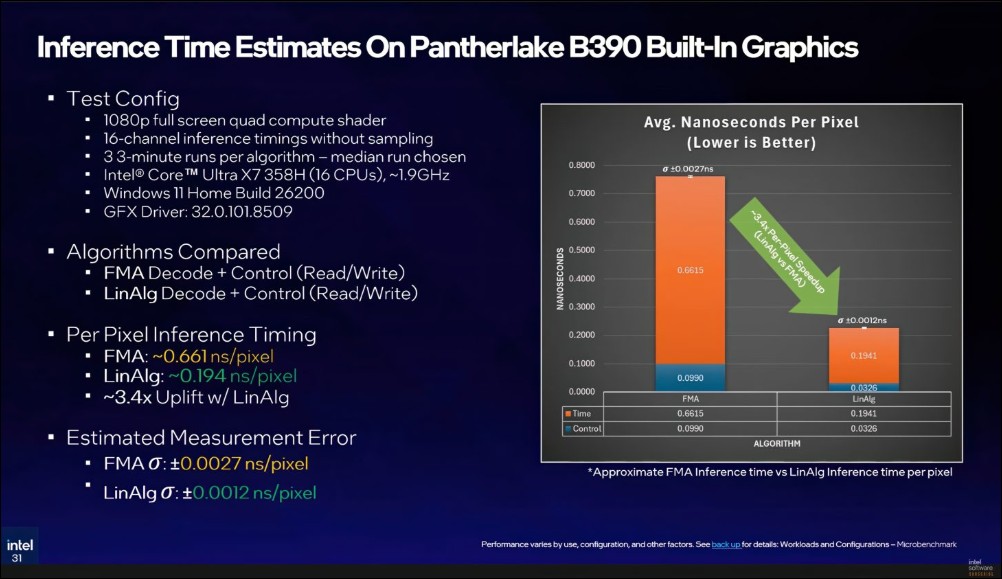
Benchmarks at 1080p resolution on a Panther Lake laptop with Arc B390 show:
- FMA path: 0.661 nanoseconds per pixel
- XMX Linear Algebra Path: 0.194 nanoseconds per pixel
- Performance improvement: 3.4 times
It is worth noting that even on integrated display chips, such performance makes the “sampling phase” deployment method more feasible.[2]
SDK Development Timeline
After Intel first demonstrated TSNC in the form of an Intel Labs research prototype at GDC 2025, the entire TSNC compressor has been Slang op shaderReconstruct from scratch. Whether developers use Unreal Engine, self-developed engines or texture decompression on the CPU,The same decompression code can be executed against the correct backend. Intel positions TSNC as a standalone SDK that converts standard BC1 compressed textures (a format widely used in games) into an efficient decompression format optimized for modern GPUs and CPUs.
Time schedule:
- Alpha SDK: Released in 2026 (for developers)
- Beta version: Schedule to be determined
- Official version: Schedule to be determined
summary
The emergence of TSNC represents that game graphics technology has officially entered a new era of “AI-assisted compression”. In the past, developers could only choose between “image quality” and “capacity”. Now neural network compression technology provides the possibility of taking both into account. What’s even more noteworthy is that Intel has chosen to promote this technology as an open SDK rather than binding it to specific hardware: This means that regardless of whether players are using NVIDIA, AMD or Intel graphics cards, they are likely to benefit from this technology. At a time when the demand for VRAM is exploding, the timely emergence of TSNC provides a feasible solution for the gaming industry.
Source: KOCPC Chinese