


As we all know, Claud Code often suffers from instability or intelligence degradation due to excessive usage and insufficient computing power. Therefore, Anthropic, the AI company behind Claude, has swept through almost all available computing resources this year, including SpaceX, AMD, Broadcom, Google, Amazon and other companies that have signed huge contracts. Now, even social platform giant Meta may become its latest computing power landlord. According to the New York Timesexclusive report, Meta is negotiating with Anthropic for a two-year data center computing power leasing agreement with a scale of up to US$10 billion (approximately NT$325 billion).

transaction details
According to reports from The New York Times and CNBC, the core terms of the deal include:
- Contract term: For two years, Anthropic pays Meta monthly
- upper limit of scale: US$10 billion (approximately NT$325 billion)
- Initiator: Anthropic unsolicited in June 2026
- current situation: Meta is still under evaluation and transaction details are still being adjusted.
- Exit mechanism: Both parties have the right to terminate the contract early before expiration
According to confirmation from people familiar with the matter, the two parties have indeed begun “very preliminary negotiations.” However, both companies declined to comment. The report also emphasized that the negotiations are still in the early stages and there is no guarantee that a formal contract will eventually be signed.
Anthropic is Hungry for Computing Power
To understand why this deal happened, one must first look at the size of other computing power contracts Anthropic has signed this year. The popularity of Claude Code has put Anthropic’s infrastructure under tremendous pressure. The company itself admitted that insufficient computing power has affected the “reliability and performance” of users.
The major computing power contracts signed by Anthropic this year include:
- SpaceX Colossus 1:Rent all the computing power at Elon Musk’s SpaceX data center in Memphis(220,000 NVIDIA processors, 300 MW), the total contract value is up to US$45 billion (approximately NT$1.46 trillion), for a period of three years, with monthly payments of US$1.25 billion.
- AMD: Purchase up to 2 GW of Instinct MI450 wafers,Contract size reaches tens of billions of dollars. AMD will invest up to another $5 billion in Anthropic, with the first 1 GW expected to be deployed in the first half of 2027.
- Broadcom: Sign a multi-GW level computing power contract.
- Google: Obtain computing power resources through TPU.
- Amazon: Commitment to future investment of up to US$25 billion (approximately NT$812.5 billion) to provide Trainium chips.
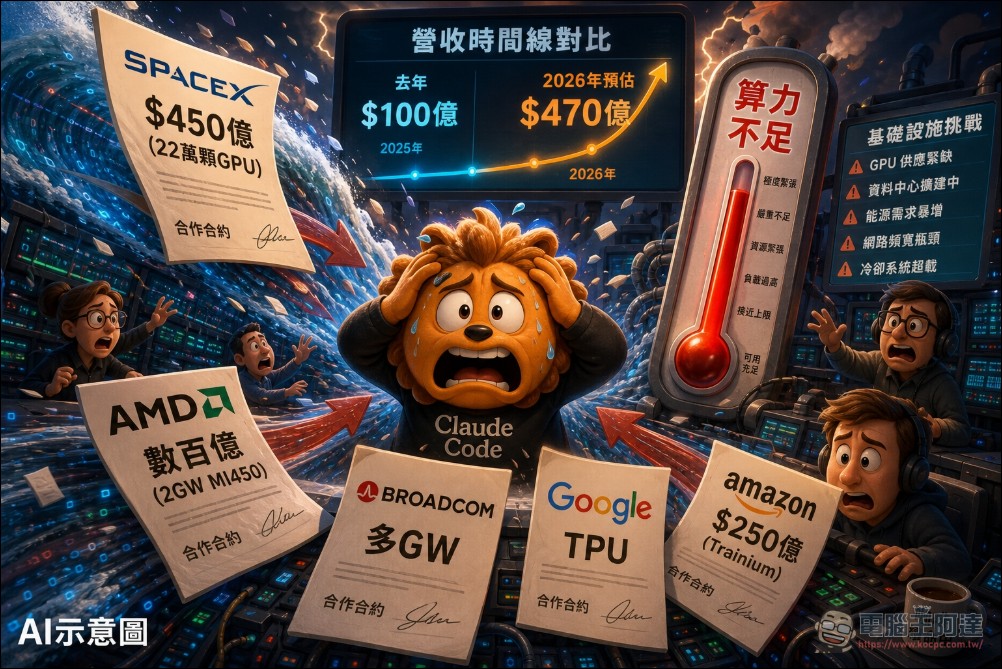
Tom Brown, co-founder and head of computing power at Anthropic, once said publicly: “Acquiring computing power is the core of keeping Claude at the forefront of technology and meeting user needs.” This sentence accurately describes Anthropic’s current situation. Annual revenue has soared from US$10 billion last year to US$47 billion (approximately NT$1.53 trillion), and its valuation has reached US$965 billion. It has secretly submitted an IPO. prospectus, but computing power supply has always been the company’s most thorny issue.
Meta’s computing power landlord dream
For Meta, this deal is no spur of the moment. In early July, Bloomberg first disclosed that Meta was establishing an internal cloud computing business unit called “Meta Compute” to sell excess AI computing power to external parties and open up the SPARK model API. As soon as the news came out, Meta’s stock price soared 8.81% that day. But other AI group stocks fell sharply, with Micron plunging 10.57%, AMD plunging 6.89%, and NVIDIA falling slightly 1.25%. The market interpretation is straightforward: once Meta has idle GPUs for takeout, it means that AI computing power is no longer a scarce commodity, and the pricing logic of the entire hardware supply chain will be rewritten.
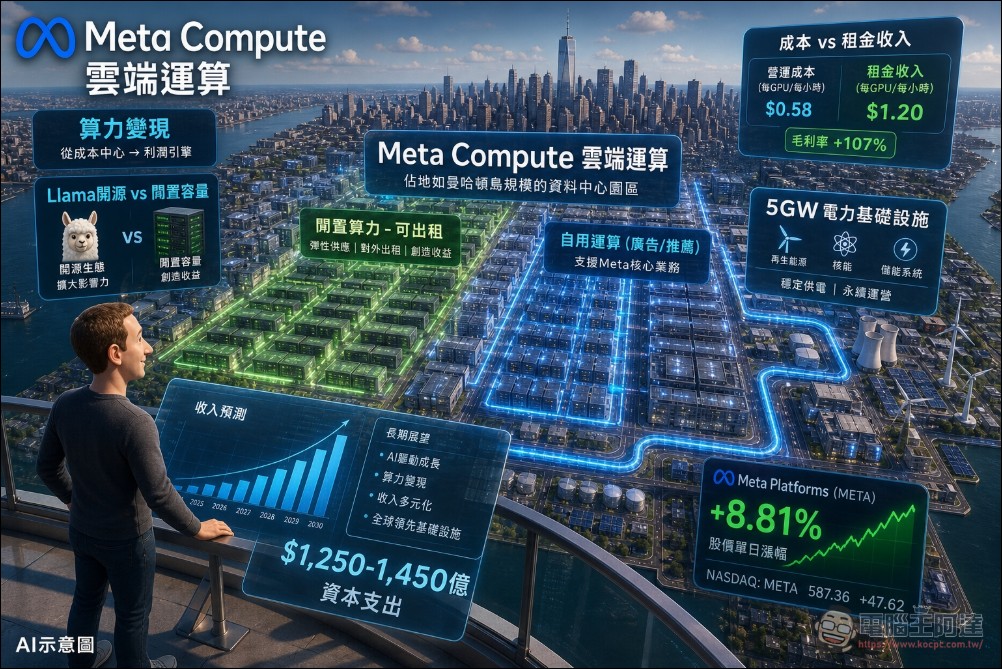
Meta has an incentive to do this. Capital expenditures in 2026 are expected to be as high as US$125 billion to US$145 billion (approximately NT$4.06 to 4.71 trillion), nearly double last year, with the vast majority invested in AI infrastructure. But Meta’s own AI workload, including ad sorting, recommendation systems, etc., simply cannot afford so much computing power. Unlike Google or OpenAI, Meta has no obvious source of AI revenue. Llama itself is open source and free, and its status has long been replaced by China’s open source model due to stagnant development in the past two years.
Mark Zuckerberg publicly stated in May this year that the company is “definitely considering” entering the cloud computing business so that investment in AI infrastructure can generate additional revenue beyond what is needed for its own operations. In October last year, he even revealed that companies have come to buy computing power at prices higher than Meta’s own costs.
The scale of the 5 GW AI data center Meta is building is staggering, with a single cluster occupying nearly a large portion of Manhattan. The problem is that the Llama series’ leading advantage in the open source market is being chased by DeepSeek and Qwen, and a large amount of computing power may be idle. Renting excess capacity to Anthropic will, firstly, recover costs, and secondly, prove to investors that the huge investment in AI has commercial value.
In other words, the Meta Compute on July 1st was the “plan”, and the Anthropic negotiation on July 17th was the “first potential customer coming to the door.” SpaceX did the same thing earlier, and xAI’s Colossus 1 data center was fully leased to Anthropic. Meta is just the next tech giant to decide to turn computing power into a business.
The deal, if negotiated, would still be smaller than Anthropic’s contract with SpaceX. SpaceX’s Colossus 1 contract is for three years, totaling $45 billion, with monthly payments of $1.25 billion; Meta’s plan is two years, with a maximum of $10 billion. The difference is that SpaceX has a large GPU cluster that has been built, while Meta is still under construction.
The bigger picture of the battle for computing power
The negotiations between Meta and Anthropic are just the tip of the iceberg in the current battle for AI computing power. While Anthropic is scouring the market, other AI companies are doing the same. OpenAI has signed a contract of comparable size with AMD, also involving tens of billions of dollars in chip purchases. Google and Amazon have tied Anthropic as long-term customers through their own chips (TPU, Trainium) and huge investments.
A new business model for the AI industry is taking shape: chip manufacturers invest in customers, customers return to purchase chips, and cloud platforms rent out idle capacity. AMD invested US$5 billion in Anthropic, and Anthropic in turn bought AMD’s GPUs; SpaceX leased the entire data center to Anthropic, and Meta planned to sell the excess computing power to Anthropic. All parties have formed a mutually bound interest cycle. Chip companies exchange equity for orders, platform companies exchange capacity for income, and AI companies exchange banknotes for survival.
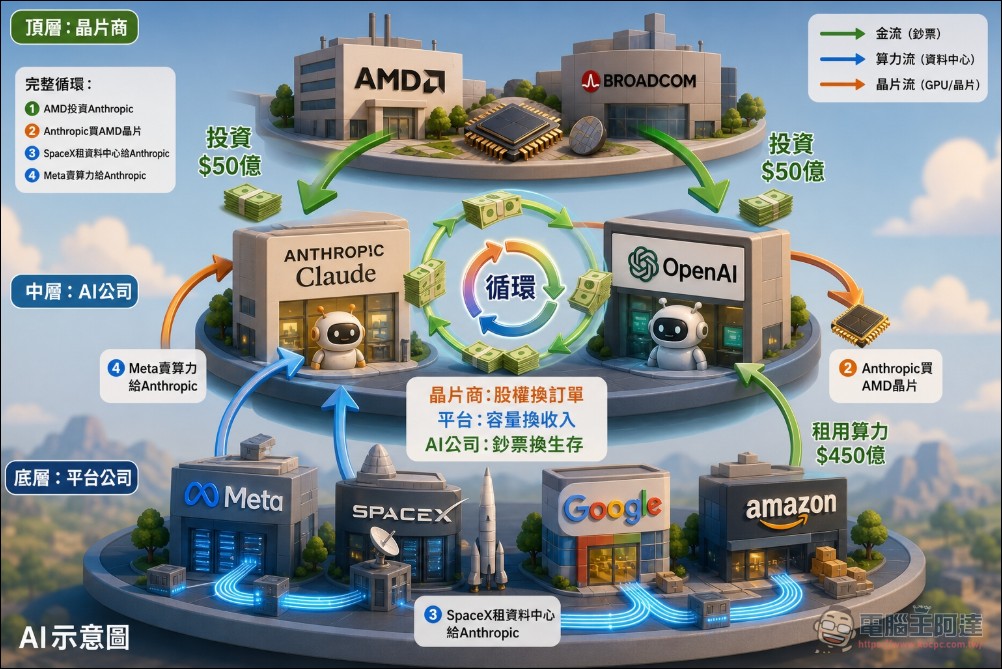
For NVIDIA, the multiple transactions mentioned above mean that the AI computing power market is fragmenting. Anthropic no longer relies solely on NVIDIA GPUs, but also obtains computing power from multiple suppliers such as AMD, Broadcom, and Google. This multi-vendor strategy is both to reduce risk and because NVIDIA’s production capacity really can’t keep up with demand.
Conclusion
Anthropic has gained huge revenue from the popularity of Claude Code, but it has also been overwhelmed by the demand for computing power. 10 billion US dollars to rent computing power from Meta, 45 billion US dollars to rent SpaceX data centers, and tens of billions of dollars to buy AMD chips. The logic behind the astronomical figures is simple: without computing power, there would be no Claude. For Meta, turning idle computing power into a source of income may be the best way to prove that its sky-high AI investment is worth the money.
Whether this deal will ultimately come to fruition is yet to be seen. Negotiations between the two parties are still in the preliminary stage, and the details of the transaction are continuing to be adjusted. Either party has the right to withdraw before signing. But the trend it reflects is already very clear: AI computing power is becoming a scarcer strategic resource than the model itself, and companies that master computing power infrastructure, whether they are chip factories, cloud platforms or social media giants, are becoming the winners in this AI race.
Source: KOCPC Chinese