


If one day, developers no longer need to manually adjust the AI system prompts (system prompts) and let the AI find a better version on its own, this is happening now. Nous Research, an artificial intelligence research organization, recently open sourced a project called Hermes Agent Self-Evolution ’s new project allows its open source AI Agent “Hermes Agent” to have the ability to evolve itself: by analyzing its own execution records, it automatically generates improved versions of skill instructions (skills), tool descriptions (tool descriptions) and system prompts, and submits them as candidate upgrade versions after passing the test.

The core engine of this framework is called GEPA (Genetic-Pareto Prompt Evolution), a set of prompt word optimization algorithms recognized by the top AI academic forum ICLR 2026, the highest honor “Oral”. In the actual measurement of six tasks, GEPA outperformed the mainstream reinforcement learning method GRPO by an average of 6%, with a maximum gap of 20 percentage points. At the same time, the amount of training data required was only one-thirty-fifth of the latter.
What is Hermes Agent Self-Evolution?
Hermes Agent is an open source AI Agent framework launched by Nous Research in February 2026. Its functions cover web browsing, program writing, file operations, memory management, etc., emphasizing the self-optimization design of “the more you use it, the smarter it gets.” In just a few weeks after its launch, it was listed on GitHub Trending and quickly accumulated more than tens of thousands of stars, making it one of the most watched projects in the recent AI open source community.
The open source sub-project hermes-agent-self-evolution is the automatic optimization pipeline of Hermes Agent. It is mainly developed by teknium1, co-founder of Nous Research. according to GitHub README, the operating logic of the entire system is as follows:
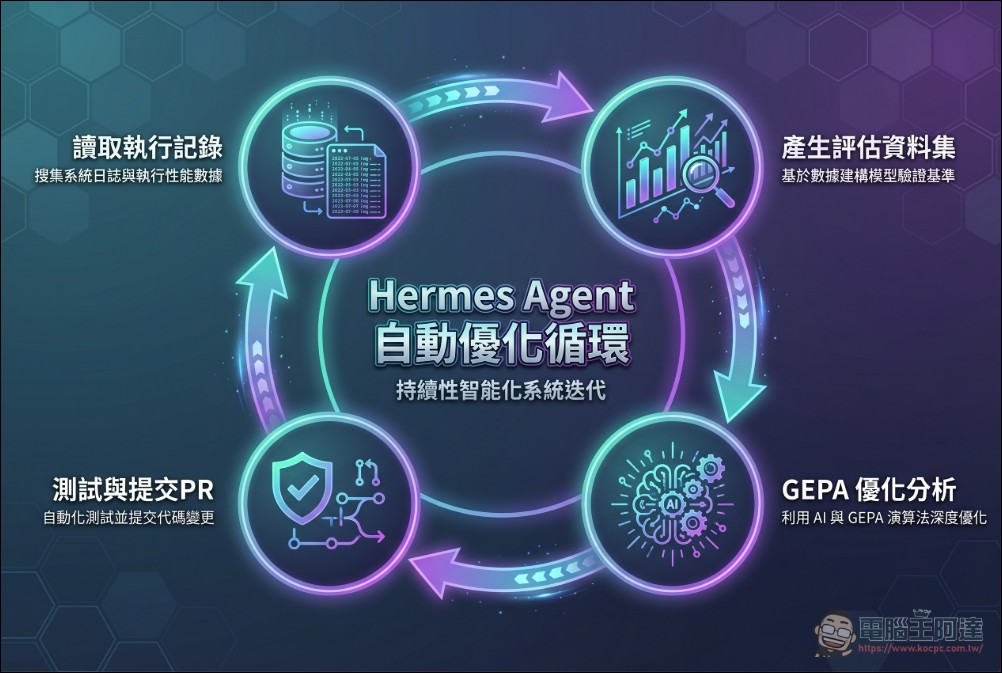
- Read the skill description file, tool description or system prompt currently used by the Agent
- Automatically generate evaluation data sets based on real execution records (reasoning, tool calls, tool outputs)
- Let the GEPA optimizer analyze the cause of the failure and propose candidate improved versions.
- Each candidate version must pass the complete test suite (including 100% pass of pytest test, size limit, semantic preservation, etc.)
- The best version that passes all levels, submitted as a Pull Request for human review, not written directly
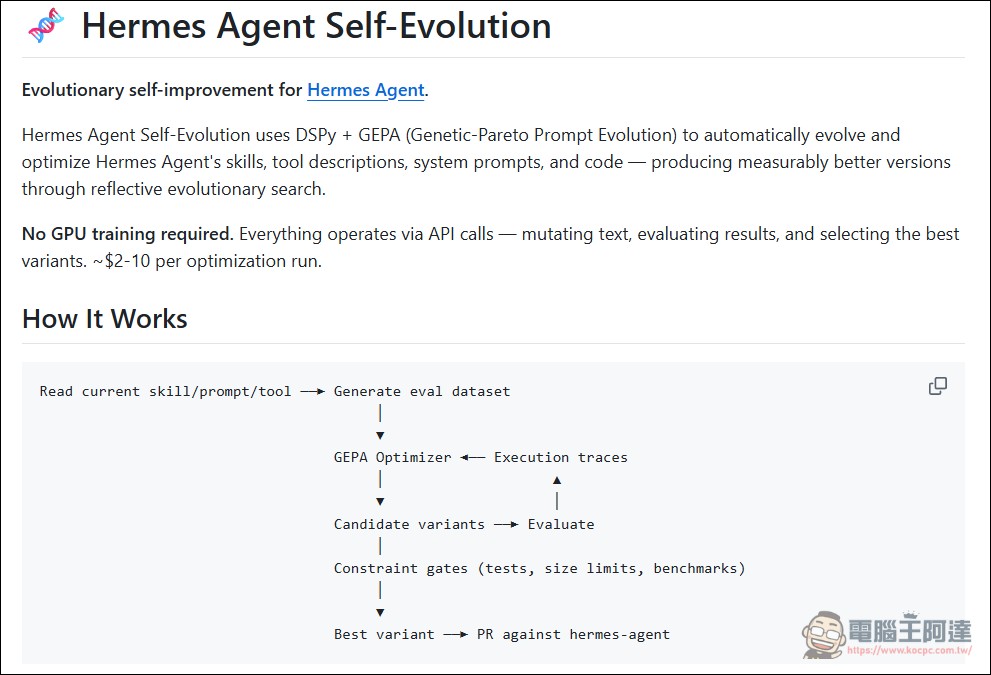
It is worth noting that the entire processNo GPU training required, can be done via just an API call. The official estimate is that the execution cost of each optimization is about NT$65 to NT$325 (about US$2 to US$10, converted at an exchange rate of about 32.5). Compared with traditional reinforcement learning training methods that often consume a lot of computing power, the threshold is significantly lowered.
What is GEPA? Why is it more efficient than reinforcement learning?
The full name of GEPA is Genetic-Pareto Prompt Evolution, published by researchers in the form of a paper on arXiv (Paper number 2507.19457), and was recognized by ICLR 2026 Oral and was one of the highest-level papers at the conference.
Traditional reinforcement learning methods (such as GRPO) usually requireThousands of rollouts(model execution attempt) to effectively update the policy. The starting point of GEPA is that the language model itself can understand “why it failed” instead of just accepting the signal of “failed”.
Therefore, what GEPA does is: let the model read its own execution trace (including inference process, tool call record), and usenatural language reflectionFind the problem, propose an improved version, test each version, and finally select the most complementary optimization results from the “Pareto frontier” and merge them. This allows GEPA to produce significant quality improvements with only a small amount of data.
The quantitative results revealed in the paper are quite eye-catching:
- Among the six missions, GEPA Average 6% higher than GRPO, the maximum difference reaches 20 percentage points
- The amount of rollout data used is only GRPO 1/35(Approximately 35 times less data used)
- On the AIME-2025 mathematics question bank test, GEPA is higher than the current strongest prompt optimization tool MIPROv2 12%
- At the same time, it shows the potential as a search strategy during inference, and has significant effects on code optimization tasks.
Scope of self-evolution: four stages, two sets of engines
The currently announced roadmap of hermes-agent-self-evolution is divided into five evolution stages, using two different engines:
- Phase 1 (implemented): Automatic optimization of the skill description file (SKILL.md) – this is the core file used by Hermes Agent to record the operation methods of various tasks, which determines the behavioral framework of the AI when facing specific tasks.
- Phase 2 (planned): Optimization of tool descriptions to allow AI to more accurately understand when to call which tool
- Phase 3 (planned): System prompt (system prompt) automatic optimization of each section
- Phase 4 (planned): The tool implements the optimization of the program code itself, using the external open source tool Darwinian Evolver (simulating biological evolution in Git commit units)
- Phase 5 (planned): Continuous optimization automation pipeline connecting the first four stages
The main engine DSPy + GEPA is licensed for open use by MIT; the Darwinian Evolver planned to be introduced in Phase 4 is licensed by AGPL v3 and will be called as an external CLI tool and will not be directly integrated into the core. The entire framework also makes a clear commitment to security – all optimized changes are subject to manual review through the Pull Request process and are not allowed to be automatically written directly into the official version.
The end of Prompt Engineering?
For many AI developers, “writing the system prompt” (system prompt word) is currently one of the most labor-intensive aspects of actually deploying AI Agents. What hermes-agent-self-evolution opens is a path to automate this matter: instead of engineers manually experimenting with various prompt writing methods, the framework can read failure cases by itself, propose improvements by itself, and verify the results by itself.
Of course, this system is still in its early stages: Phase 1 skill file optimization has been implemented, but more core system prompts and program code optimization are still under planning. And even if the optimization process can be automated, the level of manual review remains, showing that Nous Research does not intend to let AI rewrite itself completely autonomously.
But from a more macro perspective, the direction is already clear: the next competitive dimension of AI Agent will not be just “does it have many functions” or “is the model strong”, but whether it can be used inContinuously optimize your own behavior. This move from Nous Research may be one of the first cards in the race.
Source: KOCPC Chinese