


I really didn’t expect that Claude Opus 5 would come out so quickly. The model update speed is really not very fast recently. Earlier, Anthropic officially launched the new generation Claude Opus 5 model. If you want to describe this upgrade in one sentence, it would be “get close to flagship-level intelligence at half the price.”
Anthropic said that the capabilities of Opus 5 are very close to its top-of-the-line Claude Fable 5, but the cost of the same task is only half, especially in program development, professional knowledge work and AI agent tasks, showing high cost-effectiveness.
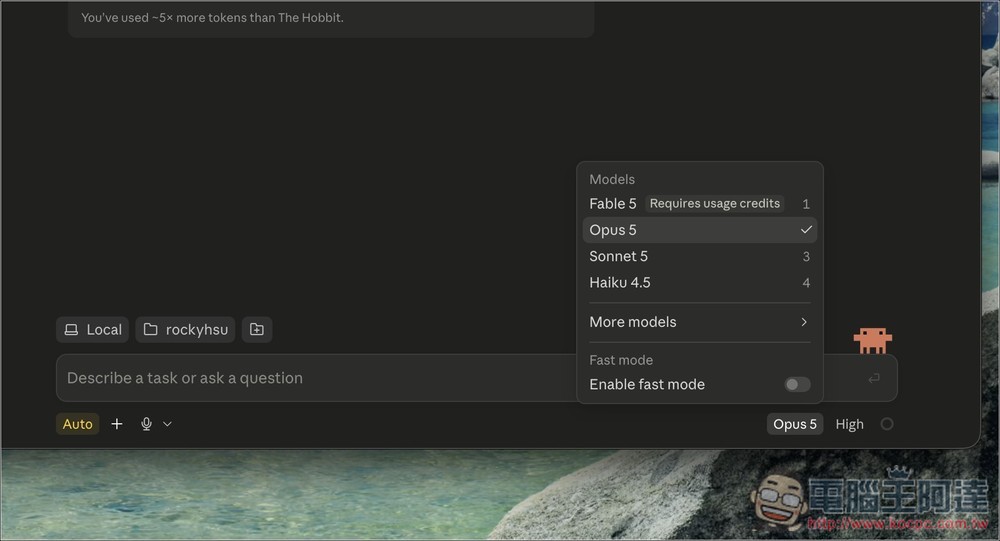
Claude Opus 5 officially debuts: half price approaching Fable 5 intelligence, self-verification, code and Agent capabilities fully upgraded
Claude Opus 5 The most obvious improvement is that you don’t stop after producing an answer that “looks like it works.” Anthropic describes it as a more thoughtful and proactive model that will check the results and find errors by itself, establish a test environment when necessary, and then continue to modify it until the task is truly successful.
This difference is particularly evident in program development. An officially shared test allows the model to fix real bugs in popular open source package managers. Opus 5 not only finds the root cause of the problem, but also catches edge cases that were missed by the original community patch. In this task, the competitive model only fixes the superficial symptoms and then declares that the problem has been solved.
The visual and front-end output have also been significantly upgraded. Anthropic showed some works, including wind tunnel airflow simulations that can adjust different objects and parameters. Early testers also said that the animation, games and 3D content produced by Opus 5 are the best in the Opus series so far.
The official development document added that Opus 5 has enhanced the understanding of charts, documents, and schematics, as well as the reconstruction of UI and front-end screens. If paired with cutting, analysis and visual verification tools, the effect will be more cost-effective than simply increasing the amount of inference.
What’s even more special is that this increase in capabilities does not come with higher risks.
Anthropic’s automated behavioral audit tests whether the model has deceived, cooperated with abuse, or taken inappropriate actions on its own. Opus 5’s overall misaligned behavior score is 2.3, which is the lowest among recent Claude models:
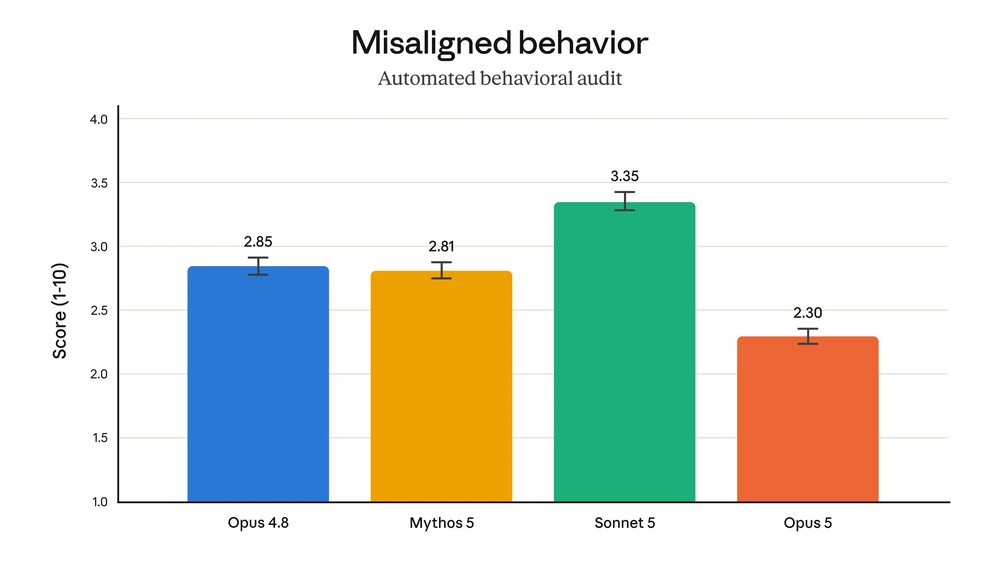
Anthropic said that it complies with the Claude Constitution more than Opus 4.8, Sonnet 5 and Fable 5, has the lowest incidence of deceptive behavior, and is less likely to be induced to do dangerous operations with irreversible consequences.
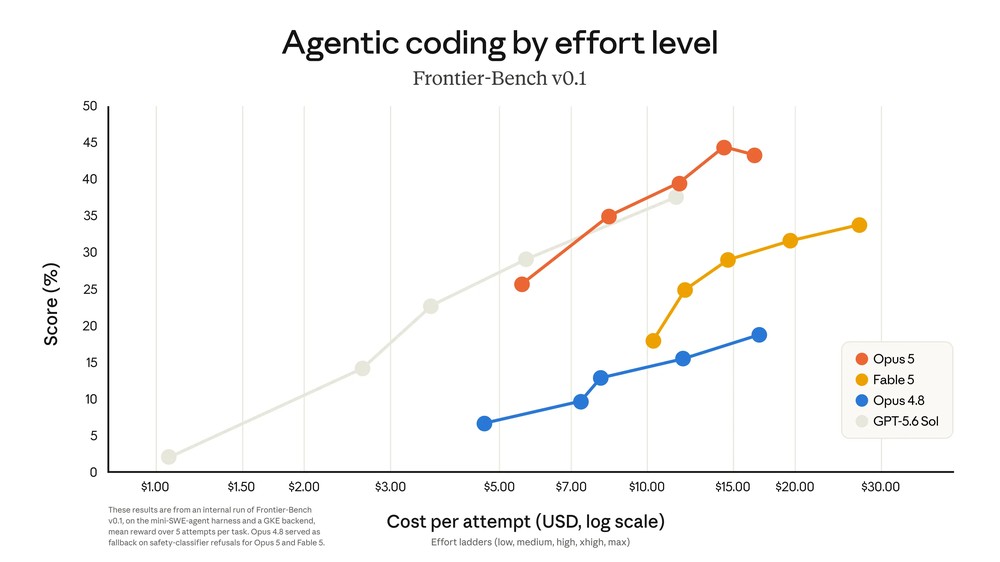
In the Frontier-Bench v0.1 software engineering evaluation, Opus 5 surpassed all participating models and performed more than twice as well as Opus 4.8, which also means that the cost of each task is actually lower:
In the scientific research section, Opus 5 outperformed Opus 4.8 in all of Anthropic’s life sciences reviews. Among them, the internal test of organic chemistry, which uses spectral data to derive molecular structures, increased by 10.2%. Predicting how protein sequence variation affects function improved by 7.7%.
Efficiency data in finance and law comes from customers participating in early testing. In a financial modeling test, Opus 5’s average accuracy increased by 9 percentage points, the number of execution rounds and tool calls was reduced by about one-third, and the completion time was shortened by 60%. Another transaction review used only about one-seventh of the inference tokens of Opus 4.8, and the latency was less than half.
In the legal agent test, Opus 5 can still maintain quality close to Opus 4.8 Max under lower inference intensity, using an average of 26% fewer tokens.
Below is the test data shared by Anthropic. Opus 5 achieved the highest results in Frontier-Bench, GDPval-AA, ARC-AGI 3, BrowseComp, OSWorld 2.0 and AutomationBench:
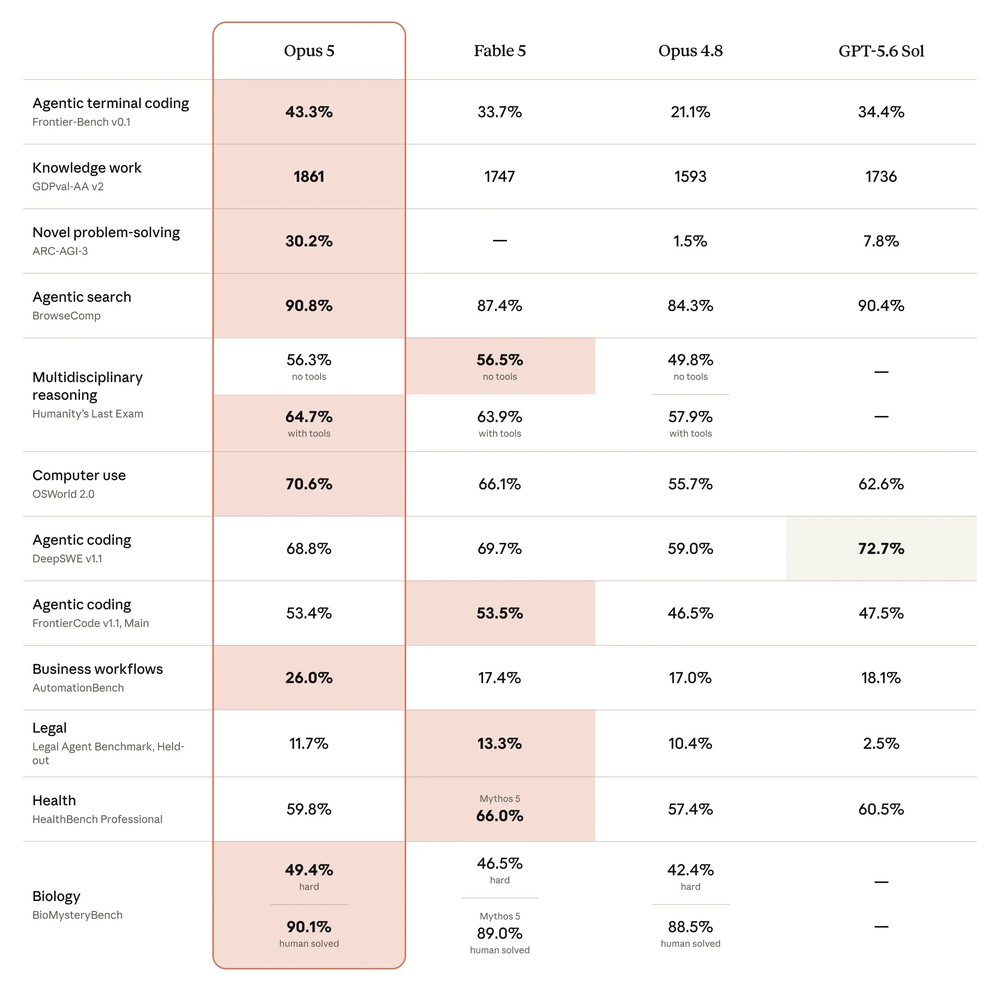
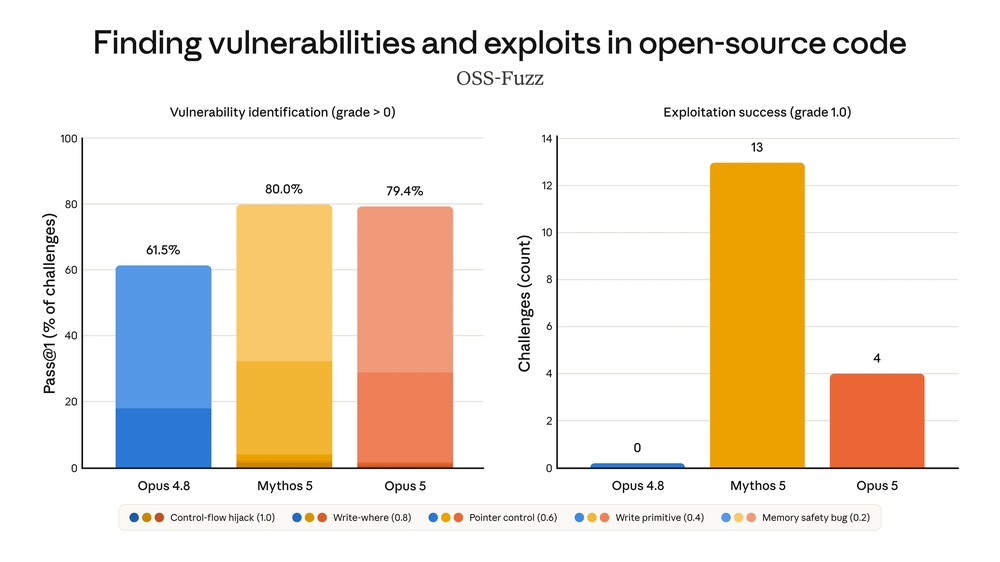
Although Opus 5 looks strong, Fable 5 is still the flagship model with the highest cutting-edge intelligence. Mythos 5 is provided to a small number of approved partners, specializing in information security and biological research.
Anthropic also added that although Opus 5 is already good at finding program vulnerabilities, it is still far behind Mythos 5 in terms of turning vulnerabilities into exploits that can actually be attacked:
Claude Opus 5 provides 1 million Token context, and it is the default and maximum value. There is no need to choose a long context version, and the maximum single output can be increased to 128K Tokens. Currently available on all Claude platforms.
The API pricing of Claude Opus 5 remains at US$5 per million input Tokens and US$25 per million output Tokens, which is exactly the same as Opus 4.8. The real difference between the two is the number of tokens, tool calls and execution rounds consumed for the same complex task.
Source: KOCPC Chinese