


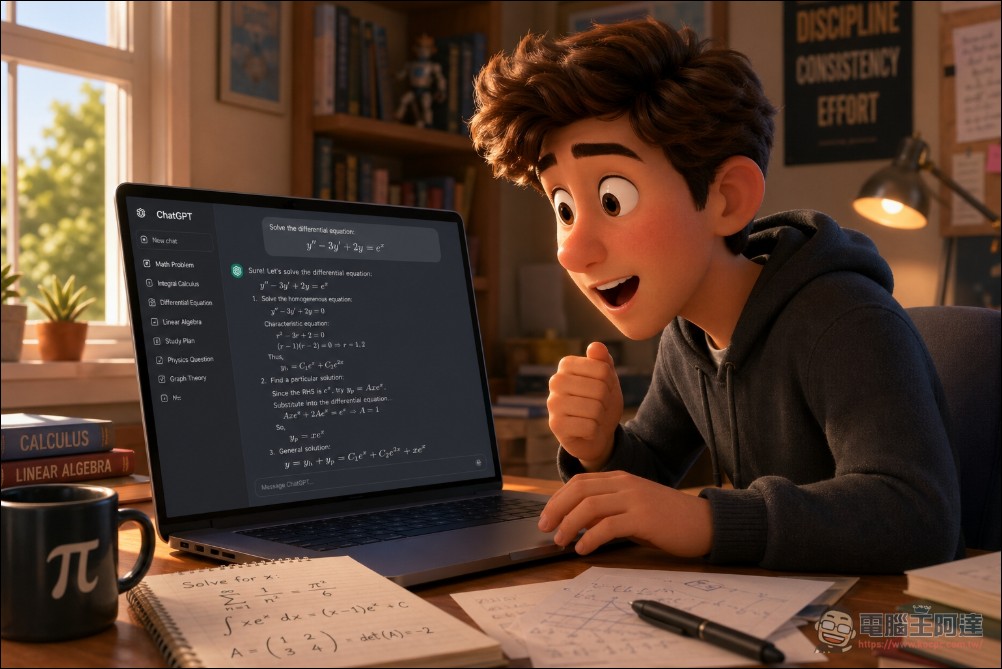
In the era of AI, anything is possible. A classic conjecture that has troubled the mathematics community for 60 years was overcome by a 23-year-old young man who had never received formal mathematics training using ChatGPT through a prompt word (prompt). According to “Scientific American”report, this young man’s name is Liam Price, an amateur math enthusiast. He used a subversive method called “vibe-math” in the industry. He did not start from the strict formalization or proof of traditional mathematics. Instead, he first allowed AI to freely think and then let humans be responsible for choices and choices. This seemingly “speculative” approach has created a miracle this time.
The 60-Year Puzzle: The Challenge Left by Paul Addiscus
This puzzle is one of the unsolved problems posed by Paul Erdős, the most influential mathematician of the 20th century. Edich proposed at least a thousand conjectures throughout his life and was known as the “problem raiser.” He offered bounties for these problems, ranging from $25 to $10,000. Solving Edich’s problem has always been regarded as a major achievement in the mathematical community.

The problem Price solved this time (#1196) is related to “Primitive Sets”. A primitive set is a set of integers in which no number is divisible by another number. Erdős designed a scoring system for these sets called “Erdős sum”. He guessed that the lowest value of this sum would be exactly 1, and would approach this lower limit as the numbers in the set approach infinity. This seemingly simple conjecture, but no one has been able to prove it for 60 years.
When Price randomly threw the question to ChatGPT on a boring Monday afternoon, he had no idea he was picking on a 60-year-old super-hard problem. He revealed in an interview: “I don’t know what the problem is, but sometimes I throw the Adish problem to AI to see what it can give.” This pure curiosity eventually led to major breakthroughs in mathematics.
ChatGPT’s proof is of “poor quality,” but key insights matter
Price sent ChatGPT’s response to his collaborator Kevin Barreto, a second-year mathematics student at the University of Cambridge, and Barreto immediately recognized what they had on their hands. Experts soon took note of the answer.
However, the process has not been smooth sailing. Fields Medal winner and mathematician Terence Tao pointed out an interesting phenomenon when reviewing this proof: “Everyone who studied this problem before collectively took the wrong direction in the first step.” This discovery made experts rethink: The reason why this problem has been unresolved for 60 years may not be because it is inherently too difficult, but because the entire mathematical community has fallen into the same thinking inertia.
LLM (Large Language Model) does not directly write a complete mathematical proof, but uses a formula that is well known in related mathematics fields but has never been applied to this type of problem – this perspective surprised all experts. However, the quality of the “proof” output by ChatGPT is actually quite poor, and mathematicians need to spend a lot of effort to decipher what it wants to express.
Human-machine collaboration shows transformative potential, but AI won’t replace mathematicians yet
The cooperation model between Price and ChatGPT is now called “vibe-mathing” in the mathematics community. The core spirit of this method is to let AI freely generate ideas first, and then humans play the role of “quality control”. This reversal of the order challenges the basic logic of “rigor first, then proof” in traditional mathematical research.
The value of AI doesn’t stop there. Researchers now use ChatGPT to search past literature and find that cases of answers or partial solutions that were ignored in the past are increasing; some research teams have also found new proof ideas with the assistance of AI. Terence Tao and other mathematicians believe that this model of “AI expanding the boundaries of human thinking” may be widely applied to other unsolved problems.
However, AI still has obvious limitations in its ability to autonomously construct rigorous mathematical proofs. Tao Zhexuan also emphasized that this case does not mean that AI will replace mathematicians, but marks the rise of a new research collaboration model.
Jared Lichtman, a mathematician at Stanford University, is excited about this result because it verifies an intuition he had during his graduate school days: “There is some unified structure between these problems.” He believes that the new methods discovered by AI are confirming this conjecture and may have a profound impact on future mathematical research.
The result this time is not that AI has defeated humans in mathematics, but it proves the possibility of “an ordinary person using the creativity of AI to stand at the same height as the collective efforts of experts for decades.” Terence Tao’s statement that “human beings go astray in the first step” may reveal how group thinking can become a stumbling block to breakthroughs, and AI happens to be unaffected by this group blind spot.
Source: KOCPC Chinese