


The AI wave is sweeping across various industries. For small, medium and micro enterprises with relatively limited resources, how to efficiently introduce AI tools and lower the threshold for digital transformation has become the most urgent issue at present. Meta recognized this demand and joined hands with the Small, Medium and New Enterprises Administration of the Ministry of Economic Affairs and the Taiwan School of Artificial Intelligence to jointly hold the “AI Marketing Power: Practical Forum on Growth of Small and Medium-sized Enterprises” on April 29, attracting more than 250 business representatives from across Taiwan. In the forum, Meta focused on introducing its three major AI marketing tools: full-process automation solutions from strategic decision-making, creative output to advertising placement. It hopes to accelerate the digital upgrade of Taiwan’s small and medium-sized enterprises through the cooperation of industry, government and academia.
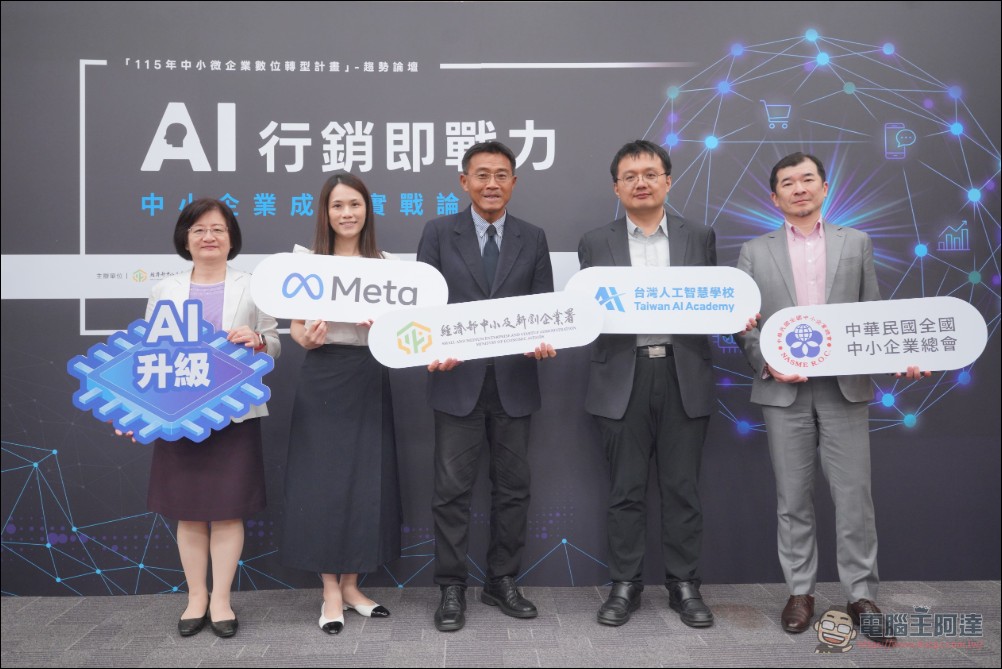
Industry, government, and academia join forces to build an AI empowerment platform for small and medium-sized enterprises
The forum was kicked off by Li Guanzhi, Director of the Small, Medium and New Enterprises Administration of the Ministry of Economic Affairs. The Enterprise Administration of China pointed out that with the rapid development of AI technology, enterprises are facing urgent transformation needs in various aspects such as brand management, community communication, customer interaction, advertising and operation management. However, compared to large enterprises with abundant resources, small, medium and micro enterprises often face greater challenges in terms of manpower, digital capabilities and introduction costs. To this end, the government has continued to promote digital transformation-related plans in recent years, striving to lower the barriers to entry through course training, expert guidance and the promotion of AI tools. Li Guanzhi emphasized that AI applications should be practical and easy to use, allowing enterprises to use them flexibly, as an important foundation for promoting industrial development and strengthening international competitiveness.
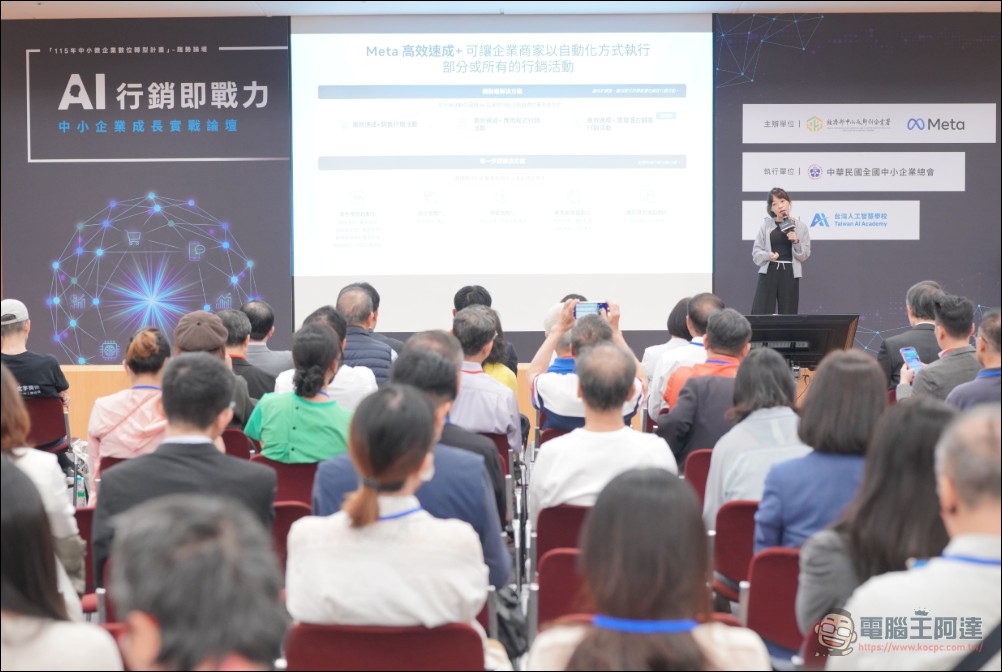
Dr. Chen Lingzhi, CEO of the Taiwan Artificial Intelligence School and Director of the Information Services Department of Academia Sinica, gave a speech titled “From Output to Trust” to discuss how companies can balance efficiency and responsibility in the process of introducing AI. He emphasized that strengthening consumer trust through transparent and fair AI applications, and then turning this trust into the core competitive advantage of the brand, is a key issue that companies cannot ignore in the AI era.
Pan Xianguo, General Manager of Meta Taiwan and Hong Kong, shared after the meeting that Meta has been deeply involved in the Taiwan market for a long time and has always been empowering the development of small and medium-sized enterprises. He pointed out that the core goal of this forum is to enable Taiwanese business owners to actually understand and use Meta’s three major AI marketing tools through practical training, and to encourage partners in the social marketing ecosystem to share various AI services to resolve practical problems in the introduction process and accelerate the digital upgrade of small, medium and micro enterprises.
Meta’s three major AI marketing tools: full-process automation from strategy to delivery
In order to help small and medium-sized enterprises better understand how to introduce AI into the brand communication process, Meta introduced its three major AI marketing tools in the course, which respectively correspond to the three key stages of strategic decision-making, creative output, and advertising in the marketing process.
Step one: Use “Meta AI Merchant Assistant” to formulate brand strategy
Strategy formulation is the first step in marketing, and it is also the most troublesome part for many small and medium-sized enterprises with limited resources. Meta AI Merchant Assistant is the first AI tool launched by Meta for small and medium-sized enterprises in the United States in October 2025. It will be officially opened for testing in Taiwan in late April 2026 and supports the Traditional Chinese interface.
The core function of this tool is that companies can generate exclusive data insight reports through the Meta AI merchant assistant to obtain customized diagnostic “opportunity scores” for brand strategies and related optimization suggestions, helping brands to review advertising effectiveness, compare with market benchmarks, and adjust delivery strategies in real time. According to data released by Meta, during the initial testing phase, after companies used Meta AI merchant assistant, the resolution rate of common account-related problems increased by 20%. In addition, it also has a built-in real-time troubleshooting function for account abnormalities to help small and medium-sized enterprises quickly solve technical problems, and provides one-stop smart consulting services from marketing planning to account management.
Step 2: Use “generative AI advertising tools” to produce diverse creative materials
After having a strategy, the next step is the production of actual materials. Meta’s generative AI advertising tools can help brands’ marketing teams produce various marketing communication materials more efficiently. Specific functions include: quickly producing multiple versions of communication copy for different audiences, automatically adjusting image proportions to suit different placements, generating diverse background scenes for products, and even converting static images into dynamic video content.
The greatest value of this tool is that it greatly shortens the material production cycle. In the past, companies often needed to spend a lot of time and budget to test different versions of creatives. Brands can now use this tool to quickly produce diverse materials for A/B testing, quickly identifying the creative content that best touches the target audience, thereby improving the overall communication and advertising effectiveness.
Step Three: Use the “High Efficiency Express+” system to amplify communication effectiveness
The last link is also the most critical launch stage. Meta’s “Advantage+” is an automated advertising delivery system driven by AI. In addition to accumulating brand favorability through native social creative materials on Facebook, Instagram and Threads, many brands also have the need to expand local audiences and even expand overseas markets.
The core advantage of Efficient Express+ is that it can significantly reduce the time the marketing team spends manually setting up audiences, placements and material testing. The system will automatically conduct a large number of material tests, and AI will learn and continuously optimize them in real time to reach more potential audiences and help companies achieve revenue growth goals.
Pan Xianguo also mentioned in the interview that Meta’s long-term observation of the Taiwan market found that many small and medium-sized enterprises do not want to do digital marketing, but do not know where to start, lack data analysis capabilities, or do not have enough manpower to operate complex advertising backends. The purpose of these three major AI tools is to let AI take on these heavy tasks so that business operators can focus on their core business.
Six local partners build a complete ecosystem
In addition to Meta’s own tools, this forum also invited six AI application service partners with deep roots in Taiwan to jointly build a complete local social marketing ecosystem. From data integration, creative generation to video production and advertising, it comprehensively demonstrates how AI can reshape the brand marketing process.
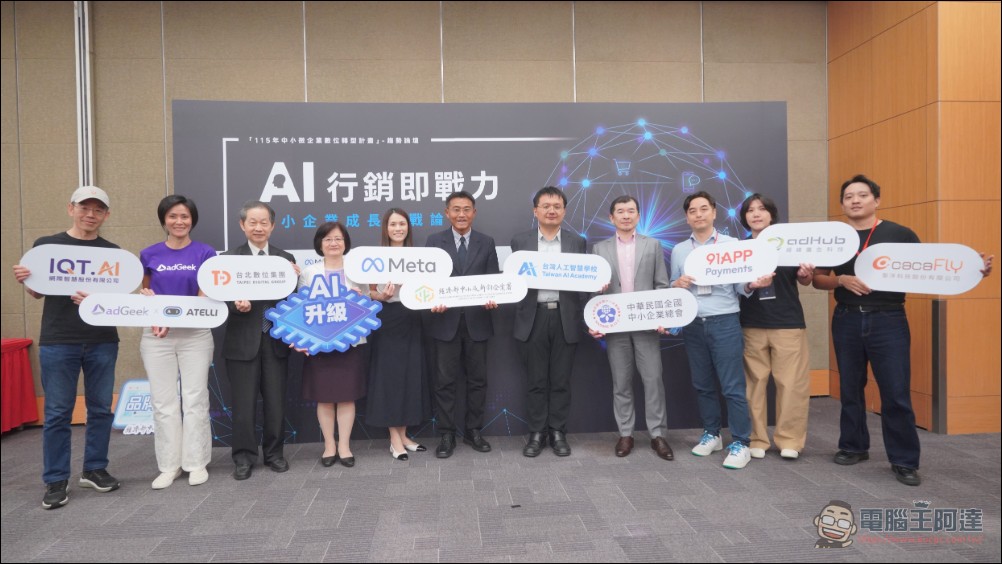
In terms of advertising delivery and data decision-making, Taipei Digital Group demonstrated the Mentor AI delivery platform, which simplifies the operation process to help small and medium-sized enterprises to deliver more efficiently and accurately; 91APP published the concept of “AI Smart Chain Future”, which combined with non-inductive payment technology, allows companies to effectively create revenue momentum while improving consumer experience; adGeek shared practical experience in moving from manual decision-making to AI automation, using data to drive breakthroughs in growth bottlenecks.
In terms of marketing tools and creative generation, adHub launched the AI Studio on-demand toolbox to provide flexible and real-time AI marketing support for small and medium-sized enterprises; cacaFly focuses on AI creative generation technology to help brands speed up the advertising material production process; IQT Internet Intelligence demonstrated an AI dual-platform solution that uses low-cost and efficient video generation capabilities to produce diverse content while taking into account advertising compliance requirements.
The National Federation of Small and Medium Enterprises of the Republic of China also shared the “Digital Transformation Plan for Micro, Small and Medium Enterprises” at the event, explaining the various digital transformation and AI introduction coaching resources provided by the government, so that business owners can clearly understand the channels from which they can obtain assistance.
From AI Marketing to AI Thinking: The Next Step for Taiwan’s SMEs
This forum reflects a more important trend: in 2026, AI is no longer just the patent of large technology companies. From Meta’s three major AI tools to solutions from local ecosystem partners, small and medium-sized enterprises can now obtain marketing capabilities that were previously costly to acquire at a very low threshold.
Compared with large enterprises with dedicated data science teams and marketing automation systems, small, medium and micro enterprises have always been slow in digital transformation in the past. However, with the free open testing of Meta AI Merchant Assistant, generative AI tools that make material production flexible and instant, and efficient Quick+ system that minimizes the threshold for advertising, AI is becoming an “affirmative weapon” for small and medium-sized enterprises.
Pan Xianguo said in the conclusion of the forum that Meta will continue to develop more AI business tools in the future to help more companies use accurate decision-making and innovative ideas to stand firm in the changing digital environment and pursue steady growth. Dr. Chen Lingzhi from the Taiwan Artificial Intelligence School also reminded that the process of AI introduction is not only the selection of tools, but more importantly, the establishment of a correct understanding and trust mechanism for AI, in order to truly realize its value.
Summarize
Meta’s forum with the theme of “AI Marketing Is Combat Power” conveyed a clear message to Taiwan’s small and medium-sized enterprises: AI transformation is no longer an unreachable future, but is ongoing now. From strategy formulation to creative output, and from advertising to effectiveness analysis, Meta’s three major AI tools form a complete marketing automation process, giving small, medium and micro enterprises with limited resources the opportunity to gain a competitive advantage in the AI era.
For Taiwanese small and medium-sized business owners who are worrying about how to introduce AI, they might as well start with Meta AI Merchant Assistant and experience how AI can provide specific marketing suggestions for brands – this may be the easiest step on the road to digital transformation.
Source: KOCPC Chinese