


Tianfeng International Securities AnalystMing-Chi Kuo(Ming-Chi Kuo) released the latest industry survey report stating that,OpenAI The development process of the first AI Agent mobile phone may be accelerating, with the goal of entering mass production as soon as the first half of 2027 (1H27). If development goes smoothly, total shipments in 2027 and 2028 will reach approximately 30 million units.
OpenAI AI Agent mobile phone wins processor order from MediaTek, mass production in the first half of 2027 at the earliest
Mass production schedule is advanced, paving the way for IPO at the end of the year
According to Ming-Chi Kuo’s latest survey, OpenAI is accelerating this project mainly because of two factors: first, the theme narrative that is conducive to the IPO at the end of the year; second, the market competition for AI Agent mobile phones is heating up, and it must speed up its pace to seize the opportunity. This is significantly ahead of the 2028 mass production time originally estimated by the outside world.
【產業調查更新】OpenAI 可能正加速首款 AI agent 手機開發,目標最快於 1H27 量產,考量原因或包括有利年底 IPO 敘事、AI agent 手機競爭加速等。目前聯發科更有可能獨家取得處理器訂單,該機預計採用基於天璣 9600 的客製版本,並於 2H26 由台積電 N2P 生產。ISP… https://t.co/EYEtbWf16X
— 郭明錤|Ming-Chi Kuo (@mingchikuo) May 5, 2026
As early as the end of April this year, Guo Mingchi hadBreak the news OpenAI is developing its own brand of mobile phones, with mass production expected to fall in 2028. Now, in less than two weeks, the schedule has been significantly advanced from 2028 to the first half of 2027, showing that OpenAI’s internal emphasis on this hardware project is rapidly increasing.
MediaTek is expected to exclusively supply processors
In terms of chip suppliers, Kuo Ming-Chi pointed out that MediaTek is now more likely to exclusively obtain processor orders for this AI Agent mobile phone. The machine is expected to use a customized version of the chip based on Dimensity 9600 and will be produced by TSMC in the second half of 2026 using an advanced N2P process.
The choice of MediaTek over Qualcomm may be related to MediaTek’s advantages in AI computing architecture and customization flexibility. This will also be MediaTek’s first entry into the OpenAI hardware supply chain, which is of great strategic significance.
Hardware specifications focus: dual NPU, enhanced ISP and new generation memory
Ming-Chi Kuo listed the key specifications of this AI Agent phone:
- Dual NPU architecture — Adopting a hierarchical design of AI computing power, simple tasks are processed by the low-power NPU on the device side, while complex tasks are coordinated through the cloud AI system to achieve a balance between efficiency and performance.
- Harden ISP —The image signal processor focuses on high dynamic range (HDR) output, which is conducive to real-world visual perception and allows the AI Agent to more accurately understand environmental information. It is regarded as the core focus of the specification design.
- LPDDR6 + UFS 5.0 — New-generation memory and storage specifications designed to alleviate memory bottlenecks during sustained AI operations.
- pKVM + inline hashing — Strengthen security design to protect user data and AI Agent’s computing process.
AI Agent redefines mobile phone interaction
The core concept of this device is to replace traditional applications with AI Agents. According to Ming-Chi Kuo’s previous concept drawings, this phone will replace the traditional home screen with an information panel and ongoing AI Agent tasks (such as booking flights, compiling market data, etc.). Users no longer need to open different apps one by one, but can directly complete tasks according to their intentions through the AI Agent.
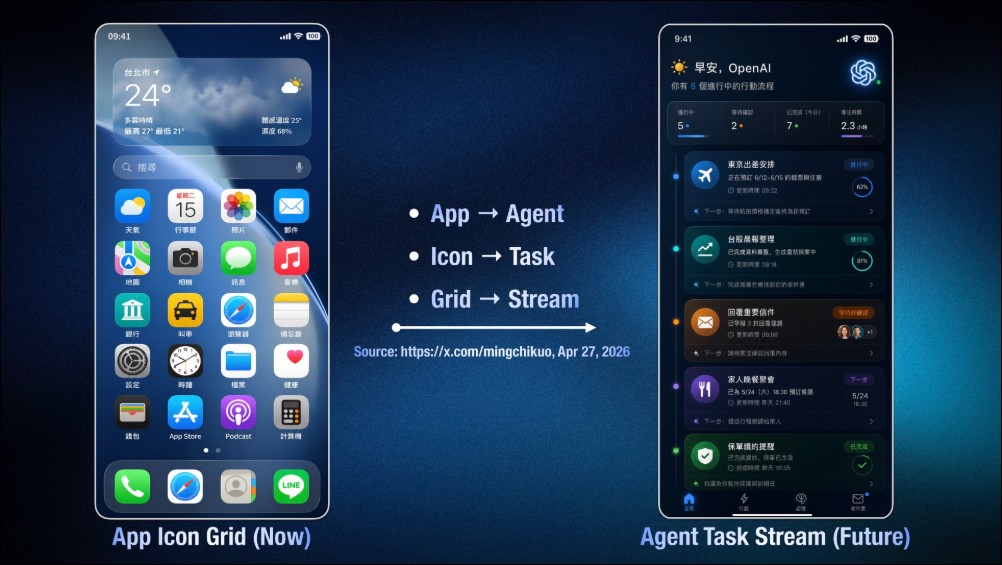
This model requires deep integration between the device and the cloud, allowing OpenAI to fully control the user experience without the platform constraints of the existing mobile ecosystem. Devices need to continuously process user contextual information, including behavioral patterns and usage habits, which makes device-side computing efficiency crucial.
The phone is expected to be produced and assembled by iPhone assembly plant Luxshare, and the final version of the hardware design may not be finalized until the end of 2026 or early 2027.
Source: KOCPC Chinese